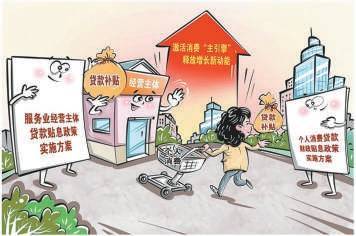
供强需弱

Search documents
大越期货碳酸锂期货早报-20251027
Da Yue Qi Huo· 2025-10-27 06:16
1. Report Industry Investment Rating No information provided in the report. 2. Core Views of the Report - Supply side: Last week, lithium carbonate production was 21,308 tons, a 1.14% week - on - week increase, higher than the historical average. In September 2025, production was 87,260 tons, and next - month production is forecasted to be 89,890 tons, a 3.01% increase. Lithium carbonate imports in September 2025 were 19,597 tons, and next - month imports are forecasted to be 22,000 tons, a 12.26% increase [8][9]. - Demand side: Last week, the inventory of lithium iron phosphate sample enterprises was 104,347 tons, a 1.49% week - on - week increase, and the inventory of ternary material sample enterprises was 18,592 tons, a 3.50% week - on - week increase. Next - month demand is expected to strengthen, and inventory may decrease [8]. - Cost side: The cost of purchased lithium spodumene concentrate is 76,653 yuan/ton, a 0.93% daily increase, with a production loss of 2,342 yuan/ton. The cost of purchased lithium mica is 80,139 yuan/ton, a 1.46% daily increase, with a production loss of 7,835 yuan/ton. The recycling - end production cost is close to the ore - end cost, with average production enthusiasm. The quarterly cash production cost of the salt - lake end is 31,477 yuan/ton, significantly lower than the ore - end, with sufficient profit margins and strong production motivation [9]. - Overall situation: The imbalance between supply and demand persists, with strong supply and weak demand. The downward trend is difficult to change. The 2601 lithium carbonate contract is expected to fluctuate in the range of 78,660 - 80,380 yuan/ton [9][13]. 3. Summary by Directory 3.1 Daily Views - Supply: Last week's production increase and future production and import forecasts show a growing supply [8][9]. - Demand: Inventory increases in downstream enterprises and expected future demand changes [8][9]. - Cost: Different raw - material production costs and profit situations [9]. - Other factors: Bullish factors include manufacturers' production cut plans and a decline in lithium carbonate imports from Chile. Bearish factors include high supply at the ore/salt - lake end and weak acceptance from the power - battery end [11][12]. 3.2 Fundamental/Position Data - **Market Data**: - Futures closing prices of different contracts show price fluctuations, and most contracts have price changes. For example, the 01 contract price decreased by 420 yuan to 79,520 yuan, a 0.53% decrease [16]. - Base - difference data shows that the spot price of battery - grade lithium carbonate on October 24 was 75,400 yuan/ton, and the 01 contract base difference was - 4,120 yuan/ton, indicating spot discount to futures [9][16]. - Registered warehouse receipts decreased by 60 to 28,699, a 0.21% decrease [16]. - **Upstream Price Data**: - Lithium ore prices increased, with lithium spodumene (6%) rising by 11 dollars to 881 dollars/ton, a 1.26% increase, and lithium mica concentrate (2% - 2.5%) rising by 50 yuan to 1,940 yuan/ton, a 2.65% increase [16]. - Other raw - material prices also had different degrees of changes, such as a 4.01% increase in the price of lithium hexafluorophosphate [16]. - **Supply - side Data**: - Production and cost data of different raw - material lithium carbonate, such as daily lithium spodumene production cost increasing by 708 yuan to 76,653 yuan/ton, a 0.93% increase [19]. - Import and export data of lithium carbonate and lithium ore, such as a 10.61% increase in monthly lithium - concentrate imports [19][20]. - **Demand - side Data**: - Inventory data of downstream enterprises, such as a 1.49% increase in the weekly inventory of lithium iron phosphate to 104,347 tons [19]. - Battery - loading volume data, such as a 21.60% increase in the monthly total power - battery loading volume to 76,000 GWh [20]. 3.3 Supply - Related Content - **Lithium Ore Supply**: - Price trends of lithium ore over the years and production trends of domestic lithium spodumene and lithium mica mines [26][27]. - Import volume and self - sufficiency rate of lithium ore, such as the import volume and proportion of Australian lithium ore [27]. - Supply - demand balance of domestic lithium ore, showing the relationship between production, import, export, and demand in different months [30]. - **Lithium Carbonate Supply**: - Weekly and monthly production, production capacity, and import volume of lithium carbonate from different sources (lithium spodumene, lithium mica, salt - lake, recycling) [31][32]. - Supply - demand balance of lithium carbonate, with different monthly supply - demand balance situations [38]. - **Lithium Hydroxide Supply**: - Capacity utilization, production, and export volume of lithium hydroxide from different sources (smelting, causticizing) [40][41]. - Supply - demand balance of lithium hydroxide, showing the relationship between production, import, export, and demand in different months [43]. 3.4 Lithium Compound Cost - Profit - Different raw - material production costs and profit situations of lithium carbonate, such as the cost and profit of purchased lithium spodumene and lithium mica [46]. - Recycling production cost and profit of lithium carbonate from different waste materials, such as waste lithium - iron - phosphate batteries and ternary materials [48]. - Cost - profit situations in the production and processing of lithium hydroxide, such as the profit and cost of smelting and causticizing methods [51]. 3.5 Inventory - Weekly and monthly inventory data of lithium carbonate, including smelter inventory, downstream inventory, and total inventory [19][53]. - Monthly inventory data of lithium hydroxide, including smelter inventory and downstream inventory [53]. 3.6 Demand - Related Content - **Lithium Battery Demand**: - Battery price trends, production volume, loading volume, and export volume of lithium batteries [55][56]. - Cost data of different types of lithium - battery cells [56]. - **Ternary Precursor Demand**: - Price trends, cost - profit situations, production volume, and supply - demand balance of ternary precursors [61][62][65]. - **Ternary Material Demand**: - Price trends, cost - profit situations, production volume, and import - export volume of ternary materials [67][68][70]. - **Phosphorus Iron/Phosphorus Iron Lithium Demand**: - Price trends, cost - profit situations, production volume, and export volume of phosphorus iron and phosphorus iron lithium [73][76]. - **New - Energy Vehicle Demand**: - Production volume, sales volume, export volume, and sales penetration rate of new - energy vehicles [80][81]. - Retail - wholesale ratio and inventory data of new - energy vehicles [85].
PVC 短期偏弱运行
Bao Cheng Qi Huo· 2025-10-24 02:09
Report Summary 1. Report Industry Investment Rating No investment rating is provided in the report. 2. Core View of the Report The PVC market is currently in a pattern of strong supply and weak demand. With continuous release of new production capacity, weak real - estate demand, high inventory, and weak cost support, the PVC futures 2601 contract is expected to maintain a weak and volatile trend in the future [2][6]. 3. Summary by Related Content Cost Support Weakening - The price of calcium carbide, the main raw material for calcium carbide - based PVC, is continuously low, and the international crude oil market is weak, which weakens the cost support for ethylene - based PVC [2]. - Although some enterprises are in a loss state, the "alkali - for - chlorine" model of chlor - alkali integrated enterprises maintains production, and the cost's regulatory effect on supply is limited [3]. High Supply Pressure - In 2025, domestic PVC new production capacity features large - scale, technology switching, and concentrated production. The annual planned/expected new capacity is 2.5 - 3.5 million tons, and the actual new capacity is about 2.5 million tons, pushing the total domestic PVC capacity close to or exceeding 30 million tons [3]. - As of now, 1.45 million tons of new PVC capacity have been added this year, and another 0.5 million tons are to be fully released in the fourth quarter [3]. - After the holiday, the overall operating rate of PVC enterprises remains high, and the supply pressure has not been significantly relieved [4]. - The new PVC capacity is mainly ethylene - based, which has a cost - squeezing effect on calcium carbide - based PVC and intensifies industry competition [4]. Persistent Weak Demand - PVC is a typical post - real - estate cycle product, and the real - estate market has been weak since 2025. In the first three quarters of 2025, real - estate development investment decreased by 13.9%, new commercial housing sales area decreased by 5.5%, and sales volume decreased by 7.9%, which directly suppresses the procurement demand in the hard - product fields such as pipes and profiles [4]. - Although the operating rate of some downstream enterprises has slightly increased after the weather turns cool, orders are generally insufficient, and enterprises mainly replenish inventory based on low - price rigid demand [5]. - The traditional peak seasons of "Golden September and Silver October" did not arrive as expected, and the demand improvement expectation after the holiday was disappointed [5]. High Inventory Pressure - As of the week of October 17, PVC social inventory reached 1.0338 million tons, a year - on - year increase of 33.52%. The PVC futures warehouse receipt volume also reached a historical peak, indicating strong hedging willingness in the industry and difficult spot sales [6].
缺乏向上驱动 PVC短期偏弱运行
Qi Huo Ri Bao· 2025-10-24 01:13
Core Viewpoint - The domestic PVC futures market continues to show a weak downward trend post-National Day holiday, with the 2601 contract breaking through key support levels of 4800 yuan/ton and 4700 yuan/ton, reaching a low of 4644 yuan/ton [1] Cost Support Weakening - PVC prices lack effective support from the cost side, as the price of calcium carbide, a key raw material for calcium carbide method PVC, remains low due to the impact of staggered production in Inner Mongolia [2] - International crude oil prices have also been weak, with WTI crude oil futures dropping to a low of $56.63 per barrel and Brent crude oil futures falling to $60.11 per barrel, both hitting new lows since the second quarter of this year [2] - The expectation of oversupply in the global oil market continues to weigh on the outlook for oil prices, which in turn weakens the cost support for ethylene-based PVC [2] - Despite some companies facing losses, integrated chlor-alkali enterprises maintain production through a "sodium carbonate compensating for chlorine" model, resulting in stable PVC operating rates above 76% [2] Significant Supply Pressure - In 2025, new domestic PVC production capacity is characterized by large scale, technology switching, and concentrated commissioning, with an expected annual increase of 2.5 to 3.5 million tons [3] - As of now, 1.45 million tons of new PVC capacity has been added this year, with major plants like Wanhua Chemical and Tianjin Bohua already in stable operation [3] - The overall operating rate of PVC enterprises remains high despite some planned maintenance, indicating persistent supply pressure [3] - New capacity primarily utilizes the ethylene method, which is more sensitive to crude oil and ethylene price trends, intensifying competition within the industry [3] Weak Demand Situation - PVC demand is closely tied to the real estate market, which has been weak since 2025, with real estate development investment down by 13.9% and new housing sales area declining by 5.5% year-on-year [4] - The weak construction and sales data directly suppresses the procurement demand for hard products like pipes and profiles [4] - Despite a slight recovery in downstream operating rates, overall orders remain insufficient, leading to pressure on profitability and a focus on low-price essential stock replenishment [6] - High inventory levels continue to accumulate, with PVC social inventory reaching 1.0338 million tons, a significant year-on-year increase of 33.52% [6] - The current PVC market is characterized by strong supply and weak demand, with multiple negative factors contributing to a lack of upward momentum [6]

供强需弱格局不改 鸡蛋主力合约低位宽幅震荡
Jin Tou Wang· 2025-10-23 06:00
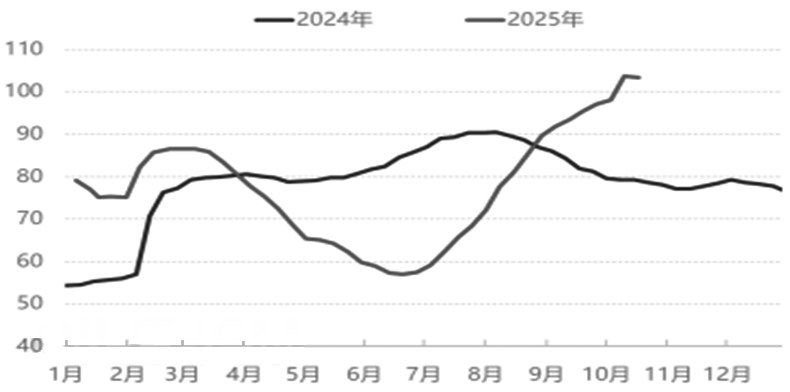
Group 1 - The domestic futures market for agricultural products shows mixed results, with egg futures experiencing a strong upward trend, reaching a high of 3009.00 yuan per 500 kg, reflecting an increase of approximately 2.52% [1] - Current egg prices are under pressure due to significant supply-side challenges, with no clear signs of excess capacity being eliminated, leading to a continued weak price outlook [1][2] - The national inventory of laying hens remains at a high level compared to the past five years, and the market is characterized by a stalemate between slaughterhouses and farmers, resulting in limited changes in the market dynamics [1][2] Group 2 - Short-term forecasts indicate that egg prices have hit new lows, with accumulated inventories and weak downstream demand, leading to a wide fluctuation in the main contract within the range of 2800 to 3000 yuan [1] - The medium-term outlook suggests that while inventories are decreasing, the supply-demand imbalance persists, with high ages of chickens affecting supply pressure, indicating limited upward momentum for current prices [2] - Long-term projections highlight that the continuous increase in egg-laying capacity may extend the price bottom cycle, necessitating patience for the market to adjust through the elimination of excess capacity [2]
铁矿石:供强需弱,库存增价格短期看750 - 800
Sou Hu Cai Jing· 2025-10-23 02:56
Core Insights - The iron ore market is currently facing a situation of strong supply and weak demand, with short-term trends dependent on policy stimuli and production cuts from steel mills [1] Supply Side - Australia shipped 14.149 million tons of iron ore to China this week, a decrease of 454,000 tons week-on-week - Brazil's shipments to China were 7.269 million tons, down by 220,000 tons week-on-week - Overall shipment volumes have slightly declined [1] Demand Side - The capacity utilization rate of 163 steel mills is at 90.33%, a decrease of 0.24% week-on-week - Daily pig iron production is 2.4095 million tons, down by 5,900 tons week-on-week - Demand remains relatively stable [1] Inventory Levels - Imported iron ore port inventory stands at 135.6 million tons, an increase of 2.5077 million tons week-on-week - The average daily throughput at 45 ports is 3.27 million tons, a decrease of 112,800 tons week-on-week - Total inventory at steel mills is 89.827 million tons, down by 634,600 tons week-on-week, indicating a slight overall increase in inventory [1] Market Dynamics - Iron ore futures have been on a downward trend, primarily due to the shift in fundamentals towards strong supply and weak demand - Global major mining shipments are at seasonal highs, leading to ample port arrivals and inventory accumulation, which exerts price pressure [1] Steel Industry Challenges - The downstream steel industry is facing difficulties, with steel mill profits being squeezed and operating near breakeven - Some steel mills are planning maintenance and production cuts, leading to a decline in daily consumption and cautious procurement, which weakens demand support [1] Macro Environment - The overall market sentiment is bearish, influenced by changes in China-U.S. trade relations, raising concerns about global growth and commodity demand, which casts a shadow over iron ore prices [1] Short-term Outlook - The iron ore market is under pressure from three main factors: ample supply, weakening demand, and insufficient macro confidence - Short-term trends will depend on stimulus policies and production cuts from steel mills - Iron ore main contract 01 has recently seen a slight decline, with a short-term reference range of 750 to 800, indicating high volatility and the need for risk management [1]
供强需弱 LPG偏空格局持续
Qi Huo Ri Bao· 2025-10-22 23:22
Core Viewpoint - The LPG market is experiencing significant fluctuations due to its strong correlation with crude oil prices, seasonal variations, and recent tariff issues affecting price dynamics [1] Group 1: Market Dynamics - LPG is a terminal product and chemical raw material used in producing polypropylene and gasoline blending products, with its price closely tied to crude oil [1] - The price ratio between LPG and crude oil has seen substantial volatility, reaching a near five-year high in April [1] - The U.S. is the largest source of LPG imports for China, accounting for approximately 50% of total imports, followed by countries in the Middle East [1] Group 2: Supply and Demand - China's LPG imports are diversifying, with a notable decrease in propane imports from the U.S. to the lowest level since 2021 [1] - Domestic LPG demand is primarily driven by chemical needs, particularly from propane dehydrogenation (PDH) processes, with potential benefits for alternative production methods if PDH feedstock is restricted [1] - Current supply pressures are indicated by the October CP (Saudi LPG contract price) opening lower than expected, suggesting a significant supply burden [3] Group 3: Cost Factors - The current weak trend in crude oil prices contrasts sharply with the performance of precious and base metals, influenced by factors such as the rise of new energy vehicles and ongoing trade tensions [2] - LNG prices are currently lower than LPG prices, with an expanding price gap accelerating LNG's market penetration [2] - Shipping costs for LPG are relatively low, with favorable conditions in key transit areas like the Panama Canal [2] Group 4: Inventory and Utilization - Port inventory levels are at mid-range historical levels, while refinery inventory rates are near multi-year lows, indicating a mixed supply situation [3] - The overall chemical industry is facing profitability challenges, with declining margins in PDH and related products, contributing to a bearish outlook for LPG prices [3]
尿素:10月22日暂稳运行,短期或延续偏弱
Sou Hu Cai Jing· 2025-10-22 11:58
Core Viewpoint - The urea market is currently stable but is expected to continue weak performance in the short term due to limited supportive factors and cautious trading behavior [1] Market Conditions - As of October 22, the urea market is operating steadily, influenced by expectations from industry conferences, with most companies maintaining stable pricing [1] - There is some demand present; however, the support for price increases is limited, leading to cautious trading with downstream buyers purchasing only as needed [1] Supply and Demand Dynamics - The market is characterized by a strong supply and weak demand, resulting in a cautious market sentiment [1] - Without any policy disruptions, there are no optimistic expectations for price increases, as upstream pricing adjusts according to market sentiment while downstream buyers remain cautious [1] Future Outlook - The internal demand has not been fully released, and the oversupply issue remains unresolved, with no immediate drivers for price rebounds [1] - Short-term fluctuations are anticipated, with future attention needed on industry conferences, futures market sentiment, and reserve demand [1]
10.20纯碱日评:纯碱市场局部报价下调
Sou Hu Cai Jing· 2025-10-21 07:58
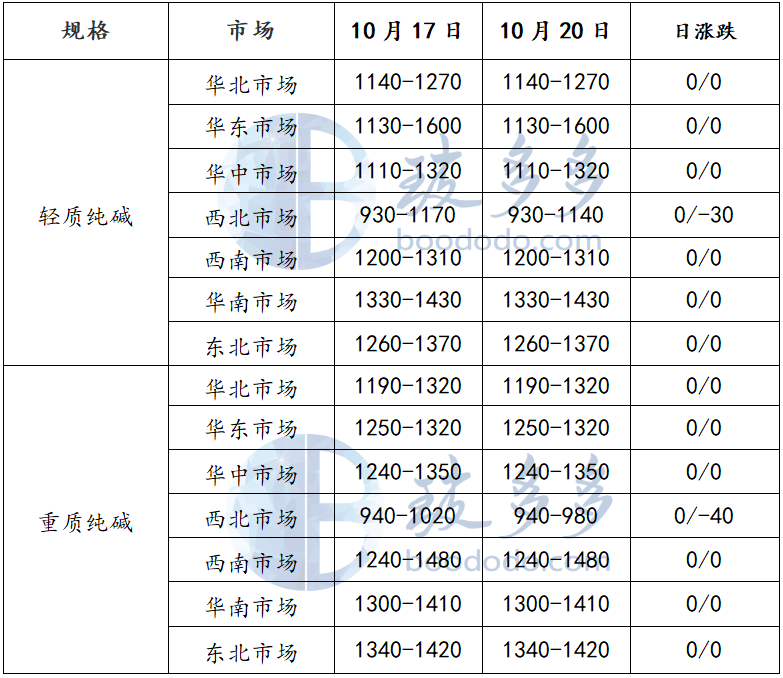
Core Viewpoint - The domestic soda ash market is operating steadily with a slight downward trend in some regions, as demand remains weak and market participants exhibit cautious purchasing behavior [2]. Price Summary - Light soda ash prices in East China are maintained at 1130-1600 CNY/ton, while heavy soda ash prices are at 1250-1320 CNY/ton [2]. - In Central China, light soda ash prices range from 1110-1320 CNY/ton, and heavy soda ash prices are between 1240-1350 CNY/ton [2]. - The price indices for light and heavy soda ash on October 20 are 1160 and 1211.43 respectively, remaining unchanged from the previous working day [3]. Market Dynamics - The soda ash futures market showed a slight fluctuation, with the main contract SA2601 opening at 1214 CNY/ton and closing at 1219 CNY/ton, reflecting a daily change of 0.00% [5]. - The industry is characterized by a strong supply and weak demand situation, with high operating rates and accumulating inventories, leading to significant de-stocking pressure [5]. - The downstream glass market continues to decline, contributing to weak support for soda ash prices [5]. Future Outlook - The soda ash market is expected to continue its weak performance in the short term, with a gradual recovery in operating rates as previously shut-down facilities restart [6]. - Demand remains soft, with limited new orders and cautious purchasing intentions from downstream enterprises [6]. - If inventory pressures persist, manufacturers may implement discount measures to stimulate sales [6].
弘业期货纸浆周报-20251020
Hong Ye Qi Huo· 2025-10-20 07:42
1. Report Industry Investment Rating - No relevant information provided 2. Core Views of the Report - The pulp main contract fluctuated at a low level last week. The SP2601 opened at 5080, reached a minimum of 5042, a maximum of 5198, and closed at 5122, with a gain of 0.87%. As of October 17, the top 20 long positions in the pulp 2601 contract were 114,426 lots (an increase of 5,390 lots from the previous day), and the top 20 short positions were 127,104 lots (an increase of 5,198 lots from the previous day) [2] - As of October 17, the price of Shandong Yinxing was 5,500 yuan/ton, a decrease of 20 yuan/ton from last week; the price of Shandong Wuzhen was 5,000 yuan/ton, a decrease of 50 yuan/ton from last week [2] - It is reported that in September 2025, Chile's Arauco Company's quotation for coniferous pulp Yinxing remained unchanged at $700/ton; the quotation for broadleaf pulp Mingxing was $540/ton, an increase of $20/ton; the quotation for natural pulp Jinxing remained unchanged at $590/ton [2] - In September 2025, China's pulp imports were 2.952 million tons, a month-on-month increase of 11.3% and a year-on-year increase of 10.3%. From January to September, the cumulative imports were 27.061 million tons, a cumulative year-on-year increase of 5.6%. In September 2025, the import volume of bleached coniferous pulp was 691,000 tons, a month-on-month increase of 12.5% and a year-on-year increase of 11.3%. From January to September, the cumulative import volume was 6.431 million tons, a cumulative year-on-year increase of 2.4% [2] - In this period, the downstream demand for household paper was weak, the paper mills' shipments were poor, and the industry's operating rate was low. The large white cardboard manufacturers had strong production and sales, the paper mills' profitability improved, but the traders' shipments were average and their trading enthusiasm was not high. The downstream consumption of offset paper continued to be weak, the operating level of some printing factories was not high, and the procurement was mainly for rigid demand replenishment. The copperplate paper market had sufficient supply, the demand was weak, the consumption speed of downstream base paper was slow, and users purchased according to quantity [2] - As of October 16, 2025, the inventory of mainstream pulp ports in China was 2.074 million tons, a month-on-month decrease of 0.1% and a year-on-year increase of 25.7%. The weak demand from downstream paper mills and limited提货 led to high inventory [2] - The total import volume of pulp continued to increase year-on-year, and the shipments of international mainstream suppliers to the Chinese market also remained at a high level. Coupled with the high port inventory, the short-term pressure on the supply side was difficult to relieve. The overall terminal demand in the downstream base paper market was weak, paper mills mainly purchased raw materials for rigid demand, and the willingness to actively increase purchases was weak. The overall market sentiment was cautious. The current "supply is stronger than demand" pattern in the pulp market continued, but thanks to the relatively strong spot price and the support of import costs, the downward space for prices may be limited, and it is likely to maintain a low-level fluctuation in the short term [2] 3. Summary by Relevant Catalogs Pulp Price Data - The report presents the price data of pulp, including the closing price of the pulp futures main contract, pulp basis, the CFR intermediate price of Yinxing in China's main port area, the CFR intermediate price of broadleaf pulp Mingxing, the mainstream price of Mingxing brand broadleaf pulp in Shandong, and the market price of coniferous pulp Yinxing in Shanghai [3][5][7][8][10][13][15] Pulp Supply - The report shows the pulp import volume and coniferous pulp import volume from 2021 to 2025 [16][18][20] Pulp Demand - The report includes the consumption of coniferous pulp in Europe, the apparent consumption of pulp in China, the operating rate of downstream base paper, the consumption of downstream base paper, the inventory of downstream base paper, and the price of downstream base paper [21][22][24][33][37][41] Pulp Inventory - The report presents the inventory data of pulp, including European pulp port inventory, global wood pulp finished product inventory available days, pulp futures inventory, European coniferous pulp inventory, and European coniferous pulp inventory available days [44][45][46][48][50][54]
推动“供强需弱”转向“供需同强”
Sou Hu Cai Jing· 2025-10-19 19:55
Core Viewpoint - Despite facing multiple challenges in recent years, China's economy has made significant progress in technological transformation and upgrading in key industries, leading to an increase in overall productivity and supply-side capabilities [2][4] Group 1: Demand-Supply Relationship - The primary contradiction in the current demand-supply relationship is insufficient demand, which has been a typical fact in recent years [2] - Within total demand, the main contradiction is insufficient domestic demand, with external demand contributing significantly more to GDP growth compared to previous periods [2][3] - The investment and consumption dynamics show that consumption is the more prominent issue, with consumption rates in China significantly lower than the international average [3][4] Group 2: Consumer Behavior - Among total consumption, the weakness in household consumption is a major concern, with data indicating that China's household consumption rate is 18 percentage points lower than the G20 average [3] - Service consumption, particularly in education, healthcare, and housing, is lagging, which is linked to the slow progress in equalizing basic public services [3][4] Group 3: Public Resource Allocation - The allocation of public resources has historically favored investment and development, which has led to a relative weakness in final consumption [4][6] - There is a need to optimize the allocation of public resources to support consumer spending without hindering supply-side advancements [5][6] Group 4: Strategies for Boosting Consumption - To stimulate consumption, it is essential to adjust the focus of public resource allocation towards enhancing final consumption and expanding domestic demand [7] - Systematic reforms in public services and fiscal policies are necessary to improve accessibility and equality in services for urban and rural residents [7][8] - Reforms in the household registration system and land use rights are crucial for fostering urban-rural integration and enhancing consumer capacity [8]