再工业化

Search documents
Orion(OESX) - 2026 Q2 - Earnings Call Transcript
2025-11-05 16:00
Financial Data and Key Metrics Changes - Orion reported Q2 2026 revenue of $19.9 million, a slight increase from $19.4 million in Q2 2025, with a gross profit margin rising to 31% from 23.1% year-over-year, reflecting an 800 basis point improvement [8][17] - The net loss improved to $0.6 million or $0.17 per share from a net loss of $3.6 million or $1.10 per share in Q2 2025, indicating better financial performance [17] - Adjusted EBITDA turned positive at $0.5 million in Q2 2026 compared to a negative $1.4 million in Q2 2025, marking the fourth consecutive quarter of positive adjusted EBITDA [17] Business Line Data and Key Metrics Changes - The LED lighting segment revenue decreased by 2% to $10.7 million in Q2 2026 from $10.8 million in Q2 2025, impacted by lower ESCO channel sales despite increased project activity [13] - Maintenance segment revenue increased by 18% to $4.5 million in Q2 2026 from $3.8 million in Q2 2025, benefiting from new customer contracts and expanded existing relationships [15] - EV charging solutions revenue was $4.8 million in Q2 2026, slightly up from $4.7 million in Q2 2025, reflecting the completion of a significant project [15] Market Data and Key Metrics Changes - The Dodge Momentum Index report indicated that commercial, industrial, and public sector construction planning is 33% ahead of year-ago levels, suggesting a positive outlook for the lighting market [6] - The EV charging market outlook improved with the federal declaration of $5 billion in government EV charging funds, boosting confidence in the sector [7] Company Strategy and Development Direction - Orion aims to achieve three milestones in fiscal 2026, including maintaining its NASDAQ listing, implementing a growth profitability and cost containment initiative, and reaching $84 million in revenue with positive adjusted EBITDA for the full fiscal year [4][5] - The company is focusing on expanding its LED lighting distribution business and enhancing its electrical infrastructure offerings, integrating various services to meet customer demands [11][12] Management's Comments on Operating Environment and Future Outlook - Management expressed optimism about sustainable and profitable growth beginning in the second half of the fiscal year, driven by ongoing improvements in cost control and operational efficiency [4][11] - The company anticipates modest growth in LED lighting and electrical maintenance revenues, with flat to slightly lower EV charging revenues for the fiscal year [18] Other Important Information - Orion's total operating expenses declined to $6.4 million in Q2 2026 from $7.7 million in Q2 2025, reflecting ongoing cost control measures [16] - The company issued $1 million of common stock and made $875,000 in cash payments to partially satisfy an earn-out obligation during the quarter [18] Q&A Session Summary Question: What is the outlook for the EV business given recent government clarity? - Management noted an increase in enterprise customers integrating EV charging into their projects, with ongoing expansion in utility programs and infrastructure work [19] Question: Are there plans for geographic expansion in the EV segment? - The company is looking at geographic expansion and has hired personnel to lead efforts in new areas, particularly where EV infrastructure work is prominent [22] Question: Can you clarify the $42 million-$45 million recurring revenue potential? - This figure represents the total over the life of a three-year contract renewal with a major customer [22] Question: What are the expectations for gross margins moving forward? - Management indicated that while improvements are expected, gross margins are likely to remain in the high 20s to low 30s range, depending on revenue mix and sales volumes [24] Question: How much revenue headwind was faced due to the unprofitable maintenance contract? - The headwind from the unprofitable contract was estimated to be less than $500,000, as the company is growing in other areas [29] Question: Is the maintenance business a lead generator for product sales? - Yes, the maintenance business is seen as a lead generator, providing insights and opportunities for additional sales in lighting and EV segments [32]

聊聊这周的几个热点
表舅是养基大户· 2025-11-02 13:37
Group 1 - The article discusses the recent macroeconomic events, including the US-China talks and the Federal Reserve's interest rate cut, indicating a potential macroeconomic window of calm in the short term [1][2] - Key focus areas for the remainder of the year include the US non-farm employment and inflation data in October and November, which will help assess the likelihood of another interest rate cut in December [1] - In the domestic context, the issuance quota for 2026 and the upcoming economic work conference are highlighted as critical points to watch before the year ends [1] Group 2 - The A-share third-quarter reports have been released, with a notable market decline despite over 70% of stocks rising, indicating a rare market behavior where the top traded stocks all fell [5][7] - The AI industry stocks, which had been performing well, experienced significant drops, suggesting a potential risk as fund concentration in the TMT sector reached extreme levels [7][8] - The article notes a shift in investor sentiment, leading to a concentrated sell-off of previously leading growth stocks, indicating a crack in the previous market consensus [8] Group 3 - The article analyzes the performance of the Hong Kong stock market, which lagged behind after several months of gains, with a net inflow of approximately 85 billion yuan from southbound funds in October, marking a four-month low [10][11] - The performance of Japanese and Korean markets is contrasted with the Hong Kong market, suggesting a reallocation of foreign capital towards these markets due to recent geopolitical agreements [13] Group 4 - The article discusses the implications of major investors halting new subscriptions, indicating potential structural overheating in the A-share market [19][21] - Despite the concerns, the article maintains a positive outlook on quality equity investments, emphasizing the ongoing low-interest-rate environment and the shift in household wealth [23][24] Group 5 - New tax regulations on gold are expected to increase the cost of purchasing gold jewelry and physical gold bars, while making gold ETFs and bank paper gold investments relatively cheaper [25][29] - The article suggests a trend towards ETF investments in gold as a response to the new tax policies [29] Group 6 - The analysis of A-share and US stock quarterly reports indicates a lack of clear profit recovery for non-financial enterprises, with significant structural differentiation observed [31] - The article highlights that despite the absence of profit growth, listed companies may still hold relative operational advantages over non-listed firms, reinforcing the rationale for investing in quality equities [31] Group 7 - The article provides insights from insurance companies regarding their investment strategies, emphasizing the pressure on net investment returns due to declining interest rates and credit risks [37] - Insurance firms are adjusting their asset allocations, focusing on alternative assets and growth opportunities in digital economy and healthcare sectors [37]


港股收评:10月飘绿收官!恒指再失守26000点,科技股、大金融齐挫
Ge Long Hui· 2025-10-31 08:55
Market Overview - The Hong Kong stock market experienced a decline, with the Hang Seng Index falling by 1.43% to close below 26,000 points, marking three consecutive days of decline [1] - The cumulative decline for the Hang Seng Index in October is 3.35%, while the National Index and Hang Seng Tech Index fell by 4.05% and 8.62%, respectively [2] Sector Performance - Major technology stocks dragged down market sentiment, with significant declines in large financial stocks, semiconductor stocks, and various other sectors including military, automotive, coal, gold, real estate, aviation, and solar energy [3] - The biotechnology sector saw multiple catalysts igniting interest, leading to gains in education, home appliance, and gaming stocks [3] Notable Stock Movements - Alibaba dropped by 4%, Tencent fell over 3%, and other tech stocks like Kuaishou, Baidu, JD.com, and Xiaomi also saw declines exceeding 2% [4] - Financial stocks such as Everbright Securities and Huatai Securities experienced declines over 5%, while major banks also reported losses [5][6] Specific Stock Highlights - The automotive sector saw declines with BYD and Great Wall Motors dropping over 3%, while semiconductor stocks like Huahong Semiconductor and ZTE fell by over 6% [9][10] - The pharmaceutical and innovative drug sectors performed well, with companies like 3SBio and Innovent Biologics seeing significant gains [11] Capital Inflows - There was a notable net inflow of capital from southbound trading, with over 8.719 billion HKD in net purchases [12] Future Outlook - Analysts suggest that the current market conditions may favor sectors such as raw materials, export-oriented industries, and those benefiting from RMB appreciation, including aviation and paper manufacturing [14]

APi (APG) - 2025 Q3 - Earnings Call Transcript
2025-10-30 13:32
Financial Data and Key Metrics Changes - Reported revenues for Q3 2025 were $2.1 billion, a 14.2% increase from $1.83 billion in the prior year period, with organic growth of approximately 10% [13] - Adjusted gross margin for Q3 2025 was 31.5%, a 50 basis point increase compared to the prior year, driven by disciplined customer and project selection [13] - Adjusted EBITDA increased by 14.7% for Q3 2025, with an adjusted EBITDA margin of 13.5%, representing a 10 basis point increase year-over-year [13][14] - Adjusted diluted earnings per share for Q3 was $0.41, a 20.6% increase compared to the prior year [14] Business Line Data and Key Metrics Changes - Safety Services segment reported revenues of $1.4 billion, a 15.4% increase compared to $1.2 billion in the prior year, with organic growth of 8.7% [14][15] - Specialty Services segment reported organic revenues of $683 million, an increase of 11.6% compared to $612 million in the prior year [15][16] - Adjusted gross margin for Safety Services was 37.3%, an 80 basis point increase, while Specialty Services saw a gross margin of 19.3%, a 60 basis point decrease [15][16] Market Data and Key Metrics Changes - The company experienced double-digit inspection revenue growth in North America for the 21st consecutive quarter [9] - The backlog remains at record highs across both segments, indicating strong future revenue potential [12][71] Company Strategy and Development Direction - The company aims to grow into a $10 billion entity by 2028, with targets of mid-single-digit organic growth and 16%+ adjusted EBITDA margin [6][8] - Investments in technology, including AI and market-leading systems, are intended to empower field leaders and improve operational efficiency [6][8] - The company is focused on disciplined customer and project selection, pricing, and selective business pruning to achieve its financial targets [9] Management's Comments on Operating Environment and Future Outlook - Management expressed confidence in the ability to execute the strategy and deliver on 2025 targets, citing strong momentum in inspection, service, and monitoring business [12][21] - The company anticipates continued strong performance in the project environment, with expectations for mid to upper single-digit organic growth in the long term [51][72] Other Important Information - The company completed four bolt-on acquisitions in the quarter, bringing the total for the year to 11, with a target of approximately $250 million in M&A activity [11][12] - Free cash flow for Q3 was $248 million, representing an adjusted free cash flow conversion of 88% [16][17] Q&A Session Summary Question: Can you provide more detail on the organic growth in Safety Services? - Management noted robust activity in the data center space, with expectations for data centers to account for 9%-10% of total revenue, alongside strong growth in semiconductor and healthcare sectors [26] Question: How is the M&A pipeline progressing? - Management indicated they are on track with M&A plans, with a focus on North America in fire and security, and noted ongoing activity in the international business [29][30] Question: What is the current status of the elevator and escalator segment? - The elevator segment is experiencing high single-digit organic growth, with positive cross-selling opportunities developing [67] Question: How do you balance growth priorities with M&A? - Management stated they are able to pursue both growth in inspection services and consolidation in the elevator segment simultaneously, leveraging their geographic footprint [36] Question: What are the expectations for incremental margins going forward? - Management indicated that while project work impacts margins, they expect margins to improve as projects progress towards completion [90]

格林大华期货碳酸锂价格上行报告:储能需求激增,碳酸锂价格上行
Ge Lin Qi Huo· 2025-10-24 08:58
Global Economic Outlook - Goldman Sachs expects a more sustained upward trend in Chinese stocks in the future, and the structural shift of Chinese capital into stocks may have begun. The willingness of Chinese market entities to settle foreign exchange has significantly increased. Traders are increasing bets that the Fed will implement at least one 50 - basis - point interest rate cut in its meeting later this month or in December [4] - Although AI infrastructure investment has reached a record high in nominal terms, compared with historical technology cycles, it is not exaggerated. Currently, US AI investment accounts for less than 1% of GDP [4] - Meta has joined hands with private - equity giant Blue Owl to raise $27 billion through the issuance of private bonds to build data centers. DeepSeek has launched a revolutionary OCR model to solve the computing power problem of AI in processing long documents [4] - An executive at Apollo Global Management warns that there is a huge gap between the huge energy demand of artificial intelligence and the current global power supply, and this gap may not be filled in our lifetime [4] - Due to the continuous wrong policies of the US, the global economy is entering the top - region [5] - After the US imposed reciprocal tariffs on various countries, the competitiveness of Chinese goods has increased, and the US imports from China in August increased by nearly 40% month - on - month [6] - The US Market manufacturing PMI in September was 52.0, continuing to expand [9] - In August, the US manufacturing unfilled orders were at a record high, with a year - on - year increase of 7.1%, indicating high business sentiment [12] - The US capital goods import amount in August was $91.9 billion, still at a high level, and the year - on - year growth rate was 10.5%, indicating that the US manufacturing industry is accelerating its return and the US "re - industrialization" is speeding up [15] - The US wholesalers' sales in August were $711.3 billion, a record high, with a year - on - year increase of 6.2%, indicating strong US consumption [18] - The total retail and food sales in the US in August increased by 0.6% month - on - month, exceeding expectations, showing strong US consumption [21] - The eurozone's manufacturing PMI slightly contracted in September, while the service - sector PMI accelerated its expansion [24] - India's manufacturing and service - sector PMIs continued to expand in September, and India's manufacturing and service industries have maintained expansion for more than three years [26] - The upward trend of Japan's long - term government bond yields has not changed [29] Asset Allocation - The Fed is expected to continue cutting interest rates in October [31] - Wait for the Sino - US agreement at the end of the month in the context of Sino - US game [32] - The market's defensive state has not ended, and the Shanghai Stock Exchange 50 Index, representing the value style, has reached a new high. The Fourth Plenary Session of the 20th CPC Central Committee's communiqué emphasizes seizing the high - ground of scientific and technological development, and the technology sector has become active again. Policies are favorable to semiconductor equipment ETFs and science and technology innovation chip ETFs [33] - AI infrastructure drives a rapid increase in power demand, leading to a stronger copper price [34][47] - The container shipping European line 2512 contract has entered the seasonal peak season [35][50] - Awaited for the clarity of the Sino - US agreement at the end of the month, the CSI 300 Index is both offensive and defensive, and the stock - index allocation is mainly long positions in CSI 300 stock - index futures [39] Lithium Carbonate Market - The growth rate of lithium carbonate demand is much higher than the production growth rate. In October 2025, the planned production of power + energy - storage + consumer batteries in the Chinese market was 186 GWh, a month - on - month increase of 22.4% and a year - on - year increase of 45.3%. The planned production of lithium - battery A was 61.3 GWh, lithium - battery B was 30.9 GWh, and lithium - battery C was 13 GWh. The planned production of energy - storage cells accounted for about 40.3%, and the planned production of ternary cells accounted for about 15%. The average operating rate of the lithium - battery industry was close to 90%, and the production lines of leading enterprises were operating at full capacity [41] - In October 2025, the total production of power + energy - storage + consumer batteries in the global market was about 205 GWh, a month - on - month increase of 25.8%. Currently, the increased production of domestic spodumene and salt - lake lithium mines offsets the reduction in lithium - mine production, but the total supply has not increased, while the demand has increased significantly, resulting in nine consecutive weeks of inventory reduction, which will continue in the future [42] - PwC reports that in 2026, thanks to the explosive growth of energy - storage and the continuous growth of power batteries, the total demand for lithium carbonate will reach 2.05 million tons of LCE, a year - on - year increase of 35% compared with 1.55 million tons in 2025 [42] - The expansion of lithium carbonate production capacity is expected to slow down significantly in 2026, with an expected growth of only about 10%, and the new supply will be difficult to match the continuously high - speed growth in demand [43] - The surge in energy - storage demand, with the demand growth rate of lithium carbonate far exceeding the production growth rate, has pushed up the price of lithium carbonate [44]
哥伦比亚再工业化进展不及预期
Shang Wu Bu Wang Zhan· 2025-10-15 17:10
Core Insights - Colombia's reindustrialization progress is lagging behind expectations, with only 17.37% of the target achieved compared to the planned 38.56% by 2024 [1] Group 1: Reindustrialization Progress - The United Nations Economic Commission for Latin America and the Caribbean (CEPAL) reports that Colombia faces significant challenges in executing and coordinating production development policies [1] - The transition from traditional extractive industries to high-value-added goods and services is particularly difficult for Colombia [1] - Despite establishing public information collection and data assessment mechanisms, Colombia needs to accelerate policy implementation and outcome transformation to meet its reindustrialization goals by 2034 [1]
稀土牌只是开胃菜,第二张王牌已炸,外媒:美再工业将彻底被扼杀
Sou Hu Cai Jing· 2025-10-15 15:54
Core Points - The recent escalation in US-China trade tensions is marked by China's new export controls on rare earth materials and synthetic diamonds, which are critical for high-tech and defense industries in the US [2][3][5] - The US stock market reacted negatively, losing $2 trillion in value, with significant drops in major tech stocks following the announcement of these measures [2][6] Group 1: Export Controls - China announced export controls on rare earth materials, requiring licenses for mining, refining, and related technologies starting November 8 [3][5] - The controls include five categories of heavy rare earth metals and extend to high-tech applications such as chip manufacturing [5][8] - The measures are expected to increase global rare earth prices by over 20% due to China's dominant position, supplying 80% of the world's rare earths [3][5] Group 2: Impact on US Industries - The US heavily relies on China for rare earths, with 70% of its supply coming from China, which poses a risk to its defense and semiconductor industries [3][6] - The export controls on synthetic diamonds, crucial for cooling high-density AI chips, could severely impact the US's ability to expand its data centers and semiconductor production [9][11] - The US Department of Defense has indicated that shortages in rare earths could directly affect military production capabilities [3][6] Group 3: Global Reactions - The EU is coordinating with the US to assess the impact on supply chains and is looking to increase imports from Australia and Canada [3][5] - Other countries like India are attempting to ramp up domestic production of rare earths, but their current capacity is insufficient to meet global demand [5][11] - The situation has prompted discussions among US allies about diversifying supply chains, but immediate alternatives to Chinese materials are limited [11]
联合国报告:稀土只是小试牛刀,2030中国或将焊死美国再工业化大门
Sou Hu Cai Jing· 2025-10-14 04:54
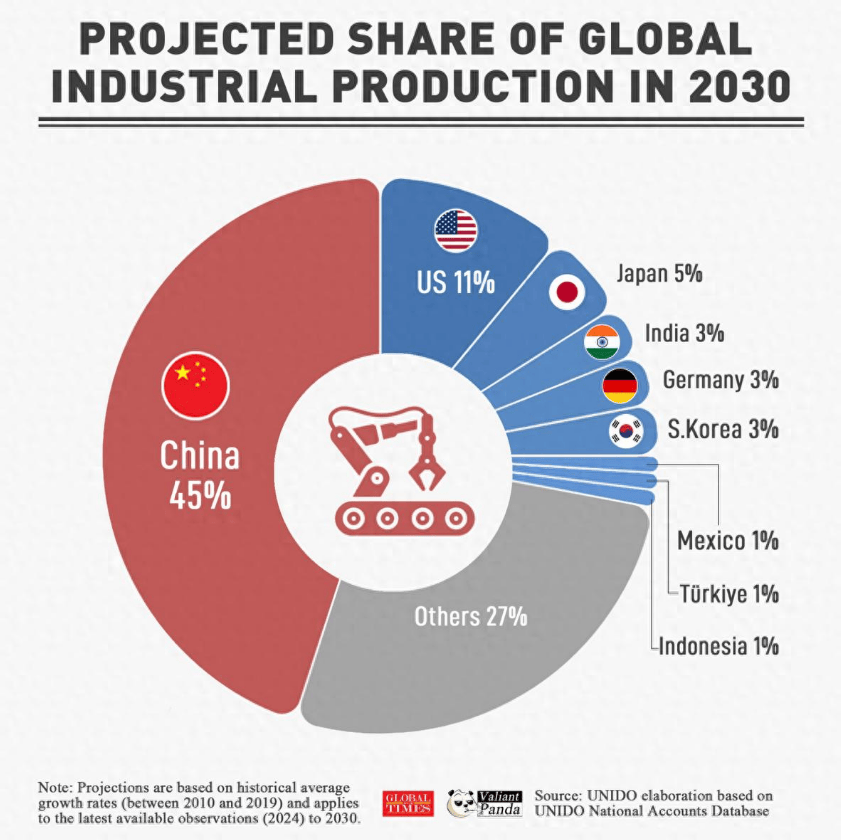
10月9日,中国商务部发布了一份新的稀土原料和技术出口管制通知,瞬间点燃了美中之间的贸易战。这并不是简单的报复行为,而是背后深层次战 略博弈的表现。诸多西方专家对此分析认为,"稀土卡脖子"只是中国小试牛刀,更加深刻的行业变革还有待揭晓。展望未来,到了2030年,中国将 不仅仅是制造业的巨头,还可能彻底封死西方国家的再工业化之路。 中国的崛起还得益于科技的进步与工业自动化的普及。中国工厂的自动化程度已在全球名列前茅,工业机器人密度亦居于世界第二。这使得中国的 工业生产效率大幅提升,其性价比远超越南和印度等其他发展中国家。这种规模与成本壁垒的形成,意味着任何国家想要追赶中国,都需要投入巨 额资金与时间。 根据联合国的《Sustainable Development Report 2024》报告,中国目前在全球制造业中的占比已达到30%,远超竞争对手——欧盟的15%和美国的 16%。若不出意外,至2030年这一数字将增加到45%。这意味着,几乎一半的全球工业产能都将在中国完成,这样的声势让传统的制造强国如美 国、德国等感受到了前所未有的压力。 要知道,这种快速发展并非偶然。中国在41个大类、207个中类及666个小 ...
“我们重拾了尊严!”巴西总统动情称赞比亚迪第1400万辆新能源车下线
Xin Lang Cai Jing· 2025-10-10 08:57
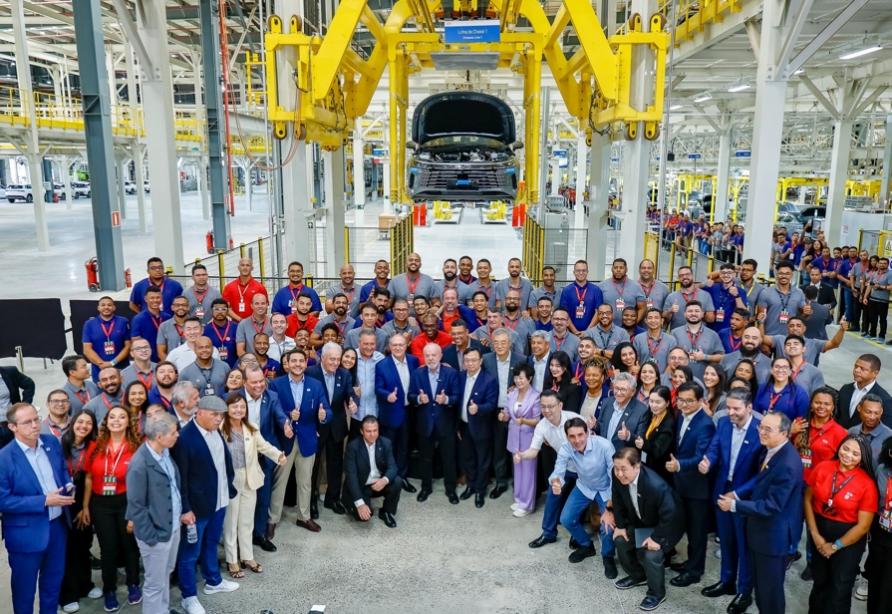
Core Insights - BYD has achieved a significant milestone by producing its 14 millionth electric vehicle, marking it as the first global company to reach this achievement in the electric vehicle sector [1][5][9] - The handover of the vehicle to Brazilian President Lula symbolizes a strategic partnership between China and Brazil, highlighting BYD's role in the global automotive industry's transformation [3][5] - The establishment of BYD's factory in Brazil represents a shift from traditional fuel vehicles to electric vehicles, contributing to the region's re-industrialization and sustainable economic development [5][7] Summary by Sections Milestone Achievement - The production of the 14 millionth vehicle is a testament to BYD's strength and innovation in the electric vehicle market, showcasing China's transition from a technology-importing nation to a leader in the global automotive industry [5][9] Investment and Economic Impact - BYD's investment of 5.5 billion Brazilian Reais (approximately 7.1 billion RMB) has created 20,000 jobs and established a production capacity of 150,000 vehicles per year, providing a boost to the local economy [5][7] - The factory is seen as a beacon of hope for re-industrialization in a region facing de-industrialization challenges, emphasizing the importance of green technology [5][7] Global Strategy and Local Integration - BYD's operations in Brazil reflect its global strategy, moving beyond mere production to creating a localized ecosystem that includes R&D, production, and talent development [7][9] - The naming of a road after BYD near the factory signifies the cultural integration of the brand in the local community, marking a step towards deeper global presence [7][9]

APCO大中华区主席麦格雷戈:小米的故事正在中国各地发生
新浪财经· 2025-10-08 07:12
Group 1 - The core attractiveness of China for multinational companies lies in its structural advantages, including a vast market size that remains central to global strategies across various sectors such as manufacturing, energy, consumer goods, and finance [2] - China's innovation capability is characterized by "incremental innovation," focusing on rapid improvements in business models, product iterations, and supply chain efficiency, exemplified by Huawei's significant investment in an innovation park in Shanghai [2] - Multinational companies are increasingly recognizing that their strongest future competitors may come from China, leading to more collaborations and alliances with Chinese firms in emerging fields like new energy vehicles, artificial intelligence, and biomedicine [3] Group 2 - The manufacturing sector in China is undergoing a "re-industrialization" wave, with factories adopting "dark factory" operations, where smart robots replace traditional production lines, significantly reducing supply chain response times [3] - The return of scientists and engineers who studied and worked in the U.S. is driving breakthroughs in deep technology fields in China, reminiscent of the internet boom, but this time focused on hard technology [3] - The rapid transformation of companies like Xiaomi, which transitioned from a smartphone manufacturer to establishing a fully automated electric vehicle factory, highlights the revolutionary changes occurring in Chinese manufacturing [4]