
AI投资

Search documents
中国银行:2026中国银行个人金融全球资产配置白皮书
Sou Hu Cai Jing· 2026-01-24 08:01
Core Viewpoint - The report outlines the global asset allocation strategy for personal finance by Bank of China, predicting a slow recovery in the global economy in 2026, with a focus on the performance of various asset classes amid changing monetary policies and economic conditions. Economic Overview - In 2025, global economic growth is expected to slow down with inflation receding, leading G10 countries (excluding Japan) into a rate-cutting cycle. The Federal Reserve's continued rate cuts are anticipated to push the US dollar index down, resulting in strong global asset performance, particularly in gold and silver, while oil is expected to be the only asset with negative returns. The Chinese asset market is entering a phase of value reassessment, with a slow bull market forming and the RMB expected to appreciate against the USD [1][8]. - For 2026, the global economy may continue its weak recovery, with uncertainties remaining. China's economy is projected to stabilize and grow between 4.7% and 5.0% due to supportive macro policies. The US is expected to see reduced policy uncertainty, while the Eurozone's economic fundamentals remain robust, and the UK economy shows resilience [1][8][10]. Equity Market - The internationalization and value reassessment of Chinese assets are ongoing, with the A-share market expected to solidify its slow bull market and potentially evolve into a long bull market. Hong Kong stocks are positioned to benefit from global liquidity inflows as a core hub for RMB asset allocation. The US stock market is expected to rise but may underperform compared to non-US markets, while European and Japanese markets are anticipated to see moderate gains [1][9][12]. Bond Market - The bond market is influenced by the Federal Reserve's rate cuts and balance sheet expansion, leading to a downward shift in US Treasury yields. The UK bond market shows high allocation value, while German bonds are expected to perform slightly weaker. In China, the 10-year government bond yield is projected to fluctuate between 1.6% and 1.9% [2][10][11]. Foreign Exchange Market - The trend of "de-dollarization" is expected to continue, with the US dollar's central tendency likely to decline. Non-US currencies are showing mixed performance, with the Euro and Malaysian Ringgit slightly stronger, while the Japanese Yen, British Pound, Australian Dollar, and Indonesian Rupiah are in the middle range. The RMB is expected to fluctuate within a stable range against the USD and may depreciate slightly against other major non-US currencies [2][10][20]. Commodity Market - The long-term upward trend for gold remains solid, with expectations for new historical highs in 2026, albeit with increased volatility. Silver is also expected to trend upwards due to multiple support factors. The demand dynamics for copper and aluminum are being reshaped by AI developments, while oil is expected to remain in a supply surplus situation. Prices for polyester and industrial silicon are anticipated to recover due to supportive policies, and lithium carbonate is expected to see price fluctuations based on supply and demand changes [2][11][12]. Asset Allocation Strategy - The recommended global asset allocation order for 2026 is precious metals, non-ferrous metals, equities, and bonds. Gold and silver are expected to outperform copper and aluminum, while non-US equities are projected to outperform US stocks. In the bond sector, US Treasuries are favored over Chinese bonds, and oil is suggested for lower allocation [3][11][12].



美联储政策突传转向 沪金警示回调风险
Jin Tou Wang· 2026-01-22 06:05
Group 1 - Gold futures are currently trading around 1074.22, with a slight decline of 0.09%, reaching a high of 1099.62 and a low of 1074.00 [1] - The short-term outlook for gold futures appears bearish [1] Group 2 - A Reuters survey indicates that most economists expect the Federal Reserve to maintain the benchmark interest rate at 3.50%-3.75% this quarter, reversing previous expectations of a rate cut before March [3] - The strong growth outlook for the U.S. economy and persistent inflation above the 2% target are the main reasons supporting this judgment [3] - 58% of economists surveyed expect no change in rates this quarter, with a consensus that the January FOMC meeting will result in no action [3] - Concerns about political interference are rising, with Trump criticizing Powell for not cutting rates effectively and potential criminal investigations into Powell's actions [3] Group 3 - The survey has raised the U.S. GDP growth forecast for this year to 2.3%, up from 2% last month, with an average of 2% expected by 2028 [4] - The chief economist at Oxford Economics is more optimistic, predicting a growth rate of 2.8% due to AI investments and tax cuts contributing 0.6 percentage points [4] - Inflation, as measured by PCE, is expected to remain above the 2% target this year and through 2028, with an average unemployment rate of 4.5% [4] Group 4 - As of January 22, 2026, the main gold futures contract has surpassed 1100 yuan/gram, creating a historical high and showing a high-level oscillation [5] - Technical indicators suggest a bullish trend in the short term, but caution is advised due to the RSI nearing the overbought zone [5] - Support is noted at 1090 yuan/gram, while resistance is observed at 1120 yuan/gram, with geopolitical tensions and global central bank gold purchases supporting the long-term trend [5]
印度股市持续“不温不火”
日经中文网· 2026-01-21 03:07
Core Viewpoint - The Indian SENSEX index is underperforming compared to other markets, with a projected increase of only 9% in 2025, while the Chinese Shanghai Composite Index is expected to rise by approximately 18% and the Korean Composite Index by 75% [2][8]. Group 1: Market Performance - The SENSEX index has shown weakness entering January 2026, hovering around the 25-day moving average since December 2025, with a significant net sell-off by foreign investors amounting to ₹1.6628 trillion (approximately ¥127.186 billion) in 2025 [4]. - As of January 13, 2026, the net sell-off reached ₹185.8 billion, indicating continued outflows from the Indian stock market [4]. - The SENSEX index increased by 9% in 2025, but this is lower than the approximately 13% rise of the Dow Jones Industrial Average and about 17% of the S&P 500 [7]. Group 2: Economic Context - The Indian economy remains robust, with a projected GDP growth of 7.4% for the fiscal year 2025, and a significant 8.2% growth in GDP for the July-September 2025 quarter, exceeding expectations [4][5]. - The Indian government has implemented several reforms, including GST reductions and labor market reforms, to enhance economic vitality and mitigate the impact of high U.S. tariffs [5]. Group 3: Investment Trends - There has been a notable decline in sovereign wealth fund investments in India, dropping from $20.1 billion in 2024 to $5.7 billion in 2025, a decrease of 72% [7]. - The majority of new investments from sovereign wealth funds are now coming from the Middle East, focusing on AI and data centers, with a significant portion redirected to the U.S. [7]. - The global trend of increasing AI investments since mid-2025 has contributed to the relative weakness of the Indian stock market, which lacks a substantial number of high-tech stocks [7]. Group 4: Future Outlook - Investor sentiment is shifting towards markets with better returns, with a prevailing view that the Indian stock market may struggle to generate profits in a moderate economic environment [9]. - The performance of Indian companies in 2026 is expected to improve in the first half, but this growth is not anticipated to rely on AI infrastructure [9]. - The geopolitical landscape and India's positioning will become increasingly important for overseas investors [9].

华泰证券今日早参-20260120
HTSC· 2026-01-20 06:09
Group 1: Market Overview - The A-share market experienced a significant increase in trading volume, surpassing 3 trillion yuan in the first half of last week, but faced a pullback in the latter half due to increased counter-cyclical policy adjustments [2] - There is a divergence in market sentiment, with leveraged funds and individual holdings in ETFs continuing to see net inflows, while broad-based ETFs with high institutional holdings experienced a net outflow of approximately 135.1 billion yuan [2] - The overall market sentiment remains high post-volume increase, with potential upward movement if supported by fundamental and liquidity catalysts [2] Group 2: Fixed Income Insights - The public market saw a net injection of 111.28 billion yuan last week, with a total of 18.515 billion yuan injected, including 9.515 billion yuan in reverse repos [3] - The average rates for DR007, R007, and GC007 increased by 5 basis points, 6 basis points, and 3 basis points respectively compared to the previous week [3] - The liquidity environment is expected to remain tight initially but may ease as the week progresses [3] Group 3: Economic Data Analysis - In December 2025, the GDP growth rate was 4.5% for Q4 and 5% for the entire year, aligning with market expectations [5] - Industrial production and service sector output showed signs of recovery, while the construction sector is expected to maintain a significant negative growth [5] - The consumer retail sales in December increased by 0.9% year-on-year, totaling 4.5 trillion yuan, influenced by high base effects from durable goods [7] Group 4: Real Estate Sector - The real estate sector is stabilizing, with the central government's commitment to support the industry reflected in recent policy adjustments [8] - Recommended stocks include those with strong credit, good cities, and quality products, such as China Overseas Development and China Resources Land [8] - The market is expected to benefit from improved cash flow management among companies during the adjustment phase [8] Group 5: Consumer Sector - The new round of replacement policies for household appliances is expected to support demand in key categories, with a focus on smart products [7] - The consumer spending in early January 2026 showed a year-on-year increase of 6.1%, indicating a positive start to the year [7] - Investment opportunities are suggested in high-growth sectors, including domestic brands and technology consumption [7] Group 6: Company-Specific Insights - Inner Mongolia Huadian is highlighted as a stable high-dividend stock with a projected dividend yield of 4.5% for 2025 [12] - Tencent is expected to see a 13% year-on-year revenue growth in Q4 2025, driven by gaming and advertising sectors [13] - Hunan YN is projected to achieve a net profit of 11.5 to 14 billion yuan for 2025, reflecting a 115% increase year-on-year, primarily due to product price increases [15]
开门红-之后
2026-01-20 01:50
Summary of Key Points from Conference Call Industry or Company Involved - The discussion primarily revolves around the investment landscape in China, focusing on monetary policy, market trends, and the impact of AI technology across various sectors. Core Insights and Arguments - **Investment Window**: The first half of the year is identified as an investment window, with a focus on growth sectors, overseas opportunities, and cyclical turning points. Short-term recommendations include optical communication, lithium batteries, and humanoid robots, while emphasizing the need to monitor profit expectations and valuation digestion [2][3] - **Monetary Policy**: The central bank's structural interest rate cuts aim to stabilize the economy and ensure a strong market opening. The total policy for 2026 is expected to be stable, which is crucial for maintaining market confidence [4][6] - **Market Dynamics**: Current market conditions show a divergence between the stock market and the real economy, with capital flowing into the stock market rather than the real economy. This trend is expected to continue, leading to a prolonged disconnection between stock performance and economic fundamentals [10] - **AI Penetration**: AI technology is rapidly penetrating various sectors, particularly in legal and financial services. The growth in AI search capabilities is expected to drive significant traffic increases, although there are concerns regarding public sentiment and misinformation related to AI [12][13][14] - **US-China AI Landscape**: There are notable differences in the AI industry landscape between the US and China, particularly in infrastructure, model development, and talent availability. The US has a lead in data center infrastructure, while China has advantages in power generation and a growing talent pool [21][22] Other Important but Potentially Overlooked Content - **Economic Indicators**: High-frequency data indicates that the first quarter's performance is likely to be lower than the previous year, with challenges in achieving a strong market opening. The overall economic policy for the year is expected to mirror last year's intensity, with potential for additional policies in the second half [9][10] - **Investment Strategy**: The investment strategy should focus on sectors benefiting from credit expansion, while avoiding areas with credit contraction, such as traditional real estate and consumer sectors, until clear improvements are observed [29][31] - **Market Performance**: The A-share market has shown strong performance compared to the Hong Kong market, which has lagged since October 2025. This disparity is attributed to structural differences and varying credit cycles [25][28] - **Future Investment Opportunities**: Key investment opportunities in the AI sector include hardware and chip-related companies, with a focus on high-profit expectations amid government support. The application layer presents diverse opportunities across different markets [26][30] This summary encapsulates the essential insights and arguments presented during the conference call, highlighting the current investment landscape, monetary policy implications, and the evolving role of AI in various industries.
2026企业创新创投年会圆满举办,共探AI投资新图景与全球化未来
创业邦· 2026-01-20 00:10
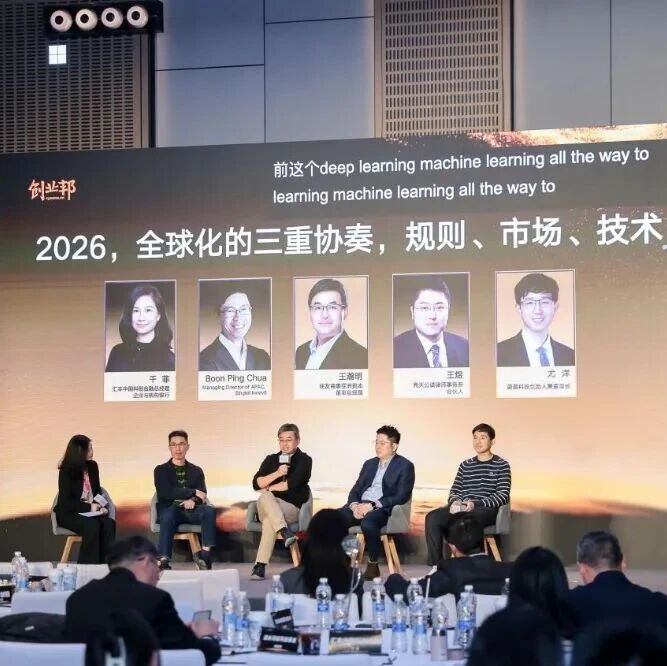
Group 1 - The 2026 Enterprise Innovation and Venture Capital Annual Conference focused on key topics such as AI reshaping industries, hard technology investment cycles, and new global rules, aiming to identify growth logic and collaboration opportunities in an uncertain market environment [2] - Li Chunbo, Chairman of Citic Lyon, shared insights on the resilience of the Hong Kong stock market, indicating that 2025 will be a turning point for asset valuation and perception in China, with a shift towards tech-driven enterprises like chips and AI [2] - The report on CVC development in China for 2025 highlighted a significant drop in new fund registrations, with over one-third of new funds registered in Zhejiang, Guangdong, and Shandong, and Lenovo Capital leading in investment events [4] Group 2 - The first roundtable discussion on "AI Investment New Landscape" emphasized a shift in AI investment logic from chasing star teams to focusing on product-market fit and commercialization capabilities, predicting 2026 as a year of explosive AI application growth [6] - The second roundtable on "How AI Reshapes Automotive Intelligence" discussed the importance of high-quality real-world data and safety validation in overcoming technological gaps, with B-end closed scenarios already demonstrating viable business models [8] - The third roundtable on "How Hard Technology Venture Capital Can Be 'Friends of Time'" stressed the need for capital to provide comprehensive industry empowerment beyond funding, to help navigate the challenges from lab to mass production [10] Group 3 - The fourth roundtable on "2026, the Triple Concerto of Globalization: Rules, Markets, Technology" highlighted the evolution of Chinese enterprises' overseas strategies from product export to ecosystem and supply chain expansion, with Southeast Asia being a primary market due to geographical and cultural advantages [12] - The conference facilitated discussions on breaking industry barriers and achieving consensus on cross-border collaboration and ecosystem building, aiming to inject strong momentum into the technology innovation industry for 2026 [14] - The upgrade of the Corporate Venture Capital Alliance to the Corporate Innovation Venture Capital Alliance in 2024 aims to enhance the synergy between large enterprises' internal investments and innovations, accelerating the application of innovations [15]
今夜!特朗普 震动全球
Zhong Guo Ji Jin Bao· 2026-01-19 16:27
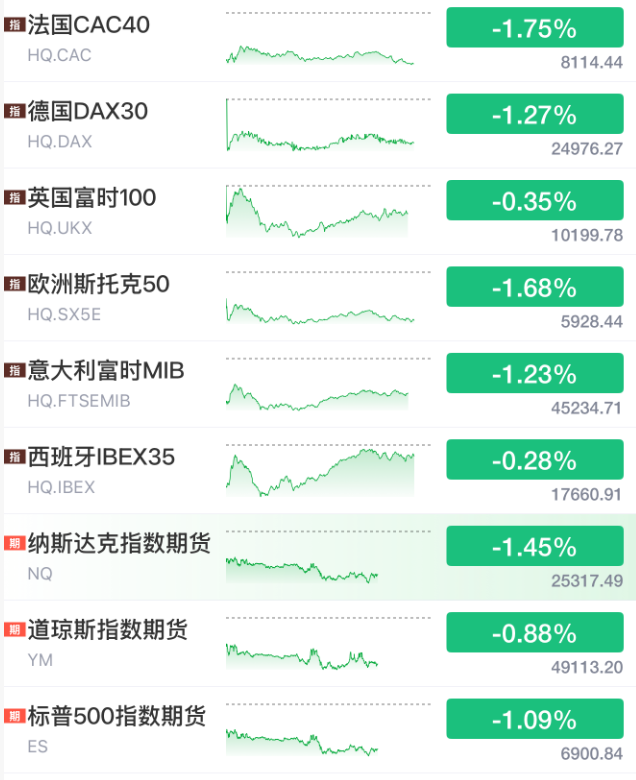
Group 1 - The U.S. stock market and bond market are closed for Martin Luther King Jr. Day, marking the first collective holiday since the New Year [1] - European stock markets experienced a significant decline, with the Stoxx 600 index set to record its worst single-day performance in two months, particularly affected by luxury and automotive stocks [5] - Tensions have escalated due to President Trump's push for control over Greenland, threatening tariffs on countries opposing this claim, which may reignite market volatility reminiscent of his earlier presidency [5] Group 2 - Analysts indicate that the current market environment is underpinned by strong corporate earnings and ongoing AI investments, but the future trajectory will depend on the EU's response to U.S. tariffs [5] - The EU is considering imposing tariffs on €93 billion worth of U.S. goods, with French President Macron advocating for the activation of the EU's "anti-coercion tool" [5] - The potential for European governments to reduce their holdings of U.S. assets could support the euro, as Europe holds approximately $8 trillion in U.S. bonds and stocks, nearly double that of other regions combined [5] Group 3 - Some traders expect the volatility to be short-lived, viewing market pullbacks as buying opportunities, provided that the fundamental bullish logic for risk assets remains intact [7] - Japanese Prime Minister Kishida has set February 8 for early elections, aiming to gain authorization for fiscal discipline while promoting growth through expansionary policies [7] - Japan's 10-year government bond yield has risen to its highest level since 1999, reflecting changing market dynamics [7]
2026年美国经济展望:乐观预期背后的三个风险
Sou Hu Cai Jing· 2026-01-19 05:57
Group 1: Core Viewpoint - The 2026 economic outlook for the U.S. is optimistic, with expectations of growth exceeding 2%, driven by AI investments, tax reforms, and continued interest rate cuts by the Federal Reserve [1][6][7] Group 2: Optimistic Factors - AI investment is expected to continue expanding, contributing to GDP growth, although the growth rate may significantly decline compared to previous years [1][6] - The "Big and Beautiful" tax reform has already been implemented in 2025, with limited incremental policies in 2026, leading to a potential decrease in fiscal stimulus effects [1][6] - The Federal Reserve plans to cut interest rates only twice in 2026, maintaining a neutral policy rate around 3%, which may provide some economic relief but not strong stimulus [1][6] Group 3: Risks - The negative impact of tariffs is expected to persist, with the effective tariff rate reaching its highest since 1943, potentially reducing long-term economic growth by 0.7 percentage points and contributing to inflationary pressures [2][7] - The labor market is projected to remain weak, with high unemployment rates and low job growth, which may constrain consumer spending and income growth [2][7] - Stock market returns may decline due to uncertainties related to AI narratives, monetary policy, and midterm elections, leading to a weakened wealth effect that could suppress consumption and investment [2][8]
万和财富早班车-20260119
Vanho Securities· 2026-01-19 01:43
Core Insights - The report emphasizes the importance of identifying investment opportunities and risks in the current market landscape, particularly focusing on sectors poised for growth such as AI, energy transition, and semiconductor industries [1]. Domestic Financial Market - The Shanghai Composite Index closed at 4101.91, down by 0.26%, while the Shenzhen Component Index closed at 14281.08, down by 0.18%. The ChiNext Index also saw a decline of 0.20%, closing at 3361.02 [2]. Macro News Summary - The State Council is reviewing measures to boost consumer spending and is focusing on new growth points in service consumption [4]. - The China Securities Regulatory Commission has initiated an investigation into Rongbai Technology for misleading statements regarding a major contract [4]. Industry Dynamics - The energy storage industry is entering a new growth phase driven by AI infrastructure, energy transition, and grid congestion, with related stocks such as Kelon Electronics and Jinrong Tianyu highlighted [5]. - Elon Musk has announced plans to produce 10,000 Starship rockets annually, indicating significant long-term growth potential in the commercial space sector, with stocks like Guoji Jinggong and Aerospace Morning Light being relevant [5]. - TSMC's financial report has led to a surge in US semiconductor stocks, suggesting a new growth opportunity for the semiconductor supply chain, with companies like Jingce Electronics and Zhongwei Company being mentioned [5]. Company Focus - Time Space Technology (605178) is strategically enhancing its semiconductor storage capabilities by leveraging the Shenzhen industrial ecosystem [6]. - Yanjing Co., Ltd. (300658) plans to acquire 98.54% of Yongqiang Technology, marking its entry into the integrated circuit interconnect materials sector [6]. - Jing Shan Light Machinery (000821) is addressing historical issues and has initiated a comprehensive internal control system upgrade [6]. - Starry Sky Technology (002439) has signed a framework agreement with Hong Kong Broadband to provide network security products and solutions [6]. Market Review and Outlook - On January 16, the market opened high but closed lower, with a total trading volume of 3.03 trillion, an increase of 120.8 billion from the previous trading day. Over 2900 stocks declined [7]. - The semiconductor supply chain showed strong performance, with stocks like Changdian Technology hitting a five-year high. Storage chip concepts also saw significant gains, with companies like Baiwei Storage reaching historical highs [7]. - The report maintains a positive outlook on AI investments and the recovery of global manufacturing, particularly in industrial commodities such as copper, aluminum, tin, lithium, crude oil, and oil transportation [7].
盘前公告淘金:国联民生预计去年净利润预增406%左右,民爆光电拟收购PCB标的企业
Jin Rong Jie· 2026-01-19 00:59
Important Matters - TCL Zhonghuan plans to invest in a new energy acceleration company to promote its moderate integration strategy [1] - Yanjiang Co. intends to acquire 98.54% equity of Yongqiang Technology, with stock resuming trading [1] - Minexplosion Optoelectronics is planning to acquire 100% of Xiazhi Precision and Jiangxi Maida, focusing on core consumables in PCB manufacturing, leading to stock suspension [1] Investment Operations - Baiwei Storage urges investors to continuously monitor the sustainability of AI investments and the cyclical changes in the storage industry, noting that current storage prices are at historical highs [1] - Trina Solar has made long-term comprehensive layouts in three areas related to space photovoltaic, including crystalline silicon batteries (HJT, etc.), perovskite stacked batteries, and III-V arsenide multi-junction batteries [1] Performance - Guolian Minsheng expects a net profit increase of approximately 406% year-on-year for 2025 [1] - Changxin Bochuang anticipates a net profit increase of 344%-413% year-on-year for 2025, driven by steady growth in data communication-related product revenue [1] - Shenghong Technology projects a net profit increase of 260%-295% year-on-year for 2025 [1] - Northern Rare Earth expects a net profit increase of 117%-135% year-on-year for 2025, with production and sales of rare metals and rare earth permanent magnet motors increasing year-on-year [1] - Cambridge Technology forecasts a net profit increase of 51%-67% year-on-year for 2025, with Q4 performance below expectations [1] - Lanke Technology anticipates a net profit increase of 52%-66% year-on-year for 2025, with a significant increase in the shipment volume of interconnect chips [1] - Ruiming Technology expects a net profit increase of 27.58%-37.92% year-on-year for 2025 [1]
