
AI硬件

Search documents
一条不存在的AI耳机广告,为什么惊动OpenAI总裁?
36氪· 2026-02-10 13:30
Core Viewpoint - OpenAI is preparing to launch its first hardware products, including a unique AI headset and a pen, amidst a recent controversy involving a fake advertisement that generated significant public interest [4][10][41]. Group 1: Fake Advertisement Incident - A Reddit user claiming to be an OpenAI employee leaked a video of a supposed advertisement for OpenAI's hardware, which was later confirmed to be fake by the company [7][10]. - The video featured a sleek device and garnered widespread attention on social media, prompting OpenAI to label it as "fake news" [9][10]. - The incident suggests a coordinated effort to create buzz around OpenAI's secretive hardware project, as the video was of high production quality [15][17]. Group 2: Hardware Development Insights - OpenAI is working on its first hardware product, expected to be revealed later this year, with a team that includes members from Apple's product lines [19][22]. - The company is in talks with manufacturers like Foxconn and Luxshare Precision for assembly, aiming to produce the devices outside of China [21]. - The hardware is anticipated to be simple and innovative, with at least two products in development: a headset and a pen [22][23]. Group 3: Product Specifications and Features - The AI headset, referred to as "DIME," is designed to be a simplified audio device that may allow direct interaction with Siri and ChatGPT [23][28]. - The pen, internally called "Gumdrop," is expected to have sensors for context awareness and the ability to convert handwritten notes into text [29][34]. - Both devices will primarily utilize voice interaction, with OpenAI enhancing its audio AI models to support these products [36][41]. Group 4: Market Position and Future Plans - OpenAI's approach to hardware development appears cautious, focusing on gradual market entry rather than aggressive competition with established players like Apple [39][40]. - The company has plans for additional products beyond the headset and pen, including smart glasses and smart speakers, indicating a broader vision for its hardware ecosystem [36][41].


第一批爆火的AI硬件,正在悄悄退场
创业邦· 2026-02-10 10:32
Core Insights - The article discusses the challenges faced by AI hardware companies, particularly highlighting the case of Rabbit, which was once considered a leading product but ultimately failed due to high return rates and cash flow issues [4][5]. - It emphasizes that many current AI hardware products are transitional and do not meet user expectations, indicating that the market is not yet ready for a breakthrough akin to the iPhone [5][8]. Group 1: Market Challenges - Rabbit's experience illustrates that high sales do not guarantee success; instead, negative user feedback can lead to financial collapse [4]. - Many AI hardware products on the market are perceived as toys and fail to deliver on their promises, lacking real-time interaction capabilities [5][7]. - The current AI hardware landscape is characterized by products that are more about the concept of AI rather than practical applications, leading to user disappointment [8][10]. Group 2: Investment Opportunities - Despite the challenges, there is a significant investment interest in AI hardware, with some companies experiencing dramatic valuation increases, such as an AI glasses company whose valuation rose by 240% in just two hours [14]. - The article notes that the AI hardware investment trend is particularly strong in China, where there is a mature supply chain and a pool of young engineers [13][14]. - Successful AI hardware startups are often led by individuals with strong backgrounds, including those from major tech companies, which attracts substantial investment [15][16]. Group 3: Future Directions - The article suggests that the future of AI hardware is uncertain, with no clear standard for what successful products will look like, as traditional metrics for success may not apply [18][20]. - Companies that can quickly iterate and adapt their products to meet market needs are more likely to succeed, as seen with firms like玄源科技, which maintain control over their development processes [21][22]. - The potential for unique market opportunities remains, as evidenced by successful products like the AI recording pen Plaud, which found a niche in the market despite initial skepticism [20][22].

天孚通信(300394):业绩符合预期,1.6T光引擎和CPO、NPO产品放量可期
Shanxi Securities· 2026-02-10 06:32
Investment Rating - The report maintains a "Buy-A" rating for Tianfu Communication (300394.SZ) [1] Core Views - The company's performance meets expectations, with anticipated growth in the 1.6T optical engine and CPO, NPO products [1] - The company forecasts a significant increase in net profit for 2025, projected between 1.88 billion to 2.15 billion yuan, representing a year-on-year growth of 40.0% to 60.0% [3] - The report highlights the alleviation of material bottlenecks and the expected ramp-up in the 1.6T optical engine production, driven by strong demand for AI hardware [4] - The company is positioned as a key player in the supply chain for NVIDIA's CPO products, leveraging its manufacturing capabilities [5] Financial Performance and Projections - The company expects revenues to grow significantly, with projected revenues of 5.41 billion yuan in 2025, 10.55 billion yuan in 2026, and 16.64 billion yuan in 2027, reflecting year-on-year growth rates of 66.4%, 95.0%, and 57.7% respectively [8] - Net profit projections for 2025, 2026, and 2027 are 2.01 billion yuan, 3.78 billion yuan, and 5.58 billion yuan, with respective growth rates of 49.3%, 88.6%, and 47.4% [8] - The report indicates a diluted EPS of 2.58 yuan for 2025, 4.87 yuan for 2026, and 7.18 yuan for 2027, with corresponding P/E ratios of 115.4, 61.2, and 41.5 [7][8] Market Position and Competitive Landscape - The report notes that the company is likely to benefit from the strong demand for 1.6T optical modules driven by capital expenditures in North America [7] - The company is expected to play a significant role in the CPO/NPO market, particularly in the Scaleup segment, which is anticipated to have a larger growth curve compared to Scaleout [6][7]

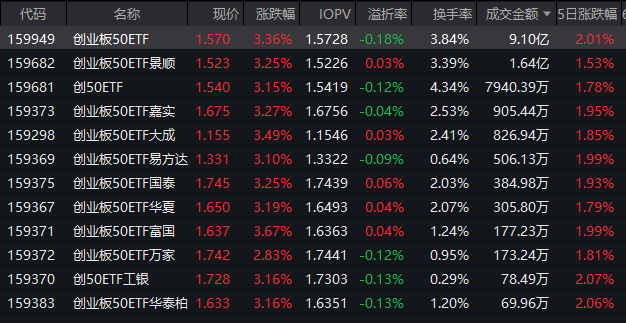
创业板50ETF放量大涨3.36%,半日成交9.1亿元领跑同类,资金悄然回流
Xin Lang Cai Jing· 2026-02-09 04:17
Core Viewpoint - The recent trend of the ChiNext 50 ETF (159949) has shifted from net outflows to net inflows, indicating a potential recovery in investor sentiment and market conditions [1][5]. Fund Flow - As of February 6, 2026, the ChiNext 50 ETF has a circulating scale of 23.148 billion yuan. Over the past 60 trading days, there has been a net outflow of 3.39 billion yuan, while the last 10 days saw a net outflow of 1.04 billion yuan, and the last 5 days experienced a net inflow of 190 million yuan [1][6]. Institutional Perspectives - Industrial insights from Xinyu Securities suggest that the recent global asset adjustment is more about narrative-driven emotional digestion rather than fundamental or policy changes. The market is expected to recover due to increased event catalysts and the "Spring Festival effect" [3][8]. - The report emphasizes a shift from defensive strategies to focusing on the Spring Festival market, particularly in sectors like technology manufacturing and resource-based infrastructure, which are expected to outperform post-holiday [3][8]. - Huaxi Securities notes that despite short-term pressure on the China-US tech sector due to overseas AI expectations, a rebound in US tech stocks on February 6 may lead to a recovery in domestic related sectors [3][8]. ETF Performance - The ChiNext 50 ETF has delivered a return of 36.20% over the past three years, outperforming its benchmark and ranking 435th among 1,634 similar products. It is recommended for investors looking to access China's technology growth sector [4][9]. - Investors can trade the ETF directly through stock accounts or via linked funds, with suggestions to adopt a dollar-cost averaging strategy to mitigate short-term volatility [4][9].

第一批爆火的AI硬件,正在悄悄退场
3 6 Ke· 2026-02-09 03:27
Core Insights - Rabbit, once hailed as a leading AI hardware product, faced a downfall due to high return rates and cash flow issues, highlighting the challenges in meeting user expectations in the AI hardware market [1][2] - The current AI hardware landscape is characterized by transitional products that are not yet ready for mass adoption, indicating a need for further innovation and development [2] Group 1: Market Challenges - Rabbit's initial success was overshadowed by negative user feedback and high return rates, leading to financial difficulties for the small team behind it [1] - Many AI hardware products on the market fail to deliver on their promises, often resembling toys rather than functional devices [1][3] - The high cost of computational power and limitations in edge computing technology hinder the development of effective AI hardware solutions [3][4] Group 2: Investment Opportunities - Despite the challenges, there is a growing interest in AI hardware, with significant investment flowing into the sector, particularly towards established entrepreneurs and innovative startups [6][7] - The Chinese market presents unique opportunities due to its mature supply chain and engineering talent, making it an attractive landscape for AI hardware development [6] - Successful AI hardware products often find niche markets and differentiate themselves through unique functionalities, as seen with products like Plaud and Oura [11][13] Group 3: Future Directions - The AI hardware sector is evolving, with a shift towards products that can effectively integrate AI capabilities into everyday use, indicating a potential for significant market transformation [5][6] - Entrepreneurs are encouraged to focus on solving real user problems rather than merely incorporating AI concepts into their products [4][9] - The lack of a clear standard for successful AI hardware products suggests that companies must remain agile and responsive to market changes to thrive [10][12]
吴晓波×杨龙昇:从跟随到领航,AI眼镜的中国底气|直播预告
吴晓波频道· 2026-02-08 00:29
Core Viewpoint - The future of AI hardware is expected to be dominated by China, particularly in the AI glasses segment, which is emerging as a significant smart hardware market [2]. Group 1: Industry Insights - The AI glasses showcased at various exhibitions, including CES and Alibaba Cloud's smart hardware event, indicate a growing trend and interest from Chinese companies in this sector [2]. - The manufacturing components required for AI glasses, such as cameras, displays, optical modules, chips, batteries, and frames, can largely be sourced domestically, showcasing China's manufacturing capabilities [4]. - The competition in the AI glasses market is anticipated to see two to three leading American brands, while the remaining market share will be captured by Chinese companies [5]. Group 2: Entrepreneurial Perspectives - The upcoming live discussion will feature Yang Longsheng, founder of Yingmu Technology, who will share insights on the challenges and innovations in the AI glasses industry, reflecting the resilience of Chinese hardware entrepreneurs [8][9]. - Yang's entrepreneurial journey, which includes significant risks and investments in core technologies during industry downturns, exemplifies the determination and innovative spirit within China's hard tech sector [8][9]. - The live session will also demonstrate the capabilities of the INMO Go 3, highlighting its features such as real-time transcription and translation in over 260 languages, showcasing the practical applications of AI glasses [11].

20cm速递|科创200ETF国泰(589220)盘中涨超0.5%,制造业与科技产业景气获关注
Mei Ri Jing Ji Xin Wen· 2026-02-06 08:27
Core Viewpoint - The manufacturing and technology sectors are experiencing increased attention due to rising profitability forecasts in AI hardware and price increase chains, with a notable impact on the industry chain [1] Group 1: Industry Insights - The average year-on-year growth rate of net profit forecasts for AI hardware (semiconductors, components, communication network equipment, etc.) and price increase chains (industrial metals, energy metals, agrochemicals, etc.) for Q4 2025 is expected to improve compared to Q3 2025 [1] - Recent price increases have been observed in electronic components and minor metals, indicating a spillover effect from the upstream price hikes [1] - Concerns have emerged regarding potential declines in profit growth for certain midstream manufacturing products in Q4 2025, with expectations of continued challenges into Q1 2026 [1] Group 2: Investment Opportunities - The current market environment suggests that investors may consider sectors with good growth logic that have not yet fully realized their potential gains during the recent spring market rally, such as electronics (components/semiconductors) and communications [1] - The Guotai Science and Technology 200 ETF (589220) tracks the Science and Technology 200 Index (000699), which includes 200 stocks selected from the Sci-Tech Innovation Board, reflecting the overall performance of the market [1] - The index samples cover multiple high-tech and strategic emerging industries, including information technology, biomedicine, and new energy, showcasing strong innovation and growth characteristics [1]
多重利好突袭,A股“V”型大反转!
天天基金网· 2026-02-06 05:25
Market Overview - A-shares experienced a "V" shaped reversal with the Shanghai Composite Index rising by 0.11%, Shenzhen Component Index by 0.65%, and ChiNext Index by 0.65% as over 3,800 stocks increased [2] Sector Performance - The pharmaceutical, chemical, electric infrastructure, lithium battery supply chain, and AI hardware sectors saw gains, while the consumer sector experienced a pullback [4] - In the AI hardware sector, fiber optics, PCB, and liquid cooling servers showed significant increases, with the leading fiber optics stock, Yangtze Optical Fibre, hitting a historical high with a market cap of 147.32 billion [4] Pharmaceutical Sector - The pharmaceutical sector was active, with traditional Chinese medicine leading the gains, alongside pharmaceutical e-commerce, innovative drugs, and chemical pharmaceuticals [6] - A recent policy from eight departments, including the Ministry of Industry and Information Technology, aims to enhance the quality and development of the traditional Chinese medicine industry by 2030, focusing on clinical value and innovation [8][9] Lithium Battery Supply Chain - The lithium battery supply chain saw an uptick, with solid-state batteries and lithium extraction from salt lakes performing well, highlighted by a 2.52% increase in Ningde Times stock [11] - Recent advancements in solid-state battery technology are expected to catalyze industry growth, with 2026 identified as a key year for commercialization [13]

各产业场景稀土刚性需求凸显,稀土ETF嘉实(516150)一键布局稀土产业链机遇
Xin Lang Cai Jing· 2026-02-06 03:06
Group 1 - The core viewpoint of the news highlights the strong performance of the rare earth permanent magnet sector, with the China Rare Earth Industry Index rising by 1.39% as of February 6, 2026, driven by significant gains in stocks such as Shengxin Lithium Energy and Zhongzi Technology [1] - Huatai Securities notes that while wind and solar companies are facing profitability pressures due to low-priced domestic projects and rising costs from increased silver prices, the overall trend for profitability recovery in the wind and solar sector is reaffirmed for 2026 [1] - Jianghai Securities emphasizes the strategic value of tungsten as a key material in photovoltaic cutting and electric motors for new energy vehicles, highlighting the increasing demand for ultra-fine tungsten wire and its implications for upstream rare metals [1] Group 2 - As of January 30, 2026, the top ten weighted stocks in the China Rare Earth Industry Index account for 61.43% of the index, with notable companies including Northern Rare Earth and Jin Feng Technology [2] - The rare earth ETF by Jiashi (516150) closely tracks the China Rare Earth Industry Index, providing a convenient tool for investors to access the domestic rare earth industry chain [2] - The formation of a MACD golden cross signal indicates a positive trend for these stocks, suggesting potential investment opportunities [2]
基础材料动态点评:电子布再提价,开启新一轮上行周期
HTSC· 2026-02-06 02:25
Investment Rating - The industry investment rating is "Overweight (Maintain)" [6] Core Views - The report indicates that the electronic fabric industry is entering a new price increase cycle due to supply constraints and recovering demand, particularly for ordinary electronic fabrics, which are expected to see significant price increases starting in 2026 [1][2] - The report highlights that the recent price increase for ordinary electronic yarns has been the largest since early 2025, with prices exceeding 10,000 yuan per ton, reflecting a tight supply-demand situation [2] - The supply of ordinary electronic yarn is expected to have limited net growth in 2026, with new production lines contributing less than 10% to current capacity, while high demand for specialty electronic fabrics continues to drive prices upward [3] - Major companies in the industry, such as China Jushi and International Composites, are expected to benefit significantly from the price increases, with estimated net profit increments of 4.4 million yuan for China Jushi, 1.1 million yuan for International Composites, and 1.1 million yuan for Honghe Technology [4] Summary by Sections Price Increases - As of February 4, 2025, the price of G75 ordinary electronic yarn has increased to 10,300-10,700 yuan per ton, marking a more than 10% increase, while the price of E225 electronic yarn is 25,000 yuan per ton and D450 is 51,000 yuan per ton [2] - The main market price for 7628 electronic fabric is currently 5.1-5.5 yuan per meter, reflecting a 10-13% increase [2] Supply Constraints - The report notes that there are no new production lines for ordinary electronic yarn expected to come online until 2026, with only limited capacity increases from existing producers [3] - The rising prices of upstream metals and precious alloys are expected to further suppress supply, as they significantly impact investment and operational costs [3] Demand Recovery - Demand for ordinary electronic fabrics is anticipated to grow due to policies promoting upgrades in home appliances and new energy vehicles, alongside a surge in AI hardware demand [4] - The inventory levels of major companies are at manageable levels, with China Jushi, International Composites, and Honghe Technology holding 37.2 billion, 19.2 billion, and 1.7 billion yuan in inventory, respectively [4]