国产替代

Search documents
电连技术(300679.SZ):用于AI及存储服务器的高速线缆连接组件产品目前营收占比较小,处于市场拓展与业务培育阶段
Ge Long Hui· 2026-02-03 06:51
Core Viewpoint - The company is in the market expansion and business cultivation stage for its high-speed cable connection components used in AI and storage servers, with current revenue contribution being relatively small [1] Industry Summary - The market demand for high-speed cable connection components is growing rapidly, with the competitive landscape dominated by foreign connector manufacturers holding the majority of market share [1] - The company is increasing its investment in technology research and development as well as capacity layout to leverage advantages in localized service, cost-effectiveness, and quick response to customer needs [1] - The company aims to seize market development opportunities brought by domestic substitution and is working to enhance its market share for related products [1]

AI驱动存储涨价效应扩散,全球半导体设备龙头业绩高增,半导体设备ETF(561980)午后上涨1.25%!
Sou Hu Cai Jing· 2026-02-03 06:32
Core Viewpoint - The semiconductor equipment sector is experiencing a strong resurgence, driven by significant growth in earnings from both domestic and international companies, particularly in the context of AI and storage expansion [1][2][24]. Group 1: Market Performance - The semiconductor equipment ETF (561980) saw a 1.25% increase in the afternoon session, with a peak rise of 1.8%, and a trading volume of 223 million yuan [1]. - Over the past 10 trading days, the ETF has received a net inflow of approximately 483 million yuan [1]. - The index has shown a maximum increase of over 690% during the last semiconductor upcycle and over 283% since 2020, outperforming comparable indices [3][20]. Group 2: Company Earnings - Major semiconductor equipment manufacturers, including ASML and KLA, reported earnings that exceeded expectations, indicating a robust market environment [1][24]. - Domestic companies like Zhongwei Company and Changchuan Technology have also reported significant revenue and net profit growth, with some achieving profitability for the first time [1][8]. - The anticipated net profit for a leading domestic chip design company is projected to be between 1.85 billion to 2.15 billion yuan, marking a substantial year-on-year increase of 410% to 496% [8]. Group 3: Industry Trends - The global semiconductor industry is witnessing a major expansion in storage capacity, with key players like Samsung and SK Hynix planning to increase their NAND flash production [2]. - The semiconductor equipment sales are expected to reach a historical high in 2025, with a projected year-on-year growth of 13.7% [11]. - The demand for high-performance storage products, driven by AI applications, is leading to price increases across various segments, including DRAM and NAND flash [7][26]. Group 4: Investment Opportunities - The semiconductor equipment ETF is heavily weighted towards leading companies in the sector, with the top ten holdings accounting for approximately 75% of the index [2][16]. - The index's focus on upstream and midstream sectors of the semiconductor industry positions it well for future growth, particularly in the context of domestic substitution and policy support [16].







国产设备全球排名跃升至TOP5!国产替代从追赶实现领跑,半导体设备ETF(561980)午后上攻涨超1%
Sou Hu Cai Jing· 2026-02-03 06:04
Group 1 - The semiconductor equipment sector is experiencing a strong performance, with the semiconductor equipment ETF (561980) rising by 1.25% and achieving a net inflow of approximately 483 million yuan over the last 10 trading days [1] - Major semiconductor companies, including domestic firms like Zhongwei Company and Changchuan Technology, have reported significant revenue and profit growth, with some companies like Cambrian and ZKFL achieving profitability for the first time [1][2] - International leaders in semiconductor equipment, such as ASML and KLA, have also reported earnings that exceeded expectations, indicating a robust market environment [1][2] Group 2 - The global semiconductor industry is entering a major expansion phase, with companies like Samsung and SK Hynix planning to increase their NAND flash production capacity significantly, and TSMC projecting over 100% capacity expansion in the next decade [2] - The semiconductor equipment ETF (561980) tracks the CSI Semiconductor Index, which has a high concentration of leading companies, with the top ten stocks accounting for approximately 75% of the index [2][3] - The index has shown strong performance, with a maximum increase of over 690% during the last semiconductor upcycle and a 283% increase since 2020, outperforming other comparable indices [3][20] Group 3 - The semiconductor equipment sector is expected to see a record high in sales, with a projected 13.7% year-on-year growth in 2025, driven by strong demand from AI and storage expansion [13][24] - The demand for high-performance storage products is surging due to AI applications, leading to significant price increases in DRAM and NAND flash memory [7][25] - Domestic chip design leaders are projected to achieve their first annual profits in 2025, with expected revenues of 6 to 7 billion yuan, reflecting a substantial year-on-year growth of 410% to 496% [8]


三星半导体玻璃基板目标2027年实现量产,科创半导体ETF(588170)近4天合计“吸金”6.16亿元,半导体设备ETF华夏(562590)近10天合计“吸金”2.08亿元
Mei Ri Jing Ji Xin Wen· 2026-02-03 05:45
Group 1 - The core index for semiconductor materials and equipment on the STAR Market has seen a strong increase of 2.03%, with notable gains in constituent stocks such as Oulain New Materials up by 10.49% and Huafeng Measurement Control up by 6.04% [1] - The semiconductor equipment ETF, Huaxia, has also shown a robust performance, rising by 2.23% with a latest price of 1.88 yuan, while the STAR semiconductor ETF increased by 2.05% to 1.74 yuan [1] - In terms of liquidity, the STAR semiconductor ETF recorded a turnover of 8.15% with a transaction volume of 669 million yuan, while the Huaxia semiconductor equipment ETF had a turnover of 5.21% and a transaction volume of 147 million yuan [1] Group 2 - The STAR semiconductor ETF has experienced continuous net inflows over the past four days, totaling 616 million yuan, with a peak single-day inflow of 343 million yuan [2] - In contrast, the Huaxia semiconductor equipment ETF has seen a net outflow of 54.19 million yuan, although it has had net inflows on 8 out of the last 10 trading days, accumulating 208.1 million yuan [2] - Samsung Electro-Mechanics is advancing its semiconductor glass substrate commercialization project, indicating preparations for mass production expected after 2027 [2] Group 3 - The transition to glass substrates in semiconductor packaging is driven by the limitations of traditional organic substrates, with glass offering lower signal loss, higher dimensional stability, and better thermal resistance [3] - Glass substrates are becoming the preferred choice for advanced packaging technologies like CoWoS and HBM, as they meet the demands for high connection density and electrical performance [3] - The semiconductor equipment and materials industry is crucial for domestic substitution, benefiting from low domestic replacement rates and high ceilings for domestic alternatives, particularly in the context of the AI revolution [3] Group 4 - The Huaxia semiconductor equipment ETF focuses on the upstream semiconductor sector, with 63% of its index comprising semiconductor equipment and 24% comprising semiconductor materials [4]
利好扎堆!化学化工行业持续走强,金晶科技涨停领衔,多标的联动走高,行业复苏信号拉满!
Jin Rong Jie· 2026-02-03 05:36
3. 江天化学产品涨价+国产替代突破:据韭研公社1月22日资讯,江天化学核心产品多聚甲醛涨价,电 子级超高纯化学品通过中芯国际认证,国产替代红利释放,支撑其大幅上涨。 受积极影响的行业梳理 1. 光伏(核心股)化工(核心股)行业:核心受益于光伏行业复苏及金晶科技利好带动。据中国好青年 1月27日分析,光伏玻璃需求随新能源产业增长,金晶科技作为光伏玻璃核心企业,充分享受行业红 利,带动相关配套化工领域同步受益。 2. 精细化工(核心股)行业:受益于产品涨价与国产替代,江天化学作为细分龙头,核心产品提价且实 现技术突破,切入头部企业供应链。据韭研公社1月22日研报,精细化工国产替代空间广阔,华融化 学、江天化学等标的直接受益。 今日A股化学化工(核心股)板块持续拉升,午后加速走高,赚钱效应凸显。龙头股金晶科技午后强势 封死涨停,成为板块核心引擎;江天化学涨幅超10%,表现亮眼;华融化学、中毅达、博源化工等标的 同步跟涨,形成"龙头引领、梯队跟涨"格局。受行业利好催化,场内资金关注度提升,领涨标的交投活 跃,光伏(核心股)化工、精细化工等细分领域同步发力,彰显板块复苏态势。 化学化工(核心股)行业最新准确的利好消息 ...

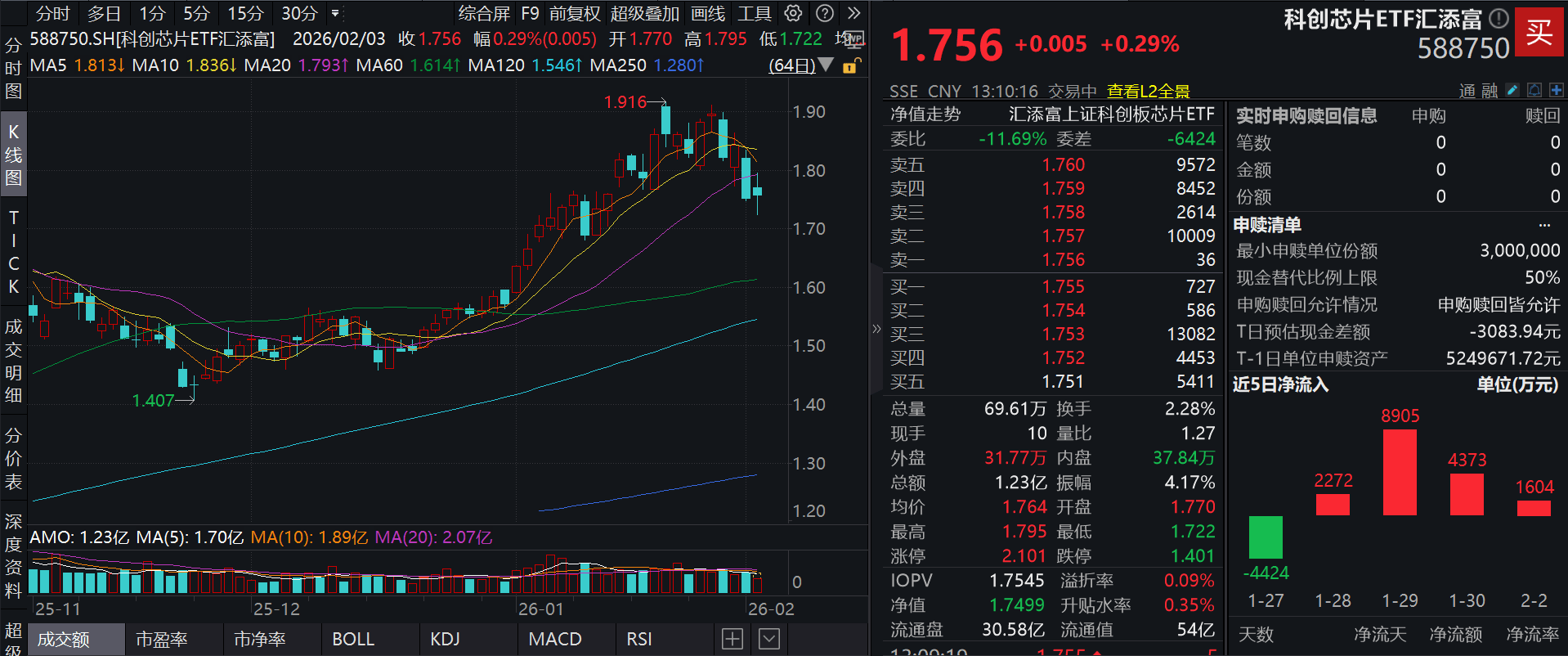
寒武纪一度跌近14%,官方发声!科创芯片ETF汇添富(588750)深V翻红,连续4日“吸金”超1.7亿元!涨价潮提振,存储龙头业绩大面积预喜
Sou Hu Cai Jing· 2026-02-03 05:36
Core Viewpoint - The semiconductor sector, particularly the Sci-Tech Innovation Board chip index, is experiencing significant growth, driven by strong demand in AI and data centers, leading to price increases in memory chips and a favorable investment environment for related ETFs [1][4][8]. Group 1: Market Performance - As of February 3, 2026, the Sci-Tech Innovation Board chip index (000685) rose by 0.21%, with notable increases in constituent stocks such as Huafeng Measurement Control (up 6.95%) and Chip Origin Technology (up 6.75%) [1]. - The Sci-Tech chip ETF, Huatai-PineBridge (588750), has seen a 1-month cumulative increase of 11.46% as of February 2, 2026, with a latest price of 1.75 yuan [1]. - The trading volume for the Sci-Tech chip ETF was 1.23 billion yuan, with a turnover rate of 2.28% [1]. Group 2: Fund Flows and Performance - The latest scale of the Sci-Tech chip ETF reached 5.352 billion yuan, ranking second among comparable funds [3]. - Over the past six months, the ETF's shares increased by 1.437 billion, indicating significant growth [3]. - The ETF has experienced continuous net inflows over the last four days, totaling 172 million yuan, with a maximum single-day inflow of 89.048 million yuan [3]. Group 3: Industry Trends - TrendForce reported that prices for DRAM and NAND flash memory chips have increased by over 300%, with NAND Flash contract prices expected to rise by 33-60% in the first quarter of 2026 due to heightened demand from AI and data centers [4]. - Many storage chip companies have reported positive earnings forecasts, attributing their performance to the AI-driven growth cycle [4]. - The semiconductor industry is expected to continue its upward trend, with AI and storage as core growth drivers, as indicated by Guoyuan Securities [4]. Group 4: ETF Characteristics - The Sci-Tech chip ETF focuses on the "high-tech" upstream and midstream segments of the chip industry, with a core segment representation of 96%, which is higher than other indices [6][7]. - The ETF's index is adjusted quarterly, allowing it to respond more swiftly to trends in the chip industry [6]. - The index has shown a net profit growth rate of 94% for the first three quarters of 2025, significantly outperforming peers [8].
套现超7亿元,盛美上海控股股东“高位”兑现浮盈
Huan Qiu Lao Hu Cai Jing· 2026-02-03 05:14
Group 1 - The core point of the news is that ACMR, the controlling shareholder of Shengmei Shanghai, is transferring approximately 4.8016 million shares at a price of 160 RMB per share, raising about 768 million RMB, while still retaining its controlling stake after the transfer [1] - ACMR's shareholding before the transfer was approximately 358 million shares, representing 74.49% of Shengmei Shanghai's total shares [1] - This marks the second reduction in shareholding by Hui Wang, the actual controller of Shengmei Shanghai, within six months, with previous reductions occurring at high stock price levels [1] Group 2 - Shengmei Shanghai is a leading domestic semiconductor cleaning equipment manufacturer, with a global market share of 8%, ranking fourth worldwide according to Gartner [2] - The company has a strong order reserve, with total orders amounting to 9.072 billion RMB as of September 2025, reflecting a year-on-year increase of 34.10% [2] - For the first three quarters of 2025, Shengmei Shanghai reported a revenue of 5.146 billion RMB, a year-on-year growth of 29.42%, and a net profit of 1.266 billion RMB, up 66.99% [2]

由盈转亏!万东医疗发布2025年业绩预告
思宇MedTech· 2026-02-03 04:18
Core Viewpoint - WanDong Medical is expected to report a significant net loss for 2025, transitioning from a profitable state to a phase of pressure on earnings [1][3]. Performance Overview - The company forecasts a net profit attributable to shareholders of between -199 million to -257 million yuan for 2025. - The net profit after deducting non-recurring items is expected to be between -213 million to -271 million yuan. - In contrast, the company achieved a net profit of 157 million yuan in 2024, with a net profit of 142 million yuan after deducting non-recurring items, indicating a clear reversal in performance for 2025 [3]. Reasons for Performance Pressure - The decline in performance for 2025 is attributed to three main factors: 1. The impact of centralized procurement and price adjustments on gross profit margins. The company is participating in centralized procurement for medical equipment, adopting more competitive pricing strategies to increase bid success rates, which compresses product gross margins and affects current profits [4]. 2. Increased R&D investment leading to short-term cost pressures. The company is intensifying R&D in high-end medical imaging equipment, focusing on CT, MR, and DSA products, which results in a temporary drag on profits due to increased R&D expenditures [5]. 3. Rising costs associated with expanding into overseas and high-tier hospital markets. The company is advancing its overseas market layout and enhancing its marketing and organizational investments in domestic high-tier hospitals, leading to increased costs [6]. Industry Perspective - The expected loss for WanDong Medical in 2025 is seen as a typical case of "transitional pressure" in the imaging equipment industry amid centralized procurement and structural upgrades. - High-end imaging equipment is gradually being included in more price-constrained procurement systems, making it difficult for domestic manufacturers to avoid temporary declines in gross margins, even with increased bid volumes. - The shift towards high-end, systematic, and overseas operations inherently requires longer cycles, higher R&D intensity, and heavier organizational investments. - The company has not retreated from its strategic goals but has chosen a path of "exchanging scale for time and investment for technological reserves" in the centralized procurement environment. This strategy may be unfavorable for profits in the short term but is worth observing from a medium to long-term perspective, especially in core areas like CT, MR, and DSA where domestic replacement is deepening [7]. Key Variables for the Future - The future performance will depend on the commercialization pace of high-end imaging products, the efficiency of overseas market order conversions, and the ability to rebalance product structure and gross margins post-centralized procurement [8].


东北证券:半导体需求有望加速扩张 国产替代或重塑电子气体供给格局
智通财经网· 2026-02-03 04:11
Core Viewpoint - The electronic gas sector is expected to experience long-term value due to supply-demand resonance, with the market poised for nonlinear expansion, driven by changes in the external environment that compel downstream manufacturers to accelerate supply chain restructuring [1] Demand Side - The global wafer expansion is anticipated due to the increasing demand for AI chips in data centers and edge devices, with significant support from China's "14th Five-Year Plan" and the National Fund Phase II, leading to substantial procurement needs for domestic equipment and materials [2] - The transition from mature nodes to advanced processes in wafer manufacturing is expected to significantly increase the consumption of electronic gases per wafer, resulting in a projected market size of 42 billion yuan for electronic specialty gases and 28.8 billion yuan for electronic bulk gases by 2030 [2] Supply Side - The global electronic gas market is characterized by an oligopolistic structure dominated by companies from Europe, the United States, and Japan, with domestic firms currently covering only 20%-30% of the required varieties for integrated circuit manufacturing [3] - The domestic electronic specialty gas industry is in the early stages of achieving self-sufficiency, with a projected localization rate of only 25% by 2025, influenced by recent trade policies and potential supply chain risks from overseas suppliers [3]

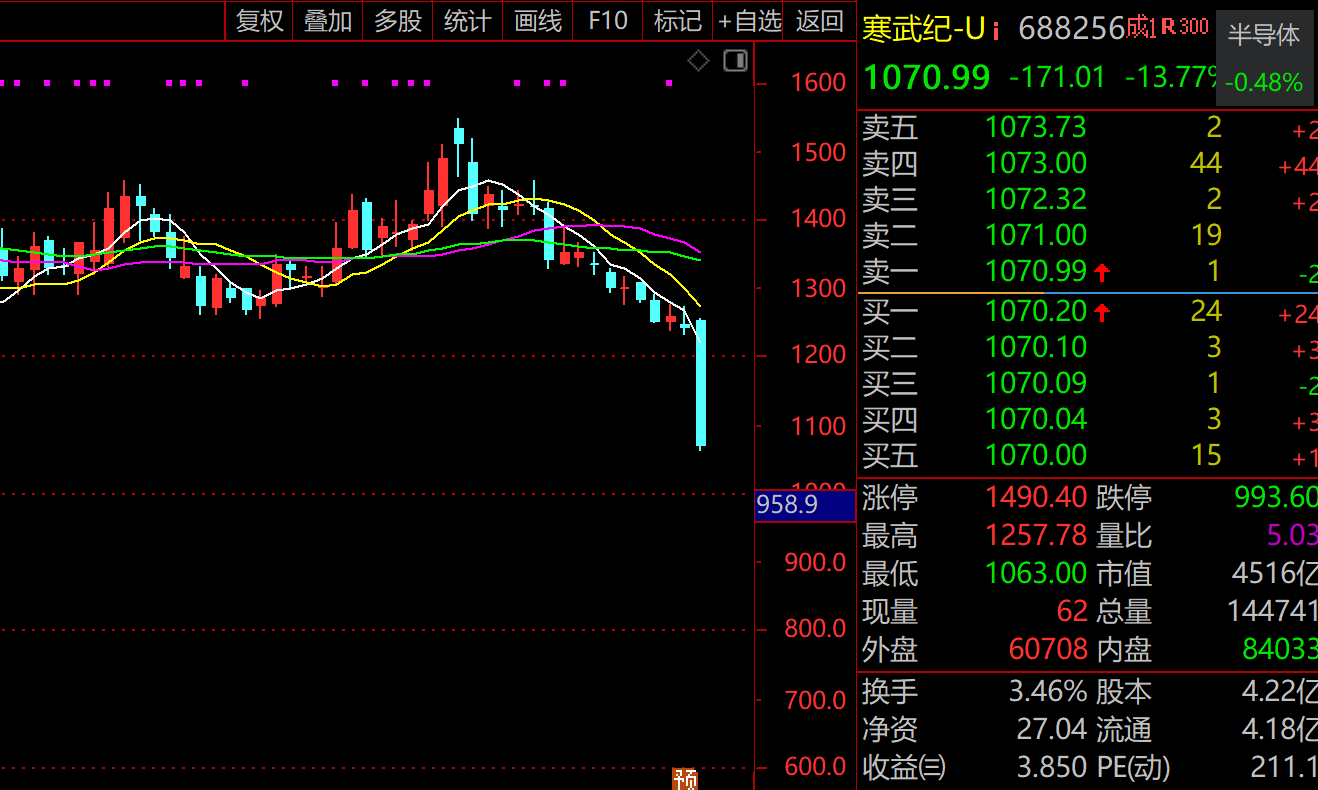
“中国英伟达”突发跳水!寒武纪大跌14%市值跌破5000亿,业绩指引“小作文”流传,公司称很多传闻都是假的
Jin Rong Jie· 2026-02-03 03:42
Core Viewpoint - Cambricon, a leading player in the A-share technology sector, has experienced significant stock price fluctuations, with a peak market value exceeding 670 billion yuan and a subsequent decline of nearly 30% since January 12, bringing its market value to approximately 450 billion yuan [1][2]. Group 1: Company Performance - Cambricon's core business logic revolves around three main aspects: accelerated domestic substitution, explosive demand for large model inference, and its industry-leading position as a "Chinese NVIDIA" [2]. - The company anticipates a substantial increase in revenue, projecting 6 billion to 7 billion yuan for the full year of 2025, representing a year-on-year growth of 410.87% to 496.02% [2]. - Expected net profit, excluding non-recurring gains and losses, is forecasted to be between 1.6 billion to 1.9 billion yuan, with net profit attributable to shareholders estimated at 1.85 billion to 2.15 billion yuan [2]. Group 2: Market Dynamics - The demand for AI chips is rapidly increasing due to geopolitical factors, with domestic cloud service providers and internet giants seeking self-controlled AI chips, benefiting Cambricon directly [2]. - The rapid development of local large models, exemplified by DeepSeek, has led to a strong demand for high-performance AI inference chips [2]. - Cambricon's technological accumulation in AI chip architecture design and hardware-software collaboration is beginning to show its value in the market [2]. Group 3: Recent Developments - Cambricon's fundraising application for 3.985 billion yuan has been approved by the Shanghai Stock Exchange, with the funds intended for the development of large model chips and software platforms [2]. - The company has responded to recent stock price fluctuations, stating that it is unclear about the specific reasons behind the market rumors and encourages rational engagement from investors [2].