
关税

Search documents
原油日报:高关税将冲击印度经济与石油需求-20250822
Hua Tai Qi Huo· 2025-08-22 05:26
Report Industry Investment Rating - The short - term oil price is expected to fluctuate within a range, and a medium - term short - position allocation is recommended [3] Core View - If the Russia - Ukraine situation doesn't change and they fail to reach a peace agreement on August 27th, India will face an additional 25% tariff, which will impact India's economy and oil demand and lead to a downward revision of India's oil demand [2] Summary by Relevant Catalogs Market News and Important Data - The price of light crude oil futures for October delivery on the New York Mercantile Exchange rose 81 cents to $63.52 per barrel, a 1.29% increase; the price of Brent crude oil futures for October delivery in London rose 83 cents to $67.67 per barrel, a 1.24% increase. The SC crude oil main contract closed up 1.27% at 493 yuan per barrel [1] - Canadian Prime Minister Carney had a phone call with US President Trump on Thursday to discuss trade challenges and opportunities [2] - Israeli Prime Minister Netanyahu instructed to immediately start negotiations to release all hostages in Gaza and end the war there under acceptable conditions [2] - The US imposed sanctions on vessels and entities related to Iran [2] - Indian Ambassador to Russia Vinay Kumar said that despite US pressure, New Delhi will continue to buy Russian oil. On August 21st, the foreign ministers of Russia and India will discuss strengthening strategic partnership in Moscow. Kumar emphasized that India won't consider an embargo on Russian oil for reasons of national security, economy, energy interests, and the energy needs of its 1.4 billion people [2] Investment Logic - The hope of a Russia - Ukraine peace agreement on August 27th is slim. If the situation remains unchanged, India will face an additional 25% tariff, which will impact its economy and oil demand and cause a downward revision of its oil demand [2] Strategy - The short - term oil price is expected to fluctuate within a range, and a medium - term short - position allocation is recommended [3] Risk - Downside risks include the US relaxing sanctions on Russian oil and macro black - swan events [3] - Upside risks include the US tightening sanctions on Russian oil and large - scale supply disruptions due to Middle East conflicts [3]
成本“每周都在增加”!沃尔玛警告关税影响将“持续到第三、第四季度”
美股IPO· 2025-08-22 03:46
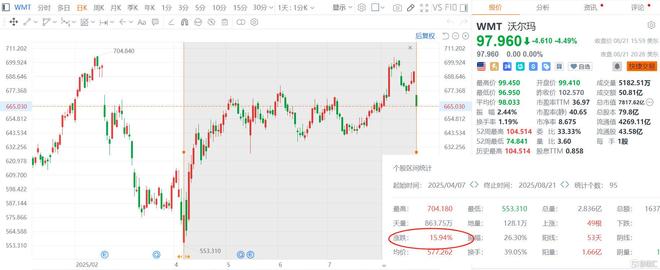
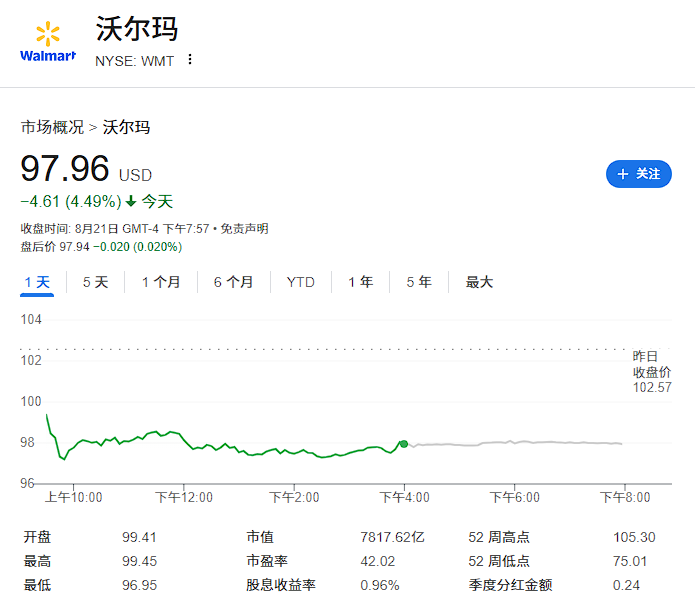
Core Viewpoint - Walmart's CEO Doug McMillon warns that rising tariffs are increasing operational costs, which are expected to persist into the third and fourth quarters, despite efforts to lower product prices [1][3][6] Group 1: Financial Performance - Walmart's Q2 revenue grew by 4.8% to $177.4 billion, exceeding expectations, and the company raised its full-year sales guidance [3] - However, operating profit declined by 8.2% to $7.3 billion, falling short of expectations, leading to a 4.5% drop in stock price, marking the largest single-day decline in over four months [3][6] Group 2: Impact of Tariffs - The company indicates that the cost of goods is rising weekly due to tariffs, with about one-third of its U.S. products imported from countries like China, Mexico, Vietnam, and India [6] - The same-store inflation rate increased by 1.1% year-over-year, doubling from the previous quarter, although it remains below the overall U.S. inflation rate [6] - Despite some price reductions in food items, the overall grocery inflation rate in the U.S. rose by approximately 1.5%, while prices for clothing and electronics have decreased [6] Group 3: Consumer Behavior - McMillon noted that while there hasn't been a drastic change in consumer spending behavior due to tariffs, adjustments are more pronounced among middle- and low-income households compared to high-income households [6]



关税压顶、利润逊预期,全球零售巨头绩后暴跌!
Ge Long Hui· 2025-08-22 02:10
Core Viewpoint - The latest financial reports from global retail giants, particularly Walmart, show mixed results amid the impact of tariffs, with challenges in profit expectations despite revenue growth [1]. Group 1: Financial Performance - Walmart's Q2 revenue reached $177.4 billion, a year-on-year increase of 4.8%, surpassing market expectations of $176.16 billion [3]. - The GAAP earnings per share for Q2 were $0.88, while adjusted earnings per share were $0.68, falling short of the market estimate of $0.74, marking the first miss since May 2022 [3]. - Operating profit declined by 8.2% to $7.3 billion, while net income rose by 51.8% to $7.151 billion [3]. Group 2: Growth Drivers - The growth in performance was primarily driven by Sam's Club and e-commerce, with global e-commerce sales increasing by 25% and global advertising revenue rising by 46% [5]. - Same-store sales in the U.S. grew by 4.6%, exceeding analyst expectations of 4%, and e-commerce sales in the U.S. increased by 26% [5]. - In China, net sales reached $5.8 billion, a 30.1% year-on-year increase, with e-commerce net sales growing by 40% [5]. Group 3: Strategic Initiatives - Walmart's CEO Kathryn McLay highlighted the growth of e-commerce in China, noting the opening of 33 new front warehouses and cloud warehouses, totaling 455, enabling rapid delivery to customers [7]. - The company plans to increase prices on certain imported goods to offset tariff costs, which has drawn criticism from former President Trump [8][9]. - Walmart's CFO John David Rainey indicated that the cost impact from tariffs is continuously rising, but the company is working to maintain low prices through accelerated imports and limited-time discounts [9]. Group 4: Future Outlook - Walmart has raised its full-year net sales growth forecast for fiscal 2026 to between 3.75% and 4.75%, and adjusted earnings per share expectations to between $2.52 and $2.62 [9]. - The company is assessing various scenario models due to trade policy negotiations, demand fluctuations, and future expansion flexibility [9].
金荣中国:美经济数据高于市场预期,金价触底反弹维持偏多震荡
Sou Hu Cai Jing· 2025-08-22 01:54
美国8月标普全球制造业PMI初值录得53.3,高于市场预期49.5,前值位49.8;美国8月标普全球服务业PMI初值录得55.4,高于市场预期54.2,前值位55.7. 行情回顾: 国际黄金周四(8月21日)维持震荡走势,开盘价3340.68美元/盎司,最高价3352.09美元/盎司,最低价3325.13美元/盎司,收盘价3343.60美元/盎司。 消息面: 周四公布的美国7月咨商会领先指标月率录得-0.1%,符合市场预期,前值位-0.3%;美国7月成屋销售总数年化录得401万户,高于市场预期392万户,前值位 393万户。 谘商会高级经理Justyna Zabinska-La Monica表示:"美国7月领先经济指标仅小幅下降。消费者对商业环境的悲观预期以及新订单疲弱继续拖累该指数。同 时,股价仍然是领先经济指标的重要正面支撑。7月初请失业金人数较6月大幅下降,是LEI的第二大积极因素,此前三个月这一指标对指数产生了负面影 响。"她补充道:"虽然LEI的六个月增速仍为负值,但7月略有改善,不过不足以避免再次触发衰退信号。尽管如此,谘商会目前并未预测会出现衰退,但我 们预计2025年下半年经济将走弱,因为关税 ...

国泰君安期货商品研究晨报:黑色系列-20250822
Guo Tai Jun An Qi Huo· 2025-08-22 01:29
Report Summary 1. Report Industry Investment Rating - No specific industry investment ratings are provided in the report. 2. Core Views - The report provides daily research on the black series futures, including iron ore, rebar, hot - rolled coil, ferrosilicon, silicomanganese, coke, coking coal, and logs. The views on these commodities are as follows: - Iron ore: Macro - risk appetite has not significantly declined, and there is still support [2][5]. - Rebar, hot - rolled coil, ferrosilicon, silicomanganese, coke, and coking coal: All are expected to have wide - range fluctuations [2][8][9][13][16]. - Logs: Expected to fluctuate repeatedly [2][19]. 3. Summary by Commodity Iron Ore - **Fundamental Data**: The closing price of futures contract I2601 was 772.5 yuan/ton, up 3.5 yuan or 0.46%. The import and domestic spot prices mostly increased. The basis and spreads also showed certain changes [6]. - **News**: On August 15, 2025 (local time), the Trump administration in the US announced an expansion of the scope of a 50% tariff on steel and aluminum imports, including hundreds of derivative products [6]. - **Trend Intensity**: 0, indicating a neutral trend [6]. Rebar and Hot - Rolled Coil - **Fundamental Data**: For rebar contract RB2510, the closing price was 3,121 yuan/ton, down 1 yuan or 0.03%. For hot - rolled coil contract HC2510, the closing price was 3,375 yuan/ton, down 15 yuan or 0.44%. Spot prices in different regions had minor changes, and the basis and spreads also varied [9]. - **News**: On August 21, steel production, inventory, and apparent demand data showed that the production of rebar decreased by 5.8 tons, while that of hot - rolled coil increased by 9.65 tons. In July 2025, national steel production data showed a decline in crude steel and pig iron production year - on - year, and an increase in steel production year - on - year [10][11]. - **Trend Intensity**: 0 for both rebar and hot - rolled coil, indicating a neutral trend [11]. Ferrosilicon and Silicomanganese - **Fundamental Data**: The futures prices of ferrosilicon and silicomanganese showed small changes. The spot prices of ferrosilicon and silicomanganese decreased, and the manganese ore price also decreased slightly. The price spreads had different changes [13]. - **News**: On August 21, the prices of different grades of ferrosilicon in various regions decreased, and the prices of silicomanganese also decreased. The export and import data of silicomanganese in July 2025 were also provided [14]. - **Trend Intensity**: 0 for both ferrosilicon and silicomanganese, indicating a neutral trend [15]. Coke and Coking Coal - **Fundamental Data**: The closing price of coking coal contract JM2601 was 1147 yuan/ton, down 15.5 yuan or 1.3%. The closing price of coke contract J2601 was 1664 yuan/ton, down 14 yuan or 0.8%. The spot prices of coking coal and coke were mostly stable, and the basis and spreads changed [16]. - **News**: On August 15, 2025 (local time), the Trump administration in the US announced an expansion of the scope of a 50% tariff on steel and aluminum imports, including hundreds of derivative products [17]. - **Trend Intensity**: 0 for both coke and coking coal, indicating a neutral trend [18]. Logs - **Fundamental Data**: The prices of different log contracts showed small fluctuations. The spot prices of most log varieties in Shandong and Jiangsu markets were stable [20]. - **News**: In July, the sales prices of commercial residential buildings in 70 large and medium - sized cities decreased month - on - month, and the year - on - year decline generally narrowed [22]. - **Trend Intensity**: 0, indicating a neutral trend [22].
成本“每周都在增加”!沃尔玛警告关税影响将“持续到第三、第四季度”
Hua Er Jie Jian Wen· 2025-08-22 00:34
Group 1 - Walmart warns that U.S. tariffs are increasing its operating costs, with the impact expected to continue into Q3 and Q4 [1][4] - Despite an influx of customers seeking affordable products, Walmart's profit margins are under pressure, with Q2 revenue growth of 4.8% to $177.4 billion, but operating profit down 8.2% to $7.3 billion [1][5] - The company's stock fell 4.5%, marking its largest single-day decline in over four months [1] Group 2 - The cost pressure from tariffs is increasing weekly, with about one-third of Walmart's U.S. goods relying on imports from countries like China, Mexico, Vietnam, and India [4] - The same-store inflation rate rose 1.1% year-over-year in Q2, doubling from the previous quarter, but remains below the overall U.S. inflation rate [5] - Walmart has indicated the need to raise prices on certain items to offset tariff costs, which has drawn criticism from President Trump, who argues that tariffs do not lead to inflation [5]
零售商乐观暗藏隐忧 关税涨价成美国消费者韧性“终极考验”
智通财经网· 2025-08-22 00:14
Group 1 - Major U.S. retailers, including Walmart and Home Depot, express optimism about consumer resilience despite potential challenges from rising prices due to tariffs [1][2] - Walmart raised its full-year performance expectations based on strong sales momentum, while Home Depot reported that customer spending remains "very healthy" [1] - Target's sales are still declining year-over-year, but the performance is better than expected, indicating a mixed retail environment [1] Group 2 - Retailers are facing increased costs as new inventory is subject to higher tariffs, which may lead to price increases in the latter half of the year [2][3] - The impact of price increases is uncertain, as retailers have different strategies for passing on costs to consumers [2] - Consumers are becoming more price-sensitive, seeking value through second-hand stores and private label products, indicating a shift in spending behavior [3] Group 3 - Analysts predict that inflation will accelerate in the second half of the year as retailers deplete pre-tariff inventory and pass on more costs to consumers [3][4] - The holiday shopping season is expected to be subdued due to rising essential goods prices, which will limit disposable income for budget-sensitive consumers [3]


欧元区8月综合PMI创15个月新高,制造业活动三年来首现扩张
Xin Hua Cai Jing· 2025-08-21 23:54
Group 1 - The Eurozone's business activity growth accelerated in August, with the composite PMI rising to 51.1, up from 50.9 in July, marking the highest level since May 2024 and exceeding the expected value of 50.7 [1] - The manufacturing PMI in the Eurozone increased to 50.5, the first return to expansion territory in three years, with the output sub-index reaching 52.3, the fastest growth in nearly three and a half years [1] - The services PMI slightly decreased to 50.7, indicating a slight slowdown in expansion [1] Group 2 - Germany's private sector activity improved slightly in August, primarily supported by better-than-expected manufacturing performance, with the manufacturing PMI rising to 49.9, the highest level since June 2022 [2] - New factory orders in Germany saw significant growth, although export sales experienced a slight decline for the first time in five months [2] - The services PMI in Germany fell to 50.1, reflecting a small decline in new business volume and indicating stagnation in growth momentum [2] Group 3 - France's overall business activity remained stable in August, with the manufacturing PMI rising to 49.9, the highest level since January 2023, despite challenges from weakened international competitiveness and trade environment issues [2] - The services PMI in France improved to 49.7, the highest level in a year, indicating a narrowing decline in output and a slowdown in the contraction of new business [3] - Employment in the French services sector showed improvement, with companies increasing both permanent and temporary hiring [3] Group 4 - Moody's analysts believe that while tariffs may weigh on the Eurozone economy, they are not sufficient to derail it [4]
大摩闭门会-关税将造成多大损害;股市将遭遇强风暴还是夏季短暂风暴;对中国 A 股及日本市场的看法
2025-08-21 15:05
Summary of Key Points from Conference Call Records Industry Overview - The records discuss the impact of tariffs on Asian exports and the overall economic growth in the region, particularly focusing on the effects of U.S.-China trade relations and the performance of various markets including India, Japan, and China [1][2][3]. Core Insights and Arguments 1. **Asian Export Performance**: Asian exports have shown limited improvement after a brief rebound, with exports to the U.S. stagnating and non-tech sector exports fluctuating within a narrow range, indicating significant impacts from global economic slowdown [1][2][3]. 2. **Tariff Impact**: Tariffs have had a notable negative effect on both Asian and U.S. economic growth, with U.S. GDP growth expected to slow from 2% in Q2 to 1% in Q4 of 2025, while global growth is projected to decline from 3.9% to 3.5% [2][9]. 3. **Capital Expenditure Stagnation**: U.S. capital expenditures have stagnated, with capital goods imports showing zero growth, which poses challenges for Asian economies, particularly in tech and non-tech sectors [5][9]. 4. **India-U.S. Trade Tensions**: Trade tensions between India and the U.S. may lead to a reduction in Indian exports to the U.S., but the overall impact is deemed manageable, with Indian corporate revenue expected to improve by Q3 2025 due to government policy actions [6][7][25]. 5. **Market Dynamics**: Recent market volatility suggests a significant directional change, with high valuations and risks of downturns in both U.S. and Chinese markets. Financial stocks have outperformed hardware companies, while AI-driven software firms have shown better performance [8][9]. 6. **China's Market Performance**: The onshore Chinese market has outperformed offshore markets, driven by rising long-term bond yields and positive liquidity indicators, with the Shanghai Composite Index reaching its highest level since 2015 [12][13][14]. 7. **Japan's Market Outlook**: Japan's stock market has rebounded strongly but may be overbought, with potential short-term correction risks. Long-term factors supporting the market include U.S. tax reforms and political changes in Japan [18][19]. 8. **Sector Performance in Japan**: Attractive sectors in Japan include construction software, information communication, real estate, and utilities, while the automotive sector faces uncertainties due to trade policies [19][20]. Additional Important Insights 1. **CPI and Deflationary Pressures**: Deflationary pressures from China are spreading across the region, contributing to downward pressure on CPI, which has remained below central bank targets [21][22]. 2. **Investment Strategy in A-shares**: Increasing positions in A-shares can effectively reduce portfolio risk due to their low correlation with global markets, especially during periods of significant volatility [16]. 3. **Monitoring Indicators for China**: Investors should focus on financing balance ratios, government bond yields, and upcoming policy events to assess the sustainability of the Chinese market [15]. 4. **Political Landscape in Japan**: The political situation in Japan remains uncertain, with potential leadership changes that could impact economic policies and market dynamics [27][28]. This summary encapsulates the critical insights and data points from the conference call records, providing a comprehensive overview of the current economic landscape and market dynamics in Asia.
【环球财经】欧元区8月综合PMI创15个月新高 制造业活动三年来首现扩张
Xin Hua Cai Jing· 2025-08-21 14:41
Group 1 - Eurozone's composite PMI for August rose to 51.1, up from 50.9 in July, marking the highest level since May 2024 and exceeding the expected value of 50.7 [1] - Manufacturing PMI in the Eurozone increased to 50.5, the first return to expansion territory in three years, with the output sub-index reaching 52.3, the fastest growth in nearly three and a half years [1] - Service sector PMI slightly decreased to 50.7, indicating a slight slowdown in expansion [1] Group 2 - Germany's manufacturing PMI for August improved to 49.9, up from 49.1 in July, indicating a gradual approach to stability, supported by a significant rise in new factory orders [2] - New orders in Germany's manufacturing sector grew at the fastest pace since March 2022, although export sales saw a slight decline for the first time in five months [2] - Germany's service sector PMI fell to 50.1, reflecting a small decline in new business volume after a recent increase, indicating stagnation in growth momentum [2] Group 3 - France's manufacturing PMI for August rose to 49.9, significantly up from 48.2 in July, marking the highest level since January 2023, despite challenges from weakened international competitiveness and trade environment issues [2] - France's service sector PMI improved to 49.7, the highest level in a year, showing a reduction in the rate of output decline and a slowdown in the contraction of new business [3] - The employment situation in France's service sector showed improvement, with companies increasing both permanent and temporary hiring, marking the strongest employment growth since April 2024 [3] Group 4 - ECB President Lagarde noted that recent trade agreements have alleviated some global uncertainties, with a strong labor market and domestic demand being key drivers of Eurozone growth [3] - Moody's analysts believe that while tariffs may weigh on the Eurozone economy, they are not sufficient to derail it [4]