
机器人

Search documents
“PEEK”龙头,收购PEEK!
DT新材料· 2026-01-18 16:05
Group 1 - The core point of the article is that Xinhang New Materials plans to acquire 51% of Hai Rui Te Engineering Plastics Co., Ltd. for 12.8826 million yuan, aiming to enhance its capabilities in the PAEK resin industry and explore new growth opportunities [2][3] - Hai Rui Te, established in 2013, specializes in the synthesis and modification of PEEK and PAEK resins, with an annual production capacity of over 200 tons, serving sectors such as aerospace, automotive, electronics, energy, and medical devices [2] - The acquisition aligns with the company's strategic planning to strengthen its service capabilities for PAEK resin customers and reduce costs by controlling raw material supply [3] Group 2 - Xinhang New Materials is the largest global supplier of DFBP, with an annual production capacity of 8,000 tons, and plans to increase this to 12,000 tons by the end of 2025 [6] - Competitors like Zhongxin Fluorine Materials and Dayang Biological are also expanding their production capacities, indicating a trend towards integrated supply chains in the PEEK industry [7] - The company faces challenges from international trade tensions and a declining European chemical market, which could impact its export business [8]



任泽平:在火爆的CES和硅谷,我看到了未来的AI世界
泽平宏观· 2026-01-18 16:05
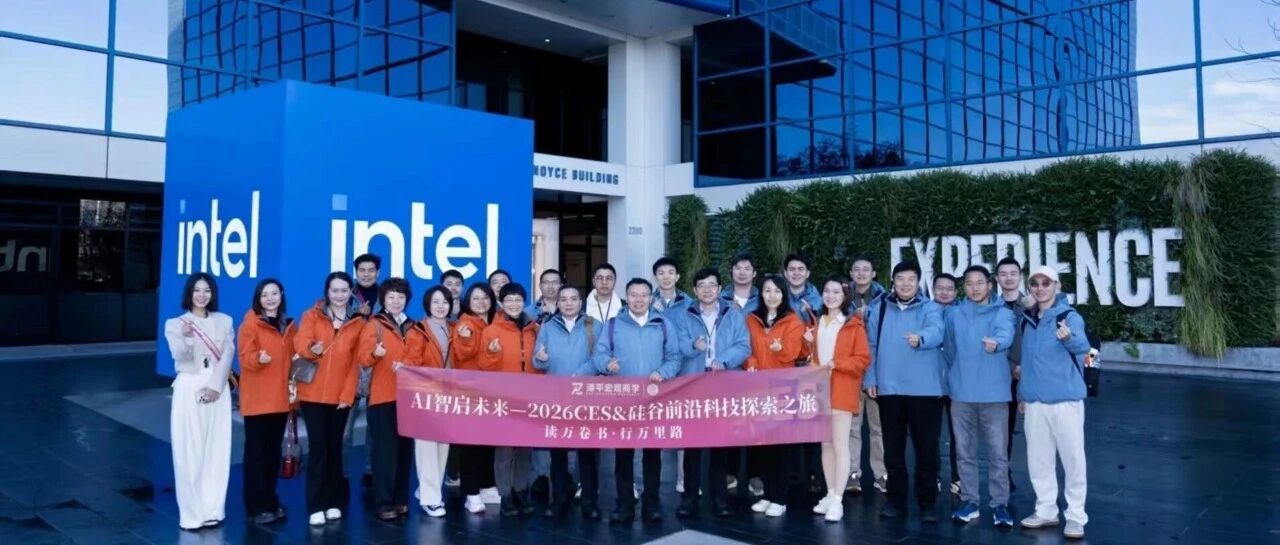
Group 1 - The core theme of the article is the rapid advancement of AI technology, which is transforming the world and is seen as a significant opportunity, potentially surpassing the impact of the IT internet revolution from thirty years ago [3][8]. - The CES event showcased AI as the dominant theme, with significant advancements in robotics and autonomous driving, indicating a forthcoming revolution in transportation [5][16]. - Major players in the AI space, such as Nvidia, are leading the GPU race, while companies like Google are also making strides with their TPU technology [7]. Group 2 - The demand for AI computing power is expected to grow by a hundredfold, driven by advancements in physical AI, which integrates AI into physical devices like robots and autonomous vehicles [12]. - The AI competition is primarily between the US and China, with other countries having minimal presence, indicating a widening gap in technological capabilities [13]. - The future of AI will lead to the emergence of new species of technology and applications, fundamentally altering industries and potentially replacing many traditional jobs [28][31]. Group 3 - Tesla's Full Self-Driving (FSD) technology is advancing rapidly, with the potential to leap directly to Level 4 autonomous driving, which could significantly change urban transportation dynamics [16][24]. - The integration of AI in various sectors, including healthcare and robotics, is expected to lead to breakthroughs in understanding and solving complex problems, such as cancer and aging [29][30]. - The rise of AI agents is anticipated to reshape organizational structures, enabling smaller companies to achieve remarkable productivity and market value [32].



沪港创新发展交流会:鼓励内地企业利用香港平台“出海”
Zhong Guo Xin Wen Wang· 2026-01-18 14:58
Group 1 - The "2026 Shanghai-Hong Kong Innovation Development Exchange Conference" focuses on innovation development, enterprise globalization, and technology cooperation between Shanghai and Hong Kong [1] - Hong Kong is accelerating the establishment of an international innovation and technology center through three major innovation parks, five research institutions, and three "100 billion yuan plans" [1] - The conference featured insights from experts in investment, law, technology, and academia, emphasizing the importance of technology empowerment and the unique story of Chinese enterprises in AI [1] Group 2 - The Hong Kong Trade Development Council (HKTDC) and the Shanghai Hong Kong Chamber of Commerce have initiated the "Hong Kong Business Innovation Development Plan" to explore new opportunities in various cities [2] - The HKTDC plans to support Hong Kong businesses in expanding into new fields such as artificial intelligence, robotics, and green economy, while facilitating resource connections between the two regions [2] - The Shanghai Hong Kong Chamber of Commerce will continue to focus on the application and commercialization of products in its upcoming innovation project evaluations [2]
策略周报:理性降温,景气度仍是避风港-20260118
HWABAO SECURITIES· 2026-01-18 14:33
Group 1 - The report emphasizes a rational cooling in the market, suggesting that the economic climate remains a safe haven for investors [1][3] - The bond market sentiment has improved due to recent central bank operations that injected liquidity, leading to a quick recovery in the 10-year government bond yield, which is expected to fluctuate around 1.85% [2][12] - The report highlights the importance of high coupon bond allocations, especially if government bond supply pressures ease in late January, presenting a potential mid-term buying opportunity [12][13] Group 2 - The stock market is experiencing a shift back to rationality, with regulatory measures aimed at preventing overheating risks, leading to adjustments in major indices like the CSI 300 [3][10] - The report suggests that after the market returns to rationality, it will benefit a slow bull market and attract funds back to high-growth sectors such as AI hardware, robotics, semiconductors, new energy, non-ferrous metals, and chemicals [3][13] - Short-term market indices may still be in a cooling phase, and it is recommended to wait for reduced selling pressure before making new investments [12][13] Group 3 - The report notes that the overseas markets are likely to continue a strong but volatile trend, although geopolitical risks in the Middle East have increased uncertainty [13] - Recent adjustments in financing margin ratios by the China Securities Regulatory Commission aim to lower leverage levels and protect investor rights, which may contribute to long-term market stability [9][10] - The report indicates that the A-share market has seen a significant increase in trading volume, with daily average turnover rising to 34,651 billion, marking a historical high [20]
北交所日报:主线轮动分化,政策导向明确-20260118
Western Securities· 2026-01-18 13:25
Investment Rating - The report indicates a focus on technology sectors and policy-supported areas, suggesting a positive outlook for specialized and innovative companies in the semiconductor and robotics fields [3]. Core Insights - The market is currently experiencing a rotation with clear policy guidance, emphasizing the importance of technology and innovation in driving growth [3]. - The North Exchange A-share trading volume reached 30.43 billion yuan, a decrease of 2.79 billion yuan from the previous trading day, with the North Exchange 50 Index closing at 1548.33, up 0.23% [7]. - The report highlights the performance of individual stocks, with 119 out of 288 companies rising, while 165 fell, indicating a mixed market sentiment [16]. Summary by Sections Market Review - On January 16, the North Exchange A-share trading volume was 30.43 billion yuan, down from the previous day [7]. - The North Exchange 50 Index closed at 1548.33, with a PE_TTM of 64.92 times, while the specialized and innovative index closed at 2666.88, up 0.46% [7][16]. Stock Performance - The top five gainers included Kema Materials (371.3%), Kaide Quartz (20.3%), and Tietuo Machinery (10.2%) [16]. - The top five losers were Liujin Technology (-13.9%), Keli Co., Ltd. (-11.8%), and Meideng Technology (-9.2%) [16]. Important News - Significant advancements in liquid metal flexible electronics manufacturing have been reported, providing innovative solutions for high-performance and green applications [2]. - The Chinese FAST telescope has made a breakthrough in capturing the evolution of fast radio bursts, marking a significant achievement in astrophysics [19]. Company Announcements - Ximic Technology has been re-certified as a high-tech enterprise, enhancing its innovation capabilities [20]. - Kangbiter announced the lifting of restrictions on 211,500 shares, representing 0.17% of its total share capital, effective January 21, 2026 [22].
中企对德投资十年迭代:从规模扩张到价值深耕︱问海·中企出海新观察
Di Yi Cai Jing· 2026-01-18 12:41
Core Insights - The systematic risks associated with Chinese enterprises' direct investment in Germany have significantly increased over the past decade, shifting from opportunistic technology acquisitions to deeper integration within the industrial chain [1] - The investment landscape has transformed, necessitating a transition from broad-scale expansion to a more refined focus on value creation and compliance [7] Regulatory Changes - Since 2016, Germany has progressively strengthened its foreign direct investment (FDI) security review mechanisms through amendments to the Foreign Trade Regulation (AWV), impacting the investment environment for Chinese firms [2] - The introduction of the EU Foreign Direct Investment Screening Regulation in 2019 established a unified framework for FDI reviews among member states, enhancing scrutiny on investments from China [2][3] - Key revisions in 2021 expanded the scope of review to include critical technologies such as AI, semiconductors, and cybersecurity, increasing compliance costs and uncertainties for Chinese investors [3] Compliance Risks - Compliance risks for Chinese companies in Germany have evolved from transaction-based compliance to ongoing operational and governance responsibilities, particularly in light of the European Green Deal and the Supply Chain Due Diligence Act [4] - The implementation of the General Data Protection Regulation (GDPR) has intensified scrutiny on data security and privacy, posing additional challenges for Chinese investments [5] - The upcoming Corporate Sustainability Reporting Directive (CSRD) will require comprehensive ESG disclosures, further complicating compliance for Chinese firms operating in Germany [5] Investment Environment Changes - The investment environment in Germany has undergone significant changes due to structural and cyclical factors, with economic growth slowing and macroeconomic uncertainties rising since 2020 [6] - Despite challenges, Germany remains an attractive destination for high-end manufacturing and technology investments due to its skilled labor force and robust vocational education system [6] - Rising energy costs and labor market changes have impacted operational costs, prompting a shift in investment strategies towards clean energy and infrastructure [6][7] Strategic Shifts - Chinese enterprises have shifted their investment strategies from large-scale acquisitions to minority stakes, strategic partnerships, and greenfield investments, reflecting a more diversified approach [8] - The focus has moved towards compliance-friendly sectors aligned with EU policies, emphasizing local employment, R&D investment, and supply chain collaboration [7][8] - The competitive advantage for Chinese firms in Germany will increasingly hinge on compliance capabilities, depth of local integration, and innovation in green technologies [9]
主题风向标1月第2期:主题轮动加快,聚焦国产半导体与电力
GUOTAI HAITONG SECURITIES· 2026-01-18 12:13
Group 1 - The report highlights that the trading heat of hot themes has reached historical highs, with advanced packaging and equipment themes in the semiconductor sector gaining strength, while the commercial aerospace theme has cooled down. The average daily trading volume of hot themes reached 1.436 billion yuan, with an average turnover rate of 5.9%, marking a historical peak [7][9][12] - The report emphasizes the acceleration of theme rotation, focusing on sectors with strong demand support and concentrated industrial catalysts, particularly in low-tech areas such as domestic computing power, new power grids, robotics, and domestic consumption [4][6][20] Group 2 - In the domestic computing power theme, TSMC's capital expenditure is expected to exceed expectations, boosting demand in the semiconductor advanced manufacturing sector. TSMC's net profit for Q4 2025 is projected to grow by 35% year-on-year, with capital expenditure potentially reaching a historical high of 56 billion USD in 2026, a 37% increase from 2025 [20][25][29] - The new power grid theme sees the State Grid announcing a fixed asset investment of 4 trillion yuan during the 14th Five-Year Plan, a 40% increase from the previous plan, aimed at constructing a new power system. The proportion of non-fossil energy consumption in China is expected to reach 20% by 2025 and 25% by 2030 [21][35][40] - The robotics theme is highlighted by the participation of Chinese robotics companies at CES 2026, showcasing advancements in various application scenarios. The industry is entering a phase of large-scale development, with significant growth in repetitive and dangerous industrial tasks as well as personalized consumer scenarios [22][39][41] - The domestic consumption theme is driven by government initiatives to cultivate new growth points in service consumption, with a focus on enhancing the domestic market. The report notes the emergence of new consumption scenarios in sports events, ice and snow tourism, and cultural performances, with significant economic impacts [23][43][44]


“难以解释”!业绩暴增,股价微涨......
Zhong Guo Ji Jin Bao· 2026-01-18 11:08
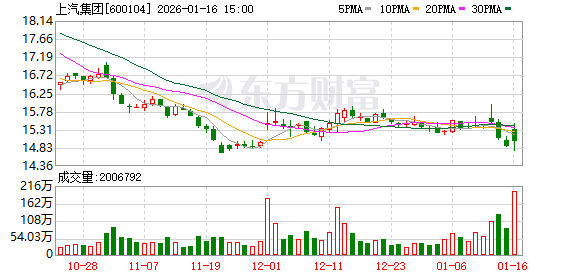
Core Viewpoint - SAIC Motor Corporation has announced a significant profit forecast for 2025, expecting a year-on-year increase in net profit attributable to shareholders of 438% to 558%, yet its stock price remains undervalued and in a state of net asset deficit [4][10]. Group 1: Company Performance and Market Position - As of January 16, 2026, SAIC Motor's market capitalization stands at 172.3 billion RMB, ranking first among state-owned listed automotive companies, but significantly lower than BYD's market cap of 874 billion RMB [5][6]. - The company's price-to-earnings ratio is 15.95, and its price-to-book ratio is 0.58, indicating a valuation below industry averages [6][11]. - Despite a strong profit forecast, SAIC Motor's stock has declined by 26.37% in 2025, and it remains in a "broken net" state, with a closing price of 14.99 RMB per share, below its net asset value of 25.71 RMB per share [8][10]. Group 2: Market Challenges and Investor Sentiment - Many investors have expressed concerns regarding SAIC Motor's market value management, questioning whether the company's strategies are effective or merely superficial [8][12]. - The automotive industry is facing intense competition and rapid transformation towards new energy and smart technologies, which complicates investment prospects [21][22]. - There is a perception among industry executives that their companies are undervalued in the market, with most listed automotive companies having market caps below 200 billion RMB [20]. Group 3: Value Management and Strategic Initiatives - The company has previously implemented three rounds of share repurchase plans totaling 4.747 billion RMB, but the effectiveness of these measures has been questioned [16][18]. - According to the regulatory guidelines, companies in a long-term net asset deficit must disclose their valuation enhancement plans, which SAIC Motor has committed to improving [10][12]. - The focus on operational quality and the development of popular vehicle models is seen as crucial for enhancing market value, rather than relying solely on share buybacks [24][26].

汽车行业周报:泛AI&机器人赛道进入景气验证期 关注业绩确定性
Xin Lang Cai Jing· 2026-01-18 10:35
Industry Overview - The EU and China reached a preliminary agreement on electric vehicle tariffs, establishing a minimum import price to replace high anti-subsidy tariffs set to take effect in 2024 [2] - ZhiYuan Robotics has spun off its dexterous hand business into a new company named "Critical Point," signaling a move towards specialization and commercialization [2] - A U.S. House committee held a hearing to discuss legislation aimed at simplifying the deployment process for autonomous vehicles, potentially increasing the annual limit on new autonomous vehicles from 2,500 to 90,000 [2] Company Updates - SAIC Motor Corporation announced a profit forecast for 2025, expecting a net profit attributable to shareholders of 9 to 11 billion yuan, representing a year-on-year increase of 438% to 558% [3] - JAC Motors released a profit forecast for 2025, projecting a net loss of approximately 1.68 billion yuan, which is a reduction in loss of about 100 million yuan compared to the previous year [3] - WeRide's global Robotaxi fleet surpassed 1,000 vehicles, reaching 1,023 units as of January 12, 2026 [3] Investment Insights - The automotive market is expected to enter an upward recovery phase, supported by the implementation of vehicle trade-in policies in 2026, which may boost domestic demand [4] - The AI sector is entering a verification phase, with clear marginal catalysts in robotics and AIDC, as Tesla's robot is set to enter mass production in 2026 [4] - Long-term focus on stable growth is recommended, with significant potential in overseas markets, as China's automotive export volume is projected to reach 6.34 million units in 2026, a year-on-year increase of about 13% [4] Related Stocks - Key stocks include Weichai Power, Yutong Bus, China National Heavy Duty Truck Group, BYD, SAIC Motor, Geely Automobile, Leap Motor, Xpeng Motors, Seres, Fuyao Glass, Songyuan Safety, Sanhua Intelligent Control, Zhejiang Rongtai, Top Group, Yinlun Holdings, Junsheng Electronics, Horizon Robotics, BYD Electronics, Hesai Technology, and SUTENG [5]

活跃周期在途,但短线情绪过热或暗含局部波动风险
Huajin Securities· 2026-01-18 09:45
Group 1 - The new stock market is currently active, but short-term sentiment may be overheated, indicating potential local volatility risks [1][12] - Since the beginning of the year, the new stock sector has shown strong performance for two consecutive trading weeks, with a favorable atmosphere for buying [2][12] - The average increase of new stocks listed since 2025 is approximately 3.1%, with about 70.7% of new stocks showing positive returns [6][26] Group 2 - The average issuance price-to-earnings ratio for new stocks in January is 19.6X, slightly down from the previous month [13][15] - The average first-day closing price-to-earnings ratio for new stocks in January is 52.2X, down from 69.9X in the previous month [15][16] - The first-day average increase for new stocks in January is 138.8%, compared to 205.6% in the previous month, indicating a temporary decline in trading enthusiasm [16][24] Group 3 - Upcoming new stocks include Aisheren, Hengyun Chang, and Guoliang New Materials, with expected issuance price-to-earnings ratios of 44.1X for the new stocks [4][30] - The new stock issuance remains constrained, but the active funding environment suggests continued profit opportunities in new stock subscriptions [30][31] - Specific stocks recommended for attention include Tongyu New Materials, Fengbei Biological, and Hengkang New Materials, which are expected to show significant activity [39][40]