即时零售

Search documents
“双11”本地之战 | 紧邻美团,京东折扣超市北京首店将落地门头沟 为何大厂偏爱五环外
Bei Jing Shang Bao· 2025-11-10 14:31
Core Insights - The competition in the instant retail sector is intensifying as major players like JD.com and Meituan are establishing physical stores in close proximity to each other, targeting community commerce as a key battleground [1][3][6] - The focus on community retail is driven by the need to meet high-frequency, essential consumer demands, with both companies leveraging their existing traffic to stimulate local markets [1][4][7] Group 1: Market Dynamics - JD.com is set to open its first discount supermarket in Beijing's Mentougou district, strategically located near Meituan's "Happy Monkey" supermarket, highlighting the competitive landscape [2][3] - The shift towards hard discount models is gaining traction, with companies like Yonghui and Meituan introducing private label products to attract consumers [4][8] - The community retail strategy is characterized by a focus on essential goods and quick delivery, with both JD.com and Meituan aiming to capture local consumer needs [6][7] Group 2: Strategic Positioning - The new JD.com discount supermarket will occupy a space of 47,000 square meters, indicating a significant investment in the community retail sector [2] - Meituan's "Happy Monkey" supermarket, which opened earlier, emphasizes fresh produce and baked goods, showcasing a similar business model [3] - Both companies are avoiding saturated urban core areas and instead targeting suburban markets where operational costs are lower and consumer demand is high [11][12] Group 3: Consumer Behavior - The community-focused retail approach is designed to cater to the needs of densely populated residential areas, with both companies aiming to provide better services to local residents [6][7] - The trend towards discount retailing is a response to changing consumer preferences for value and quality, prompting retailers to streamline operations and reduce costs [8][10] - The collaboration between e-commerce giants and local shopping centers is expected to enhance the shopping experience and drive foot traffic [9][10]


进博会闭幕累计成交834.9亿美元 电商平台成采购“新主体”
2 1 Shi Ji Jing Ji Bao Dao· 2025-11-10 12:18
Group 1 - The eighth China International Import Expo (CIIE) concluded with a total intended transaction of $83.49 billion, marking a 4.4% increase from the previous year and setting a new historical high [1] - E-commerce platforms have become a new window for international brands to debut in China, with significant sales growth reported by companies like Hema, which saw a 40% year-on-year increase in imported direct sales [1] - Nearly 100 overseas new brands from countries such as the USA, France, Japan, South Korea, and Thailand showcased over 100 global new products at the expo, indicating sustained enthusiasm from international brands to invest in the Chinese market [1] Group 2 - The CIIE has facilitated a digital pathway for overseas brands, allowing them to seamlessly transition from showcasing to establishing a presence in the Chinese market, with over 2,000 new overseas brands opening their first stores in China this year [3] - The advanced digital commerce ecosystem in China provides an "instant plug-and-play" entry for overseas brands, significantly reducing operational costs and risks [3] - Hema's strategic collaboration with a leading Spanish olive oil brand highlights the importance of understanding Chinese consumer preferences to develop products that cater to local tastes [3] Group 3 - Meituan Health made its debut at the expo, forming strategic partnerships with seven multinational pharmaceutical companies, which will aid in expanding their market presence in China [4] - The introduction of a cross-border e-commerce section at the expo gathered leading players in cross-border payment, supply chain, and e-commerce, creating a one-stop service ecosystem [4] Group 4 - The online shopping inclination of Chinese consumers is significantly higher than the global average, with 43% preferring online shopping, reflecting a better shopping experience [5] - IKEA's participation in the "CIIE New Products Showcase" led to the global debut of its Chinese New Year series, demonstrating the effectiveness of the expo in transforming exhibits into sales [5] - Skechers has partnered with JD.com and plans to launch on Meituan and Taobao, expanding its instant retail business across over 600 stores in 60 cities, with future plans for broader coverage [5]
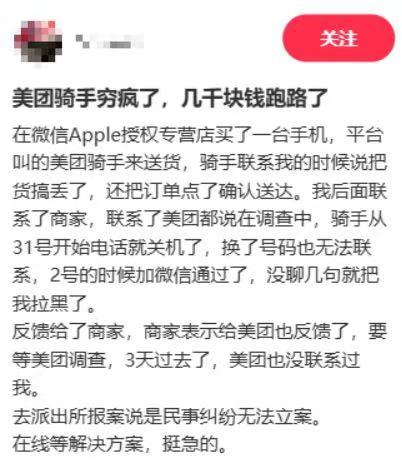
贵货都上即时零售,骑手频繁上演“零元购”,偷单还会少吗?
3 6 Ke· 2025-11-10 12:13
Core Viewpoint - The incident of a lost delivery highlights the growing risks in the instant retail industry, where the convenience of rapid delivery is overshadowed by issues of trust and accountability among platforms, merchants, and delivery personnel [1][3][9]. Group 1: Incident Overview - A consumer from Shaanxi reported that a mobile phone ordered through Meituan was lost during delivery, with the rider claiming the item was missing and the merchant stating the order was completed [1][3]. - The consumer sought help on social media, leading to Meituan eventually compensating the consumer after public pressure [3][6]. Group 2: Industry Implications - The rise of instant retail has led to an increase in high-value item deliveries, making incidents of "zero-cost purchases" by riders more frequent and concerning [4][9]. - Trust is essential in instant retail, and incidents like these can erode consumer confidence, potentially stunting market growth [9][17]. Group 3: Responsibility and Accountability - The lack of clear responsibility among merchants and platforms complicates the resolution of delivery issues, with both parties often deflecting accountability [12][13]. - Merchants are often seen as "passive" in these situations, needing to take a more proactive role in addressing consumer concerns to maintain their reputation [16][21]. Group 4: Future Risks and Market Growth - The rapid expansion of instant retail, projected to reach a market size of approximately 7.515 trillion yuan by 2024, raises concerns about the sustainability of current operational practices if risks are not managed effectively [17][20]. - The shift from low-value items to high-value goods in deliveries necessitates a reevaluation of trust and security measures within the industry [23].


全国快递投递量再创新高,双十一为何对品牌依然不可替代?
2 1 Shi Ji Jing Ji Bao Dao· 2025-11-10 12:01
Core Insights - The necessity of "Double Eleven" is reaffirmed, showcasing its enduring value for brands despite market fluctuations [2][5][9] - The event continues to serve as a critical platform for brand growth and consumer engagement, reflecting the evolving dynamics of the e-commerce industry [3][6][9] E-commerce Performance - Tmall reported that 35 brands achieved over 100 million yuan in sales during the first hour of pre-sale, with 80 brands surpassing this mark during the official sale, indicating growth compared to the previous year [1] - From October 9 to November 3, the transaction volume on Taobao and Tmall increased by 11% year-on-year, while the national express delivery volume reached 4.305 billion packages, a 10% increase from last year [1] Brand Growth Dynamics - The "brand growth" narrative remains strong, with Tmall's Double Eleven continuing to generate significant "brand building" and "star-making" effects [3][4] - In the first hour of sales, notable brands like Apple and Nike achieved over 100 million yuan in sales, with 30,516 brands doubling their sales compared to the previous year [4] Consumer Behavior Trends - Research indicates that consumers are increasingly favoring quality brands over generic products during promotional events, highlighting a shift in purchasing behavior [3][6] - The demand for quality brands is particularly strong in lower-tier markets and among younger consumers, contributing to a robust growth trajectory for brands [6] Technological Integration - This year's Double Eleven marked the first instance of comprehensive AI integration across various operational aspects, enhancing efficiency and consumer experience [7][8] - AI tools have significantly improved merchant efficiency, with a reported 1.5 times increase in productivity for 500,000 merchants [7] New Market Opportunities - The rise of instant retail through Taobao Flash has created new growth avenues, with over 37,000 brands participating in this model during Double Eleven [8] - The collaboration between Tmall and Taobao Flash has resulted in substantial increases in new customer acquisition for brands, exemplified by Huawei's 1910% week-on-week sales growth during the event [8] Evolution of Commercial Models - The transformation of Double Eleven from a simple promotional event to a complex commercial ecosystem reflects the self-evolution of China's business models [9][10] - The integration of AI and new consumption patterns signifies a pivotal shift in how brands engage with consumers, presenting ongoing growth opportunities [9]
中国互联网巨头财报将至:AI、即时零售都在烧钱,三季度进入利润真空期?
Hua Er Jie Jian Wen· 2025-11-10 08:52
Core Insights - The upcoming Q3 earnings reports from major Chinese internet companies are expected to reveal a harsh reality, with aggressive investments in "instant retail" significantly eroding profits despite growth in AI and cloud businesses [1][2] - Goldman Sachs predicts a substantial year-on-year profit decline of 31% for the Chinese internet sector in Q3, worsening from a 9% decline in Q2 [1][2] - The focus for investors will shift from quarterly earnings to management guidance on investment intensity and paths to narrowing losses for Q4 and 2026 [1][2] Group 1: Profit Decline and Losses - Instant retail is projected to cause significant losses for Alibaba (RMB 36 billion), Meituan (RMB 20 billion), and JD.com (RMB 13 billion) in Q3 [4] - Despite expectations of a reduction in losses for Q4, achieving a 50% reduction in losses remains unlikely at this stage [4] Group 2: AI and Cloud Business - AI is a central theme in this quarter's earnings, with cloud revenue expected to accelerate due to strong AI demand, particularly for Alibaba and Tencent [3] - Alibaba's cloud revenue is forecasted to grow by 31% year-on-year in Q3, up from 26% in the previous quarter [3] Group 3: Capital Expenditure and Profit Erosion - Major investments in AI infrastructure are leading to increased capital expenditures, which are expected to dilute short-term profits [3] - Goldman Sachs anticipates Alibaba's capital expenditures to reach RMB 460 billion for the fiscal years 2026-2028, exceeding the company's previous target of RMB 380 billion [3]

电商升级+免税新政!消费龙头ETF(516130)拉升2%!机构:AI融合与出海或成消费景气主线
Xin Lang Ji Jin· 2025-11-10 06:47
Group 1 - The core viewpoint of the articles highlights the performance of the Consumption Leader ETF (516130), which saw a 2.0% increase in price and a transaction volume of 13.71 million yuan, with a total fund size of 150 million yuan [1] - Key stocks within the ETF include China Duty Free, which hit the daily limit, and New Spring Co., which fell to the daily limit, while ShouLai Hotel and YanJin PuZi saw significant gains of 9.88% and 7.6% respectively [1] - The upcoming 2025 Double 11 shopping festival will incorporate instant retail as a core focus, enhancing "minute-level delivery" services, which is expected to benefit companies like Yili and Haier from increased demand for smart home appliances and fast-moving consumer goods [1] Group 2 - The Ministry of Finance and other departments have issued a notice to optimize duty-free shopping policies, which may provide policy benefits to companies like China Duty Free [1] - The consumption sector is under pressure, but four main trends are identified: (1) Brand expansion into emerging markets, (2) Emotional value sectors like trendy toys and pet products, (3) Growth in AI-driven consumer sectors, and (4) The rise of instant retail and cost-effective dining options [1] - The Consumption Leader ETF passively tracks the Consumption Leader Index, with top ten weighted stocks including Kweichow Moutai, Gree Electric, Yili, and others [2]






中国互联网行业_专家系列_电商平台如何在竞争格局演变中定位_ China Internet Sector _Expert series_ How do e-com platforms position amidst evolving competitive landscape_
2025-11-10 03:34
Summary of Conference Call on China Internet Sector Industry Overview - **Sector**: China Internet Sector, specifically focusing on e-commerce platforms and apparel brands - **Event**: Discussion on the performance during the Double 11 shopping festival and the evolving competitive landscape in e-commerce Key Takeaways Double 11 Performance - **Growth Acceleration**: Double 11 GMV (Gross Merchandise Value) growth improved from Q3, driven by higher platform subsidies, user reactivation through quick commerce, and favorable early winter weather boosting apparel demand [2][3] - **Platform Performance**: - **Taobao Tmall**: Most significant GMV acceleration and increase in merchant support and subsidies compared to last year - **Douyin**: Notable growth, followed by PDD and JD, with VIPS showing moderation compared to Q3 [2][3] Offline Retail Challenges - **Declining Foot Traffic**: Offline retail is facing challenges with reduced customer foot traffic and conversion rates - **Shift to Online**: Consumers are increasingly trying products offline but purchasing online, which may pressure merchant margins due to higher average selling prices (ASP) in offline retail [2][3] Quick Commerce Insights - **Contribution to Sales**: Quick commerce currently accounts for 5% of total sales, expected to rise to 10% in the long run for the apparel category [3] - **Consumer Behavior**: 70% of quick commerce customers are existing e-commerce customers, with 20% overlapping between online and offline, and 10% being new traffic [3] - **Traffic Conversion**: Low lifetime value (LTV) for new consumers from food delivery initiatives, indicating price sensitivity and a focus on white label products [3] Merchant Strategies - **ROI-Focused Advertising**: Merchants are prioritizing efficient platforms for ad spend, with about 30% allocated to acquiring new traffic targeting higher quality consumers [4] - **Impact of New Tax Policy**: The new ad tax policy, effective from October 1, limits tax-deductible ad spending, with potential larger impacts on short-form video platforms like Douyin and Kuaishou if strictly enforced [4] - **AI Tools**: AI-powered chatbot search on Taobao Tmall has shown a 5% ROI improvement, with expectations for further enhancements as data accumulates [6] Competitive Landscape - **BABA (Alibaba)**: Focus on enhancing execution and merchant efficiency, shifting from low-price competition to quality focus [7] - **JD (Jingdong)**: Apparel investments are driving growth, but consumer perception and app interface need time to evolve [7] - **PDD (Pinduoduo)**: Leading in brand penetration, with a significant portion of sales priced similarly to Taobao Tmall, supported by a merchant support initiative [7] Risks and Challenges - **Key Risks**: - Evolving competitive landscape and intensifying competition - Rapid technological changes and shifting consumer preferences - Uncertain monetization and rising costs of traffic acquisition - Regulatory changes and market sentiment fluctuations [8] Conclusion The conference call highlighted the robust growth in the China Internet sector, particularly during the Double 11 shopping festival, while also addressing the challenges faced by offline retail and the strategic shifts of major e-commerce platforms. The insights provided a comprehensive view of the current landscape and potential future developments in the sector.

砸下3.6亿销售费用 净利反降4%!自由点母公司舆情阴霾难消
Xin Jing Bao· 2025-11-10 01:08
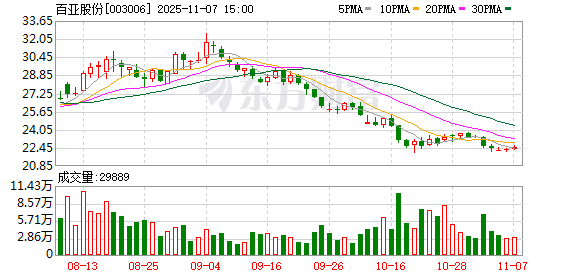
Core Viewpoint - The company, Baiya Co., is facing challenges in its online sales channels due to public sentiment and platform strategy adjustments, leading to a decline in revenue and profit despite overall growth in other areas [2][3]. Financial Performance - For Q3 2025, Baiya Co. reported revenue of 858.79 million yuan, an increase of 8.33% year-on-year, while net profit decreased by 3.89% to 56.53 million yuan [4][5]. - In the first three quarters of 2025, the company achieved a total revenue of 2.62 billion yuan, up 12.80% from the previous year, with net profit of approximately 244.56 million yuan, a growth of 2.53% [5]. Online Sales Channel - The online sales channel experienced a revenue decline of 11.4% in Q3, totaling 341 million yuan, and a 10.2% decrease year-to-date, amounting to 933 million yuan [6]. - The "refurbished sanitary napkin" incident negatively impacted the company's online sales, with a 9.44% year-on-year decline in the first half of the year [6]. Offline Sales Channel - Baiya Co. saw significant growth in offline sales, with revenue reaching 1.62 billion yuan in the first three quarters, a 35.7% increase year-on-year [6]. - The company reported a 113.4% growth in revenue from regions outside its core areas [6]. Brand Performance - The brand "Ziyoudian" remains a key revenue driver, with a 16.4% increase in revenue to 2.51 billion yuan in the first three quarters, accounting for 95.58% of total revenue [7]. - The company is focusing on enhancing brand influence and expanding its consumer base through marketing efforts, including appointing a new brand ambassador [7]. Investment in Sales and R&D - Sales expenses for the first three quarters reached 1.01 billion yuan, a 15.7% increase, representing approximately 38.35% of total revenue [8][9]. - R&D investment was only 49.37 million yuan, a slight decrease from the previous year, indicating a low R&D expense ratio of less than 2% [9].
砸下3.6亿销售费用,净利反降4%!自由点母公司舆情阴霾难消
Xin Jing Bao· 2025-11-10 00:48
Core Viewpoint - The parent company of the sanitary napkin brand "Free Point," Chongqing Baiya Hygiene Products Co., Ltd., is still facing challenges due to the "refurbished sanitary napkin" scandal, impacting its online sales and overall profitability [1][2]. Financial Performance - In Q3 2025, Baiya achieved revenue of 858.79 million yuan, an increase of 8.33% year-on-year, but net profit declined by 3.89% to 56.53 million yuan [3][4]. - For the first three quarters of the year, the company reported total revenue of 2.62 billion yuan, up 12.8% year-on-year, with net profit around 245 million yuan, a growth of 2.53% [4]. Sales Channel Performance - Online sales revenue fell by 11.4% in Q3, totaling 341 million yuan, largely due to negative public sentiment and platform strategy adjustments [4][5]. - The company's online channel revenue for the first three quarters was 933 million yuan, down 10.2% year-on-year, reflecting the ongoing impact of the scandal [4][5]. Brand and Product Insights - The "Free Point" brand remains a key revenue driver, with its revenue growing by 16.4% to 2.51 billion yuan in the first three quarters, accounting for 95.58% of total revenue [6][8]. - The company is focusing on enhancing brand influence and expanding its consumer base, with significant marketing efforts, including appointing a new brand ambassador [6][8]. Cost Structure - Sales expenses increased by 15.7% to 1.01 billion yuan in the first three quarters, representing approximately 38.35% of total revenue [7][8]. - Research and development expenses were only 49.37 million yuan, a decrease of 2.03% year-on-year, indicating a low R&D expense ratio of less than 2% [8].

拉餐饮外卖入局 “双11”从囤货到即享
Bei Jing Shang Bao· 2025-11-09 16:17
Core Insights - This year's "Double 11" has shifted from a focus on e-commerce sales volume (GMV) to an emphasis on local life services and instant retail, with food delivery services taking a central role [1][3][4] Group 1: E-commerce Participation - For the first time, food and beverage brands actively participated in the "Double 11" event, with platforms like Taobao Flash Sale launching special promotions and discounts [3][4] - Taobao Flash Sale reported over 100 million e-commerce orders from new users during the "Double 11" period, with nearly 20,000 restaurant brands seeing their sales increase by over 100% compared to before the event [3][4] - JD's first report on its food delivery performance during "Double 11" indicated that the average daily order volume for its top 300 restaurant brands increased 13 times compared to the first month of its food delivery service [4] Group 2: Instant Retail Competition - The competition has evolved to focus on "minute-level delivery," with platforms like Meituan and JD emphasizing rapid delivery services [5][6] - Meituan reported that nearly 800 brands saw sales growth of over 100% during the first day of "Double 11," with significant increases in various product categories including electronics and beverages [5][6] - Taobao Flash Sale integrated 37,000 brands and 400,000 stores into its platform, promoting a new convenience store model that offers 24-hour service with 30-minute delivery [6][8] Group 3: Market Strategy and Adaptation - The shift towards instant retail indicates that e-commerce platforms need to adapt their strategies, focusing on increasing customer spending domestically and expanding user bases internationally [8] - Platforms are leveraging local resources and partnerships to enhance their service offerings, with Meituan activating offline resources and JD focusing on exclusive deals for popular products [8] - The restructuring of the near-field e-commerce market necessitates upgrades in supply chains, warehousing, and delivery systems to meet the demand for rapid delivery [8]