
地缘政治不确定性

Search documents
5万亿美元市值!白银超越英伟达升至全球第二资产,还能追吗
Di Yi Cai Jing· 2026-01-15 00:32
Core Viewpoint - Silver prices are experiencing a significant surge, with the potential to reach $100 per ounce, driven by various factors including inflation, a weakening dollar, and increased demand from central banks and investors seeking safe-haven assets [1][4]. Group 1: Market Dynamics - Silver futures prices have risen sharply, breaking through multiple key levels, with a cumulative increase of over 200% since the beginning of the current bull market in 2025 [1]. - The market capitalization of silver has surpassed $5 trillion, making it the second most valuable asset globally, only behind gold [4]. - The demand for silver is structurally increasing due to its industrial applications, particularly in electric vehicles and solar panels, which are expected to drive further price appreciation [5]. Group 2: Economic Influences - Historical context suggests that reaching $100 per ounce is feasible, especially when considering inflation-adjusted values from past peaks [6]. - The supply-demand balance is critical, with rising physical demand from central banks and declining available supply potentially accelerating price increases [6]. - Geopolitical uncertainties and concerns regarding the Federal Reserve's independence may create conditions conducive to higher silver prices [4]. Group 3: Market Signals - The gold-silver ratio has dropped below 50 for the first time since March 2012, indicating that silver's price increase is outpacing that of gold [8]. - A low gold-silver ratio may suggest that silver is overvalued, as historical averages indicate fluctuations based on macroeconomic cycles [8]. - Market participants are advised to consider their exposure to monetary assets rather than fixating solely on the allocation between gold and silver [9].


“资源民族主义”引爆贵金属,白银有望再次成为“领头羊”
Jin Shi Shu Ju· 2026-01-14 12:58
Core Insights - Gold and silver prices have reached record highs in 2025, with predictions for further increases in 2026 driven by supply shortages, geopolitical tensions, and concerns over central bank independence [1][4] - The concept of "resource nationalism" is emerging, contributing to the upward trend in precious metal prices, as geopolitical risks escalate [2][3] Price Trends - In 2025, spot gold prices surged approximately 65%, while spot silver prices increased by about 150% [3] - As of early 2026, gold prices have risen over 7%, and silver prices have increased by more than 25% [3] Geopolitical Factors - The ongoing geopolitical uncertainties, including the U.S. controlling Venezuela and potential military actions regarding Greenland, are intensifying political risks that support precious metal prices [2] - The investigation into Federal Reserve Chairman Jerome Powell regarding the $2.5 billion renovation project has raised concerns about the Fed's independence, enhancing gold's appeal as a safe-haven asset [4] Market Dynamics - The silver market is experiencing a supply shortage due to export control measures from China, leading to significant price premiums in the Shanghai market compared to international prices [3] - The demand for silver is driven by its critical role in various industries, including electronics and automotive, indicating substantial potential for price increases [3] Investment Outlook - Analysts predict that gold could reach $5,000 per ounce and silver could surpass $100 per ounce in 2026, based on current market dynamics and geopolitical factors [2][3] - The expectation of continued loose monetary policy from the Federal Reserve is likely to support gold prices, with no immediate factors suggesting a decline in precious metal prices [4]
黄金ETF持仓量报告解读(2026-1-14)金价创新高 到4600美元上方
Sou Hu Cai Jing· 2026-01-14 03:50
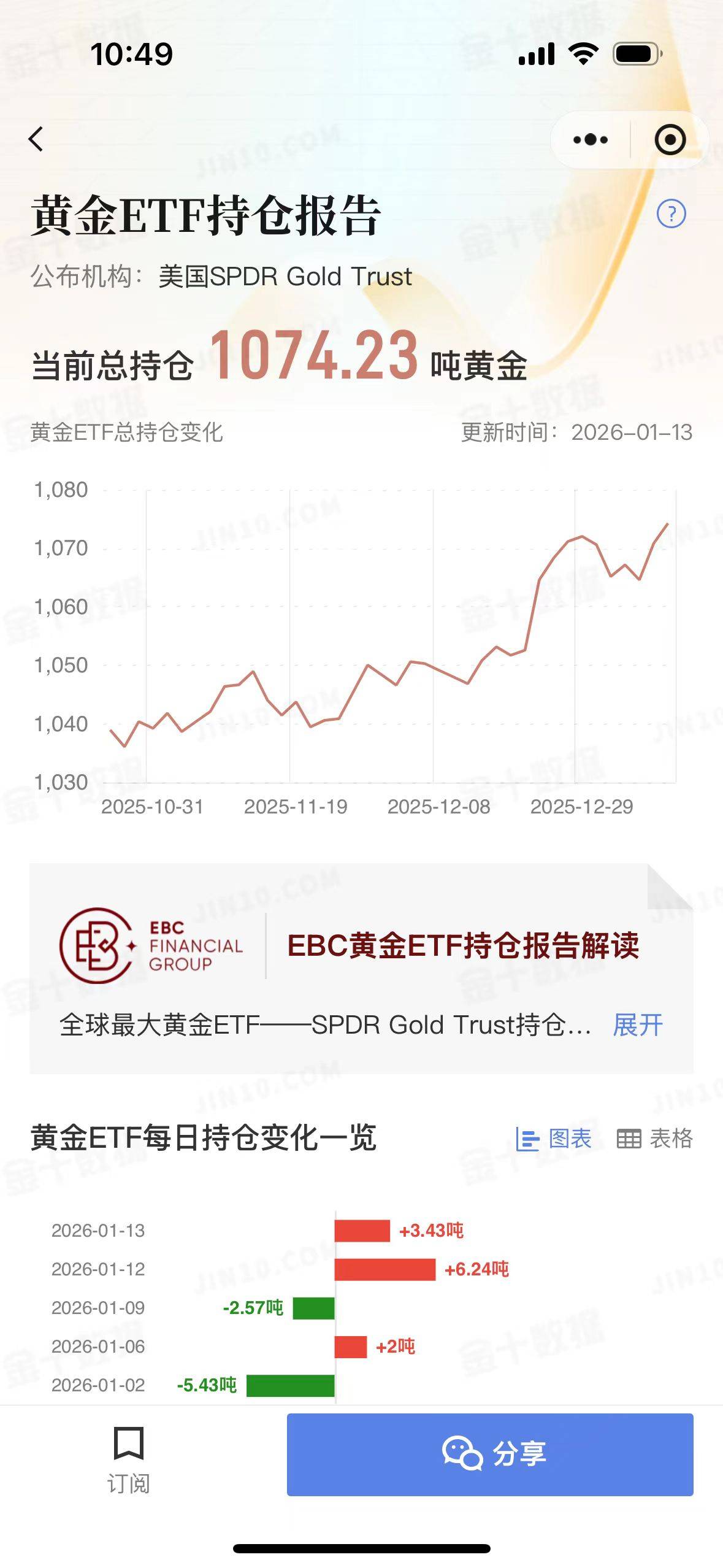
Core Viewpoint - The SPDR Gold Trust, the world's largest gold ETF, reported a total holding of 1,074.23 tons of gold, reflecting an increase of 3.43 tons from the previous trading day, amidst fluctuating gold prices around the $4,600 per ounce mark [5]. Group 1: Gold Market Dynamics - On January 13, spot gold prices fluctuated, reaching a high of $4,634.26 per ounce before closing at $4,586.64, down by $10.76 or 0.23% [5]. - The recent CPI data showed a month-on-month increase of 0.3% in December, aligning with market expectations, and the year-on-year increase reached 2.7%, consistent with forecasts [5]. - The core CPI, excluding volatile food and energy prices, remained steady at 2.6%, marking the lowest level since March 2021 [5]. Group 2: Federal Reserve and Interest Rate Expectations - Traders have increased bets on potential interest rate cuts by the Federal Reserve, with a 42% probability of a cut in April, up from 38% prior to the CPI data release [5]. - The market anticipates two interest rate cuts from the Federal Reserve this year, although recent employment reports have tempered expectations for aggressive cuts [6]. Group 3: Geopolitical and Economic Influences - Geopolitical tensions and concerns over the independence of the Federal Reserve have bolstered demand for gold as a safe-haven asset [6]. - The Trump administration's investigation into Fed Chair Powell has raised market concerns regarding the Fed's independence, influencing gold prices [6]. Group 4: Institutional Outlook on Gold - Major investment banks, including Bank of America, JPMorgan, Goldman Sachs, Morgan Stanley, and UBS, maintain a bullish outlook on gold, predicting prices to remain between $4,500 and $5,000 per ounce through 2026 [6]. - Factors supporting this outlook include anticipated Fed rate cuts, increasing debt concerns, ongoing central bank and ETF purchases, and persistent geopolitical uncertainties [6]. Group 5: Silver Market Performance - Silver prices have significantly outperformed gold, surging above $87 per ounce, with a year-to-date increase of approximately 20%, following a nearly 150% rise last year [6]. - The gold-silver ratio has fallen below 60, the lowest level since 2013, indicating stronger performance of silver relative to gold and reflecting improved expectations for industrial metal demand [7]. Group 6: Technical Analysis - Recent price movements indicate a temporary consolidation phase, with overbought signals prompting technical selling [8]. - Key support levels for gold are identified at $4,555 (December 26 high) and around $4,500, while resistance is noted at $4,625 (Monday high) and $4,714, corresponding to the 161.8% Fibonacci retracement level [8].
投行看涨金价上探5000美元 伦敦金逼近4620
Jin Tou Wang· 2026-01-14 03:21
Group 1 - The latest price of London gold is $4,617.33 per ounce, showing an increase of $31.96 or 0.70% from the previous trading day, indicating a strong upward trend [1] - The opening price for the day was $4,585.49 per ounce, with a high of $4,620.56 and a low of $4,585.49, reflecting significant market activity [1] Group 2 - The U.S. Department of Justice has issued a subpoena to Federal Reserve Chairman Jerome Powell as part of a criminal investigation related to his testimony regarding a $2.5 billion renovation project, raising concerns about the independence of the Federal Reserve [2] - Major investment banks, including Bank of America, JPMorgan, Goldman Sachs, Morgan Stanley, and UBS, are optimistic about gold prices, predicting they will remain between $4,500 and $5,000 per ounce by 2026 due to expectations of interest rate cuts and rising debt concerns [2] - The current market anticipates that the Federal Reserve may cut interest rates approximately twice this year, although recent employment reports have weakened aggressive rate cut expectations [2] Group 3 - The 21-period Simple Moving Average (SMA) has crossed above the 50-period SMA, both trending upwards, which reinforces the current bullish trend in gold prices [3] - Key support levels for gold are identified at approximately $4,534.94 (21-period SMA) and $4,468.91 (50-period SMA), indicating a strong technical foundation for price stability [3] Group 4 - Momentum indicators remain positive, with the MACD in the positive territory above the signal line, suggesting strong bullish momentum [4] - The RSI is at 67.3, indicating a potential short-term pause or consolidation in the upward trend, but any pullback is likely to be viewed as a correction rather than a trend reversal [4]
黄金冲高回落 今夜CPI数据成多空最终裁决
Jin Tou Wang· 2026-01-13 10:35
Core Insights - Gold prices surged past $4,600 per ounce, marking a historic high driven by geopolitical uncertainties and Federal Reserve policy fluctuations [1] - The surge in gold prices reflects heightened investor demand for safe-haven assets amid concerns over the independence of the Federal Reserve and ongoing geopolitical tensions [1] Geopolitical Factors - Iranian Foreign Minister Zarif stated that Iran is prepared for any potential military actions from the U.S., indicating a readiness for a strong response [2] - Hungary's Foreign Minister warned that military involvement by the UK and France in Ukraine could lead to direct conflict between NATO and Russia, potentially dragging Hungary into war [2] - Greenland's autonomous government rejected U.S. takeover, emphasizing its status as part of Denmark and NATO, and warned that military actions could lead to NATO's dissolution [2] Market Reactions - Silver prices also saw a significant increase, reaching a historic high of $86.24 per ounce, closing at $85.15, with a rise of 6.5% [2] - The small market capacity of silver makes it more sensitive to capital inflows, resulting in more pronounced price movements compared to gold [2] Technical Analysis of Gold - Recent price movements indicate a potential "false breakout" above the $4,600 level, driven more by fundamental news than technical indicators [3] - The market is currently experiencing a high volatility phase, with potential for price corrections if supportive news does not materialize [3] - Key support levels to watch include $4,560 and $4,520, while resistance remains at the $4,600 mark [3] Upcoming Economic Data - Key economic indicators to be released include the NFIB Small Business Confidence Index and the Consumer Price Index (CPI) for December, which may influence market sentiment [4][5]
李鑫恒:黄金高位震荡 晚间CPI数据或定方向
Xin Lang Cai Jing· 2026-01-13 08:12
Core Viewpoint - The current financial market is experiencing a typical risk-averse trading pattern, with significant inflows into precious metals as U.S. stocks, bonds, and the dollar face pressure, leading to a surge in gold prices [1][7]. Group 1: Market Dynamics - Gold prices soared nearly 2% on January 13, closing at $4,597 per ounce, with an intraday peak of $4,630, reflecting heightened investor interest in safe-haven assets amid geopolitical uncertainties and Federal Reserve policy turmoil [1][7]. - Silver prices also surged, reaching a historical high of $86.24 per ounce before closing at $85.15, marking a 6.5% increase, driven by its smaller market capacity and sensitivity to capital inflows [10]. Group 2: Fundamental Drivers - The criminal investigation into Federal Reserve Chairman Jerome Powell by the Trump administration has emerged as a key catalyst for the surge in gold prices, raising concerns about the independence of the Federal Reserve [2][9]. - The U.S. Department of Justice's threat to pursue criminal charges against Powell regarding his testimony on a $2.5 billion renovation project has intensified market anxieties [2][9]. Group 3: Geopolitical Factors - Iranian Foreign Minister Zarif indicated Iran's readiness for any potential U.S. military actions, emphasizing a well-prepared military stance compared to previous conflicts [3][10]. - Hungary's Foreign Minister warned that military involvement by the UK and France in Ukraine could escalate direct conflicts with Russia, posing risks to neighboring countries [3][10]. - Greenland's autonomous government rejected any U.S. takeover, asserting its status as part of Denmark and NATO, warning that such actions could lead to the end of NATO [3][10]. Group 4: Technical Analysis - The technical analysis of gold indicates a complex short-term direction, with recent geopolitical tensions reigniting market risk aversion, leading to emotional trading patterns [4][11]. - A breakthrough above the $4,580-$4,600 resistance level is viewed as a potential "false breakout," reliant on continued positive fundamental support to maintain strength [4][11]. - The market is currently in a corrective phase, with key support levels to watch at $4,560 and potential gaps to fill around $4,520-$4,510 [4][11]. Group 5: Trading Recommendations - A trading strategy suggests short positions near $4,610 with a stop-loss at $4,620, targeting a decline towards $4,580-$4,570, while remaining aware of the market's emotional state and dependence on fundamental news [5][12].
美联储风波叠加地缘政治不确定性 黄金白银期价再创新高
Di Yi Cai Jing· 2026-01-13 02:06
Core Insights - The article highlights the significant rise in gold and silver futures prices due to the investigation of the U.S. Federal Reserve Chairman and geopolitical uncertainties [1] - Gold futures for February reached a peak of $4640 per ounce, while March silver futures hit $86 per ounce, both marking historical highs [1] Group 1: Market Reactions - The price increase of gold is attributed to its status as a safe-haven asset amid the turmoil surrounding the Federal Reserve and geopolitical tensions [1] - The investigation into Chairman Powell has raised concerns about the independence of the Federal Reserve in setting monetary policy, potentially shaking market confidence [1] Group 2: Federal Reserve Context - Chairman Powell disclosed that the U.S. Department of Justice issued a subpoena related to his testimony before the Senate Banking Committee regarding a renovation project [1] - Powell characterized the criminal investigation as a pretext that undermines the Federal Reserve's independence in monetary policy [1]
贵金属价格“闪耀”开年
Sou Hu Cai Jing· 2026-01-12 17:05
Core Viewpoint - The precious metals sector continues its strong performance from the previous year, with both gold and silver prices reaching historical highs in early January 2025 [1][2]. Group 1: Gold Price Performance - On January 12, 2025, the London gold spot price surpassed $4600 per ounce for the first time, reaching a peak of $4611.210 per ounce, marking a historical high. The year-to-date increase in international gold prices has exceeded 6% [1]. - The Shanghai Gold Exchange's Au99.99 gold spot opened at 1003.50 yuan per gram on the same day, with a peak of 1029.00 yuan per gram, also a historical high [1]. Group 2: Silver Price Performance - The London silver spot price also showed strong performance, breaking through the $84 and $85 per ounce thresholds on January 12, 2025, with a peak of $85.546 per ounce, setting a new historical high [1]. Group 3: Factors Influencing Gold Prices - Short-term gold price movements are driven by three main factors: strengthened expectations of Federal Reserve interest rate cuts, geopolitical uncertainties acting as short-term catalysts, and ongoing purchases of gold by central banks [2]. - The World Gold Council reported that global central banks net purchased 45 tons of gold in November 2025, maintaining a high level of gold buying despite a slight decrease from October [2]. - From early 2025 to November 2025, global central banks reported a cumulative net purchase of 297 tons of gold, indicating strong demand, although lower than record levels from previous years [2]. Group 4: Market Outlook - The ongoing willingness of global central banks to allocate gold remains a core factor influencing gold prices. Additionally, rising U.S. debt risks and questions about fiscal sustainability are decreasing the attractiveness of U.S. dollar assets, prompting a shift towards gold and other safe-haven assets [2]. - The expectation of continued Federal Reserve interest rate cuts, persistent gold purchases by central banks, and ongoing geopolitical risks are likely to sustain long-term demand for gold as a safe-haven asset [2]. Group 5: Market Volatility - Despite reaching new highs, precious metal prices have shown increased volatility. The market may seek a new widely accepted trading range as prices break historical peaks, looking for the next key psychological and technical resistance levels [3].
宏观与大宗商品周报:冠通期货研究报告-20260112
Guan Tong Qi Huo· 2026-01-12 12:38
Report Overview - Report Title: Macro and Commodity Weekly Report - Analyst: Wang Jing - Release Date: January 12, 2026 - Report Institution: Guantong Futures Co., Ltd. 1) Report Industry Investment Rating No information provided. 2) Core Viewpoints - In the first week of 2026, the global capital market showed a positive trend. A-shares in China had a strong start, while overseas, geopolitical tensions increased, and the probability of the Fed's interest rate cut decreased. The US dollar first rose and then fell, and the RMB remained stable and strong. Commodities performed well, with precious metals leading the way, followed by non-ferrous and black metals, energy, and agricultural products [5][10]. - The domestic bond market declined, with short-term bonds performing better than long-term bonds. The stock market had a broad-based rally, with the growth style outperforming the value style, and the CSI 500 leading the gains. All domestic commodity sectors closed higher, with the Wind Commodity Index rising 4.01% week-on-week [5]. - In the futures market, funds flowed into the commodity market, especially into non-ferrous metals, non-metallic building materials, coal, coking, and steel, oilseeds, and energy sectors. The soft commodity sector saw a significant outflow of funds. The volatility of the international CRB Commodity Index continued to decline, while the volatility of the domestic Wind and Nanhua Commodity Indexes increased [6]. 3) Section Summaries Market Overview - Global capital markets were positive in the first week of 2026. A-shares in China had a strong start, while overseas, geopolitical tensions increased, and the probability of the Fed's interest rate cut decreased. The US dollar first rose and then fell, and the RMB remained stable and strong. Commodities performed well, with precious metals leading the way, followed by non-ferrous and black metals, energy, and agricultural products [5][10]. - The domestic bond market declined, with short-term bonds performing better than long-term bonds. The stock market had a broad-based rally, with the growth style outperforming the value style, and the CSI 500 leading the gains. All domestic commodity sectors closed higher, with the Wind Commodity Index rising 4.01% week-on-week [5]. Futures Market Capital Flow - The commodity futures market saw a significant inflow of funds. The non-ferrous metals, non-metallic building materials, coal, coking, and steel, oilseeds, and energy sectors had obvious inflows, while the soft commodity sector had a significant outflow [6][19]. Futures Market Volatility - The volatility of the international CRB Commodity Index continued to decline, while the volatility of the domestic Wind and Nanhua Commodity Indexes increased. Most commodity futures sectors saw an increase in volatility, with the oilseeds and grain sectors seeing a significant decline, and the non-ferrous and soft commodity sectors seeing a notable increase [6][28]. Fed Interest Rate Expectations - The probability of the Fed cutting interest rates in January decreased. The probability of keeping the interest rate unchanged at 3.5 - 3.75% was 95.4%, significantly higher than last week's 81.4%. The probability of a 25bp rate cut to 3.25 - 3.5% dropped to 4.6%. The market still expects about 2 rate cuts in 2026 [6]. US Stock Market - The US stock market started strongly in 2026 but will face challenges in the coming week, including the start of the Q4 earnings season, the release of December inflation data, and increasing geopolitical uncertainties. The VIX index remained close to its 2025 low [7]. Sector Performance - In the futures market, most domestic commodity futures closed higher. The top gainers were lithium carbonate, platinum, and silver futures, while the top losers were polysilicon, container shipping index, and industrial silicon futures [24]. - In terms of market sentiment, there were few commodity futures with significant increases in both price and open interest, such as apples, aluminum, and coking coal. There were many commodity futures with significant decreases in both price and open interest, such as polysilicon, container shipping index, and peanuts [26]. Macro Logic - The domestic stock market rose across the board, with the growth style outperforming the value style. The valuation of the stock market increased, and the equity risk premium (ERP) decreased [34][35]. - The commodity price index fluctuated strongly, and the inflation expectation continued to rebound [38]. - The "fund seesaw" effect between the stock market and commodities was not significant, and the spread between domestic and international commodity futures widened [41][44]. - The US bond yield showed a differentiated trend, with the term spread slightly decreasing. The real interest rate was under pressure, and the gold price reached a new high [53]. - The US high-frequency "recession indicator" declined, the Citi Economic Surprise Index turned down, and the 10Y - 3M US bond spread widened significantly and then fluctuated within a narrow range [62]. Data Tracking - International commodities mostly rose, with the BDI index falling sharply, the CRB index remaining flat, soybeans and corn rising slightly, copper and oil prices increasing, and precious metals regaining their upward momentum [30]. - The asphalt开工率 decreased seasonally, real estate sales remained weak, freight rates rebounded and diverged, and short-term capital interest rates fluctuated upward [45]. - US bond yields fluctuated, the Sino-US interest rate spread remained stable, inflation expectations increased, financial conditions were loose, the US dollar index rebounded, and the RMB remained stable and strong [60]. Economic Data - The US December non-farm payroll data was mixed. The number of non-farm payrolls increased by 50,000, lower than the expected 60,000, and the unemployment rate was 4.4%, lower than the expected 4.5% [72]. - China's December inflation data showed that both CPI and PPI continued to rebound. The CPI increased by 0.8% year-on-year, and the PPI decreased by 1.9% year-on-year, with the decline narrowing [77][78]. This Week's Focus - Monday (January 12): Swiss December consumer confidence index, Eurozone January Sentix investor confidence index, Japanese stock market closed for one day. - Tuesday (January 13): US 10-year Treasury auction, Japan's November trade balance, US December NFIB small business confidence index, US December unadjusted CPI annual rate, US December seasonally adjusted CPI monthly rate, US December seasonally adjusted core CPI monthly rate, US October new home sales annualized, speeches by New York Fed President Williams and St. Louis Fed President Mousalem. - Wednesday (January 14): US API crude oil inventory for the week ending January 9, US November retail sales monthly rate, US November PPI annual rate, US Q3 current account, US December existing home sales annualized, US EIA crude oil inventory for the week ending January 9, China's December trade balance, speech by Philadelphia Fed President Patrick Harker on the economic outlook, speech by Fed Governor Michelle Bowman in Athens, OPEC monthly oil market report. - Thursday (January 15): UK November three-month GDP monthly rate, UK November seasonally adjusted goods trade balance, Germany's 2025 full-year GDP growth rate, Eurozone November seasonally adjusted trade balance, US initial jobless claims for the week ending January 10, US EIA natural gas inventory for the week ending January 9, South Korea's central bank interest rate decision, Fed Beige Book, speech by Minneapolis Fed President Neel Kashkari, opening speech by New York Fed President Williams at an event. - Friday (January 16): Germany's December CPI monthly rate final value, US December industrial production monthly rate, US January NAHB housing market index.
欧洲央行政策维稳护航复苏 地缘与政策分化成核心变量
Jin Tou Wang· 2026-01-12 11:56
Group 1: Monetary Policy and Economic Outlook - The European Central Bank (ECB) maintains a steady stance on monetary policy, keeping key interest rates unchanged: deposit facility rate at 2.00%, main refinancing rate at 2.15%, and marginal lending rate at 2.40% until June 2025 [1] - The ECB's Vice President, Luis de Guindos, stated that current interest rates are at an "appropriate level," with recent economic data aligning with the bank's forecasts [1] - Eurozone inflation is projected to be 1.9% in 2026, 1.8% in 2027, and rebound to 2.0% in 2028, indicating effective control over inflation expectations [1] Group 2: Economic Growth Projections - Eurozone economic growth is expected to be 1.4% in 2025, higher than previous forecasts, followed by a slowdown to 1.2% in 2026, and a rebound to 1.4% in 2027-2028, with domestic demand as the main growth driver [1] - Consumer expectations for economic growth over the next 12 months have weakened to -1.3%, reflecting cautious market sentiment regarding short-term economic prospects [1] Group 3: Geopolitical Risks and Their Impact - Ongoing geopolitical events, such as the Ukraine conflict and the situation in Venezuela, are critical variables affecting the Eurozone economy, potentially suppressing corporate investment and increasing household savings [2] - The divergence in monetary policy between the Federal Reserve and the ECB may lead to a stronger euro, which could weaken the Eurozone's export competitiveness [2] Group 4: Consumer Expectations - Consumer expectations for nominal income growth remain stable at 1.2%, while consumption growth expectations have slightly decreased to 3.4%, with lower-income groups showing higher consumption expectations than higher-income groups [3] - The unemployment rate expectation for the next 12 months has slightly decreased to 10.9%, indicating a stable labor market that supports economic recovery [3] - Expectations for rising housing prices and mortgage rates have declined, which may dampen activity in the real estate market and become a potential drag on consumption and investment [3]