
猪周期

Search documents
华联期货生猪年报:供强需弱格局延续,猪价低位震荡
Hua Lian Qi Huo· 2025-12-15 11:09
蒋琴 交易咨询号:Z0014038 从业资格号:F3027808 0769-22110802 审核:姜世东,从业资格号:F03126164,交易咨询号:Z0020059 请务必阅读正文后的免责声明。本报告的信息均来自已公开信息,关于信息的准确性与完整性,建议投资者谨慎判断,据此入市,风险自担。 1 国际形势 2 国内形势 3 宏观政策 4 供需基本面及观点策略 5 技术面 请务必阅读正文后的免责声明。本报告的信息均来自已公开信息,关于信息的准确性与完整性,建议投资者谨慎判断,据此入市,风险自担。 期货交易咨询业务资格:证监许可【2011】1285号 华联期货生猪年报 供强需弱格局延续 猪价低位震荡 20251215 国际形势 请务必阅读正文后的免责声明。本报告的信息均来自已公开信息,关于信息的准确性与完整性,建议投资者谨慎判断,据此入市,风险自担。 国际形势 请务必阅读正文后的免责声明。本报告的信息均来自已公开信息,关于信息的准确性与完整性,建议投资者谨慎判断,据此入市,风险自担。 u 全球经济增长放缓。IMF最新预测2025年全球GDP增长3.2%(较7月上调0.2个百分点),低于历史平均水平(3.7%), ...
——《光大投资时钟》第二十七篇:\猪周期\投资的新范式
EBSCN· 2025-12-15 09:26
分析师:赵格格 执业证书编号:S0930521010001 0755-23946159 zhaogege@ebscn.com 分析师:刘星辰 执业证书编号:S0930522030001 021-52523880 liuxc@ebscn.com 2025 年 12 月 15 日 总量研究 "猪周期"投资的新范式 ——《光大投资时钟》第二十七篇 作者 相关研报 黄金"狂欢"未歇,铜价能否共舞?—— 《光大投资时钟》系列报告第二十六篇 (2025-10-21) 黄金周:黄金上涨的三个新变量——《光大 投资时钟》系列报告第二十五篇(2025- 10-08) 美国政府停摆:可能性与市场影响——《大 国博弈》系列第八十九篇(2025-09-25) 稳定币:从数字美元到霸权上链 ——《大国 博弈》系列第八十八篇(2025-07-25) 特朗普为何加速推进 232 调查?——《大国 博弈》第八十七篇(2025-07-09) 关税大限将至,特朗普如何抉择?——《大 国博弈》系列第八十六篇(2025-07-03) 以斗争求合作,中方打到美方筹码底线—— 《大国博弈》系列第八十五篇(2025-05- 12) 中美会晤前哨观察:特朗 ...

2025年生猪市场回顾与2026年展望:生猪:冬藏未尽,春芽尚伏
Fang Zheng Zhong Qi Qi Huo· 2025-12-15 06:35
Group 1: Report's Core View - In 2025, the overall commodity market showed a high - opening and low - closing trend. Agricultural products were less affected by macro - liquidity but pressured by cyclical factors. The downstream of the breeding industry chain led the decline, and pig prices hit a new low in Q3 2025. The industry focused on cost - reduction and efficiency - improvement, with no significant increase in absolute production capacity, but the production efficiency of sows improved [2]. - Looking ahead to H1 2026, it's difficult for feed costs to continue to decline. As the de - stocking of pig production capacity deepens, pig prices are expected to rise. It is recommended to buy contracts after 2607 below the breeding cost or go long on market volatility in Q2 [3]. Group 2: Industry Investment Rating - There is no information about the industry investment rating in the report. Group 3: Summary by Directory Part 1: Review of 2025 Pig Futures and Spot Prices 1. Review of Pig Futures and Spot Price Quotes - In 2025, domestic policies increased liquidity, but the economy still faced pressure. Commodity prices were polarized, and agricultural products generally fell. The downstream of the feed - breeding industry chain was under pressure due to over - capacity and weak demand [11]. 2. Summary of Characteristics of Typical Pig Cycle Bottoms in the Past - Different pig cycles had different bottom characteristics in terms of time, pig and piglet prices, sow inventory, and reasons for the bottom, such as diseases, trade issues, and policy impacts [47]. 3. Pig Futures Trading Volume and Open Interest - There is no specific content about pig futures trading volume and open interest in the given text. Part 2: Supply - Demand Fundamentals of Pigs 1. Supply Side - The industry's absolute production capacity did not increase significantly, but the average PSY of sows increased from 24 to over 26, with some leading enterprises approaching 29. The growth of sow inventory was limited [2]. 2. Demand Side - In 2025, consumer confidence was low, and food consumption was at a low level. The slaughter volume of large - scale pig slaughtering enterprises increased year - on - year, but the profit and capacity utilization rate of slaughtering enterprises were relatively low [78]. 3. Pork Supply - Demand Balance Sheet and Related Meat Production - From 2010 to 2025E, the pork supply - demand balance sheet showed changes in production, imports, supply, and demand. In 2025E, production was 5230000 tons, imports were 80000 tons, and the supply - demand difference was 168000 tons [95]. 4. Pig Breeding Profit and Cost - The average breeding cost of group enterprises decreased. The profit of pig breeding showed seasonal and annual fluctuations, with significant differences between self - breeding and self - raising and purchasing piglets for fattening [101][108][109]. 5. Seasonal Characteristics of Pig Prices - Pig prices showed certain seasonal patterns, with different monthly price changes in different years [112]. Part 3: Technical Analysis of Pig Futures and Option Strategies 1. Technical Analysis of Pig Futures - There is no specific content about the technical analysis of pig futures in the given text. 2. Pig Options - There is no specific content about pig options in the given text. Part 4: Outlook for the 2026 Pig Market - In 2026, it's difficult for feed costs to decline further. As the de - stocking of production capacity deepens, pig prices are expected to gradually recover from the bottom [3]. Appendix: Performance of Stock Prices of Related Listed Pig Companies - As of certain dates, different listed pig companies had different stock price performances and annual cumulative price change rates [124].




养殖概念股走强,畜牧养殖相关ETF涨超2%
Mei Ri Jing Ji Xin Wen· 2025-12-15 02:27
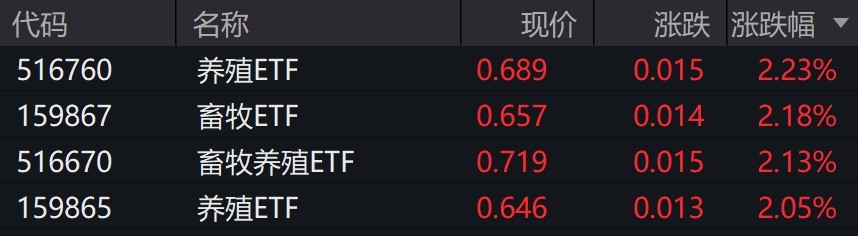
Group 1 - Livestock-related stocks have strengthened, with TianKang Biological rising over 7%, BioShares up over 3%, and MuYuan, HaiDa Group, and LiHua shares each increasing over 2% [1] - Livestock-related ETFs have also seen gains, with an increase of over 2% [1] Group 2 - Several ETFs related to livestock are showing positive performance, with the following price changes: - 516760 Livestock ETF: 0.689 (+2.23%) - 159867 Animal Husbandry ETF: 0.657 (+2.18%) - 516670 Livestock Farming ETF: 0.719 (+2.13%) - 159865 Livestock ETF: 0.646 (+2.05%) [2] - Analysts indicate that the reduction in pig production capacity is beginning to show results, and after a prolonged period of industry losses, cash pressure is significant, limiting short-term capacity expansion [2] - It is expected that pig prices will gradually rise in the second half of 2026, although challenges remain in cost control related to raw materials, animal diseases, and environmental regulations [2] - As the proportion of group farming enterprises increases, the impact of capacity changes on prices is expected to become less pronounced, leading to a more stable overall market capacity and smoother fluctuations in the pig cycle [2]

农产品日报-20251212
Guo Tou Qi Huo· 2025-12-12 11:10
| | | | | 操作评级 | 2025年12月12日 | | --- | --- | --- | | 显一 | なな☆ | 杨蕊霞 农产品组长 | | | | F0285733 Z0011333 | | 豆粕 | ★☆☆ | 吴小明 首席分析师 | | 豆油 | ななな | F3078401 Z0015853 | | 棕榈油 | ななな | 董甜甜 高级分析师 | | 薬粕 | ☆☆☆ | F0302203 Z0012037 | | 薬油 | な☆☆ | 宋腾 高级分析师 | | 五米 | ななな | F03135787 Z0021166 | | 生猪 | ななな | | | 鸡蛋 | ★☆☆ | 010-58747784 | | | | gtaxinstitute@essence.com.cn | 【豆一】 国产大豆从高位回落,盘面也在进行移仓。本周进口大豆方面市场担心通过进度放缓带动豆类价格走强,国产 大豆也被带动,价格冲高之后高位出现获利了结。本周政策端购销双向全部成交,成交均价在4110元/吨。国产 大豆现货端坚挺稳定,市场参与主体也在收购大豆。短期持续关注政策和现货端的表现。 【大豆&豆粕】 国 ...
京基智农控股股东及高管减持后抛回购计划:现金短债比低至0.53 猪价下滑再度考验业绩
Xin Lang Cai Jing· 2025-12-12 10:34
Group 1 - The controlling shareholder of Jingji Zhino disclosed a reduction in holdings, cashing out a total of 604 million yuan over three months, while management also engaged in a round of selling shares from September to November [1][2] - Following the share reductions, Jingji Zhino announced a share repurchase plan of 100 million to 200 million yuan, raising questions about its effectiveness in stabilizing the stock price amid the controlling shareholder's debt pressures [1][3] - The company's main business has shifted to pig farming due to the decline in real estate operations, and the significant drop in pig prices since October poses a challenge to its performance [1][6] Group 2 - Jingji Group reduced its stake from 53.11% to 50.33%, selling 2.78% of its shares, which equates to a cash inflow of approximately 178 million yuan from recent transactions [2][3] - Management's share reductions totaled 6.79 million yuan during the same period, indicating a broader trend of insider selling [2] - The share repurchase plan aims to utilize self-funding and/or self-raised funds, with a target to buy back between 421.94 million and 843.88 million shares, representing 0.80% to 1.59% of the total share capital [3] Group 3 - Jingji Group's high debt ratio of 64.08% and significant pledged shares indicate financial strain, with upcoming debt repayments of 699 million yuan and 973 million yuan due in the next six months and six months to one year, respectively [4][5] - Jingji Zhino's financial health is also under pressure, with a cash-to-short-term debt ratio of 0.53 and a current ratio of 0.49, raising concerns about the impact of the share buyback on its operations [5][6] - The company's revenue and net profit are projected to decline significantly in 2024, with a 52% drop in revenue and a 59.13% decrease in net profit, primarily due to the transition from real estate to pig farming [5][6] Group 4 - The pig farming business is expected to face challenges as pig prices have fallen below cost, with October and November prices at 11.87 yuan and 12.44 yuan per kilogram, respectively, indicating potential losses ahead [7][8] - The company's reliance on the pig cycle for future performance raises concerns, especially given the failed fundraising efforts aimed at expanding pig farming capacity [7][8]

农产品日报-20251211
Guo Tou Qi Huo· 2025-12-11 11:20
1. Report Industry Investment Ratings - Soybean: ★☆☆ (One star, representing a bullish bias but limited operability on the trading floor) [1] - Soybean Meal: ★☆☆ (One star, representing a bullish bias but limited operability on the trading floor) [1] - Soybean Oil: ★★★ (Three stars, representing a clearer bullish trend and relatively appropriate investment opportunities) [1] - Palm Oil: ★★★ (Three stars, representing a clearer bullish trend and relatively appropriate investment opportunities) [1] - Rapeseed Meal: ★☆☆ (One star, representing a bullish bias but limited operability on the trading floor) [1] - Rapeseed Oil: ★★★ (Three stars, representing a clearer bullish trend and relatively appropriate investment opportunities) [1] - Corn: ★★★ (Three stars, representing a clearer bullish trend and relatively appropriate investment opportunities) [1] - Live Pigs: ★★★ (Three stars, representing a clearer bearish trend and relatively appropriate investment opportunities) [1] - Eggs: ★☆☆ (One star, representing a bullish bias but limited operability on the trading floor) [1] 2. Core Views - The domestic soybean market is strong, with policy - side trading showing full - volume transactions and a strong price difference compared to imported soybeans. Short - term focus should be on policy and spot - end performance [2] - German biofuel policy changes may marginally improve palm oil demand, but the high inventory in the Malaysian market cannot be ignored, and palm oil is expected to fluctuate [3] - The domestic market continues with the logic of slow import soybean customs clearance. The soybean and soybean meal futures show different trends, and attention should be paid to US soybean exports and South American weather [5] - Rapeseed meal futures decline slightly, while rapeseed oil futures rise. The rapeseed market is expected to remain strong domestically and weak overseas in the short term [6] - Corn futures are generally oscillating strongly. Attention should be paid to the grain transportation progress in the Northeast and corn and wheat auctions [7] - Live pig futures continue to weaken, and the market is expected to face a second bottom - testing next year [8] - Egg futures have significant position - reduction, and the medium - long - term fundamentals are expected to improve gradually [9] 3. Summary by Commodity Soybean - Domestic soybeans are strong. Policy - side trading has full - volume transactions with an average price of 4110 yuan/ton. The price difference between domestic and imported soybeans is widening. Short - term focus on policy and spot - end [2] Soybean & Soybean Meal - The domestic market follows the slow - clearance logic of imported soybeans. The 01/03 contracts of Dalian soybean futures rise, and the 05 contract is flat. The USDA December report has no adjustment to US soybean data. The US soybean futures are weak. Wait for South American weather changes, be bullish on near - month contracts, and consider going long on the 05 contract at low prices [5] Soybean Oil & Palm Oil - German biofuel policy changes may affect the demand structure. The marginal demand for palm oil is expected to improve, but the high - inventory pressure in the Malaysian market exists. Palm oil is expected to fluctuate [3] Rapeseed Meal & Rapeseed Oil - Rapeseed meal futures decline slightly, and rapeseed oil futures rise. The rapeseed market is expected to be strong domestically and weak overseas in the short term. Pay attention to rapeseed import changes [6] Corn - Corn futures are generally oscillating strongly. Northeast and North Port corn spot prices are stable, while downstream procurement shows different trends. The 03 contract may have a weak correction, and the 05 contract can be considered for long - position layout at low prices [7] Live Pigs - Live pig futures continue to weaken, while the spot market is generally stable. After short - term trading on epidemic issues, the market returns to the oversupply logic. A second bottom - testing is expected next year [8] Eggs - Egg futures have significant position - reduction and small price fluctuations. The spot price is stable with some local increases. The short - term price expectation is downward, and the medium - long - term fundamentals are expected to improve [9]
养殖行业2025年度总结及未来展望
Lian He Zi Xin· 2025-12-11 11:12
Investment Rating - The report indicates a stable investment outlook for the pig farming industry, with expectations of gradual price recovery in the latter half of 2026 after a period of low profitability and cash flow challenges [2][25]. Core Insights - The pig farming industry in China is experiencing a prolonged "pig cycle" with increasing scale among enterprises and farmers, leading to enhanced resilience during downturns. Despite a slight decrease in the breeding sow inventory by the end of September 2025, supply remains within a reasonable range, with expectations of a relaxed supply-demand balance in the first half of 2026, potentially putting pressure on prices [2][25]. - The industry has seen a rise in concentration due to policy drivers and the impact of African swine fever, although it still remains at a relatively low level, contributing to significant cyclical volatility [4][5]. - The report highlights that the pig price fluctuations are influenced by the breeding sow inventory, which serves as a leading indicator for future supply. The current inventory is at the upper limit of the reasonable control zone, suggesting a potential tightening of supply in the latter half of 2026 [5][11]. Summary by Sections Industry Overview - The Chinese pig farming industry is a major contributor to the livestock sector, accounting for over 50% of both production and value. The market size reached 1.51 trillion yuan in 2024 [4]. - The concentration of the industry has increased, with the top 20 companies accounting for 27.63% of the national output, yet many small farmers still exist, leading to significant fluctuations in production [4]. Production, Output, and Price Analysis - The current pig cycle began in Q2 2022, with a recovery in prices and an increase in breeding sow inventory. By September 2025, the inventory was 40.35 million, still within the reasonable control zone [5][11]. - The report notes that the output of pigs has been increasing, with 2022 and 2023 seeing outputs of 700 million and 727 million pigs respectively, but growth rates are declining [11][10]. Upstream and Feed Price Analysis - The feed industry is crucial for pig farming, with raw material costs comprising 75-80% of feed production costs. Recent trends show a decline in grain and feed prices, alleviating some cost pressures for farmers [16][18]. - The pig-to-feed price ratio is a critical indicator of profitability, with a ratio of 6.00-7.00 indicating a break-even point for farmers. The ratio has fluctuated significantly in recent years, reflecting the volatility in both pig and feed prices [19][19]. Industry Policy - The government has implemented policies to stabilize pig production and control capacity, aiming to reduce the volatility of pig prices and enhance industry concentration [21][23]. - Recent measures include a reduction in breeding sow inventory targets and stricter controls on output weights to manage supply effectively [23][24]. Future Outlook - The report anticipates that the pig price will gradually rise in the latter half of 2026 due to a tightening supply following a period of capacity reduction. However, challenges remain in cost control related to raw materials and disease management [25][26]. - The industry is expected to stabilize as larger, more efficient farming operations increase their market share, leading to a smoother price cycle in the future [27].
二次递表的牧原食品通过港股聆讯,猪肉下跌行情下突击分红50亿元
Guan Cha Zhe Wang· 2025-12-11 03:05
Core Viewpoint - Muyuan Foods is one step away from achieving its "A+H" stock layout after passing the Hong Kong Stock Exchange hearing, despite facing challenges in the pork market and significant debt levels [1][4]. Financial Performance - In the first half of the year, Muyuan Foods reported a revenue increase of 34.46% but a staggering net profit growth of 1169.77%, reaching 10.53 billion yuan [1]. - For the first three quarters of 2023, the company achieved a revenue of 111.79 billion yuan, with a year-on-year growth of 15.52%, and a net profit of 14.779 billion yuan, reflecting a 41.01% increase [1]. - The average selling price of pork decreased by 5.6% to 15.2 yuan/kg in the first half of the year, marking the lowest price level during the reporting period [2]. Dividend Distribution - Muyuan Foods distributed over 5 billion yuan in dividends to shareholders, marking it as one of the most generous dividend distributions in the pork industry this year [1][2]. - Over the past year, the company has distributed more than 12.5 billion yuan in dividends, with the largest shareholder, Qin Yinglin, set to receive approximately 4.921 billion yuan from these distributions [3]. Debt Levels - As of June 30, Muyuan Foods had a debt ratio of 56.06%, with total liabilities amounting to 104.52 billion yuan [3]. - By the end of September, the debt ratio decreased to 55.5%, with total liabilities reduced by approximately 9.8 billion yuan since the beginning of the year [3]. Market Conditions - The average price of live pigs in early December fell to 12.21 yuan/kg, a year-on-year decline of 27.8%, while the average price of piglets dropped to 23.71 yuan/kg, down 29.6% year-on-year [2]. - The company’s slaughter volume reached 11.415 million heads in the first half of the year, representing a 10.8% increase compared to the same period last year [2]. Expansion Plans - Muyuan Foods is exploring overseas markets, having signed a cooperation agreement with BAF Vietnam Agricultural Joint Stock Company to build and operate livestock farming projects in Vietnam [4]. - The management believes that replicating its technology and production systems in overseas markets will yield good profits, with future capital expenditures expected to be lower than domestic levels [4].

生猪年报:供应前高后低磨底寻转机
Chang Jiang Qi Huo· 2025-12-08 12:55
1. Report Industry Investment Rating - Not provided in the content 2. Core Views of the Report - The year 2026 is expected to be in the bottom - grinding stage of the downward cycle, and the industry needs thorough capacity clearance to enter the upward cycle [1][12][55] - Supply in 2026 will be high in the first half and low in the second half, with significant pressure in the first quarter. The high average weight of live pigs and concentrated pre - holiday slaughtering will suppress price increases during the peak season [2][54][56] - In 2026, as the "14th Five - Year Plan" begins, the warming macro - economy and improved pork cost - effectiveness will drive a moderate increase in pork demand, but the increase is restricted by the macro - economic recovery and consumer confidence [2][40][56] - Feed costs will continue to fluctuate at a low level in 2026, and the industry will continue to reduce costs and increase efficiency, with the expected full cost dropping to around 12 yuan/kg [3][49][56] - Policies will continue to guide the orderly exit of production capacity and stabilize prices. If the pig price drops sharply below 5:1 in 2026, policy support measures such as state reserves will be implemented [3][51][57] 3. Summary by Relevant Catalogs 3.1 Market Review - In 2025, the pig market price was under pressure due to over - supply. The national live pig slaughter price fluctuated between 10.81 yuan/kg and 16.23 yuan/kg, and the futures showed a pattern of limited rebound and downward oscillation [7] - From January to February, the price fluctuated and declined. After the Spring Festival in February, the spot price quickly dropped to 14.5 yuan/kg, and then stopped falling and oscillated. The futures were relatively strong [7] - From March to June, the price fluctuated within a narrow range. After the festivals in April, the price decreased due to strong supply and weak demand. In June, it stopped falling and rebounded [8] - From July to December, the price trended downward. In September, the pig - grain ratio fell below 6:1. On December 5, the price dropped to 11.1 yuan/ton, a 31.6% decline from the beginning - of - year high [9] 3.2 Fundamental Analysis 3.2.1 Pig Cycle - Since 2006, China has experienced about four complete pig cycles. The fifth cycle lasted about 23 months. If 2024 March is the starting point of a new cycle, as of November 2025, the decline stage has reached 15 months [12] - Compared with the fifth cycle, the current cycle's loss time and amplitude in the breeding sector are still insufficient. The industry needs more losses to drive thorough capacity clearance, and 2026 is expected to be in the bottom - grinding stage of the downward cycle [12][55] 3.2.2 Supply Side - **Accelerated culling of sows but still above the normal level**: Before September 2025, the culling of sows was slow. After September, under policy pressure and losses, the culling accelerated. As of October, the official sow inventory was 3990 million, still 2.31% above the normal level [17][19] - **Optimized sow inventory structure and improved production performance**: The proportion of binary sows has increased to 95%. In 2025, the industry's production performance continued to improve. The increase in production performance will offset some of the impact of capacity culling and increase potential supply in 2026 [25][26] - **Increasing number of piglets and high supply pressure in Q1 2026**: Since February 2025, the number of new - born piglets has increased. Based on piglet and feed data, the supply pressure from December 2025 to Q1 2026 is high [30] - **Higher average slaughter weight and short - term pressure to be released**: In 2025, the influence of secondary fattening decreased. The high average weight of live pigs reflects high supply pressure. Before the Spring Festival, the concentrated slaughter of large - scale farms and big pigs may form a "double pressure" [33][34] 3.2.3 Demand Side - **Steady growth in demand driven by macro - economic recovery and cost - effectiveness**: In 2025, the macro - economy had a weak recovery, consumer confidence was low, and pig demand was weak. In 2026, the improvement of the macro - economy and the cost - effectiveness of pork will drive the growth of pork consumption, but the increase is restricted by the macro - economic recovery and consumer confidence [40][41][56] - **Seasonal demand still exists but with milder fluctuations**: In 2025, the seasonal demand boost was short - lived and weak. In 2026, the Spring Festival is postponed, and the change in the industrial pattern will further weaken the peak - season characteristics [42] - **High frozen - product inventory and limited support for consumption**: The current high frozen - product inventory will suppress supply before and after the peak season [2][56] 3.2.4 Cost Side - In 2025, the feed price was low, and the average full cost of listed companies in September/October dropped to 12.69 yuan/kg [49] - In 2026, the feed cost will continue to fluctuate at a low level, and the industry is expected to reduce the full cost to around 12 yuan/kg [50][56] 3.2.5 Policy Side - In 2025, multi - dimensional anti - involution policies were introduced to control production capacity, weight, secondary fattening, and strengthen environmental protection, aiming to guide the industry towards high - quality development [51][52] - The policy requires the reduction of sow inventory to below 3900 million by the end of January 2026, which can control the supply of live pigs in 2026 from the source [51] - In the future, policies will continue to guide the orderly exit of production capacity and stabilize prices. If the pig price drops sharply below 5:1 in 2026, policy support such as state reserves will be provided [52][57] 3.3 Outlook - Before the first half of 2026, supply will remain high, and the price during the peak season is not optimistic. The price in the first half of the year will be under pressure, and it may be relatively strong in the second half, but caution is needed due to cost reduction [57] - In terms of strategies, under supply pressure, short - term contracts should be shorted on rebounds, and long - term contracts should be cautiously bullish. The industry can hedge on rallies before effective capacity reduction [57]