
股债跷跷板

Search documents
国债期货日报:股债跷跷板明显,国债期货全线收跌-20251126
Hua Tai Qi Huo· 2025-11-26 03:24
Report Industry Investment Rating No relevant information provided. Core Viewpoints The stock - bond seesaw is obvious, and Treasury bond futures closed down across the board. Driven by the strong stock market, the rising risk appetite suppresses the bond market. There are also differences in the Fed's interest - rate cut expectations, and the increasing global trade uncertainty adds to the uncertainty of foreign capital inflows. Overall, the bond market fluctuates between stable - growth and easing expectations, and short - term attention should be paid to the policy signals at the end of the month [1][3]. Summary by Directory 1. Interest Rate Pricing Tracking Indicators - **Price Indicators**: China's CPI (monthly) had a 0.20% month - on - month and year - on - year increase, while China's PPI (monthly) had a 0.10% month - on - month increase and a - 2.10% year - on - year decrease [9]. - **Monthly Economic Indicators**: The social financing scale was 437.72 trillion yuan, with a 0.64 - trillion - yuan increase (0.15%) month - on - month. M2 year - on - year was 8.20%, down 0.20% (- 2.38%) month - on - month. The manufacturing PMI was 49.00%, down 0.80% (- 1.61%) month - on - month [10]. - **Daily Economic Indicators**: The US dollar index was 99.81, down 0.39 (- 0.39%) day - on - day. The offshore US dollar - to - RMB exchange rate was 7.0944, down 0.012 (- 0.16%) day - on - day. SHIBOR 7 - day was 1.43, down 0.01 (- 0.97%) day - on - day. DR007 was 1.45, down 0.02 (- 1.10%) day - on - day. R007 was 1.51, down 0.02 (- 1.24%) day - on - day. The 3 - month inter - bank certificate of deposit (AAA) was 1.58, up 0.01 (+ 0.44%) day - on - day. The AA - AAA credit spread (1Y) was 0.09, up 0.00 (+ 0.44%) day - on - day [10]. 2. Treasury Bonds and Treasury Bond Futures Market Overview - **Macro Policy**: On October 27, the central bank restarted open - market Treasury bond trading operations. On October 30, the China - US economic and trade teams reached three consensuses. The State Council Tariff Commission announced to continue suspending the 24% additional tariff on US goods for one year, while retaining the 10% tariff [1]. - **Inflation**: In October, CPI increased by 0.2% year - on - year [1]. - **Market Closing Prices and Fluctuations**: On November 25, 2025, the closing prices of TS, TF, T, and TL were 102.42 yuan, 105.98 yuan, 108.22 yuan, and 115.16 yuan respectively, with fluctuations of 0.01%, 0.00%, - 0.08%, and - 0.33% respectively [3]. - **Net Basis Spreads**: The average net basis spreads of TS, TF, T, and TL were - 0.056 yuan, - 0.066 yuan, - 0.088 yuan, and - 0.025 yuan respectively [3]. 3. Money Market Funding Situation - **Fiscal Situation (January - October 2025)**: General public budget revenue increased by 0.8% year - on - year, with tax revenue improving for eight consecutive months, but non - tax revenue dragging down the overall growth rate. General public budget expenditure increased by only 2% year - on - year, slowing down for three consecutive months, mainly due to the lack of follow - up force from the front - loaded fiscal efforts in the first half of the year and the weakening of infrastructure expenditures [2]. - **Financial Situation**: At the end of October, social financing and credit expanded at a low level, with strong government bond issuance and weak corporate and household financing demand. M1 declined, and the M2 - M1 gap widened, indicating weak business vitality and a return from current to time deposits [2]. - **Central Bank Operations**: On November 25, 2025, the central bank conducted 3021 billion yuan of 7 - day reverse repurchase operations at a fixed interest rate of 1.4% [2]. - **Money Market Interest Rates**: The main repurchase rates for 1D, 7D, 14D, and 1M were 1.316%, 1.433%, 1.540%, and 1.520% respectively, and the repurchase rates had recently declined [2]. 4. Spread Situation - **Inter - period Spreads of Treasury Bond Futures**: The report mentions various inter - period spreads of Treasury bond futures, such as 4*TS - T, 2*TS - TF, etc. [29][33] - **Implied Yields and Basis Spreads**: It provides information on the implied yields and basis spreads of different - term Treasury bond futures (2 - year, 5 - year, 10 - year, and 30 - year) [36][48][55][62]. 5. Two - Year Treasury Bond Futures - **Implied Interest Rate and IRR**: The report shows the relationship between the implied interest rate of the two - year Treasury bond futures main contract and the Treasury bond yield, as well as the relationship between the TS main contract's IRR and the funding rate [36][37]. - **Basis Spread Trends**: It presents the three - year basis spread and net basis spread trends of the TS main contract [46]. 6. Five - Year Treasury Bond Futures - **Implied Interest Rate and IRR**: The relationship between the implied interest rate of the five - year Treasury bond futures main contract and the Treasury bond yield, and the relationship between the TF main contract's IRR and the funding rate are provided [48]. - **Basis Spread Trends**: The three - year basis spread and net basis spread trends of the TF main contract are shown [52]. 7. Ten - Year Treasury Bond Futures - **Implied Yield and IRR**: The report shows the relationship between the implied yield of the ten - year Treasury bond futures main contract and the Treasury bond yield, and the relationship between the T main contract's IRR and the funding rate [55]. - **Basis Spread Trends**: The three - year basis spread and net basis spread trends of the T main contract are presented [57]. 8. Thirty - Year Treasury Bond Futures - **Implied Yield and IRR**: The relationship between the implied yield of the thirty - year Treasury bond futures main contract and the Treasury bond yield, and the relationship between the TL main contract's IRR and the funding rate are provided [62][65]. - **Basis Spread Trends**: The three - year basis spread and net basis spread trends of the TL main contract are shown [68]. Strategies - **Single - sided Strategy**: With the decline in repurchase rates, Treasury bond futures prices fluctuate [4]. - **Arbitrage Strategy**: Pay attention to the decline in basis spreads [5]. - **Hedging Strategy**: There is medium - term adjustment pressure, and short - side investors can use far - month contracts for appropriate hedging [5].
宁证期货今日早评-20251126
Ning Zheng Qi Huo· 2025-11-26 01:56
Key Points of Investment Analysis 1. Report Industry Investment Ratings No specific industry investment ratings are provided in the given content. 2. Core Views - OPEC+ maintains an increasing production stance, global economy and demand are weak, and new peace talks between Russia and Ukraine ease geopolitical risks, leading to a weakening trend in international oil prices [1]. - The potential end of the Russia - Ukraine conflict is favorable for risk appetite and negative for gold, but increased expectations of Fed rate cuts make gold oscillate upwards in the short - term and may oscillate at a high level in the medium - term [2]. - The domestic lithium market may face weakening fundamentals in the future, and short - term lithium prices may struggle to maintain a strong trend [4]. - The steel market has no obvious supply - demand contradiction recently, and short - term steel prices may oscillate upwards, but the upside is limited due to weak demand in the off - season [4]. - The cost of ferrosilicon remains high, but the market supply - demand is still loose, and the price is expected to run at a low level around the cost [5]. - The overall supply of pigs exceeds demand, and the short - term LH2601 contract still has downward pressure [6]. - The supply of soybean meal is abundant, and the demand is limited, so the short - term 01 contract will maintain an oscillating pattern [6]. - The export of Malaysian palm oil has declined, and the short - term near - month contract will run weakly [7]. - The supply - demand structure of PTA is relatively good in the short - term, but it is advisable to wait and see due to the weakening trend of crude oil [7]. - The natural rubber market is expected to oscillate weakly [8]. - The bond market is favorable in the medium - term but with increased operation difficulty, and attention should be paid to the stock - bond seesaw effect [9]. - The market's expectation of a Fed rate cut in December has increased to 80%, and silver will oscillate in the short - term and remain bullish in the long - term [10]. 3. Summaries by Product Crude Oil - As of November 21, 2025, US commercial crude oil inventories decreased by 1.86 million barrels, gasoline inventories increased by 539,000 barrels, and distillate inventories increased by 753,000 barrels [1]. - New peace talks between Russia and Ukraine have attracted market attention, and international oil prices are running weakly [1]. Gold - Trump's team has made great progress in ending the Russia - Ukraine conflict, and the conflict may end soon, which is negative for gold [2]. - Increased expectations of Fed rate cuts make gold oscillate upwards in the short - term and may oscillate at a high level in the medium - term [2]. Carbonate Lithium - The SMM battery - grade carbonate lithium index price is 92,462 yuan/ton, down 145 yuan/ton from the previous working day [4]. - The domestic lithium market may face weakening fundamentals in the future, and short - term lithium prices may struggle to maintain a strong trend [4]. Rebar - The blast furnace operating rate of 247 steel mills is 82.19%, down 0.62 percentage points from last week; the blast furnace iron - making capacity utilization rate is 88.58%, down 0.22 percentage points from last week [4]. - The steel market has no obvious supply - demand contradiction recently, and short - term steel prices may oscillate upwards, but the upside is limited due to weak demand in the off - season [4]. Ferrosilicon - The national inventory of 60 independent ferrosilicon enterprises is 73,050 tons, down 10.21% or 8,310 tons from the previous period [5]. - The cost of ferrosilicon remains high, but the market supply - demand is still loose, and the price is expected to run at a low level around the cost [5]. Live Pigs - On November 25, the average wholesale price of pork in the national agricultural product market was 17.72 yuan/kg, down 1.1% from the previous day [6]. - The overall supply of pigs exceeds demand, and the short - term LH2601 contract still has downward pressure [6]. Soybean Meal - As of November 25, the domestic soybean meal spot prices remained stable [6]. - The supply of soybean meal is abundant, and the demand is limited, so the short - term 01 contract will maintain an oscillating pattern [6]. Palm Oil - From November 1 - 25, the export volume of Malaysian palm oil decreased by 16.4% - 18.8% compared with the same period last month [7]. - The export of Malaysian palm oil has declined, and the short - term near - month contract will run weakly [7]. PTA - This week, the domestic PTA output is 141.98 million tons, down 3.09 million tons from last week and up 2.88 million tons from the same period last year [7]. - The supply - demand structure of PTA is relatively good in the short - term, but it is advisable to wait and see due to the weakening trend of crude oil [7]. Natural Rubber - The price of Thai raw material glue is 57 Thai baht/kg, and the price of cup glue is not available; the price of Hainan glue for whole - milk production is 16,100 yuan/ton [8]. - The natural rubber market is expected to oscillate weakly [8]. Long - term Treasury Bonds - An upcoming policy briefing may affect the bond market. The bond market is favorable in the medium - term but with increased operation difficulty, and attention should be paid to the stock - bond seesaw effect [9]. Silver - The market's expectation of a Fed rate cut in December has increased to 80%, and silver will oscillate in the short - term and remain bullish in the long - term [10].
【中金固收·信用】债市延续小幅震荡
Sou Hu Cai Jing· 2025-11-24 15:12
Market Overview - The bond market experienced slight fluctuations last week, with the long-end performing better than the short-end. The overall bond yields showed narrow movements, with the 10-year government bond yield rising by 1 basis point to 1.82% [2] - The issuance of non-financial credit bonds increased significantly, with a primary issuance volume of 409.6 billion yuan, up from 270.2 billion yuan the previous week. The net financing amount rose from 23.1 billion yuan to 132.4 billion yuan [2][3] Credit Bond Demand - Various institutional types showed net buying, although most experienced a decline compared to the previous period. Specifically, the net buying by wealth management decreased from 10.7 billion yuan to 5.5 billion yuan, while funds increased from 27 billion yuan to 34.5 billion yuan [3] - The net buying by insurance companies dropped from 8.2 billion yuan to 3.3 billion yuan, while other asset management institutions increased their net buying from 2.3 billion yuan to 10.3 billion yuan [3] Future Outlook - In the short term, the current market trend is expected to continue, but attention should be paid to stock market movements. A sustained decline in the stock market could lead to redemptions in fixed-income products, triggering bond sell-offs and upward pressure on yields [1][4] - The demand for credit bonds is anticipated to increase, particularly for bonds with maturities of 5-7 years, as a significant amount of amortized cost bond funds will enter the open period in the first half of 2026 [1][4] Issuance Analysis - This week, 418 non-financial credit bonds were issued, totaling 407.8 billion yuan, with a net increase of 130.6 billion yuan, marking a 51% rise in issuance volume and a 465% increase in net increase compared to the previous week [9] - The majority of net increases came from 1-3 year AAA-rated bonds, contributing 110 billion yuan in issuance and 45.1 billion yuan in net increase [9] Yield Trends - The issuance yields varied by rating and maturity, with AAA-rated bonds for maturities of 1 year or less, 1-3 years, and 3-5 years decreasing by 5 basis points, 8 basis points, and 8 basis points respectively [10] - For AA+ rated bonds, the yields for 1 year or less and 1-3 years changed by -3 basis points and 0 basis points, while 3-5 years saw an increase of 30 basis points [10]

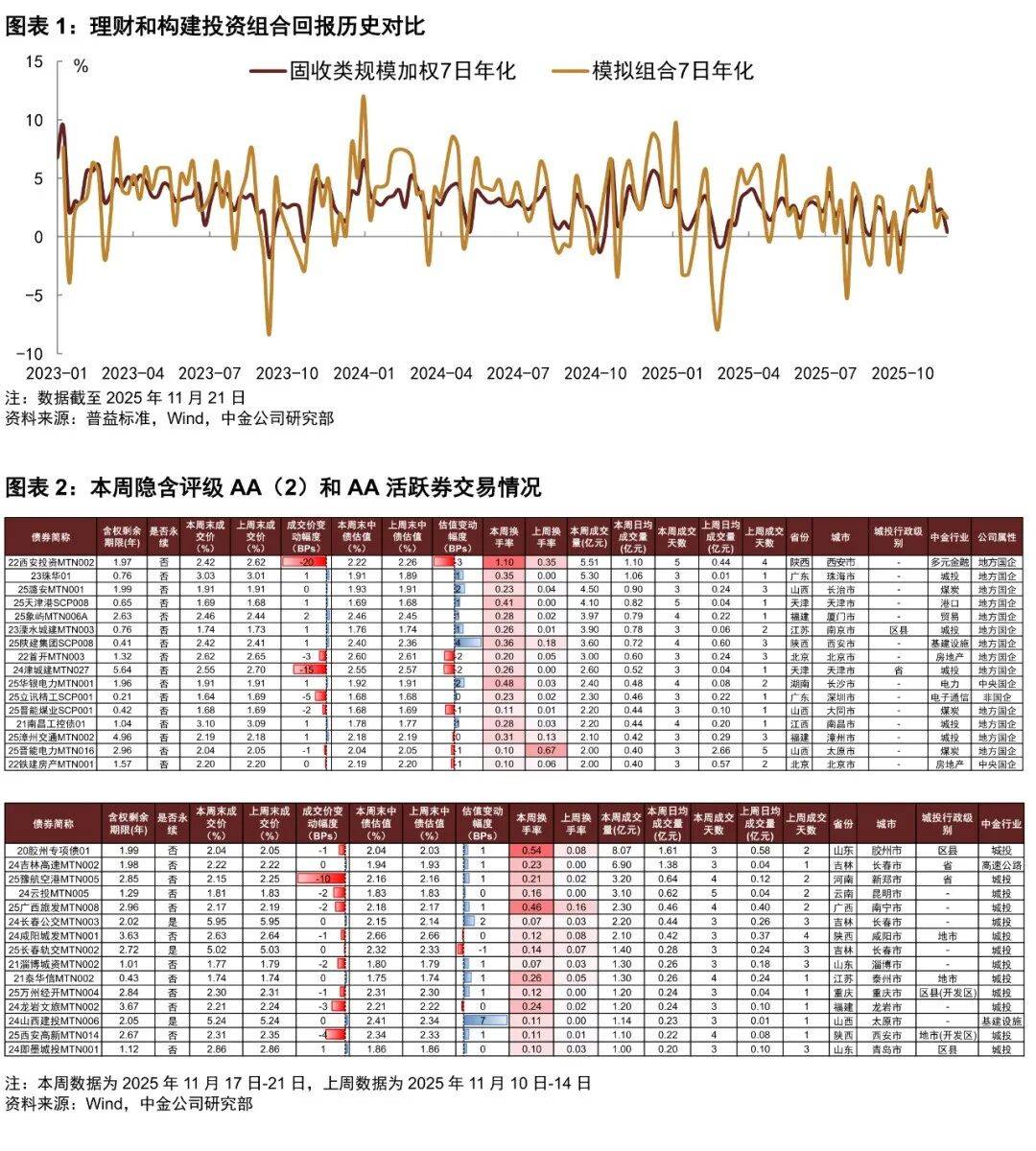
债券研究周报:债市情绪处于分歧之中-20251124
Guohai Securities· 2025-11-24 10:31
Report Overview - The report is a bond research weekly report dated November 24, 2025, analyzing the sentiment changes of bond market sellers and buyers in the latest week [1][5]. Industry Investment Rating - Not provided in the report. Core Viewpoints - From November 18 - 24, the bond market seller sentiment rose while the buyer sentiment declined again, with the two diverging, and the seller view divergence index also rose to a relatively high level. Despite the optimistic factors brought by the calendar effect, market sentiment remains contradictory and institutional caution persists [5]. Section Summaries 1. Seller Market Sentiment 1.1 Seller Market Interest - Rate Bond Sentiment Index - From November 18 - 24, the tracked unweighted index was 0.42, up 0.04 from November 11 - 17, and the proportion of market - bullish views increased. Currently, institutions generally hold neutral - to - bullish views: 2 are bullish, 7 are moderately bullish, 14 are neutral, and 1 is moderately bearish. 8% of institutions are bullish, citing factors such as economic fundamentals pressure, monetary policy easing expectations, seasonal patterns, and institutional scramble for allocation. 29% are moderately bullish, due to the deepening asset - shortage pattern, the central bank's restart of treasury bond trading, potential decline in risk appetite, and the year - end "calendar effect". 58% are neutral, as there is a tug - of - war between bullish and bearish factors, bond yields are in a range - bound oscillation, the market is in a "policy vacuum period", and the 10 - year treasury bond yield may fluctuate within the regulatory - approved range. 4% are moderately bearish, believing that the main logic is the lack of incremental funds in the bond market, the "stock - bond seesaw" effect may strengthen, and the bond market's easing environment is hard to sustain [6][13]. 1.2 Buyer Market Interest - Rate Bond Sentiment Index - From November 18 - 24, the tracked unweighted sentiment index was - 0.08, down from November 11 - 17. Currently, institutions generally hold neutral - to - bearish views: 2 are moderately bullish, 18 are neutral, and 4 are bearish. 8% of institutions are moderately bullish, based on monetary policy easing expectations, recovery in allocation demand, and potential decline in risk appetite. 75% are neutral, due to policy uncertainty, the asset - shortage pattern, a capped - and - floored market, lack of a one - sided main line, and the market entering a wait - and - see period. 17% are bearish, believing that policies fall short of expectations, structural interest rate cuts hit liquidity expectations, and policy guidance may divert funds to the equity market [7][14].
野村行业观察 | 段冰、高路延关于中国AI行业、利率策略的最新观点分享
野村集团· 2025-11-24 10:06
Group 1 - The core viewpoint is that despite the gap in AI computing power compared to overseas, China is leveraging its rich application scenarios and large user base to explore a differentiated path in AI development [2][3] - The rapid iteration of large model technology is highlighted as a key advantage for the domestic AI market, which can utilize vast consumer and enterprise data for quick application-level advancements [3][4] - China's unique advantage lies in the integration of AI applications with high-precision manufacturing, particularly in fields like autonomous driving and robotics, which is seen as a crucial breakthrough for the AI industry [3][4] Group 2 - The "stock-bond seesaw" effect is expected to continue in the short term, influenced by the current market's lack of a clear mainline [6] - The bond market is significantly affected by stock market sentiment, with daily fluctuations being minor as investors await clearer policy directions [6] - Key variables that could disrupt the current market dynamics include changes in liquidity, which may lead to rising bond yields if liquidity tightens suddenly [6]

债市对利多钝化,逢高再考虑介入
Sou Hu Cai Jing· 2025-11-24 08:53
一、债市策略总览 1.1 海外部分美国11月Markit综合PMI(54.8)创4个月以来新高,其中服务业PMI(55)供需两旺,而制 造业PMI(51.9)创4个月以来新低,主因需求放缓和成本上行压力。在借贷成本走低下,10月成屋销 售创八个月以来新高。劳动力数据喜忧参半,9月非农就业新增11.9万,远超预期,但7~8月合计下修 3.3万。劳动力参与率上升拉动9月失业率上行至4.44%,叠加时薪环比从前值0.3%降至0.2%,指向用人 需求放缓。此外,最新一周初请失业金人数虽下降,但续请人数创2021年10月以来新高,劳动力市场趋 弱压力犹存。威廉姆斯等票委表态偏鸽,带动12月CME降息预期从44.4%上行至71%,但在数据缺失 下,不排除12月暂停降息。日本10月核心CPI同比(3%)连续18个月高于2%,三季度GDP环比 (-0.4%)为六个季度以来首次负增,在滞胀压力下,政府推出21.3万亿日元刺激计划推升财政压力。 欧元区11月综合PMI初值(52.4)略低于预期,其中服务业扩张,制造业萎缩。在能源价格拖累下,欧 元区10月CPI同比(2.1%)较前值回落0.1个百分点。综合来看,在美国经济韧性+欧 ...
股弱债不强,意味着什么
GUOTAI HAITONG SECURITIES· 2025-11-23 12:19
股债定价各有独立逻辑,定价的结果或均偏向止盈。 投资要点: 市 场 策 略 周 报 股弱债不强,意味着什么 [Table_Authors] 唐元懋(分析师) 本报告导读: 证 券 研 究 报 告 | | 0755-23976753 | | --- | --- | | | tangyuanmao@gtht.com | | 登记编号 | S0880524040002 | | | 杜润琛(研究助理) | | | 021-38031034 | | | durunchen@gtht.com | | 登记编号 | S0880123090079 | | | 孙越(分析师) | | | 021-38031033 | | | sunyue6@gtht.com | | 登记编号 | S0880525080004 | [Table_Report] 相关报告 区间震荡行情延续 2025.11.22 美元流动性收紧何时缓解 2025.11.18 大行短端买入力度减弱 2025.11.18 本轮移仓有何特征和机会 20251117 2025.11.17 大行融出回落,存单发行提升,6M 期限最多 2025.11.17 请务必阅读正文之后 ...
固收周报:关注机构季节性配置会否开启-20251123
Yin He Zheng Quan· 2025-11-23 11:13
固收研究报告 关注机构季节性配置会否开启 —— 固收周报(11 月 17 日-11 月 21 日) 2025 证 11 证 22 证 ⚫ 本周债市回顾: 利率震荡回 升,收益率曲线走陡 本周( 11/17 -11/21 )债市收益率整体上行,主要受股债跷跷板、地缘影响与地产贴息 预期等影响 , 截至 11/21 ,30Y、10Y 、1Y 国债收益率分别变化 +1.85BP 、+0.57BP 、 -0.56BP 收于 2.16% 、1.82% 、1.40% ,30Y-10Y 、10Y -1Y 期限利差分别较上周变 化+0.69BP 、+1.22BP 收于 34.1BP 、41.6BP 。证证 10Y 证证证证证证证证证证证证 1证证证证证证证证证证证证证证证证证证证证 2证证证证证证证证证证证证 证 ⚫ 下周 债市展望: 临近月末关注资金面跨月情况 基本面来看, 证证证证证证证证证证证证证证证证证证证证证证证证证证证证证证证证 证证证证证证证证证证证证证证证证证证证证证证证证证证证证证证证证证证证证证证 证证证证证证证证证证证证证证证证证证证证证 证 后续关注 四方面变化: 1 )经济数据显示供需收缩,后续 P ...
债市不跟权益,自身或遇“十面埋伏”
ZHONGTAI SECURITIES· 2025-11-23 07:37
1. Report Industry Investment Rating - Not provided in the given content 2. Core View of the Report - The equity market has continued its style rotation this week, with technology stocks that rose significantly before the year experiencing continuous adjustments due to year - end profit - taking pressure and overseas market adjustments. The sudden hawkish stance of the Fed, better - than - expected employment data, and the "end - of - the - world options day" of stock index futures have further amplified market volatility. This week, there has been an unusual situation of "double - kill" in both the stock and bond markets, and the possibility of a "double - rise" in the stock and bond markets in December is not high as the bond market faces a shortage of incremental funds [1][2][3][6] 3. Summary of Related Catalogs Equity Market - **Adjustment Factors**: Technology stocks are adjusted due to year - end profit - taking pressure from absolute - return annuities and insurance funds, and the overseas market adjustment caused by concerns about high valuations in the AI sector and the lack of market response to Nvidia's earnings [1] - **Amplifying Factors**: The sudden hawkish stance of the Fed and better - than - expected employment data have made the market pessimistic about the Fed's December interest - rate cut, and the "end - of - the - world options day" of stock index futures has further amplified market volatility [2][3] Bond Market - **Weak Performance**: Since the end of the central bank's bond - buying transactions, the bond market has been in a state of weak oscillation and shrinking trading volume. The daily trading volume of long - term and ultra - long - term bonds has decreased from more than 5,500 transactions in September and October to more than 4,400 transactions in November. The slope of the central bank's short - end bond purchases in November is weaker than that in October [4][17] - **Buying and Selling Forces**: Insurance is the main buyer of long - term bonds, while securities firms are the main sellers. Insurance is pre - heating for the "good start" at the end of the year, and securities firms consider the risk - return ratio of large - exposure unilateral trading before the year - end assessment. Insurance funds have felt an increase in dividend - paying insurance and a weakening of investment in long - duration assets, and banks are more cautious in their investment behavior [4][19] - **Duration**: The fund duration has declined this week, basically erasing the increase from the end of October to early November. Interest - rate bond funds contribute the main decline, while short - end and credit bond funds are relatively stable. As of Friday, the latest reading of the duration of medium - and long - term bond funds is 3.41 years, dropping to the 28% percentile level for the year [5][21] - **Future Outlook**: The possibility of a "double - rise" in the stock and bond markets in December is not high as the bond market faces a shortage of incremental funds, the hedging trading logic lacks sustainable verification in liability behavior, and the trading and allocation difficulties in December have increased [6][24]
债市策略思考:权益长牛如何重塑转债格局?
ZHESHANG SECURITIES· 2025-11-20 05:05
Core Insights - The demand side indicates that the long bull market in equities, combined with the stock-bond seesaw effect, may lead to continued outflow of funds from the bond market, while the demand for convertible bonds remains resilient [1] - On the supply side, the prevalence of strong redemptions in convertible bonds is likely to continue, but issuance is expected to improve starting in 2026, leading to a potential new-old transition in market structure [1] - From a long-term perspective, convertible bonds are expected to enter a slow bull market alongside equities, but their performance is likely to be weaker than stocks and stronger than pure bonds [1] Demand Side Analysis - The stock-bond seesaw effect suggests that funds may continue to flow out of the bond market, with solid returns from equity markets driving this trend [2] - The core advantage of fixed income plus funds lies in their diversified asset allocation, which balances the risk-return characteristics of stocks and bonds [2] - Despite a slight outflow of funds recently, the demand for convertible bonds remains robust, with the share and scale of secondary bond funds significantly expanding in Q3 2025 [8] Supply Side Analysis - The convertible bond market saw a rapid contraction post-2015 bull market, with the market balance dropping to just 13.3 billion yuan by the end of 2015, a decrease of over 120 billion yuan from the previous year [11] - As the equity bull market continues, some existing convertible bonds will likely have strong redemption windows, and the prevalence of strong redemptions is expected to persist [11] - Starting in 2026, the issuance of convertible bonds is projected to improve, with an estimated supply of around 50-60 billion yuan, slightly better than in 2025 [16] Valuation and Market Dynamics - The historical valuation trends of convertible bonds generally follow the movements of the equity market, with the premium rate primarily driven by balanced and equity-oriented convertible bonds [19] - In a bull market for equities, investors may prefer balanced and equity-oriented convertible bonds to capture higher returns [19] - The current market faces challenges due to limited capacity for fund absorption and high price valuations, which compress the yield space for convertible bonds [19][20]