通胀对冲

Search documents
黄金持续刷新高点,央行储备量创历史新高|一财号每周思想荟(第38期)
Sou Hu Cai Jing· 2025-10-17 10:13
Group 1 - The central bank's gold reserves have reached a historical high, indicating a long-term strategic focus rather than short-term market reactions [1][2] - Gold serves as a crucial stabilizer in the national reserve system, complementing foreign exchange reserves and special drawing rights, due to its unique properties [2][3] - The continuous increase in gold reserves by central banks reflects a systematic hedge against the declining trust in the US dollar and the need for asset protection amid inflationary pressures [2][3] Group 2 - The current "gold rush" differs structurally from historical bull markets, with multiple central banks, including those from Russia and India, systematically increasing their gold holdings [3] - The rise of digital currencies and blockchain technology is reshaping the traditional monetary system, providing a new context for gold's value [3] - The participation in the gold market has broadened significantly, with retail investors and various financial instruments contributing to increased liquidity and price volatility [3]
黄金的“疯狂上涨”预示着“更大的事情”正在发生
美股IPO· 2025-10-17 02:08
Core Viewpoint - Gold serves as a hedge not only against currency devaluation but also against the entire financial system, including severe credit recessions and large-scale fiscal deficit monetization [1][4][5] Group 1: Gold's Performance and Demand - Gold prices have reached a historic high, surpassing $4,300 for the first time, with a year-to-date increase of over 60% [2][3] - The demand for gold is expected to remain high regardless of whether the market faces inflationary or deflationary shocks [6][11] Group 2: Misconceptions about Gold - The market often misunderstands gold as merely an inflation hedge; however, historical data shows that gold performs well in both low and high inflation scenarios [7][8] - Gold's returns do not solely correlate with rising inflation rates, as evidenced by its performance during the severe deflation of the 1930s [8] Group 3: Credit Market Risks - There is a significant risk of a major credit recession, with analysts suggesting that rising gold prices indicate an impending credit crisis [12][17] - The cost of borrowing in the private market has increased, indicating higher risks associated with lending [14][16] Group 4: Government Debt Concerns - Governments are facing unprecedented fiscal deficits, raising concerns about their ability to manage debt without resorting to currency printing [18][19] - The expectation that large fiscal deficits will eventually be monetized contributes to the rising demand for gold, as this action erodes the real value of fiat currency [19][20] Group 5: Future Implications for Gold - Regardless of whether the future economic shocks are inflationary or deflationary, gold is positioned to be a favored asset [23] - In the event of a credit crisis, the demand for high-quality collateral will increase, making gold a viable hedge against the potential devaluation of government debt [23][25]

贵金属缘何越来越“贵”,后续还能接着涨吗?
Sou Hu Cai Jing· 2025-10-13 17:58
Core Viewpoint - The rise in precious metal prices, particularly gold and silver, is driven by a combination of macroeconomic factors, geopolitical tensions, and supply-demand dynamics, indicating a long-term trend rather than a short-term fluctuation [1][5]. Group 1: Macro Financial Factors - Geopolitical tensions and increased uncertainty have heightened demand for gold as a safe-haven asset, particularly when investor risk appetite declines [2]. - The expectation of rising inflation enhances the attractiveness of precious metals as a hedge against inflation [4]. - Central banks have been increasing their gold reserves, which reduces market supply and supports prices [4][5]. Group 2: Supply and Demand Dynamics - Rising mining costs and scarcity of new mines are contributing to upward pressure on precious metal prices [2]. - Industrial demand for silver, particularly in sectors like photovoltaics and electronics, is expected to support silver prices [2][4]. - The cultural demand for physical gold and silver, especially in regions like Asia and India, remains robust [2]. Group 3: Market Sentiment and Technical Factors - A strong bullish sentiment in the market can lead to price acceleration if key resistance levels are breached [3]. - The presence of speculative and leveraged funds in the futures market can cause short- to medium-term price deviations from fundamental values [5]. Group 4: Price Path Scenarios - Scenario A: Continued upward trend with potential new historical highs, with optimistic mid-term targets for gold set at $4,900 per ounce by 2026 and silver potentially reaching over $50 per ounce by 2025 [7]. - Scenario B: A period of consolidation with possible short-term pullbacks but strong medium- to long-term support, with predictions of gold prices stabilizing around $3,675 per ounce by the end of 2025 [9]. - Scenario C: A significant correction could occur if investor risk appetite increases, leading to a potential decline in gold and silver prices, although a complete reversal is not widely anticipated in the near term [11][14].
比黄金涨得还猛!价格创14年新高
Sou Hu Cai Jing· 2025-10-10 08:16
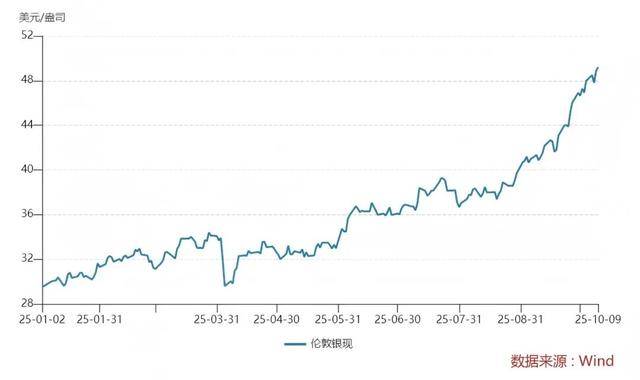
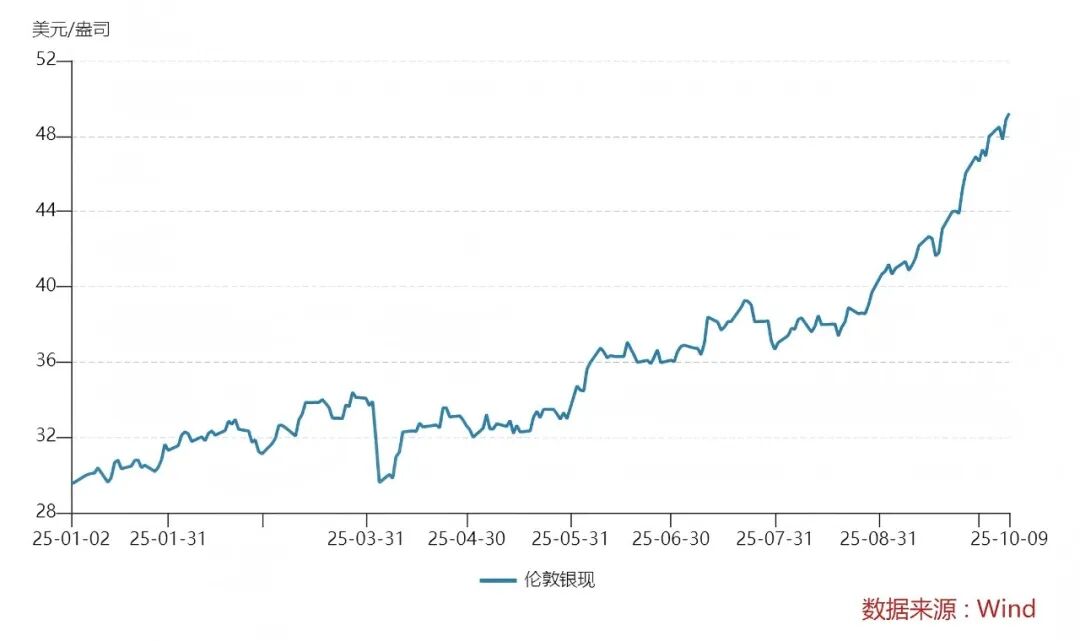
Core Insights - The spot silver price has surpassed $50 per ounce for the first time in history, marking a 14-year high with an intraday increase of over 4% [1] - Silver has shown a stronger year-to-date increase of over 70%, compared to gold's increase of over 50% [1] Group 1: Market Drivers - The recent surge in silver prices is driven by a combination of "financial attributes + industrial demand" [3] - Rising gold prices have led to a reevaluation of precious metals, with investors viewing silver as a leveraged inflation hedge [3] - Increased consumption of silver in industries such as renewable energy, photovoltaics, and electric vehicles has reinforced its dual role as both a "safe-haven asset" and an "industrial metal" [3] - Additional factors include rising expectations for Federal Reserve interest rate cuts, a weakening dollar, and heightened geopolitical risks, which have collectively pushed silver into a rapid upward trajectory [3] Group 2: Future Outlook - According to Citi's global commodity research head, both gold and silver are likely to continue their upward trends due to structural and cyclical tailwinds [4] - In the short term, silver may experience volatility and potential pullbacks after breaking the $50 per ounce mark, but the medium-term outlook remains solid [4] - The director of the China (Hong Kong) Financial Derivatives Investment Research Institute maintains a positive long-term outlook for silver prices, emphasizing the importance of risk management [4]
比黄金涨得还猛,它,价格创14年新高
3 6 Ke· 2025-10-10 07:27
Core Viewpoint - The price of spot silver has historically surpassed $50 per ounce for the first time, reaching $51 per ounce, marking a 14-year high with a daily increase of over 4% [1][3]. Price Movement - As of October 10, the spot silver price has slightly retreated to $49.73 per ounce [1]. - Year-to-date, spot silver has seen a cumulative increase of over 70%, while spot gold has risen by more than 50% [1]. Driving Factors - According to Li Gang, the recent surge in silver prices is driven by a combination of "financial attributes + industrial demand" [3]. - The rise in gold prices has led to a reevaluation of precious metals, with investors viewing silver as a leveraged inflation hedge [3]. - Strong demand from sectors such as renewable energy, photovoltaics, and electric vehicles has reinforced silver's dual role as both a "safe-haven asset" and an "industrial metal" [3]. - The expectation of interest rate cuts by the Federal Reserve, a weakening dollar, and increasing geopolitical risks have contributed to the liquidity and sentiment that propel silver prices upward [3]. Supply and Demand Outlook - A report from the World Silver Institute indicates that due to a 1% decline in demand and a 2% increase in total supply, the global silver deficit is expected to narrow by 21% to 117.6 million ounces by 2025 [4]. Future Price Predictions - Citi's global commodity research head, Maximilian Layton, has raised the three-month price forecast for silver from $45.00 per ounce to $55.00 per ounce, suggesting a continuation of the upward trend for both gold and silver [5]. - Li Gang anticipates that silver may experience some technical corrections after breaching the $50 per ounce mark, but the medium-term outlook remains strong, with expectations of silver trading between $47 and $55 per ounce over the next three months [5]. - Wang Hongying emphasizes the importance of risk control in investment strategies, suggesting that if silver prices experience a technical pullback, investors should consider building positions near key support levels, such as $46 per ounce, while maintaining strict risk management [5].
Why investors are flocking to silver and platinum, not just gold
Yahoo Finance· 2025-10-09 16:49
Core Insights - The rally in precious metals, particularly silver and platinum, indicates a broader trend towards hard assets as investors seek tangible stores of value amid geopolitical uncertainties [4][8] - Silver prices have surged 69% year-to-date, reaching around $49 per ounce, while platinum has increased by 83%, trading near $1,660 per ounce [1][2] - Gold has also seen significant gains, up 54% this year, with prices surpassing $4,000 per ounce [3] Group 1: Market Dynamics - The current market shift reflects a transition from speculative investments to structural demand for precious metals, driven by a desire for security in an increasingly fragmented world [4][6] - Central banks are engaging in unprecedented gold buying, indicating a long-term structural demand for real assets rather than short-term speculative trading [6][8] Group 2: Geopolitical Influences - The erosion of trust in traditional safe havens, such as the US dollar and Treasuries, is prompting both institutional and sovereign investors to seek alternatives outside the conventional financial system [5] - Geopolitical tensions, particularly the West's sanctions against Russia, have intensified the appeal of gold and other precious metals as safe-haven assets [5][7]
金价创历史新高!北京黄金消费“量价齐飞” 年轻人买金饰当“理财” 买涨不买跌成共识
Hua Xia Shi Bao· 2025-10-07 01:07
Core Viewpoint - Recent surge in gold prices has not deterred consumer demand, with significant sales activity observed during the National Day and Mid-Autumn Festival in Beijing [1][3][4]. Market Trends - International gold prices fluctuated around $3,900 per ounce during the holiday, briefly dipping on October 2 before rising to $3,912 on October 3 [1]. - Despite gold prices exceeding 1,130 CNY per gram, foot traffic in jewelry stores remained high, indicating strong consumer interest [1][3]. - Sales of lightweight gold jewelry and investment gold bars have been particularly strong, with a notable increase in customer engagement in major shopping districts [3]. Consumer Behavior - The primary demographic purchasing gold includes middle-aged and older consumers, who prefer lightweight gold items that combine wearability and value retention [3]. - Newlyweds are also a significant consumer group, with a 15% increase in orders for gold wedding sets compared to August [4]. - The prevailing consumer sentiment is characterized by a "buy high" mentality, driven by the perception of rising gold prices [4]. Investment Demand - Investment demand for gold has surged, with a 40% year-on-year increase in sales of the 2025 edition Panda gold coin set [4]. - Global gold demand reached 2,385 tons in the first half of 2023, up from 2,114 tons in the same period last year, indicating robust investment interest [4][5]. Economic Factors - The recent U.S. government shutdown has heightened demand for gold as a safe-haven asset, as investors seek to hedge against economic uncertainty [7][8]. - Historical data suggests that prolonged government shutdowns typically lead to increased gold prices due to rising uncertainty and potential dollar weakness [12]. Future Outlook - Analysts predict that gold prices will continue to be influenced by U.S. debt issues, geopolitical tensions, and central bank purchasing activities [12]. - The long-term outlook for gold remains positive, with expectations of significant upward movement driven by ongoing economic and political uncertainties [12].
Inflation Pressures Reignite Gold vs. Bitcoin Debate
Etftrends· 2025-10-06 22:53
Core Insights - There is increasing demand for investment products that can help investors navigate potential volatility due to uncertainties in near-term U.S. growth and persistent inflationary pressures [1] Investment Options - Gold is a traditional choice for investors seeking to hedge against inflation, functioning as a store of value with limited supply and low correlation to currency fluctuations [2] - Bitcoin is emerging as an alternative investment that also offers a store of value, limited supply, and low currency correlation, leading to ongoing debates about its viability compared to gold during inflationary periods [3] Comparative Analysis - Both gold and bitcoin serve as effective inflation hedges, but they differ in terms of long-term growth potential and volatility, suggesting that a combination of both could provide a diversified approach to inflation protection [4] Product Overview - The Calamos Bitcoin 90 Series Structured Alt Protection ETF (CBXY) offers investors access to bitcoin through an ETF structure, utilizing an options strategy to track bitcoin's price performance with an initial upside cap of approximately 24% [5] - CBXY provides downside protection, limiting overall losses to 10% during the fund's outcome period, which is particularly valuable given bitcoin's historical volatility [6] Strategic Integration - CBXY can complement a gold investment strategy, allowing investors to hedge against inflation while managing risk through the unique characteristics of both assets [7]
Gold Isn't the Only Metal That's Shining—Silver and Platinum Prices Are Surging Too
Investopedia· 2025-10-03 19:45
Group 1 - The price of gold is on track to achieve its highest yearly return in nearly 50 years, with a significant surge this year, while silver and platinum have also seen substantial gains, with silver reaching its highest historical value and platinum outperforming gold [1][5][8] - The gains in precious metals reflect a global financial market characterized by policy uncertainty, inflation concerns, and a looming U.S. government shutdown, leading investors to seek safe-haven assets [2][4][8] - The Federal Reserve's potential interest rate cuts may further support demand for precious metals by reducing competition from income-generating assets [3][4] Group 2 - Gold has increased by 48% year-to-date, trading near $3,900 per troy ounce, while silver has gained approximately 65% and is trading near $48 per troy ounce, surpassing its 2011 peak [5][6] - Platinum has shown remarkable performance with a nearly 80% year-to-date return, trading around $1,600 per troy ounce, indicating strong demand across all three precious metals [6][8] - Mining companies have benefited from rising prices, with the Van Eck Gold Miners ETF (GDX) and Global X Silver Miners ETF (SIL) each gaining about 125% [6] Group 3 - Investment demand is a primary driver of the price increases in precious metals, but central banks have also increasingly turned to gold for reserve storage, with 90% of demand coming from investors, central banks, and jewelry [7][9] - Silver and platinum have industrial applications that support their demand, with silver used in electronics and platinum in catalytic converters for automobiles [9] - Current economic conditions suggest a potential stagflationary environment, which may further bolster the appeal of precious metals as a hedge against inflation and economic uncertainty [10]
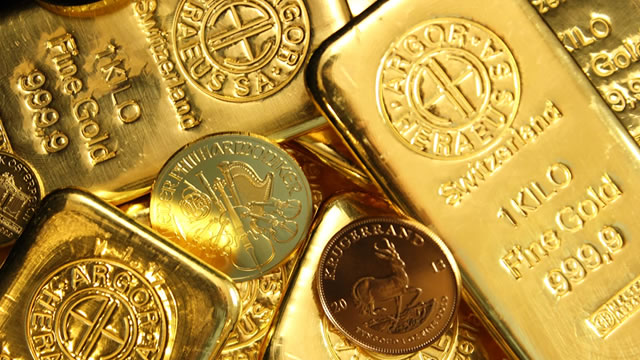
金价爆发背后的真相 意味着什么?
Sou Hu Cai Jing· 2025-10-01 11:47
Market Performance and Data - Recent surge in international gold prices, with futures prices rising significantly within weeks, indicating a rare one-sided upward trend [1] - Increased trading volume in both futures and spot markets, reflecting a substantial influx of market capital [3] Global Economic Uncertainty - Heightened global economic uncertainties, including geopolitical conflicts and slowing economic growth, have driven investors to seek gold as a safe-haven asset [4] - Major economies showing signs of contraction, with declining manufacturing PMI and lowered growth forecasts from the IMF [4] Monetary Policy Easing Expectations - Global central banks signaling a shift towards looser monetary policies, with expectations of paused interest rate hikes and potential rate cuts [5] - Increased liquidity and risk of currency depreciation make gold more attractive as a non-currency asset [5] Inflation Expectations - Divergence in inflation expectations, with some economists predicting a return to low inflation while others foresee persistent inflation due to previous monetary easing [6] - Gold's role as an inflation hedge is emphasized, leading to increased investment in gold to mitigate inflation risks [6] Impact on Financial Markets - Gold price surge positively affecting related stocks, particularly in the gold mining and jewelry sectors, while also boosting prices of other precious metals [8] - Interaction between rising gold prices and bond market dynamics, with potential capital shifts from bonds to gold [8] Impact on the Gold Industry - Gold mining companies experiencing significant profit increases due to high gold prices, with some previously unprofitable mines becoming viable [9] - Increased exploration and development activities in the gold sector as companies seek to capitalize on favorable market conditions [9] Investor Implications - Opportunities for investors to engage in gold-related assets, such as futures and ETFs, to benefit from rising prices [10] - Need for investors to maintain a rational approach and consider their risk tolerance when investing in volatile gold markets [10] Future Price Outlook - Continued uncertainty in gold price trends, supported by ongoing geopolitical tensions and expectations of monetary easing [11] - Potential factors that could suppress gold prices include unexpected economic recovery and strengthening of the dollar [11]