
关税政策

Search documents
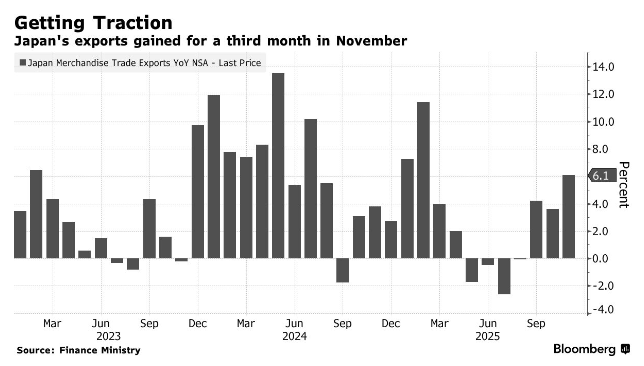
对美出口八个月来首现回升 日本11月出口增长6.1%超预期
Zhi Tong Cai Jing· 2025-12-17 02:25
Group 1 - Japan's exports increased by 6.1% year-on-year in November, driven primarily by semiconductor components and medical supplies, exceeding economists' expectations [1][3] - Exports to the United States and the European Union saw significant growth, with increases of 8.8% and 19.6% respectively [1][3] - The trade surplus for Japan was recorded at 322.3 billion yen (approximately 2.1 billion USD), with imports rising by 1.3%, slightly below general expectations [3] Group 2 - The rebound in exports to the U.S. is seen as a positive signal for the Bank of Japan, which is expected to raise the benchmark interest rate to its highest level since 1995 [3][4] - Japan's trade with China declined by 2.4%, influenced by issues related to semiconductor manufacturing machinery and non-ferrous metals, as well as diplomatic tensions following comments made by Japan's Prime Minister [3][4] - The increase in exports of automobiles and parts to the U.S. was noted after the reduction of tariffs from 27.5% to 15%, with a 1.5% increase in export value and a 7.7% increase in export quantity [4]

受关税影响,美国最大港口11月进口量同比下降11.5%
Xin Lang Cai Jing· 2025-12-16 23:20
美国最大港口洛杉矶港的执行董事Gene Seroka周二表示,该港口11月份的进口量较上年同期减少 11.5%,原因是托运人提前建立了库存,以避免美国总统特朗普对玩具、汽车零部件和金属家具等商品 征收关税。 责任编辑:于健 SF069 美国最大港口洛杉矶港的执行董事Gene Seroka周二表示,该港口11月份的进口量较上年同期减少 11.5%,原因是托运人提前建立了库存,以避免美国总统特朗普对玩具、汽车零部件和金属家具等商品 征收关税。 Seroka表示,11月份,洛杉矶港处理了406421个20英尺标准箱(TEU)的进口货物。 Seroka表示,他预计2025年该港口的总吞吐量将超过1000万标准箱,与2024年大致持平,是有记录以来 的第三高水平,尽管美国关税政策导致吞吐量大幅波动。 "我认为不确定性将继续存在,至少在明年是这样,"Seroka说。"这是我们未来一段时间可能面临的逆 风。" 供应链技术供应商笛卡尔系统集团(Descartes Systems Group,DSG)本月较早时表示,11月份美国所 有港口的进口量较上年同期下降了7.8%。 美国最高法院预计将在未来几个月就特朗普政府根据《国际紧 ...
贝森特:预计明年上半年通胀大幅下降,美联储主席人选或1月初公布、要有“开放的思维”
美股IPO· 2025-12-16 23:06
他 预计2026年前六个月通胀将大幅下降 ,房租也将大幅下降,并认为尽管物价水平已经非常高,但实际工资的提升将能解决 这一问题。 同时,贝森特指出,美国总统 特朗普将于1月初公布美联储主席人选,本周可能还有一到两次面试 。这一关键任命将影响未来 数年美国货币政策走向,市场对此高度关注。 贝森特在表态中否认了外界对新任美联储主席独立性的质疑,称特朗普在面试中对政策相关问题一直非常直率。他表示, 候选 人沃什和哈塞特都非常有资格,并驳斥了"哈塞特无法在美联储拥有影响力"的说法。 贝森特称, 国会应当停止(议员的)股票交易行为。 贝森特称,本周和下周可能还有一两次美联储主席的面试,否认对新任主席独立性的质疑,称候选人沃什和哈塞特都非常有资 格,强调新主席要有"开放的思维",特别是要打破联储常有的增长导致通胀观念,驳斥哈塞特无法在联储拥有影响力的说法;预 计1月最高院作出关税案裁决,警告推翻关税将危害国家安全;一季度会有1000亿至1500亿美元巨额退税,平均每个家庭可能 得到1000至2000美元。 新美联储主席要打破增长导致通胀的观念 周二(12月16日),美国财政部长贝森特表示,对美国经济前景表达乐观预期,预计 ...

周四10点,特朗普将全美讲话:回顾“伟大”的一年,预告明年新政
Hua Er Jie Jian Wen· 2025-12-16 21:18
Core Points - President Trump is set to deliver a crucial speech to the nation amid declining approval ratings and economic challenges, aiming to outline his policy agenda and achievements [1] - Recent polls indicate a nearly 10 percentage point drop in public approval regarding Trump's handling of economic and immigration issues since March [1][3] - The upcoming midterm elections will serve as a test of Trump's political influence and the Republican Party's ability to maintain control of Congress [1] Economic Challenges - Economic issues have emerged as a primary challenge for Trump, with concerns over wage growth slowing and rising household costs becoming central to voter concerns [2][3] - Political opponents are criticizing Trump's tariff policies, attributing rising consumer prices and inflation to these measures [3] - Trump has initiated a domestic campaign to address economic pressures, including policies aimed at reducing costs and providing assistance to farmers affected by low agricultural prices and tariffs [3] Policy and Governance - Since returning to the White House, Trump has focused on reshaping the U.S. economic and national security landscape through tariffs on trade partners and key industries [4] - His administration has tested the boundaries of executive power by reducing the federal workforce and cutting funding for programs criticized by conservatives [4] - Trump is also working to fulfill campaign promises related to immigration, including large-scale deportations and tightening legal entry pathways [4]
美国连锁餐厅通过菜单管控应对通胀与关税
Xin Lang Cai Jing· 2025-12-16 15:55
责任编辑:张俊 SF065 随着特朗普关税政策造成美国的食品、人工和公用事业成本上涨,达登餐饮旗下的Olive Garden (DRI)、Texas Roadhouse(TXRH)以及Dine Brands旗下的Applebee's(DIN)依靠选择性提价、简化 菜单及与Sysco(SYY)等供应链伙伴合作,以抵消不利影响。 责任编辑:张俊 SF065 随着特朗普关税政策造成美国的食品、人工和公用事业成本上涨,达登餐饮旗下的Olive Garden (DRI)、Texas Roadhouse(TXRH)以及Dine Brands旗下的Applebee's(DIN)依靠选择性提价、简化 菜单及与Sysco(SYY)等供应链伙伴合作,以抵消不利影响。 ...
美国11月非农录得6.4万人,失业率为四年来新高
Feng Huang Wang· 2025-12-16 14:42
Group 1 - The core point of the article highlights the mixed signals in the U.S. labor market, with November non-farm payrolls showing an increase of 64,000, surpassing expectations, while the unemployment rate rose to 4.6%, the highest since September 2021 [1][2] - The October non-farm payrolls were revised down significantly, indicating a loss of 105,000 jobs, primarily due to substantial layoffs in government sectors, which saw a reduction of 162,000 jobs in October and an additional 6,000 in November [1][2] - The average hourly wage growth in November was only 0.1% month-on-month and 3.5% year-on-year, marking the smallest annual increase since May 2021, reflecting a cautious hiring environment among businesses [2][4] Group 2 - Economists describe the current labor market as a state of "low layoffs, low hiring," with many companies hesitant to recruit due to the belief that tasks can be performed by artificial intelligence [2][3] - The delayed employment report is expected to influence the Federal Reserve's decision-making in its upcoming January meeting, as the cooling labor market was a key factor in the recent interest rate cut [2][5] - Concerns have been raised regarding the accuracy of employment statistics, with the possibility that the Labor Department's estimates may overstate job growth by as much as 60,000 per month, suggesting a potential monthly loss of about 20,000 jobs since April [3][2]
基于区域和产品结构的分析:2026年出口:驱动与增速
HUAXI Securities· 2025-12-16 13:08
Trade Environment - The trade environment is stabilizing as US-China relations improve, with significant agreements reached during recent talks[5] - Major economies in Europe and the US are still in a phase of fiscal expansion and monetary easing, with the IMF predicting stable economic growth in developed economies[8][9] Export Growth Analysis - Global trade growth is expected to slow down due to high base effects from "export grabbing" and increased tariff rates, with a projected growth rate of 0-1% for exports in 2026[2] - Exports to the US and ASEAN may exhibit a "seesaw" effect, with significant contributions from transshipment trade to ASEAN exports this year[2] - Africa is identified as the fastest-growing export region, driven by demand for vehicles, ships, and consumer electronics[2] Economic Forecasts - The IMF forecasts that global trade volume growth will decline from approximately 3.7% in 2025 to 2.0% in 2026, with China's export volume growth expected to drop from 9.8% to 1.9%[20][21] - The US economy is projected to grow by 2.1% in 2026, while the Eurozone and Japan are expected to see slight declines in growth rates[9][8] Currency and Pricing - The RMB is anticipated to maintain a "stable yet slightly strong" trend, with export prices expected to decline marginally by around 2%[2] - The IMF predicts a decrease in global trade prices from 0.6% in 2025 to 0.1% in 2026, influenced by falling oil prices and domestic inflationary pressures[2] Risks and Challenges - Potential risks include geopolitical conflicts and unexpected macroeconomic fluctuations that could impact trade dynamics[2]
特朗普过去24小时都忙了什么?(2025-12-16)
Xin Lang Cai Jing· 2025-12-16 10:11
Group 1 - Over $200 billion in tariffs collected: According to the U.S. Customs and Border Protection, the U.S. has collected over $200 billion in tariffs this year due to new tariffs implemented by President Trump since the beginning of 2025 [1][3]. - Fentanyl classified as a "weapon of mass destruction": Trump announced plans to sign an executive order to classify fentanyl as a "weapon of mass destruction" while considering relaxing federal marijuana restrictions [1][3]. - Progress on Russia-Ukraine peace agreement: Trump stated that the U.S. is closer than ever to achieving a ceasefire in the Russia-Ukraine conflict [1][3]. Group 2 - $5 billion lawsuit against BBC: Trump is suing the BBC for defamation over edited clips of his speech related to the January 6 incident, seeking $5 billion in damages [1][3]. - Suspension of U.S.-UK technology agreement: The U.S. has suspended the implementation of a technology agreement with the UK due to dissatisfaction with trade negotiations [1][3]. - Warning to Netanyahu over ceasefire violation: U.S. officials privately warned Israeli Prime Minister Netanyahu that the killing of a Hamas military commander violated a ceasefire agreement brokered by Trump [1][3]. Group 3 - Fed chair candidate battle intensifies: Sources indicate that the candidacy of White House National Economic Council Director Hassett for the Fed chair position, once seen as certain, is now facing opposition from high-level individuals close to Trump [4]. - Gaza international stabilization forces operational: Trump claimed that international stabilization forces in Gaza are now operational and functioning "in a very strong form" [4]. - Defense of White House banquet hall construction: The Trump administration argued in court that the construction of the White House banquet hall must continue for national security reasons [4]. - Verbal attack on deceased director: Trump attributed the death of actor and director Rob Reiner to his public opposition to the president in a shocking post [4].
贵金属年报:交易逻辑切换,长线趋势不变
Hong Ye Qi Huo· 2025-12-16 08:21
1. Report Industry Investment Rating - Not provided in the document 2. Core Viewpoints of the Report - In 2025, the weakening of US economic indicators and the government shutdown increased economic uncertainty, supporting precious metal prices. The trading logic of precious metals kept changing, leading to price differentiation with silver outperforming gold and the gold - silver ratio being repaired [1][64]. - In the future, under the reshaping of the global trade pattern, the long - term logic for gold and silver remains unchanged. In 2026, the Fed will still be in a rate - cut cycle, and the weakening US dollar index will support the financial attribute premium of precious metals. Silver is expected to continue rising with high volatility and outperform gold due to triple - driven factors [1][64]. 3. Summary by Directory 3.1 Market Review - **External Market (New York Gold and Silver)**: Since the beginning of the year, both New York gold and silver showed an overall upward - trending and volatile pattern, hitting new highs. By December 11, New York gold closed at $4258.30 per ounce, with a year - to - date increase of 52.86%, and New York silver closed at $62.20 per ounce, with a year - to - date increase of 101.40% [6]. - **Domestic Market (Shanghai Gold and Silver)**: The trends of Shanghai gold and silver were basically in line with the external market. By December 11, Shanghai gold closed at 956.40 yuan per gram, with a year - to - date increase of 52.39%, and Shanghai silver closed at 14373.00 yuan per kilogram, with a year - to - date increase of 88.75% [7]. - **Five Trading Stages in 2025**: From January to March, the trading logic was risk - aversion, with gold leading the rise. From April, the focus was on tariff policies, causing a price correction. From June to September, it was about the repair of the gold - silver ratio and the support of the industrial attribute, with silver rising significantly. From September to November, the main logic was the interest - rate cut expectation. From November onwards, it was the supply - demand relationship of silver, which further pushed up the silver price [9][10][12][13]. - **Gold - Silver Ratio**: It continued to rise at the beginning of the year, then soared in April due to tariff policies, and started to repair in June. Currently, it has returned to near the lowest level since 2020, with the domestic and foreign ratios gradually converging [17]. 3.2 Macroeconomic Analysis - **US Economic Fundamentals**: - **GDP**: The release of the Q3 2025 GDP data was postponed. The Q2 2025 real GDP annualized growth rate was 3.8%. The Atlanta Fed's model predicted a 3.9% growth rate for Q3 [19]. - **PMI**: The manufacturing PMI in November was 48.2%, indicating an accelerating contraction. The service PMI was 52.6%, showing continued expansion but with a downward trend in the average level over the past 12 months [20][22]. - **Inflation**: Both CPI and PCE indices fluctuated but showed a cooling trend overall. The 9 - month CPI and core CPI were in line with or lower than market expectations. Consumer inflation expectations showed a decline in the short - term and stability in the medium - and long - term [25][27][29]. - **Employment**: In September, non - farm payrolls increased by 119,000. In November, ADP employment decreased by 32,000. However, subsequent data such as Challenger job cuts and initial jobless claims eased market concerns [31]. - **US Dollar Index**: It first declined and then fluctuated at a low level. In the short term, the strength of US economic data and the Fed's monetary policy expectations drove its movement. In the long term, US fiscal sustainability, dollar credit, and global central bank policy differentiation were the influencing factors. The long - term trend of the US dollar may be weak, which supported the gold price [35][36]. - **Tariff Policy**: It went through four stages: full - scale tariff increase from January to March, establishment of the "reciprocal tariff" system in April, negotiation and adjustment from May to October, and partial adjustment from November to December. The tariff policy had a greater impact on precious metal prices in the first half of the year [38][39][42][43]. - **Fed's Interest - Rate Cut Expectation**: The Fed's interest - rate cut path in 2025 had three stages: waiting and seeing in the first half of the year, policy turning in the third quarter due to the cooling labor market, and the implementation of the third rate cut in December with internal differences. The future interest - rate path is uncertain [44][45][47]. - **Geopolitics**: The US strategic adjustment and regional armed conflicts increased global uncertainty, driving up the prices of gold and silver. Global central banks' gold - buying and investment demand supported the gold price, while high gold prices suppressed gold jewelry consumption [50][51][53]. 3.3 Fundamental Analysis - **Gold**: Investment demand was strong, with a significant increase in global gold ETF holdings and active physical investment. Central banks' net gold purchases in the first three quarters reached 634 tons. However, gold jewelry consumption declined, with a 19% year - on - year decline in the third quarter [51][53]. - **Silver**: The supply was rigid, with stagnant mine production and limited growth in recycled silver. The demand was strong, driven by both industry and investment. The industrial demand, especially from the photovoltaic industry, was the main growth engine. The World Silver Institute estimated a supply gap of 117 million ounces (about 3660 tons) in 2025 [56][57]. 3.4 Summary and Outlook - In 2025, the weakening US economic indicators and the changing trading logic supported the precious metal prices, with silver outperforming gold. - In 2026, the Fed will continue to cut interest rates, and the weakening US dollar will support precious metals. Silver will benefit from triple - driven factors and is expected to continue rising with high volatility and outperform gold [64].
贵金属年报
Hong Ye Qi Huo· 2025-12-16 07:18
Report Summary 1. Industry Investment Rating No industry investment rating was provided in the report. 2. Core Viewpoints - In 2025, the weakening of US economic indicators and the government shutdown increased economic uncertainty, supporting precious metal prices. The trading logic of precious metals kept changing, leading to price increases and differentiation, with silver outperforming gold and the gold - silver ratio being repaired [1][65]. - Looking ahead, the reshaping of the global trade pattern has damaged the US dollar's credit, and the long - term logic for gold and silver remains unchanged. In 2026, the Fed will still be in a rate - cut cycle, and the weakening US dollar index will support the financial attribute premium of precious metals. Silver, with its "strategic resource + financial attribute + industrial attribute" triple - drive, is expected to continue to rise with high volatility and outperform gold [1][65]. 3. Summary by Directory 3.1 Market Review - **External and Internal Markets**: Both New York gold and silver and Shanghai gold and silver showed an overall upward - trending and volatile pattern in 2025. New York silver and Shanghai silver had greater increases than their gold counterparts. As of December 11, New York gold closed at $4258.30 per ounce with a 52.86% annual increase, and New York silver closed at $62.20 per ounce with a 101.40% increase. Shanghai gold closed at 956.40 yuan per gram with a 52.39% increase, and Shanghai silver closed at 14373.00 yuan per kilogram with an 88.75% increase [6][7]. - **Five Trading Phases**: The trading logic of the precious metal market in 2025 can be divided into five phases: from January to March, driven by risk - aversion sentiment; from April, affected by tariff policies; from June to September, focused on the repair of the gold - silver ratio and industrial attributes; from September to November, driven by rate - cut expectations; from November onwards, influenced by silver supply - demand relationships [9][10][12][13]. - **Gold - Silver Ratio**: The gold - silver ratio continued to rise at the beginning of the year and then gradually repaired. Currently, it has returned to near the lowest level since 2020, and the ratios in domestic and foreign markets are gradually converging [17]. 3.2 Macroeconomic Analysis - **US Economic Fundamentals** - **GDP**: The release of the Q3 2025 US GDP data was postponed. The Q2 real GDP annualized growth rate was 3.8%, and the Q3 forecasted growth rate was 3.9% [19]. - **PMI**: In November, the manufacturing PMI decreased to 48.2%, indicating accelerated contraction, while the service PMI was 52.6%, continuing to expand. However, the employment index in both sectors was in a contraction state [23][24]. - **Inflation**: Both CPI and PCE indices fluctuated but showed a cooling trend overall. In September, CPI and core CPI were lower than expected, and PCE and core PCE both increased by 2.8% year - on - year [26][28]. - **Employment**: In September, non - farm employment increased by 119,000. In November, ADP employment decreased by 32,000, but subsequent data such as challenger job cuts and initial jobless claims alleviated market concerns [32]. - **US Dollar Index**: The US dollar index first declined and then fluctuated at a low level. In the short term, it was driven by economic data and Fed policy expectations, and in the long term, it was affected by fiscal sustainability and global monetary policy differentiation. Overall, the long - term trend may be weak [37][38]. - **Tariff Policy**: Tariff policy changes in 2025 can be divided into four stages: full - scale tariff increases from January to March, the establishment of a "reciprocal tariff" system in April, negotiation and adjustment from May to October, and partial adjustments from November to December. The impact of tariffs on precious metal prices weakened in the second half of the year [39][44]. - **Fed Rate - Cut Expectations**: The Fed's rate - cut path in 2025 can be divided into three stages: waiting and seeing in the first half of the year, policy turning in the third quarter due to employment data, and rate cuts and internal differences becoming public at the end of the year. The rate - cut path in 2026 is uncertain [45][48]. - **Geopolitics**: In 2025, the change in the global geopolitical pattern increased market uncertainty, driving up the demand for precious metals as a safe - haven. Geopolitics will remain a core variable in the precious metal market in 2026 [51][52]. 3.3 Fundamental Analysis - **Gold**: In 2025, the global gold supply increased steadily, while the demand side showed significant structural differentiation. Investment demand, including ETFs and central bank purchases, was strong, while high prices suppressed traditional gold jewelry consumption [53][54]. - **Silver**: The silver market in 2025 continued to face a supply - demand imbalance. Supply was rigid due to factors such as mine strikes and limited recycling growth, while demand was driven by both industry (especially photovoltaics) and investment. The World Silver Association estimated a supply gap of 117 million ounces for the whole year [56][57]. 3.4 Summary and Outlook - In 2025, the weakening US economy and changing trading logic supported precious metal prices, with silver outperforming gold. - In 2026, the long - term logic for gold and silver remains unchanged. The Fed's rate - cut cycle and the weakening US dollar will support precious metal prices. Silver is expected to continue to rise with high volatility and outperform gold due to its supply - demand situation and multiple attributes [1][65].