
PPI

Search documents
3月份核心CPI明显回升,一季度PPI降幅有所收窄
Zhong Guo Chan Ye Jing Ji Xin Xi Wang· 2025-04-14 01:38
核心CPI明显回升 提振消费政策效应显现 3月份核心CPI明显回升,一季度PPI降幅有所收窄 政策效应凸显 供需结构改善 国家统计局4月10日发布的数据显示,3月份居民消费价格指数(CPI)环比下降0.4%,同比下降0.1%, 降幅明显收窄;工业生产者出厂价格指数(PPI)环比下降0.4%,同比下降2.5%。一季度,CPI比上年 同期下降0.1%,PPI下降2.3%。 "这主要受季节性、国际输入性等因素影响。从边际变化看,提振消费需求等政策效应进一步显现,核 心CPI明显回升,同比上涨0.5%,供需结构有所改善,价格呈现一些积极变化。"国家统计局城市司首 席统计师董莉娟在解读数据时表示。 展望未来,受访专家认为,当前CPI数据反映出我国消费市场正呈现积极变化。随着国内经济持续向好 以及政策进一步发力,CPI走势有望温和回升。 "3月份,CPI环比下降主要受季节性因素和油价下行影响。"董莉娟分析称,一是天气转暖,部分鲜活食 品大量上市,食品供应总体充足。二是旅游淡季出行人数减少,出行类价格有所下降。三是受国际油价 下行影响。 值得一提的是,提振消费需求等政策效应逐渐显现,加之春节错月影响消退,更多方面显现出明显 ...
物价差异能否收敛? - 从中美比较看价格回温
2025-04-14 01:31
Summary of Key Points from the Conference Call Industry or Company Involved - The discussion focuses on the price differences between China and the United States, particularly in relation to Consumer Price Index (CPI) and Producer Price Index (PPI) trends post-pandemic [2][3][4]. Core Insights and Arguments - **CPI Trends**: Since the end of 2020, China's CPI has consistently been lower than that of the U.S., with no significant convergence observed [2]. - **PPI Growth Divergence**: As of late 2024, U.S. PPI growth has bottomed out and is recovering, while China's remains weak, primarily due to differences in supply chain sensitivity, post-pandemic policy choices, and labor cost disparities [3][4]. - **Structural Differences**: The CPI structure in the U.S. is heavily weighted towards housing, while in China, food, tobacco, and alcohol dominate. This structural difference amplifies price variations across industries [3][5]. - **Key Sectors Influencing Price Differences**: Energy, real estate, and food are identified as the main sectors causing price discrepancies. The U.S. relies more on natural gas, while China is coal-dependent, leading to contrasting price trends [6]. - **Food Consumption Patterns**: The U.S. has a higher consumption of poultry, which has seen price increases due to avian influenza, while China's pork supply is robust, keeping prices low [6]. - **Contribution to Price Index Differences**: Energy factors account for approximately 40% of the PPI growth difference, while food and real estate together explain over 65% of the divergence [7][8]. - **Potential for Price Convergence**: As supply-demand imbalances are addressed, there is a possibility for gradual convergence of prices between the two countries [9]. Other Important but Possibly Overlooked Content - **Underestimation of Price Data**: Current CPI and PPI data in China may be underestimated due to the base year being set in 2020, which was influenced by the pandemic. Changes in economic conditions and consumption patterns could further affect this [10]. - **New vs. Old Energy Industries**: New energy industries, characterized by lower resource dependency and higher R&D investment, are expected to show more stable price trends compared to traditional industries, which are more volatile due to their resource-intensive nature [11]. - **Impact of Policy Choices**: The U.S. has implemented significant fiscal stimulus and quantitative easing, which contrasts with China's more restrained approach, affecting overall economic recovery and price stability [4]. This summary encapsulates the key points discussed in the conference call, highlighting the significant differences in price trends between China and the U.S. and the underlying factors contributing to these disparities.
2025年3月物价数据点评:食品和能源价格下行,核心通胀升温
BOHAI SECURITIES· 2025-04-11 14:33
Group 1: CPI Analysis - In March 2025, the CPI year-on-year decline narrowed to 0.1%, compared to a previous decline of 0.7%[14] - Food prices were the main drag, with a month-on-month decrease of 1.4%, contributing approximately 0.24 percentage points to the CPI decline[17] - The most significant decreases in food prices included fresh vegetables at 5.1%, pork at 4.4%, and eggs at 3.1%[17] Group 2: PPI Analysis - The PPI year-on-year decline expanded to 2.5% in March 2025, compared to a previous decline of 2.2%[14] - Domestic pricing for production materials showed weakness, with coal prices decreasing by 4.3% due to seasonal demand reduction[30] - Equipment manufacturing prices fell, particularly in the computer and automotive sectors, with declines of 0.7% and 0.4% respectively, likely due to reduced export demand[31] Group 3: Future Outlook - For April 2025, the CPI month-on-month growth is expected to hover around zero, with a potential for positive year-on-year growth due to stable pork supply and seasonal vegetable price declines[21] - The PPI is anticipated to continue negative growth, influenced by external inflationary pressures and weak domestic demand in certain sectors[33] - Government fund expenditure growth is expected to rebound, supporting price stabilization in the black and non-metal industries[5]
2025年3月通胀数据点评:外部环境与内部政策共同影响通胀
Orient Securities· 2025-04-11 11:09
Inflation Data Summary - In March 2025, the CPI decreased by 0.1% year-on-year, an improvement from the previous value of -0.7%[1] - The month-on-month CPI fell by 0.4%, compared to a prior decrease of 0.2%[1] - The PPI showed a year-on-year decline of 2.5%, slightly worse than the previous decline of 2.2%[1] Food and Core CPI Insights - Food item CPI year-on-year decline narrowed to 1.4%, with a month-on-month decline of 1.4%, compared to previous values of -3.3% and -0.5% respectively[5] - Core CPI year-on-year growth improved to 0.5%, up from -0.1% in the previous month[5] - Service CPI year-on-year growth rose to 0.3%, a significant recovery from -0.4%[5] PPI Sector Analysis - The mining and raw materials sectors saw PPI declines of 8.3% and 2.4% respectively, with energy sector PPI continuing to decline[5] - The PPI for durable consumer goods showed a notable increase, with household appliances PPI improving to -0.3% from -3.3%[5] - Consumer goods PPI trends varied, with essential goods generally seeing an increase while discretionary items showed mixed results[5] Risk Factors - There are risks associated with policy effectiveness not meeting expectations and potential geopolitical conflicts affecting commodity prices[2]
中美通胀的相似与分化
Xinda Securities· 2025-04-11 08:05
| ] [Table_A 解运亮 uthor宏观首席 分析师 | | --- | | 执业编号:S1500521040002 | | 联系电话:010-83326858 | | 邮 箱: xieyunliang@cindasc.com | 证券研究报告 宏观研究 [Table_ReportType] 专题报告 麦麟玥 宏观分析师 执业编号:S1500524070002 邮 箱: mailinyue@cindasc.com 信达证券股份有限公司 CINDA SECURITIES CO.,LTD 北京市西城区宣武门西大街甲127 号金隅 大厦B 座 邮编:100031 [Table_Title] 中美通胀的相似与分化 [Table_ReportDate] 2025 年 4 月 11 日 ➢ 风险因素:地缘政治风险,国际油价上涨超预期等。 请阅读最后一页免责声明及信息披露 http://www.cindasc.com 1 [➢Table_Summary] 中国 CPI 暂未能实现转正的两个压制。中国 3 月 CPI 降幅收窄至 0.1%, 但暂未能实现转正,我们认为这主要有两方面的压制。压制 1:消费品价 格整体仍 ...
宏观日报:3月PPI降幅扩大-20250411
Hua Tai Qi Huo· 2025-04-11 04:59
Report Summary 1. Industry Investment Rating No information about the industry investment rating is provided in the report. 2. Core Viewpoints - In March 2025, the decline of PPI widened, with a year - on - year decrease of 2.5% and a month - on - month decrease of 0.4%. The decline was mainly due to international input factors, seasonal decline in energy demand, and price drops in some raw material industries [1]. - China may reduce the import of American films in response to the US tariff measures [1]. - The industry credit spread showed a slight fluctuation [4]. 3. Summary by Directory 3.1. Mid - view Event Overview - **Production Industry**: Concerns about the impact of tariff conflict escalation on exports. The decline of PPI was affected by international input factors, seasonal energy demand, and raw material industry price trends [1]. - **Service Industry**: China may moderately reduce the import of American films and introduce more excellent films from other countries [1]. 3.2. Industry Overview - **Upstream**: International oil prices fluctuated due to tariffs; prices of copper, zinc, and nickel dropped; cement and building material prices continued to fall [2]. - **Midstream**: PTA's operating rate increased, PX's operating rate declined recently, and the operating rates of polyester and urea were at a high level this year. The asphalt operating rate reached a three - year low [2]. - **Downstream**: The sales of commercial housing in first - and second - tier cities were weaker than the same period. International flight frequencies increased, while domestic flight frequencies decreased compared to the same period [3]. 3.3. Market Pricing - The industry credit spread showed a slight fluctuation. The credit spreads of various industries had different trends, with some showing a decline and others showing an increase or remaining stable [4][47]. 3.4. Key Industry Price Index Tracking - **Agriculture**: The prices of corn, eggs, palm oil, cotton, pork, etc. had different year - on - year changes, with some rising and some falling [48]. - **Non - ferrous Metals**: The prices of copper, zinc, aluminum, silver, etc. mostly declined year - on - year [48]. - **Metals**: The prices of steel products such as rebar, iron ore, and wire rod had different trends, with some showing a slight decline and some remaining stable year - on - year [48]. - **Non - metals**: The prices of natural rubber, glass, etc. had different year - on - year changes [48]. - **Energy**: The prices of WTI crude oil, Brent crude oil, and liquefied natural gas had different trends, with some rising and some falling year - on - year [48]. - **Chemical Industry**: The prices of PTA, polyethylene, urea, etc. had different year - on - year changes [48]. - **Real Estate**: The cement price index, building material comprehensive index, and concrete price index had different year - on - year trends [48].
2025年3月通胀数据点评:如何理解关税风暴下的CPI?
Tebon Securities· 2025-04-11 02:20
Group 1: CPI Analysis - In March 2025, the CPI year-on-year decline narrowed to -0.1%, improving by 0.6 percentage points from the previous month’s -0.7%[6] - The CPI month-on-month decreased by -0.4%, a decline of 0.2 percentage points compared to the previous month’s -0.2%[6] - The core CPI, excluding food and energy, rose by 0.5% year-on-year, reversing from a decline of -0.1% in the previous month[5] Group 2: Food and Energy Impact - Food prices fell by 1.4% year-on-year, with the decline narrowing by 1.9 percentage points from the previous month[5] - Key food items like beef, fresh vegetables, and eggs saw price drops of 10.8%, 6.8%, and 1.6% respectively, contributing to the overall CPI decline[5] - International oil prices decreased, contributing to a month-on-month CPI decline of approximately 0.12 percentage points[3] Group 3: PPI Insights - The PPI year-on-year decline was -2.5%, worsening from -2.2% in the previous month[26] - Month-on-month, the PPI decreased by -0.4%, a decline of 0.3 percentage points compared to the previous month[26] - The decline in PPI was influenced by falling prices in the oil and gas extraction industry, which dropped by 4.4%[10] Group 4: Economic Outlook - The 2025 CPI target growth rate is set at 2%, a reduction from the previous 3% target established since 2015[7] - The report suggests that the key to exiting the "low-price" environment is to boost core CPI, with real estate market stabilization being crucial[6] - The anticipated impact of tariff increases is expected to result in a 3% decline in export growth, correlating with a 0.20 percentage point drop in PPI and a 1.30 percentage point increase in CPI[15]
供需结构改善 物价走势平稳(锐财经)
Ren Min Ri Bao Hai Wai Ban· 2025-04-10 22:48
"CPI环比下降主要受季节性因素和油价下行影响。"董莉娟说,天气转暖,部分鲜活食品大量上市,食 品供应总体充足。3月份食品价格环比下降,影响CPI环比下降约0.24个百分点,占CPI总降幅六成。此 外,旅游淡季出行人数减少,出行类价格有所下降。其中,飞机票和旅游价格分别下降11.5%和5.9%, 合计影响CPI环比下降约0.13个百分点。 3月份CPI同比、环比有所下降,但提振消费需求等政策效应逐渐显现,加之春节错月影响消退,更多 方面显现出明显的积极变化。董莉娟介绍,从环比看,CPI环比降幅小于近十年同期平均水平0.2个百分 点。"以旧换新"等政策效应逐渐显现,扣除能源的工业消费品价格环比上涨0.5%,涨幅比上月扩大0.3 个百分点;从同比看,CPI同比降幅收窄,比上月收窄0.6个百分点。 "扣除食品和能源价格的核心CPI明显回升,同比由上月下降0.1%转为上涨0.5%。"董莉娟说,其中,服 务价格同比由上月下降0.4%转为上涨0.3%,对CPI的影响由上月下拉0.15个百分点转为上拉0.13个百分 点。 国家统计局4月10日发布的数据显示,3月份,全国居民消费价格指数(CPI)同比下降0.1%,全国工业 ...

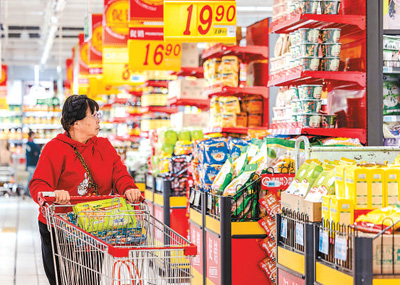
2025年3月CPI和PPI数据点评:通胀面临内外部压力,政策进入集中发力期
Cai Xin Guo Ji· 2025-04-10 14:41
Group 1: CPI Analysis - In March, the Consumer Price Index (CPI) decreased by 0.4% month-on-month and 0.1% year-on-year, with the decline narrowing by 0.6 percentage points compared to the previous month[2] - The food price decline year-on-year shrank by 1.9 percentage points to -1.4%, reducing its downward impact on CPI by 0.35 percentage points[5] - Non-food prices increased by 0.2% year-on-year, up 0.3 percentage points from the previous month, contributing an additional 0.24 percentage points to CPI[6] Group 2: PPI Analysis - The Producer Price Index (PPI) fell by 2.5% year-on-year in March, with the decline expanding by 0.3 percentage points from the previous month[2] - The decline in production materials prices increased by 0.2 percentage points to -0.4%, with significant drops in the mining and raw materials sectors[7] - The PPI is expected to decrease by approximately 2.8% in April, continuing a trend of negative growth throughout the year[8] Group 3: Economic Outlook - The low inflation environment is expected to persist in the short term, with CPI likely to continue negative growth in the second and third quarters[9] - Domestic macroeconomic policies are anticipated to focus on stimulating consumption, stabilizing the real estate market, and supporting private enterprises[9] - The impact of external factors, such as global economic slowdown and trade pressures, is expected to further challenge domestic inflation recovery[9]
3月通胀点评:低通胀,冲击后或迎转机
CMS· 2025-04-10 14:38
CPI Analysis - March CPI year-on-year decreased by 0.1%, an improvement of 0.6 percentage points from the previous month[4] - Core CPI, excluding food and energy, increased to 0.5% year-on-year from -0.1% in the previous month[11] - Food CPI year-on-year was -1.4%, a narrowing of the decline by 1.9 percentage points compared to last month[10] PPI Analysis - March PPI year-on-year decreased by 2.5%, with a month-on-month decline of 0.4%[17] - Production materials prices fell by 2.8% year-on-year, with the largest drop in the mining industry, particularly coal and oil extraction[17] - Living materials prices decreased by 1.5% year-on-year, a further decline of 0.3 percentage points from the previous month[17] Future Outlook - April CPI is expected to see a slight year-on-year increase, primarily driven by food, services, and consumer goods[24] - The overall inflation target of 2% for the year remains distant, with new consumption policies anticipated to provide some support[24] - April PPI is likely to remain under pressure due to ongoing trade tensions and weak domestic demand, with a focus on expanding internal demand and stabilizing growth policies[25]