财政政策

Search documents
中泰期货晨会纪要-20250731
Zhong Tai Qi Huo· 2025-07-31 02:44
Report Industry Investment Ratings No relevant content provided. Core Views of the Report - Based on fundamental analysis, there are trend - bearish products such as aluminum, zinc, and alumina; products with a bias towards a downward - oscillating trend like liquefied petroleum gas; oscillating products including thirty - year bonds and sugar; products with a bias towards an upward - oscillating trend such as crude oil and fuel oil; and no products with a trend - bullish view [4]. - Based on quantitative indicators, there are products with a bearish bias like corn starch and glass; oscillating products such as Shanghai gold and palm oil; and products with a bullish bias like Shanghai lead and Shanghai copper [6]. Summary by Relevant Catalogs Macroeconomic Information - China's policies include implementing more proactive fiscal and moderately loose monetary policies, addressing local government debt risks, and enhancing the attractiveness and inclusiveness of the domestic capital market. The Fed maintained the federal funds rate unchanged, and the US imposed tariffs on multiple products. China plans to allocate about 90 billion yuan for parenting subsidies, and relevant industries plan to control over - capacity [9][10][11]. Stock Index Futures - Pay attention to the support of the 5 - day moving average. If it is not broken, the trend will continue. The A - share market showed mixed trends, and the capital market has new policy expressions. Be cautious about the movement of profit - taking funds [14]. Treasury Bond Futures - Policy implementation may repair inflation expectations, and the bond market may rebound. Pay attention to the performance of the upper pressure level. In the medium term, consider shorting on rallies [15]. Black Commodities - **Coking Coal and Coke**: Prices may enter a high - level oscillation stage. Supply is expected to be tight in the short term, but there are also downward price pressures. Be cautious in operation [17]. - **Ferroalloys**: Costs vary, and the supply - demand situation is expected to weaken marginally. It is not recommended to chase the rise, and it is advisable to be bearish on rallies [18]. - **Soda Ash and Glass**: Soda ash can be shorted on rallies, and glass can be put on hold after closing long positions. Pay attention to supply - side resumption and demand improvement [19]. Non - ferrous Metals and New Materials - **Aluminum and Alumina**: Aluminum prices are expected to oscillate weakly at high levels, and alumina prices are expected to oscillate weakly. Both can be shorted on rallies [21]. - **Shanghai Zinc**: Social inventories are increasing, and zinc prices will oscillate downward due to increased supply and weak demand [22]. - **Lithium Carbonate**: It will mainly oscillate due to limited supply - side disturbances and weakening macro - sentiment [23]. - **Industrial Silicon**: It will maintain an oscillating trend, and the core contradiction lies in the resumption progress of leading manufacturers [24]. - **Polysilicon**: There is a strong policy expectation but a weak supply - demand reality. Be cautious in operation and pay attention to policy implementation and inventory generation [25]. - **Cotton**: Cotton prices are under pressure to rebound. It is advisable to be bearish on rallies and pay attention to macro and supply - demand changes [26]. Agricultural Products - **Sugar**: International sugar supply is expected to be in surplus, and domestic sugar prices are under pressure from imports but supported by low domestic inventories. It will follow international sugar prices [29]. - **Eggs**: Eggs are in a seasonal upward trend, but the supply pressure during the Mid - Autumn Festival may limit the increase. It is recommended to short on rallies and pay attention to position control [33]. - **Apples**: Consider a long - spread strategy and pay attention to the listing price and consumption of early - maturing apples [34]. - **Corn**: Corn prices will oscillate in a range. Pay attention to market sentiment and policy impacts [34]. - **Red Dates**: Observe the fruit - setting situation in the production area and changes in the market [37]. - **Hogs**: Short near - month contracts and consider a reverse - spread strategy. The short - term market is supply - strong and demand - weak [37]. Energy and Chemicals - **Crude Oil**: It may shift to a supply - exceeding - demand pattern. In the short term, it may rebound due to sanctions on Russia. Pay attention to sanctions and peak - season demand [40]. - **Fuel Oil**: It follows crude oil prices. The cracking profit is weakening, and pay attention to the impact of power generation demand and shipping [41]. - **Plastics**: The supply - demand situation is weak. It is advisable to be slightly bearish after a rebound [43]. - **Methanol**: It follows the overall commodity trend and is expected to oscillate weakly. Consider holding put options or being slightly bearish [44]. - **Caustic Soda**: The fundamentals are relatively healthy. If there are warehouse receipts, the spot and futures may be strong in the short term [45]. - **Asphalt**: It follows crude oil prices. The fundamentals are in the off - season, and production is expected to decrease in August [46]. - **Polyester Industry Chain**: It is significantly affected by macro - policies and market sentiment. Consider shorting on rallies [48]. - **Liquefied Petroleum Gas**: It rebounds with crude oil but is weaker. Supply is abundant, and demand is expected to decline in the medium - long term [49]. - **Pulp**: It will oscillate weakly with limited amplitude. Observe port de - stocking and spot transactions [50]. - **Logs**: The fundamentals are supply - and - demand weak. Be cautious about chasing high prices and consider hedging strategies [51]. - **Urea**: Be bearish as enterprise inventories increase and the market is weak [52].
申万期货品种策略日报:国债-20250731
Shen Yin Wan Guo Qi Huo· 2025-07-31 02:44
2025年07月31日申万期货品种策略日报-国债 | | | | | 申银万国期货研究所 唐广华(从业资格号:F3010997;交易咨询号:Z0011162) tanggh@sywgqh.com.cn 021-50586292 | | | | | | | --- | --- | --- | --- | --- | --- | --- | --- | --- | --- | | | | TS2509 | TS2512 | TF2509 | TF2512 | T2509 | T2512 | TL2509 | TL2512 | | | 昨日收盘价 | 102.336 | 102.384 | 105.630 | 105.675 | 108.300 | 108.210 | 118.36 | 117.96 | | | 前日收盘价 | 102.302 | 102.364 | 105.545 | 105.610 | 108.130 | 108.115 | 117.87 | 117.49 | | | 涨跌 | 0.034 | 0.020 | 0.085 | 0.065 | 0.170 | 0.095 | 0.490 | 0.4 ...
宏观政策持续发力适时加力 充分释放政策效应
Jin Rong Shi Bao· 2025-07-31 02:33
中共中央政治局7月30日召开会议,研究关于制定国民经济和社会发展第十五个五年规划的建议。会议 分析研究当前经济形势,部署下半年经济工作。 "整体来看,中央政治局会议对当前经济形势给予积极评价。我国经济运行稳中有进,主要经济指标表 现良好,新质生产力加快形成,高质量发展取得新成效。同时,会议指出经济运行依然面临不少风险挑 战。当前外部环境复杂严峻,国内仍存在结构性矛盾,要增强忧患意识,坚持底线思维,把握好巩固回 升态势与推进结构调整之间的平衡。"中信证券首席经济学家明明分析认为。 会议重申稳中求进的工作总基调,提出下半年宏观政策要持续发力、适时加力。 在业内专家看来,"持续发力"是要抓好现有政策的落实。财政政策方面包括加快政府债券发行使用,提 高资金使用效率,兜牢基层"三保"底线。 数据显示,今年上半年新增专项债发行超2.1万亿元,比去年同期多发超6670亿元,发行进度达49%, 较去年同期显著加快,带动宽口径基建投资同比增长8.9%。今年以来,财政支出进一步向"三保"领域倾 斜。根据财政预算报告,2025年民生领域支出占比为37.1%,较去年有所提升。 "对财政政策的表述从4月的'用好用足'变为'落实落细'。 ...
财政货币政策基调未变 高质量开展城市更新
3 6 Ke· 2025-07-31 01:57
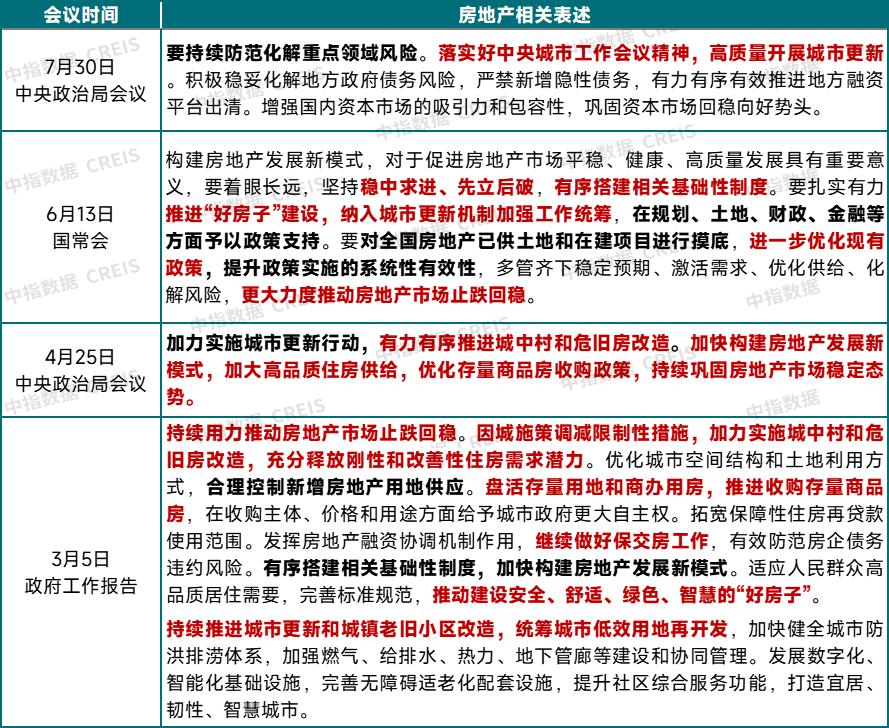
7月30日,中共中央政治局召开会议,决定今年10月在北京召开中国共产党第二十届中央委员会第四次全体会议,主要议程 是,中共中央政治局向中央委员会报告工作,研究关于制定国民经济和社会发展第十五个五年规划的建议。会议分析研究当前 经济形势,部署下半年经济工作。会议通稿中与宏观政策和房地产相关的主要内容如下: 今年以来,在以习近平同志为核心的党中央坚强领导下,各地区各部门积极作为、攻坚克难,加紧实施更加积极有为的宏观政 策,我国经济运行稳中有进,高质量发展取得新成效。主要经济指标表现良好,新质生产力积极发展,改革开放不断深化,重 点领域风险有力有效防范化解,民生兜底保障进一步加强,我国经济展现强大活力和韧性。 当前我国经济运行依然面临不少风险挑战,要正确把握形势,增强忧患意识,坚持底线思维,用好发展机遇、潜力和优势,巩 固拓展经济回升向好势头。 加快构建新发展格局,保持政策连续性稳定性,增强灵活性预见性,着力稳就业、稳企业、稳市场、稳预期,有力促进国内国 际双循环,努力完成全年经济社会发展目标任务,实现"十四五"圆满收官。 宏观政策要持续发力、适时加力。要落实落细更加积极的财政政策和适度宽松的货币政策,充分释放政策 ...

智库·理论周刊丨财政政策下半年需重点关注七个方面
Sou Hu Cai Jing· 2025-07-31 01:39
Core Viewpoint - The fiscal policy for the second half of 2025 needs to focus on seven key areas: emphasizing changes in economic development momentum, stabilizing price levels, continuously innovating fiscal efforts, prioritizing livelihood expenditures, accelerating government debt disposal, actively utilizing policy financial tools, and emphasizing the social benefits of fiscal policy [2][10][12]. Fiscal Revenue and Expenditure Status - In the first half of 2025, China's fiscal revenue showed marginal improvement but still faced pressure, with general public budget revenue growth at -0.3% and government fund budget revenue at -2.4%, leading to a combined growth rate of -0.6% [5][6]. - Tax revenue growth was positive for three consecutive months from April to June 2025, with significant contributions from industries such as railway, shipbuilding, and aerospace equipment (32.2% growth) and scientific research services (13.8% growth) [5][17]. - Non-tax revenue showed a rapid decline, with June's non-tax revenue at 518.4 billion yuan, down 3.7% year-on-year, likely due to a high base in 2024 [5][17]. - Central and local public budget revenues exhibited significant divergence, with central general public budget revenue at 48,589 billion yuan (-2.8% growth) and local revenue at 66,977 billion yuan (1.6% growth) [7][18]. Fiscal Expenditure Characteristics - The overall fiscal expenditure growth in the first half of 2025 was below the initial budget target, with general public budget expenditure growth at 3.4% and government fund budget expenditure growth at 30%, leading to a combined growth of 8.9% [8][9]. - Fiscal expenditure showed a clear focus on social welfare, with expenditures in social security, health, and education exceeding budget completion rates [9][20]. - The structure of fiscal expenditure is increasingly tilted towards livelihood support, with social security and low-income group expenditures growing at 6.6%, while infrastructure spending declined by 3.2% [9][20]. Policy Directions for the Second Half of 2025 - The economic development momentum is expected to shift, influenced by external uncertainties such as U.S. tariffs and domestic consumption patterns, necessitating adjustments in fiscal policy [10][11]. - Price stability is crucial, as fluctuations in price levels can significantly impact tax revenue, particularly in a tax system dominated by turnover taxes [10][11]. - There is a need for continued innovation in fiscal policy, with room for expanding fiscal expenditure due to slower-than-expected spending in the first half of 2025 [11][21]. - Emphasis on livelihood expenditures should focus on improving income expectations and wealth perceptions, with potential measures including increasing state-owned enterprise contributions to social security funds [12][21]. - Accelerating government debt disposal and enhancing the quality and scope of debt instruments are essential to stabilize corporate cash flows and stimulate economic activity [12][22]. - The use of policy financial tools should be expanded to direct funds towards key sectors and address market failures [12][22]. - The social benefits of fiscal policy must be prioritized, shifting from a debt-driven growth model to one that emphasizes consumption and domestic demand [13][22].

宝城期货股指期货早报-20250731
Bao Cheng Qi Huo· 2025-07-31 01:05
Group 1: Report Industry Investment Rating - No relevant content provided Group 2: Core Views of the Report - The short - term view of IH2509 is volatile, the medium - term view is rising, the intraday view is strongly volatile, and the overall view is rising, supported by positive policy expectations [1] - For IF, IH, IC, and IM, the intraday view is strongly volatile, the medium - term view is rising, and the overall view is rising. The stock index is expected to be strongly volatile in the short term [5] Group 3: Summary by Related Catalogs Variety View Reference - Financial Futures Stock Index Sector - For IH2509, short - term: volatile; medium - term: rising; intraday: strongly volatile; view reference: rising; core logic: positive policy expectations provide strong support [1] Main Variety Price Market Driving Logic - Financial Futures Stock Index Sector - Yesterday, each stock index was in a narrow - range volatile consolidation. The trading volume of the Shanghai, Shenzhen, and Beijing stock markets was 1871 billion yuan, an increase of 41.7 billion yuan from the previous day [5] - The Politburo meeting emphasized the implementation of existing policies, including more active fiscal policies and moderately loose monetary policies, focusing on boosting consumption and supporting technological innovation. It also aimed to enhance the attractiveness and inclusiveness of the domestic capital market [5] - The Politburo meeting had few incremental benefits. Since late June, some stocks have risen significantly, and some profit - taking funds may seek to take profits, weakening the short - term upward driving force of the stock index [5] - New policy incremental benefits are expected to wait for the policy guidance of the Fourth Plenary Session of the 20th CPC Central Committee in October. Currently, the stock market trading volume is at a relatively high level, and market risk appetite has recovered, so the stock index is expected to be strongly volatile in the short term [5]
冠通期货早盘速递-20250731
Guan Tong Qi Huo· 2025-07-31 01:00
Report Summary 1. Hot News - The Political Bureau of the CPC Central Committee held a meeting on July 30, emphasizing the continuous prevention and resolution of risks in key areas, including resolving local government debt risks, implementing proactive fiscal and moderately loose monetary policies, and promoting reforms [2]. - The CPC Central Committee held a symposium for non - Communist Party personages, stressing the need to adhere to the general tone of making progress while maintaining stability, boost consumption, and promote economic circulation [2]. - Chinese Commerce Minister Wang Wentao mentioned that under the guidance of the two heads of state, China and the US have formed relevant consensuses and frameworks in the economic and trade field, and the two teams held talks in Stockholm [2]. - The Shanghai International Energy Exchange imposed a 5 - day trading ban on a client for exceeding the daily trading limit in the container shipping index (European line) futures contract on July 30 [3]. - The Federal Reserve maintained the interest rate at 4.25% - 4.50%, with some members opposing and advocating for a rate cut, and Powell avoiding guidance on a September rate cut [3] 2. Sector Performance - **Key Focus**: Glass, coking coal, soda ash, PVC, and synthetic rubber [4] - **Night Session Performance**: Non - metallic building materials rose 2.58%, precious metals 27.23%, oilseeds 11.99%, non - ferrous metals 21.40%, soft commodities 2.68%, coal - coke - steel - ore 15.03%, energy 3.39%, chemicals 11.71%, grains 1.11%, and agricultural and sideline products 2.87% [4] 3. Sector Position - The report shows the changes in the positions of commodity futures sectors in the past five days, including Wind agricultural and sideline products, Wind grains, etc [5] 4. Performance of Major Asset Classes | Asset Category | Name | Daily Return (%) | Monthly Return (%) | Year - to - Date Return (%) | | --- | --- | --- | --- | --- | | Equity | Shanghai Composite Index | 0.17 | 4.97 | 7.88 | | | SSE 50 | 0.38 | 3.96 | 5.01 | | | CSI 300 | - 0.02 | 5.47 | 5.50 | | | CSI 500 | - 0.65 | 6.75 | 10.29 | | | S&P 500 | - 0.12 | 2.55 | 8.18 | | | Hang Seng Index | - 1.36 | 4.59 | 25.51 | | | German DAX | 0.19 | 1.47 | 21.86 | | | Nikkei 225 | - 0.05 | 0.41 | 1.91 | | | FTSE 100 | 0.01 | 4.29 | 11.79 | | Fixed - Income | 10 - year Treasury Futures | 0.15 | - 0.55 | - 0.57 | | | 5 - year Treasury Futures | 0.08 | - 0.50 | - 0.85 | | | 2 - year Treasury Futures | 0.03 | - 0.16 | - 0.62 | | Commodity | CRB Commodity Index | 0.00 | 2.92 | 3.11 | | | WTI Crude Oil | 1.57 | 8.15 | - 2.25 | | | London Spot Gold | - 1.53 | - 0.82 | 24.80 | | | LME Copper | - 0.69 | - 1.50 | 10.80 | | | Wind Commodity Index | 0.56 | 2.17 | 16.29 | | Other | US Dollar Index | 1.06 | 3.30 | - 7.85 | | | CBOE Volatility Index | 0.00 | - 4.48 | - 7.90 | [6]
格林大华期货早盘提示-20250731
Ge Lin Qi Huo· 2025-07-31 00:12
更多精彩内容请关注格林大华期货官方微信 更多精彩内容请关注格林大华期货官方微信 格林大华期货研究院 证监许可【2011】1288 号 2025 年 7 月 31 日星期四 研究员: 刘洋 从业资格: F3063825 交易咨询资格:Z0016580 Morning session notice Morning session notice 早盘提示 早盘提示 | 板块 | 品种 | 多(空) | 推荐理由 【行情复盘】 | | --- | --- | --- | --- | | | | | 周三国债期货主力合约开盘全线高开,早盘探底后上涨,午后延续上涨之后横向波 动,截至收盘 30 年期国债期货主力合约 TL2509 上涨 0.40%,10 年期 T2509 上涨 | | | | | 0.15%,5 年期 TF2509 上涨 0.08%,2 年期 TS2509 上涨 0.03%。 | | | | | 【重要资讯】 | | | | | 1、公开市场:周三央行开展了 3090 亿元 7 天期逆回购操作,当日 1505 亿元逆回 | | | | | 购到期,因此当日净投放 1585 亿元。 | | | | | 2、 ...
21社论丨宏观政策适时加力 巩固拓展经济回升向好势头
2 1 Shi Ji Jing Ji Bao Dao· 2025-07-30 23:10
Economic Policy and Strategy - The central political bureau meeting emphasized the need to maintain policy continuity and stability while enhancing flexibility and foresight to stabilize employment, enterprises, markets, and expectations [1] - A more proactive fiscal policy will be implemented, including the issuance of ultra-long special government bonds and local government special bonds to improve fund utilization efficiency [2] - Monetary policy should be adjusted appropriately to promote a decline in the comprehensive financing costs for society while maintaining ample liquidity [2] Domestic Demand and Consumption - The focus will be on promoting consumption to effectively release domestic demand potential, with an allocation of 138 billion yuan for the "old for new" consumption subsidy program [3] - Policies will be developed to support service consumption in areas such as elderly care, childcare, culture, and tourism, alongside financial policies to stimulate personal consumption loans [3] Market and Competition - The importance of improving supply quality through deepening reforms and stimulating market vitality is highlighted, particularly in the context of transitioning to new growth drivers [3] - The establishment of a unified national market is essential to optimize market competition and regulate disorderly competition among enterprises [3] Capital Market and Economic Stability - The capital market's role as an economic barometer is increasing, and enhancing its attractiveness and inclusiveness is crucial for stabilizing economic recovery [4] - The combination of short-term goals and long-term tasks, driven by policy tools and deepening reforms, is necessary to ensure the completion of annual economic and social development goals [4]
打破多项纪录,或有“失控危险”,德国争议声中通过2026年预算草案
Huan Qiu Shi Bao· 2025-07-30 22:52
【环球时报驻德国特约记者 青木 环球时报记者 杨舒宇】德国正在摆脱数十年的财政保守主义,同时也点燃争议。德国《商报》30日报道称,德 国内阁周三批准了2026年创纪录的预算草案以及至2029年的中期财政计划,涉及巨额的基础设施和国防项目的投资支出和借款。德媒称,执政不 到三个月,由德国总理默茨和副总理兼财政部长克林贝尔领导的联邦政府就陷入了危险的债务困境。"支出增加、债务增加、利息支付增加,成为 政府预算的戏剧性三重奏。" 创纪录的投资和借贷 据德媒报道,内阁周三通过了财政部长克林贝尔提交的一份包含创纪录投资规模的预算草案。其中包括1267亿欧元投资(比2025年高出10%,比 2024年高出70%)和1743亿欧元借款,作为其基础设施和国防财政计划的一部分。内阁批准后,该预算将被提交至德国联邦议院,预计将于11月 底获得通过。这份"大胆"的提案连日来成为该国国内讨论的焦点。 德媒称,这种预算政策"令人震惊"。虽然未来几年的财政规划中存在一定的缺口是正常的,但即使在政府内部,这样的缺口也被描述为"非常 高",弥补这一缺口被描述为一项"中央财政政策挑战"。 据报道,增加支出是政府重振低迷经济计划的一部分。该国是 ...