
反内卷

Search documents
券商晨会精华 | 反内卷持续发力 化工行业景气度有望持续提升
智通财经网· 2026-01-09 00:55
Market Overview - The Shanghai Composite Index experienced narrow fluctuations, while the ChiNext Index fell over 1% during the trading session. The total trading volume in the Shanghai and Shenzhen markets was 2.8 trillion, a decrease of 53.8 billion compared to the previous trading day, marking the fourth consecutive day with trading volumes exceeding 2.5 trillion. Market hotspots rapidly rotated, with significant performances in commercial aerospace, brain-computer interface concepts, and controllable nuclear fusion. AI application concepts rose, while sectors such as large finance, rare earth permanent magnets, and non-ferrous metals saw notable declines. By the end of the session, the Shanghai Composite Index fell by 0.07%, the Shenzhen Component Index by 0.51%, and the ChiNext Index by 0.82% [1]. Chemical Industry Insights - CITIC Securities indicated that the chemical industry's capital expenditure continues to weaken year-on-year, but the profitability of chemical enterprises is expected to gradually bottom out and recover under the backdrop of ongoing anti-involution efforts. The investment value of the chemical sector is anticipated to continue improving by 2026. Investment strategies suggested include focusing on high-energy-consuming products such as calcium carbide, caustic soda, and yellow phosphorus, which may become effective tools for anti-involution. Additionally, attention should be given to segments where self-discipline is steadily advancing, products that have fallen below or are close to cash cost lines, and chemical products driven by new demand or strong downstream demand with price increase potential [2]. Trade and Material Substitution - According to Open Source Securities, the Ministry of Commerce has initiated anti-dumping investigations against Japan, particularly concerning high-end membrane materials. Announcements made on January 6 and 7 included prohibiting the export of dual-use items to Japanese military users and launching anti-dumping investigations on imported dichlorodihydrosilane from Japan. As the global touch module, LCD/OLED display panel, and MLCC ceramic capacitor industries shift to mainland China and domestic manufacturers expand capacity, there is an urgent need for the domestic optoelectronic industry to break Japan's technological monopoly on high-end raw materials and achieve localization of critical raw material supply [3]. Chatbot Commercialization - CICC reported that the current monetization of overseas chatbots primarily relies on subscriptions, while domestic models are mostly free. In the long term, as the cost of unit reasoning decreases, a "free + transaction-oriented effect advertising" model is expected to emerge, which could lower barriers to entry and increase the ceiling in the ToC Agent field. Internet advertising leaders possess advantages in data and infrastructure dimensions [4].


多家外资机构看好2026年中国市场,高盛维持对A股和H股超配
Di Yi Cai Jing· 2026-01-08 22:46
Group 1 - The A-share market has shown strong performance at the beginning of 2026, with the Shanghai Composite Index remaining above 4000 points for four consecutive trading days [1] - UBS and Goldman Sachs have expressed optimism about the Chinese market in 2026, with UBS noting that the current asset valuations are not overheated and driven by long-term investment opportunities [1][4] - UBS predicts a 14% or higher earnings growth for the MSCI China Index in 2026, driven by structural changes in corporate fundamentals and sectors like high-end manufacturing and internet platforms [2][3] Group 2 - In 2025, the A-share market indices saw significant increases, with the Shanghai Composite Index rising by 18.41%, and the ChiNext Index increasing by 49.57% [2] - International investors have shifted from a wait-and-see approach to active participation in the Chinese market, with a notable increase in capital inflow [3] - Goldman Sachs forecasts a 20% increase in the MSCI China Index and a 12% increase in the CSI 300 Index for 2026, with market growth driven by earnings rather than valuation expansion [4][5] Group 3 - The technology, media, and telecommunications (TMT) sector is expected to see approximately 20% earnings growth in 2026, driven by artificial intelligence and corporate globalization strategies [5] - Goldman Sachs highlights the potential for significant capital inflows, predicting a record net purchase of $200 billion from southbound funds in 2026 [5] - The firm recommends focusing on sectors benefiting from AI development, export-oriented companies, and those with substantial shareholder returns [5][6]


化工-关注反内卷低估值龙头及供需边际改善板块
2026-01-08 16:02
Summary of Chemical Industry Conference Call Industry Overview - The chemical industry is currently at the bottom of the economic cycle, influenced by weak global manufacturing PMI and slowing demand growth, leading to weak chemical PPI performance [1][3] - A potential recovery in demand could occur if the Federal Reserve lowers interest rates or if domestic consumption policies are implemented, which would benefit the recovery of chemical PPI [1][4] Key Trends and Changes - The price of oil is lower than that of coal, resulting in a lack of cost support for chemical prices, while domestic real estate and high mortgage rates in the U.S. are suppressing demand [1][5] - If U.S. mortgage rates fall below 4% due to continued rate cuts, overseas real estate may recover, benefiting domestic building materials-related stocks [1][5] - The global chemical industry landscape is changing, with the sales share of European and American countries declining, while China's share has increased significantly, now accounting for nearly half of the global market [1][7] Supply and Demand Dynamics - Domestic fixed asset investment in basic industries like petrochemicals has turned negative year-on-year, indicating a reduction in new investments, which may lead to a recovery in PPI prices when supply becomes insufficient [1][9] - The overall ROE in the chemical industry is low, but many sub-sectors are undervalued. The fourth quarter may see a recovery in PB valuations for leading stocks due to a reversal in the anti-involution trend [1][10] Investment Opportunities - Recommended core assets include Wanhua Chemical and Hualu Hengsheng, both of which have significant market positions and potential for earnings elasticity [3][12] - Specific investment opportunities in sub-sectors include: - **Fertilizers**: Companies like China Heart and International Potash are highlighted due to their growth potential and favorable market conditions [3][15] - **Tires**: Domestic companies are adapting to international trade challenges, with a focus on expanding production for the growing new energy vehicle market [3][16] - **Lubricant Additives**: Ruifeng New Materials is positioned well for growth due to the ongoing reconstruction of international supply chains and domestic substitution trends [3][17] Future Outlook - The overall configuration of the chemical industry is expected to improve, particularly in the petrochemical sector, with a focus on anti-involution strategies as a key investment theme [1][11] - The fourth quarter is anticipated to see an increase in institutional holdings in leading companies, indicating a potential shift in market sentiment [2][10] Conclusion - The chemical industry is at a critical juncture, with potential for recovery driven by macroeconomic factors and strategic investments in undervalued sectors. Continuous monitoring of market dynamics and company performance will be essential for identifying further investment opportunities [1][18]


多家外资机构看好2026年中国市场表现
Di Yi Cai Jing Zi Xun· 2026-01-08 15:52
Group 1 - The A-share market has shown a strong start in 2026, with the Shanghai Composite Index remaining above 4000 points for four consecutive trading days [2] - UBS and Goldman Sachs have expressed optimism about the Chinese market in 2026, highlighting that the current valuation levels are not overheated and that the market is driven by long-term investment rather than speculative trading [2][6] - UBS predicts a 14% or higher earnings growth for the MSCI China Index in 2026, driven by sectors such as internet platforms, high-end manufacturing, and companies with global expansion capabilities [4] Group 2 - In 2025, the A-share market outperformed expectations, with major indices showing significant increases: the Shanghai Composite Index rose by 18.41%, the Shenzhen Component Index by 29.87%, and the ChiNext Index by 49.57% [3] - The valuation of the MSCI China Index is approximately 13 times earnings, slightly above the ten-year average, indicating room for growth [3] - International investors have shifted from a passive to an active approach in the Chinese market, with a notable increase in capital inflow [4] Group 3 - Goldman Sachs forecasts a 20% increase in the MSCI China Index and a 12% increase in the CSI 300 Index for 2026, with growth driven by earnings rather than valuation expansion [6] - The technology, media, and telecommunications (TMT) sector is expected to see a profit growth of around 20% in 2026, supported by artificial intelligence and corporate strategies [6] - High levels of interest from foreign investors in Chinese technology and AI companies are noted, with a significant gap in valuation compared to similar U.S. firms [5][6] Group 4 - Goldman Sachs anticipates record net inflows of $200 billion from southbound capital in 2026, alongside a potential 3 trillion RMB increase in domestic asset reallocation [7] - Investment themes to focus on include companies benefiting from AI development, export leaders, and those with substantial shareholder returns [7] - High valuations are seen in sectors such as technology hardware, insurance, materials, media/entertainment, and internet retail, which are rated as overweight by Goldman Sachs [7]


新华财经晚报:工业和信息化部等部门进一步规范动力和储能电池产业竞争秩序
Xin Hua Cai Jing· 2026-01-08 15:18
Domestic News - The Ministry of Commerce stated that China's willingness to deepen economic and trade relations with Venezuela will not change, regardless of the political situation in Venezuela [1] - A joint meeting by the Ministry of Industry and Information Technology and other departments focused on regulating the competition order in the power and energy storage battery industry, emphasizing market supervision and quality control [2] - Guangzhou's government released a plan aiming to double industrial added value by 2035, focusing on new industrialization and developing strategic industrial clusters [3] International News - The U.S. government announced its withdrawal from 66 international organizations deemed not in the U.S. interest, as stated by the White House [4] - The U.S. Vice President indicated that Venezuela can only sell oil if it aligns with U.S. interests, highlighting a financial control strategy over Venezuela [4] Economic Data and Dynamics - The latest data shows that the Shanghai Composite Index decreased by 0.07%, while the Shenzhen Component Index fell by 0.51% [6] - The U.S. Challenger Job Cut Report indicated a significant decrease in layoffs, with 35,553 job cuts reported in December 2025 [4]

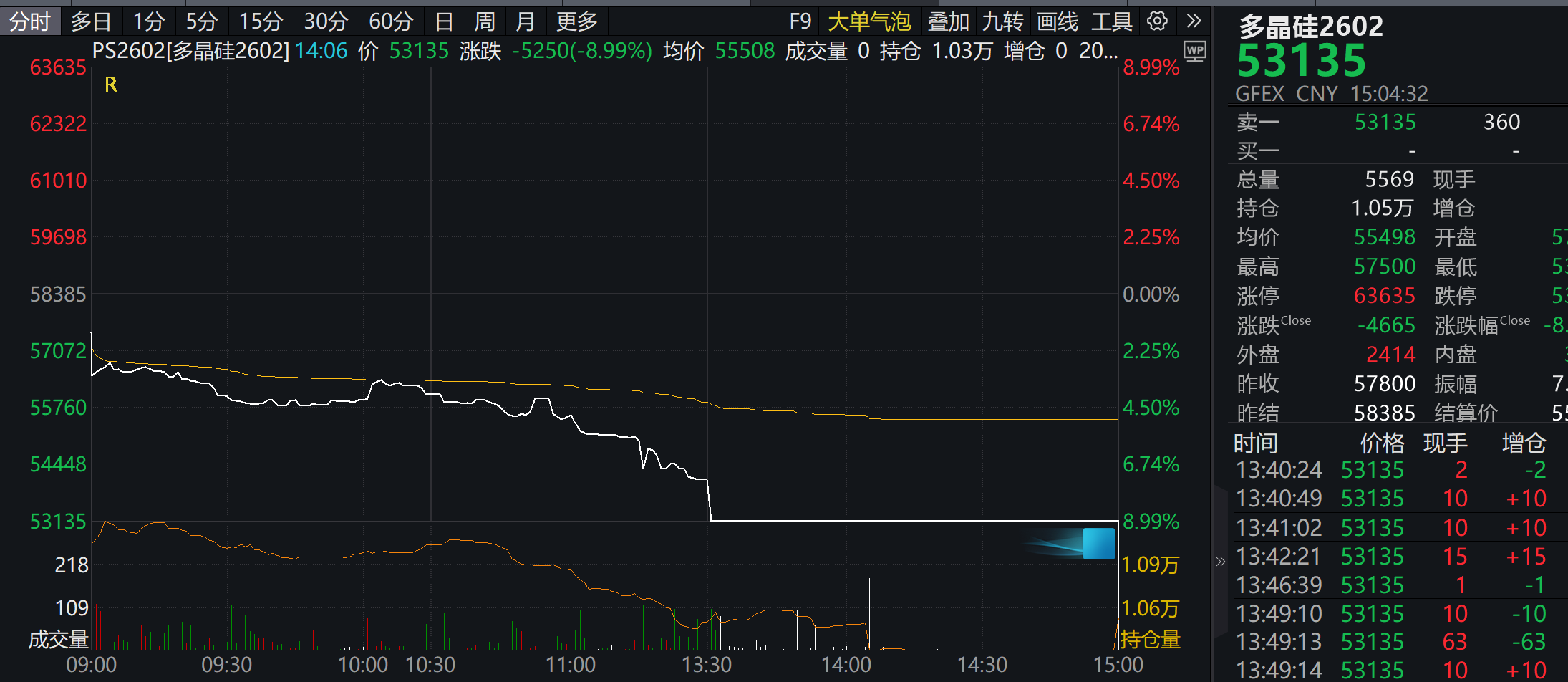
多晶硅期货跌停!知情人士:多晶硅龙头被约谈确有其事
2 1 Shi Ji Jing Ji Bao Dao· 2026-01-08 13:33
Core Viewpoint - The National Market Supervision Administration has raised concerns about potential monopoly risks in the polysilicon market, leading to a significant drop in polysilicon futures prices following a meeting with major industry players [3][4]. Group 1: Regulatory Actions - The National Market Supervision Administration held discussions with leading polysilicon companies and the China Photovoltaic Industry Association, addressing reports of price manipulation and monopolistic practices [3]. - The administration has mandated a comprehensive review of existing practices, requiring companies to submit detailed reports on their agreements and operational structures by January 20 [4]. - Specific corrective measures include prohibiting agreements on production capacity, sales prices, and market division based on investment ratios [4]. Group 2: Market Impact - Following the news, polysilicon futures experienced a significant decline, with prices reported at 53,100 CNY to 53,600 CNY per ton by the close of trading on January 8 [4]. - The establishment of the "Beijing Guanghe Qiancheng Technology Co., Ltd." as a polysilicon storage platform had previously stimulated a week-long price increase in the polysilicon market [5]. Group 3: Industry Dynamics - The polysilicon storage platform aims to address the issue of "involution" in the photovoltaic industry through a dual-track model of "debt acquisition + flexible capacity utilization" [5]. - Industry experts emphasize the need for the photovoltaic sector to avoid monopolistic practices while attempting to mitigate harmful price competition [6]. - Recent data indicates a rise in polysilicon prices, with average transaction prices for N-type polysilicon increasing by approximately 9.83% week-on-week [7].
上证指数15连阳
Tebon Securities· 2026-01-08 13:31
Market Analysis - The A-share market is experiencing a steady upward trend, with the Shanghai Composite Index achieving a 15-day consecutive rise, indicating strong market momentum and increased trading volume from approximately 1.7 trillion to about 2.9 trillion [5][6] - There is a noticeable divergence in market performance, with thematic stocks rising while heavyweight stocks consolidate, suggesting a healthy market environment that may support further index growth [5][6] - The current market is at a critical juncture of policy and industrial resonance, with long-term support from the 15th Five-Year Plan, monetary policy easing, and industrial upgrades in sectors like semiconductors and commercial aerospace [5][6] Stock Market - The Shanghai Composite Index closed at 4082.98 points, down 0.07%, marking its 15th consecutive rise, while the Shenzhen Component Index and ChiNext Index fell by 0.51% and 0.82% respectively [6] - The trading volume for A-shares was approximately 2.83 trillion, with over 3700 stocks rising, indicating active market participation [6] Bond Market - The government bond futures market saw a comprehensive rebound, with the 30-year main contract rising by 0.37% to 111.000 yuan, and the 10-year main contract increasing by 0.15% to 107.790 yuan [9] - The People's Bank of China conducted a 99 billion yuan reverse repurchase operation, maintaining a net injection of liquidity, which may influence short-term bond market dynamics [9] Commodity Market - The commodity market experienced a general decline, with most varieties falling, while coking coal and coke prices remained strong, indicating a mixed performance across sectors [8][9] - The price of polysilicon dropped significantly, closing at 53,610 yuan per ton, reflecting a relatively loose supply-demand balance despite a reduction in production [9] Trading Hotspots - Key investment themes include precious metals supported by central bank purchases and expectations of U.S. Federal Reserve rate cuts, commercial aerospace driven by government support, and nuclear fusion with accelerated industrialization [11][13] - The AI application sector is gaining traction with significant advancements from major tech companies, while consumer sectors are benefiting from currency appreciation and market style shifts [11][13] Core Thoughts - The equity market is expected to continue its upward trajectory supported by policy backing, foreign capital inflows, and industrial innovation, with a potential for short-term fluctuations [13] - The bond market may face adjustments influenced by stock-bond dynamics and central bank operations, necessitating close monitoring of policy changes [13] - The commodity index is showing signs of sustained bullish sentiment, suggesting ongoing investment interest in major global commodities and domestic anti-involution products [13]
大类资产配置月报:攻防兼备,择机布局-20260108
Guo Yuan Qi Huo· 2026-01-08 13:12
Report Industry Investment Rating No relevant content provided. Core Viewpoints of the Report - In 2026, the equity market is expected to start a new upward wave in Q1, with a long - position overweight strategy for the stock index. The bond market may continue its weak performance at the beginning of 2026 but could have a rebound after the Spring Festival, with a short - position hedge before the Spring Festival and a long - position underweight after. Commodities should be structurally allocated, with long - position overweight on precious metals, non - ferrous metals, and new energy commodities, long - position standard allocation (timing) on black building materials and agricultural products, and short - position standard allocation on crude oil [4]. Summary by Relevant Catalogs 1. Review of the Performance of Major Asset Classes - **Equity Market**: In December 2025, the A - share market oscillated upward, switching back to the growth - oriented style. Most primary industry indices rose, with national defense, communications, non - ferrous metals, non - bank finance, and machinery leading the monthly gains [8][10]. - **Bond Market**: The performance of short - and long - term bonds diverged. Short - term Treasury yields declined while long - term yields increased, and the Treasury term spread widened significantly. By December 31, 2025, the 2 - year and 5 - year Treasury yields dropped to 1.3605% and 1.3830% respectively, while the 10 - year and 30 - year yields rose to 1.8473% and 2.2674% [13]. - **Commodities**: The prices of domestic commodity futures were differentiated, with precious metals leading the gains. As of December 28, 2025, the precious metals index soared 14.38%, the metal index rose 6.18%, the industrial products index increased 1.44%, and the agricultural products index slightly declined 0.59% [17]. 2. Outlook and Analysis of Major Asset Classes - **Macroeconomic Aspect**: Abroad, the probability of further interest rate cuts by the Fed may decrease. Domestically, the probability of interest rate cuts in Q1 2026 is low, but a reserve requirement ratio cut is still expected [19][28]. - **Equity Assets**: In the short - to - medium term, the cross - year market has started, and the equity market is expected to start a new upward wave in Q1 2026. In the long - term, the policy and liquidity environment in 2026 are favorable to the market [31][32]. - **Bond Assets**: The bond market may continue its weak performance at the beginning of 2026, with the upper limit of the 10 - year Treasury yield before the Spring Festival likely between 1.90% - 1.95%. After the Spring Festival, there may be an oversold rebound opportunity [35][36]. - **Commodities**: The differentiation pattern of commodities will continue. Crude oil may remain weak after a short - term rebound. Industrial metals may face supply - demand imbalance, and agricultural product prices may fluctuate more due to various factors. Precious metals may experience significant short - term fluctuations but maintain an upward long - term trend [37][38]. 3. Allocation Strategies for Major Asset Classes - **Domestic Stock Index**: In 2026, the equity market should be strategically allocated, with a long - position overweight in January. Focus on industries such as the AI industry chain, leading companies going global, industries with improved supply - demand relationships, and the industrialization of cutting - edge technologies [40]. - **Commodities**: Increase the weight of commodities in the asset allocation. Overweight precious metals, non - ferrous metals, and new energy commodities; standard - allocate black building materials and agricultural products (timing); and short - allocate crude oil [41][42]. - **Treasury Bonds**: Hedge with short positions before the Spring Festival and underweight long positions after the Spring Festival. The bond market will remain volatile in 2026 and should be under - allocated [43].
台华新材:公司积极响应“反内卷”倡议
Zheng Quan Ri Bao Wang· 2026-01-08 12:43
Group 1 - The company actively responds to the "anti-involution" initiative, which helps optimize the market competition environment and avoids excessive internal competition among enterprises [1] - The "anti-involution" approach promotes more focus on products, brands, technology, and management, which is beneficial for enhancing the overall competitiveness of the nylon industry [1] - Long-term, the "anti-involution" strategy is expected to drive high-quality development in the nylon industry [1]

PVC:震荡偏强运行
Bao Cheng Qi Huo· 2026-01-08 12:03
Report Summary 1. Report Industry Investment Rating No relevant information provided. 2. Core View of the Report The domestic PVC futures market is in a game period between the weak reality of fundamentals and the strong policy expectations. The supply contraction expectation and the medium - term improvement in exports are the core positive factors, while the off - season demand suppression and high inventory are the main negative factors. It is expected that the domestic PVC futures will maintain a volatile bottom - building trend [2][6][8]. 3. Summary by Related Catalogs Supply Side - The overall scale of new PVC production capacity in China in 2026 is small, with only the 300,000 - tonne device of Jiaxing Jiahua in trial production, and the industry's capacity expansion cycle may be coming to an end. However, in the short term, there is still supply pressure. As of the week of January 2, 2026, the capacity utilization rate of domestic PVC producers was 78.63%, with a week - on - week increase of 1.40%. The output of domestic PVC producers that week was 483,900 tonnes, a week - on - week increase of 1.75% and a year - on - year increase of 3.95% [3]. - In the long run, China's PVC capacity is entering a contraction phase. The Ministry of Industry and Information Technology is investigating 2.85 million tonnes of over - run and 2 million tonnes of long - term idle production capacity. Old devices in Xinjiang, Shandong and other places that have been in operation for more than 20 years are expected to be phased out in the first quarter, and 3 million tonnes of high - cost production capacity are expected to be cleared throughout the year. Overall, the PVC supply side shows a differentiated feature of "short - term high and long - term contraction" [3]. Demand Side - In January 2026, it is the traditional off - season for PVC demand. The low - temperature weather in the north has slowed down construction at construction sites, and the orders of downstream product enterprises are poor, with the operating rate continuing to decline. As of the week of January 2, 2026, the operating rate of domestic PVC downstream product enterprises was 43%, a week - on - week decrease of 1.52%. The profile machine - starting rate was 28%, a week - on - week decrease of 2.57%. The pipe machine - starting rate was 30%, a week - on - week decrease of 6.20% and a year - on - year increase of 3.13%. All three are at seasonal lows [5]. - The real estate, as the core consumption area (accounting for 60%), still had a large year - on - year decline in the newly started and under - construction areas from January to November 2025. Although the transaction area of commercial housing in 30 large and medium - sized cities rebounded month - on - month, it was still at the lowest level in the same period in recent years, and it will take time to improve the demand in the real estate chain. However, policy benefits are brewing. The "14th Five - Year Plan" clearly plans major infrastructure projects, and the demand in areas such as municipal pipes and power projects is expected to become a highlight of domestic demand. It is expected that the downstream operating rate will pick up as the temperature rises and projects resume work from February to March [5]. - In terms of exports, PVC has the characteristics of short - term pressure and medium - term improvement. From January to November 2025, the cumulative export of PVC was 3.5091 million tonnes, a year - on - year increase of 47.17%. Although there is short - term pressure on exports in January, in the medium and long term, 2 million tonnes of production capacity have been shut down in Europe, Japan, the United States and other regions in 2025, the global supply - demand gap continues to widen, and China's PVC is expected to significantly increase its export volume in 2026 due to its price advantage [5]. Inventory - The high domestic PVC inventory is still the key factor suppressing the continuous rebound of futures prices. As of early January 2026, the domestic PVC social inventory climbed to 1.0612 million tonnes, a week - on - week increase of 0.42% and a year - on - year increase of 31.92%. The inventory of domestic full - sample producers reached 338,300 tonnes, a week - on - week increase of 0.44% and a year - on - year increase of 8.50%. In addition, although the futures warehouse receipts have slightly declined from the previous high, they are still at a high level, which will limit the price rebound space in the short term [6].