贸易战

Search documents
宁证期货今日早评-20250730
Ning Zheng Qi Huo· 2025-07-30 02:28
Report Industry Investment Ratings No relevant content provided. Core Views - Steel prices are expected to fluctuate and strengthen in the short term due to high - cost support from coking coal, despite the general downstream demand affected by weather and the suppression of speculative demand by the correction of coking coal and coke futures [1]. - Gold is still in a fluctuating and bearish trend but may rebound in the short term as the US tariff issue remains uncertain and the market focuses on the Fed's interest - rate meeting and non - farm data, while the US dollar index has limited upward momentum [1]. - The supply - demand relationship of ferrosilicon is currently healthy. In the short term, the price is expected to follow the sector, but the upward space in the long term should be viewed with caution as the downstream demand is resilient but production may increase [3]. - The coke market is expected to fluctuate and strengthen in the short term due to tight supply, cost support, and stable downstream demand [4]. - The bond market's logical main line is unclear. With the global economic recovery and the smooth progress of China - US talks, attention should be paid to the stock - bond seesaw effect [4]. - The national pig price continues to decline. It is recommended to short opportunistically and for farmers to sell for hedging according to the slaughter rhythm due to oversupply [5]. - Rapeseed meal is expected to continue to fluctuate in the short term due to the substitution effect of soybean meal, the weakening of US soybean prices, and the expected increase in new supply. Attention should be paid to China - Canada trade policies [6]. - Polypropylene's PP 09 contract is expected to fluctuate in the short term. It is recommended to wait and see or go long on dips as the supply is abundant and the inventory is high [7]. - Silver is expected to remain in high - level fluctuations. The positive outlook for the global economy is fundamentally beneficial to silver, and the market is waiting for the Fed's interest - rate meeting and US employment data [7]. - Palm oil prices are expected to fluctuate in a high - level range in the short term. International factors support the price, but the domestic market has a loose supply and weak demand [8]. - Soda ash's 09 contract is expected to fluctuate in the short term. It is recommended to wait and see as the production is increasing, the inventory is high, and the downstream demand is low - price - based [9]. - Crude oil should be treated as bullish at low levels as the US increases pressure on Russia and the market believes the trade war is weakening, and the inventory is not high [10][11]. - PTA should be short - term long at low levels as it follows crude oil, with a relatively balanced supply - demand situation and weakening cost support [11]. - Rubber should be treated as bullish at low levels as the weather is normal, there is a slight inventory reduction in China, and the downstream demand is improving [12]. - Methanol's 09 contract is expected to fluctuate in the short term. It is recommended to wait and see or go long on dips as the domestic production is expected to increase, the downstream demand is stable, and the port may accumulate inventory [13]. Summary by Variety Metals - **Steel (Rebar)**: On July 29, domestic steel prices turned from falling to rising. The average price of rebar in major cities was 3441 yuan/ton, up 20 yuan/ton from the previous trading day. Short - term steel prices will fluctuate and strengthen [1]. - **Ferrosilicon**: The national 136 - enterprise sample start - up rate was 33.33%, up 0.88% week - on - week, and the daily output was 14,615 tons, up 2.31% week - on - week. The weekly demand of five major steel types was 20,065.7 tons, up 0.26% week - on - week. The inventory of 60 independent enterprises decreased by 2.22% [3]. - **Coke**: On July 29, mainstream steel mills raised the bid price for wet - quenched coke by 50 yuan/ton and dry - quenched coke by 55 yuan/ton. The coke market is expected to fluctuate and strengthen in the short term [4]. Precious Metals - **Gold**: Affected by the US tariff issue and the Fed's interest - rate meeting, gold is in a fluctuating and bearish trend but may rebound in the short term [1]. - **Silver**: With the positive outlook for the global economy, silver is expected to remain in high - level fluctuations. The market is waiting for the Fed's interest - rate meeting and US employment data [7]. Agricultural Products - **Pork**: On July 29, the national average pork price was 20.50 yuan/kg, unchanged from the previous day. The national pig price is falling, and it is recommended to short opportunistically [5]. - **Rapeseed Meal**: In June 2025, Canada's rapeseed crushing volume, rapeseed oil production, and rapeseed meal production increased month - on - month, while soybean - related data decreased. Rapeseed meal is expected to fluctuate in the short term [6]. - **Palm Oil**: Indonesia is expected to export more than 500 tons of palm oil to India in 2025. The price is expected to fluctuate in a high - level range in the short term [8]. Chemicals - **Polypropylene**: The mainstream price of East - China's drawn - grade polypropylene was 7117 yuan/ton, down 14 yuan/ton. The PP 09 contract is expected to fluctuate in the short term [7]. - **Soda Ash**: The national mainstream price of heavy - quality soda ash was 1366 yuan/ton, with a recent price rebound. The 09 contract is expected to fluctuate in the short term [9]. - **PTA**: PXCFR was reported at 852 US dollars/ton. The PTA supply is expected to be abundant, and it should be short - term long at low levels [11]. - **Methanol**: The price in the Jiangsu Taicang market was 2405 yuan/ton, up 5 yuan/ton. The 09 contract is expected to fluctuate in the short term [13]. Energy - **Crude Oil**: As of July 25, US commercial crude oil inventory increased by 1.539 million barrels. Crude oil should be treated as bullish at low levels [10]. Others - **Rubber**: The raw material prices in Thailand and China are relatively stable. The European replacement tire market sales decreased year - on - year. Rubber should be treated as bullish at low levels [12].
【环球财经】纽约金价29日小幅收涨 结束“四连跌”
Xin Hua Cai Jing· 2025-07-30 00:54
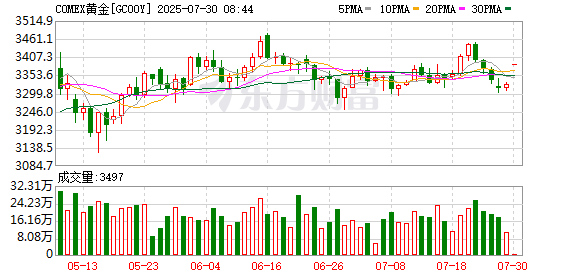
美联储公开市场委员会本月议息会议结果即将于北京时间7月31日凌晨出炉。市场普遍预计美联储本月 将维持基准联邦基金利率区间不变。但市场分析人士表示,美联储任何鸽派信号都可能对金价构成支 撑。且从长期来看,市场分析人士依然看好黄金,并表示随着美联储走向鸽派的道路更加清晰,美元可 能走软,而不断增长的财政赤字也将继续增强黄金作为硬资产的吸引力。 消息面上,美国劳工部29日发布的月度职位空缺和劳动力流动调查(JOLTS)报告显示,美国6月份职 位空缺降至744万个,低于5月份的771万个。经济学家此前预测该数字将降至751万个。 当天9月交割的白银期货价格上涨5.5美分,收于每盎司38.385美元,涨幅为0.14%。 (文章来源:新华财经) 当天原油价格上涨和美国国债收益率小幅下降为黄金提供了支撑,助力金价结束了此前连续四个交易日 的下跌。 由于美国加大对俄罗斯的施压,国际油价29日大幅上涨,布伦特原油和WTI原油双双收高超3%。 不过,由于美国与日本、欧洲达成贸易协定缓解了贸易战担忧,金价近期承压回落,29日盘中一度回踩 测试3300美元关口支撑。市场分析人士认为,在美联储就未来降息提供指引之前,金价可能仍将维持区 ...

X @外汇交易员
外汇交易员· 2025-07-30 00:32
Trade Negotiations - US and China are expected to extend the trade truce for another three months, agreeing not to impose additional tariffs or escalate the trade war [1] - The extension involves the reinstatement of the suspended 24% portion of US tariffs and corresponding Chinese countermeasures for 90 days [1] - Trade teams will maintain close communication [1] Key Issues - Discussions will focus on major sticking points, such as US concerns about China's excess industrial capacity [1] - China is expected to pressure the US regarding fentanyl tariffs [1]
贸易战预期好转,黄金持续下跌
Sou Hu Cai Jing· 2025-07-29 11:14
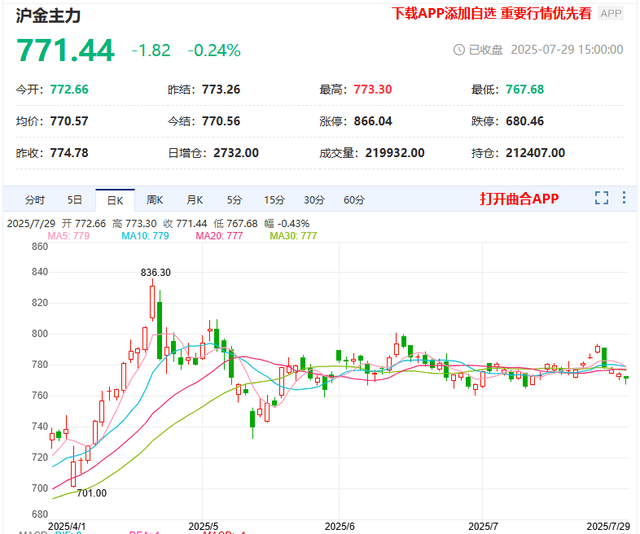
近期对黄金利空的因素,主要在美国与一系列国家和地区暂时达成了贸易协议。 期货公司观点 广发期货: 尽管前期出于对贸易冲突的担忧部分资金选择押注黄金多头,但 8 月 1 日到来前或有更多国家和美国达 成贸易协议,且美联储 7 月降息概率较低,都对美元资产形成支撑从而抑制金价涨幅,后期市场将回归 美国经济基本面的影响逻辑。 技术面上国际金价持续盘中形成三角形态在 3450 美元的前高存在阻力缺乏较强突破的驱动,短期国际 金价冲高回落受到国内商品市场情绪扰动可能再度测试60 日均线(沪金760元附近)的支撑,可逢低阶 段做多把握连跌后修复。 特别是欧盟,美国与欧盟达成贸易协议后,将对欧盟商品征收的进口关税定为15%,远低于此前特朗普 威胁的30%税率。 这一协议有效避免了美欧之间爆发更大规模的贸易战,为全球市场注入了确定性。 受此影响,美元指数上涨,而由于避险情绪的退散,此前因此上涨的黄金受利空下跌。 日内收盘,沪金下跌0.24%,报收771.44元/克。 ...
瑞达期货集运指数(欧线)期货日报-20250729
Rui Da Qi Huo· 2025-07-29 09:55
本报告中的信息均来源于公开可获得资料,瑞达期货股份有限公司力求准确可靠,但对这些信息的准确性及完整性不 做任何保证,据此投资,责任自负。本报告不构成个人投资建议,客户应考虑本报告中的任何意见或建议是否符合其特定状 明出处为瑞达期货股份有限公司研究院,且不得对本报告进行有悖原意的引用、删节和修改。 | | | | 集运指数(欧线)期货日报 | | | 2025/7/29 | | --- | --- | --- | --- | --- | --- | --- | | 项目类别 数据指标 | 最新 | 最新 | 环比 | 数据指标 | | 环比 | | EC主力收盘价 | -26.3↓ EC次主力收盘价 | 1460.000 | | | 1735 | +12.70↑ | | 期货盘面 EC2510-EC2512价差 | -40.00↓ EC2510-EC2602价差 | -275.00 | | | -61.30 | -23.10↓ | | EC合约基差 | | 856.56 | +42.80↑ | | | | | 期货持仓头寸(手) EC主力持仓量 | 50726 32↑ | | | | | | | SCFIS(欧 ...
美元利好已尽?渣打:美联储转鸽将成最大威胁!
Jin Shi Shu Ju· 2025-07-29 06:01
Group 1 - The core viewpoint is that despite the recent strengthening of the US dollar, it may face challenges due to potential dovish shifts from the Federal Reserve, which could lead to a faster-than-expected rate cut [1][2] - Standard Chartered Bank indicates that the recent weakness of the dollar may reflect market relief that the worst outcomes from trade negotiations are unlikely to occur, but attention is now shifting to the Federal Reserve [1][3] - Market expectations for the upcoming Federal Open Market Committee (FOMC) meeting are low, with no rate cuts priced in for July and only a 16 basis point cut anticipated for September [1][2] Group 2 - The divergence among FOMC members has narrowed, focusing primarily on the impact of tariffs, with some members advocating for ignoring temporary price increases while others, including Chairman Powell, suggest that the Fed could have been more accommodative without tariffs [2] - Economic data, particularly the upcoming employment report, is expected to become a focal point, with Standard Chartered warning that downside risks may outweigh consensus expectations [3] - The dollar is expected to weaken moderately over the next few months, but significant declines will depend more on actual shifts in Federal Reserve policy rather than further trade negotiation news [3]
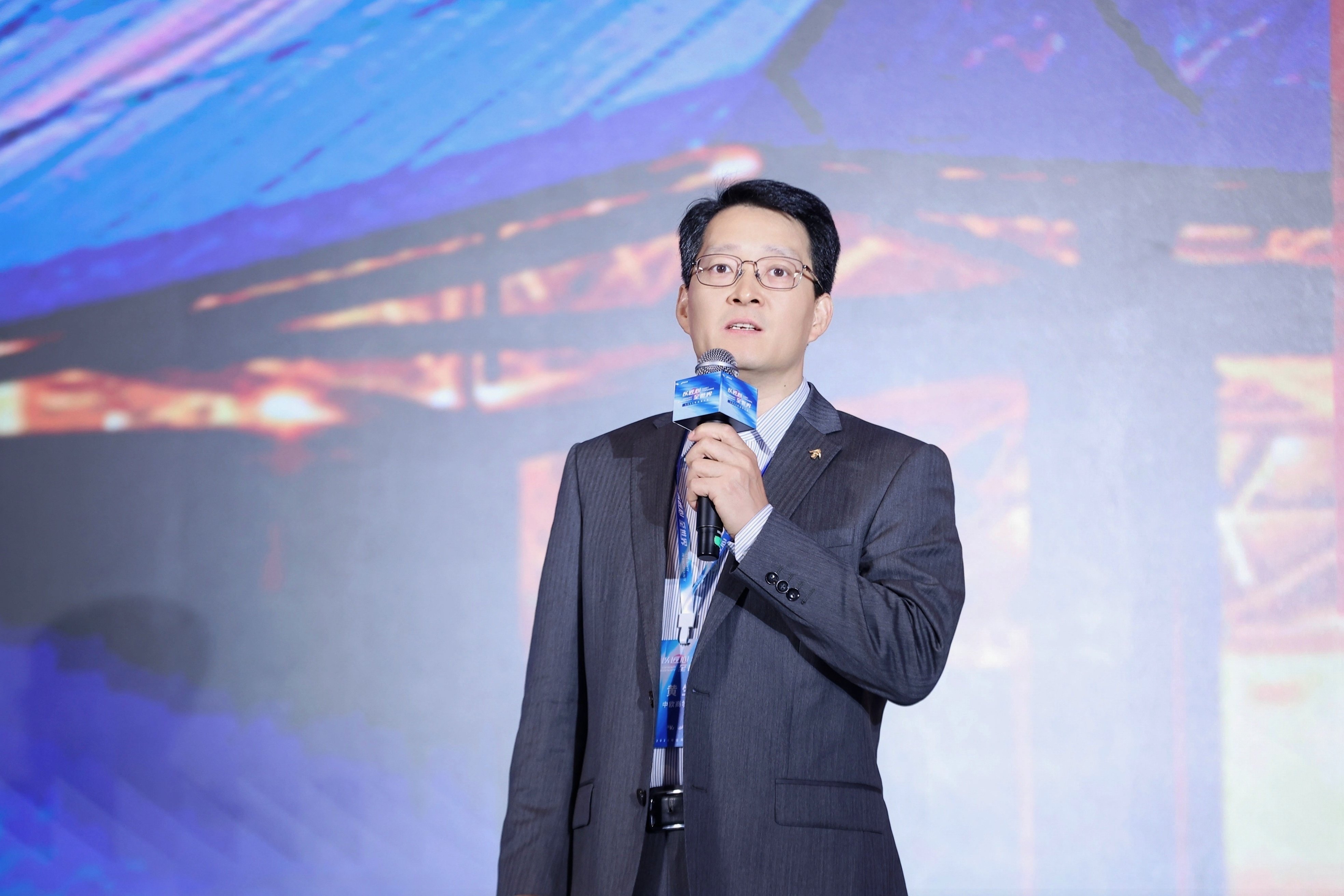
中欧国际工商学院金融学教授黄生:贸易战变局下中国企业出海的破局之道与全球化路径|2025出海大会
3 6 Ke· 2025-07-29 02:40
Group 1: Event Overview - The "Going Global" conference, themed "From Craftsmanship to the World," will be held in Hangzhou, focusing on globalization and overseas expansion [1] - The main venue will feature discussions on popular sectors such as consumption, technology, e-commerce, finance, and new energy, with over 10 keynote speeches and 5 roundtable discussions [1] - The event aims to provide a sustainable path for companies to navigate globalization challenges and enhance their overseas capabilities [1] Group 2: Insights from Huang Sheng's Presentation - Huang Sheng, a finance professor, shared insights on the trade war and strategies for Chinese companies to navigate global markets [4] - The presentation highlighted the importance of practical case studies from the past 30 years of the China Europe International Business School (CEIBS) [4] - CEIBS is collaborating with government departments to promote research on Chinese companies' overseas expansion [5] Group 3: Trade War Analysis - The essence of globalization is division of labor and cooperation, with Chinese companies traditionally exporting to the U.S. and reinvesting in the U.S. market [6] - The trade war has highlighted disparities in benefits, with multinational corporations gaining more than ordinary workers in the U.S., leading to dissatisfaction among the labor class [6] - The evolving dynamics have resulted in a trend where the U.S. seeks to enhance its supply capabilities while China aims to address demand-side issues [7][8] Group 4: Current State of Chinese Companies Going Global - Two-thirds of Chinese listed companies report overseas revenue, primarily in mid-to-high-end manufacturing sectors [9] - Over the past 20 years, overseas revenue has increased 50 times, while total revenue for A-share listed companies has only grown 20 times [9] - Despite this growth, overseas revenue accounts for only 13% of total income for Chinese listed companies, compared to 40% for S&P 500 companies [9] Group 5: Research on Internationalization Strategies - CEIBS has studied various companies, including established firms like BYD and emerging global players, to understand their internationalization strategies [10] - Successful companies often adopt diverse entry modes, including joint ventures and local operations, to mitigate risks [11] - The research emphasizes the importance of a clear international strategy, understanding local markets, and leveraging unique product advantages [13][14] Group 6: Challenges Faced by Chinese Companies - Chinese companies face challenges such as slow profit realization, talent management, and compliance risks when expanding internationally [15] - The need for deep localization and a long-term strategic approach is crucial for successful overseas operations [15] - The overall outlook for Chinese companies going global remains positive, with potential for cultural recognition and success on the international stage [15]
贸易战警报降级!美国关税冲击小于预期,华尔街松了一口气
智通财经网· 2025-07-29 00:46
Group 1 - The core viewpoint is that the recent tariff rates imposed by the U.S. are lower than initially feared, alleviating concerns about a severe economic recession [1][2] - The actual tariff rates are expected to stabilize between 15% and 20%, which is significantly higher than earlier low single-digit levels but lower than the previously anticipated 25% [1][2] - Economists have reduced the recession risk from 60% to 40%, indicating a less pessimistic outlook due to strong global economic growth and a more relaxed financial environment [1][2] Group 2 - Despite the reduction in recession risk, there are still concerns that tariffs could suppress economic growth significantly [2] - The final outcome of the trade negotiations remains uncertain, with critical issues needing resolution before the August 1 deadline [2] - The Federal Reserve is expected to consider the impact of tariffs on inflation in their upcoming discussions, with a potential interest rate cut in September if economic conditions weaken [3]


美欧签“史上最大”关税协议,欧盟官员:这“不是互利共赢贸易合作,而是单方面屈服”
Huan Qiu Shi Bao· 2025-07-28 23:07
Group 1 - The core of the agreement is a 15% tariff on EU goods exported to the US, along with a commitment from the EU to invest an additional $600 billion in the US and purchase $750 billion worth of US energy products [1][3][4] - The agreement is perceived by some European leaders as a one-sided concession rather than a mutually beneficial trade cooperation, with criticism from figures like Bernd Lange and Marine Le Pen highlighting its negative implications for the EU [1][6][7] - The US maintains a 50% global tariff on steel and aluminum, while the EU's interpretation suggests that pharmaceuticals will also be subject to the 15% tariff, which could impact EU exports significantly [4][5] Group 2 - The agreement has been met with cautious optimism from some US officials, who view it as a significant opening of the EU market, but there is a notable lack of enthusiasm from European leaders [5][6] - European media and business sectors have expressed strong criticism, arguing that the agreement could harm local employment and industry, with concerns about the imbalance in trade terms [6][7] - The new tariff structure represents a significant increase from previous averages, with the EU's average tariff on US goods being 1.32% compared to the newly established 15% [7]
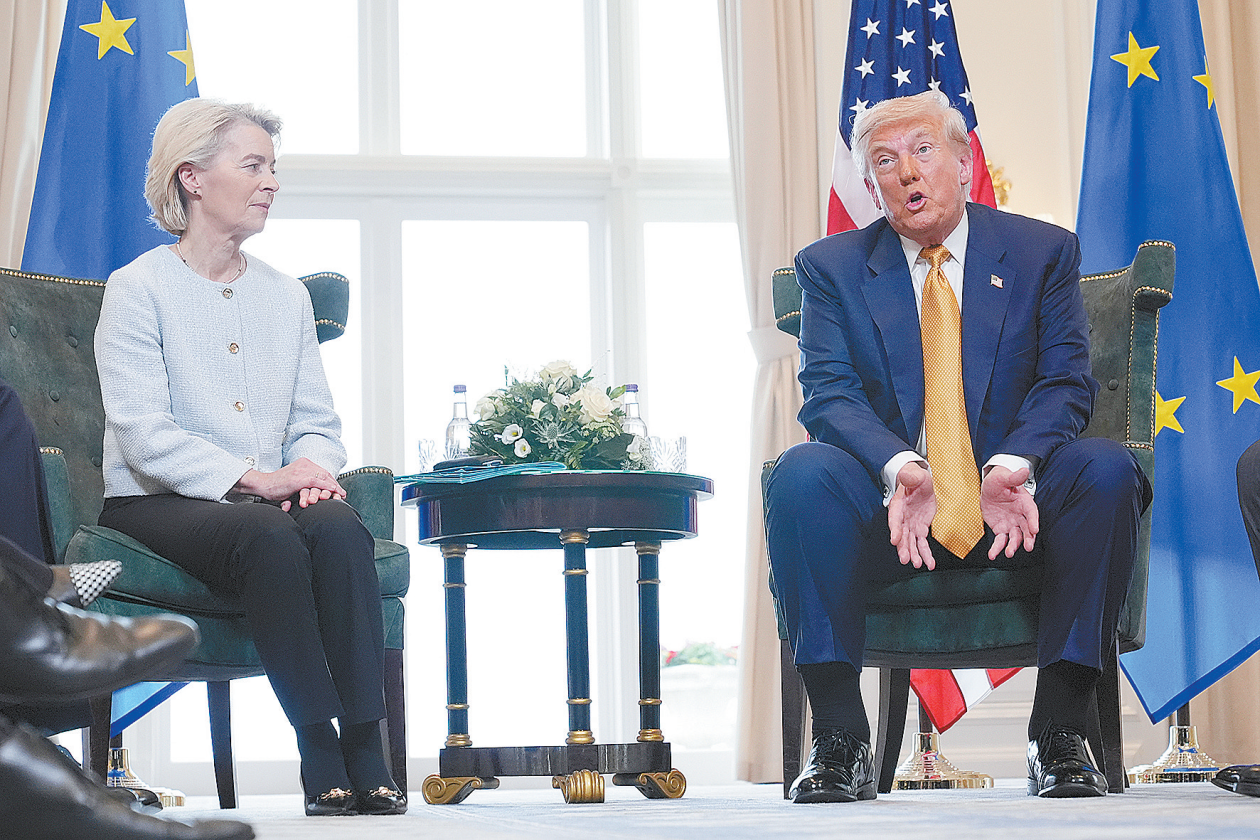
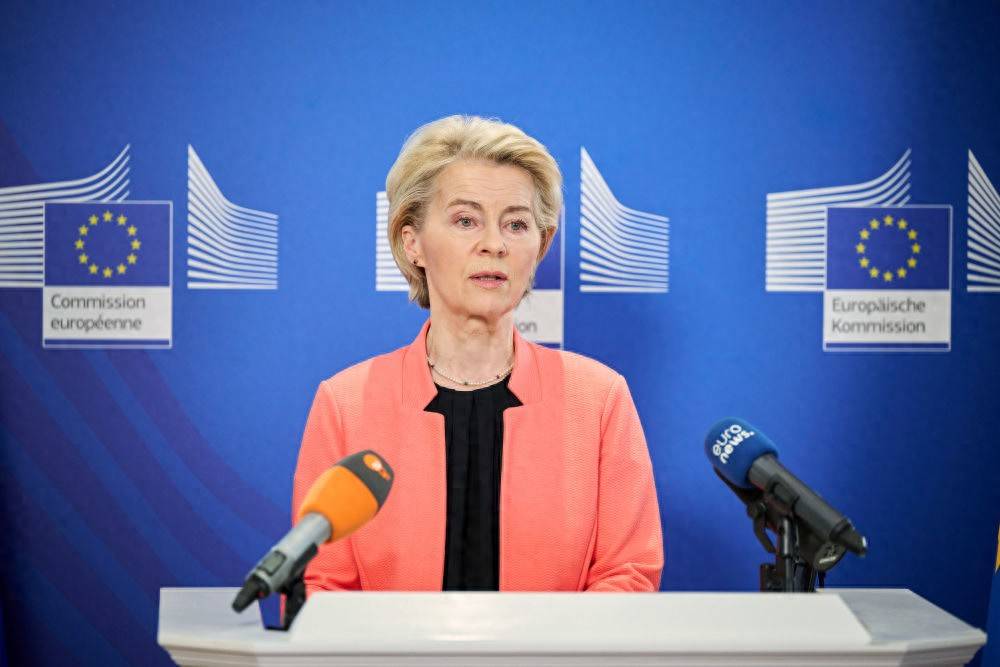
冯德莱恩称15%关税是“最好结果”,法国总理叹“黑暗一天”
Sou Hu Cai Jing· 2025-07-28 15:31
Group 1 - The core point of the news is the announcement of a framework trade agreement between the EU and the US, where the US will impose a 15% tariff on most EU imports, significantly lower than the previously proposed 30% [1][3] - The EU will invest an additional $600 billion in the US and purchase $750 billion worth of energy over three years to reduce reliance on Russian gas [3][4] - The agreement has received mixed reactions within the EU, with some leaders welcoming it for providing stability, while others, like the French Prime Minister, view it as a negative development [3][4] Group 2 - The trade relationship between the US and EU is significant, with projected trade volumes reaching $975.3 billion by 2024, while the trade between China and the EU is expected to exceed $780 billion [6] - Despite the ongoing trade negotiations, the EU's stance towards China has been cautious, with recent criticisms and sanctions against Chinese entities, indicating a complex relationship [6][8] - The EU's dependency on China in sectors like renewable energy and advanced technologies has increased, contradicting the narrative of "decoupling" from China [8][9]