
通胀

Search documents
【UNFX财经事件】政策方向趋于一致 宏观驱动退场 交易逻辑走向结构分化
Sou Hu Cai Jing· 2026-01-23 04:15
Group 1 - The latest Personal Consumption Expenditures (PCE) inflation data shows a slight increase in inflation levels, but overall trends remain within market expectations, not significantly impacting the Federal Reserve's monetary policy path [1] - The PCE price index for November rose by 2.8% year-on-year, with core PCE also recording a 2.8% increase, aligning with market expectations [1] - Despite a slowdown in personal income growth, consumer spending recorded a 0.5% month-on-month increase, indicating resilience in demand [1] Group 2 - The third quarter GDP final value indicates an annualized growth rate of 4.4%, the highest in nearly two years, while initial jobless claims remain low, reinforcing the view that the economy has not significantly cooled [2] - There is an uneven growth performance, with high-income groups and large enterprises being the main support for consumption and investment, while middle and low-income households face more significant adjustment challenges [2] - Market pricing of the Federal Reserve's policy path is stabilizing, with investors generally accepting the baseline assumption of a "high plateau" for short-term policy [2] Group 3 - Trump's fluctuating statements on trade policy, fiscal direction, and central bank independence have reintroduced policy uncertainty as a risk variable that needs reassessment [3] - The recent volatility in the Japanese bond market has brought the "widow trade" back into institutional focus, with yen financing arbitrage and global interest rate linkage risks becoming discussion points [3] - Overall, the November PCE inflation data has not shaken the Federal Reserve's short-term policy anchoring, with economic resilience and inflation persistence coexisting, keeping monetary policy in a wait-and-see mode [3]
德商银行:日本央行应适度转鹰以稳日元
Xin Hua Cai Jing· 2026-01-23 02:57
Core Viewpoint - The Japanese central bank is likely to maintain its policy interest rate at 0.75% in the upcoming decision, as inflation is approaching the 2% target, providing support for policy stability [1] Group 1: Interest Rate Decision - The Japanese central bank is expected to keep the interest rate unchanged at 0.75% due to inflation nearing the 2% target [1] - The decision is influenced by the need for policy stability amid current economic conditions [1] Group 2: Currency Concerns - The central bank is cautious about the recent depreciation of the yen, which has been driven by domestic political risks, including the Prime Minister's announcement of early elections [1] - There is a market expectation for potential "verbal intervention" or actual market intervention by Japanese authorities to support the yen [1] Group 3: Market Reactions - The wording of the policy statement, comments on the exchange rate, and hints about future interest rate paths will be critical in influencing the short-term movement of the yen [1] - The central bank may adopt a slightly firmer stance to prevent further pressure on the yen [1]

新西兰联储主席布雷曼:在当前环境下将对通胀保持高度警惕
Sou Hu Cai Jing· 2026-01-23 02:43
新西兰联储主席布雷曼:核心通胀似乎仍处于目标区间内。在当前环境下将对通胀保持高度警惕。正在 看到经济复苏迹象,但部分信号仍然偏弱。将确保通胀回到目标区间的中点。由于仍存在闲置产能且工 资增长温和,达到2%的通胀目标中点仍具备有利条件。签署支持美联储主席的声明并非旨在代表新西 兰政府的外交政策。 ...
银河期货每日早盘观察-20260123
Yin He Qi Huo· 2026-01-23 02:12
Report Industry Investment Rating No relevant content provided. Core Viewpoints of the Report The report provides a comprehensive daily morning observation of various futures markets, including financial derivatives, agricultural products, black metals, non - ferrous metals, shipping, energy and chemicals, and forest products. It analyzes the market conditions, influencing factors, and provides trading strategies for each sector. For example, in the financial derivatives sector, the stock index futures show differentiation, and the rapid repair period of treasury bond futures may have ended; in the agricultural products sector, different varieties have different supply - demand situations and price trends [19][25][59]. Summary by Relevant Catalogs Financial Derivatives - **Stock Index Futures**: The stock index differentiation continues. On Thursday, the stock index was stable with a slight increase. The CSI 500 and CSI 1000 indexes remained strong, while the Shanghai 50 and CSI 300 indexes were under pressure. The trading strategies include short - term oscillation in IF/IH, upward oscillation in IM/IC, and corresponding arbitrage and option strategies [19][20][21]. - **Treasury Bond Futures**: The rapid repair period may have ended. On Thursday, treasury bond futures closed down across the board. With the tax period affecting the market funds and the equity market's shock - strength, the upward momentum of bond futures has temporarily slowed down. It is recommended to try to go long on the TL contract at low prices [23][24]. Agricultural Products - **Protein Meal**: The supply disturbances increase, and the market as a whole rises. The demand has slightly improved, and the South American weather affects the US soybean market. However, the overall supply - demand is relatively loose, and the domestic soybean meal has short - term support but long - term pressure [26]. - **Sugar**: The international sugar price fluctuates at the bottom, and Zhengzhou sugar has strong support below. The Brazilian sugar supply pressure will gradually ease, but the northern hemisphere's sugar production is in an increasing cycle. The domestic sugar market is under supply pressure, but the price decline space is limited [30]. - **Oil and Fat Sector**: The international oil and fat prices have fallen. The domestic soybean oil is gradually destocking, and the rapeseed supply is expected to increase. The Malaysian palm oil is expected to continue to reduce production and destock, but the destocking speed is slow. The overall oil and fat market will continue to oscillate [33][34]. - **Corn/Corn Starch**: The northern port's spot price is stable, and the market oscillates at a high level. The US corn is expected to oscillate at the bottom, and the domestic corn has short - term stability but long - term pressure [36][38]. - **Hogs**: The supply pressure has improved, and the spot price has generally risen. However, the overall inventory is still high, and the supply pressure still exists [40][41]. - **Peanuts**: The peanut spot price is stable, and the market oscillates at the bottom. The import volume has decreased significantly, and the oil mill has profits. The 03 peanut contract is weak, but the market still oscillates at the bottom [43][44]. - **Eggs**: As the Spring Festival stocking approaches, the egg price has risen. The spot price increase supports the futures market, but the upward space of the 03 contract is relatively limited [46][48]. - **Apples**: The pre - festival sales are good, and the apple price is firm. The high cost of apple warehouse receipts supports the price, and if the later demand is normal, the price of the 05 contract is likely to rise [51][52]. - **Cotton - Cotton Yarn**: The sentiment is optimistic, and the cotton price is supported. The short - term driving force of cotton is limited, but the medium - and long - term fundamentals are strong, and the market is expected to maintain a strong trend [56]. Black Metals - **Steel**: The demand has weakened marginally, and the steel price continues to oscillate. The construction steel sales have declined, the steel inventory has increased, and the cost has support. The steel price is expected to oscillate before the Spring Festival [60]. - **Coking Coal and Coke**: The driving force is not obvious, and the market oscillates. The Mongolian coal customs clearance is high, the domestic coal mine production has recovered, and the downstream winter storage is limited. The market is expected to oscillate [62][63]. - **Iron Ore**: The market expectations are volatile, and the ore price is weak. The global iron ore supply is abundant, and the domestic demand is expected to be low. The ore price is expected to be weak [65]. - **Ferroalloys**: After the adjustment, the bottom support is strong. The silicon iron and manganese silicon have stable demand and cost support, and it is recommended to hold long positions and add more at low prices [68][69]. Non - Ferrous Metals - **Gold and Silver**: Geopolitical events have widened the trust gap, and gold and silver have reached new highs. The market risk - aversion sentiment has fluctuated, and the PCE data and asset allocation adjustment have promoted the rise of gold and silver. It is recommended to hold long positions in Shanghai gold and silver based on the 5 - day moving average [71][72]. - **Platinum and Palladium**: The US dollar index has weakened, and precious metals have strongly made up for the increase. The geopolitical factors and the change of the US dollar asset confidence have affected the market. Platinum has a stronger upward driving force than palladium [75][76]. - **Copper**: The bullish momentum has weakened, and the copper price is in a high - level consolidation. The geopolitical risk has decreased, the inventory has increased, and the long - term supply of ore is tight. It is recommended to wait and see in the short term [79]. - **Alumina**: The market mainly oscillates at a low level. The supply - demand is surplus, and the cost is expected to decline. It is recommended to protect the profit of the previous short positions [83][84]. - **Electrolytic Aluminum**: The market sentiment is fluctuating, and the aluminum price has stabilized in oscillation. The geopolitical concern has dissipated, and the short - term downstream replenishment sentiment exists. The price is expected to oscillate at a high level in the short term and be strong in the medium term [85][86]. - **Cast Aluminum Alloy**: The risk preference has boosted the aluminum alloy to oscillate at a high level. The geopolitical concern has dissipated, and the scrap aluminum supply is tight, which supports the price [87]. - **Zinc**: Pay attention to the change of domestic social inventory. The domestic zinc concentrate shortage has been alleviated, the refined zinc production has increased, and the demand is weak. It is recommended to pay attention to the inventory change [92][93]. - **Lead**: There may be support below. The supply may improve, the consumption has weakened, and the inventory has increased. It is recommended to try to go long lightly at low prices near the support level [97][98]. - **Nickel**: The optimistic sentiment still exists, and the nickel price is in a high - level consolidation. The geopolitical situation is tense, and the Indonesian production target has been adjusted. The price is expected to oscillate at a high level [100][101]. - **Stainless Steel**: The supply - demand is tight, and the price is firm. The supply of raw materials is short, the inventory is decreasing, and the demand is expected to increase. It is recommended to go long at low prices [103][104]. - **Industrial Silicon**: The production reduction news has fermented, but the coking coal has dragged down the market. In the short term, the market is expected to be strong in oscillation. The demand is weak in the medium term, but if the production reduction of large factories is implemented, the price is expected to be strong [104]. - **Polysilicon**: The warehouse receipts have increased significantly, and the market expectation has weakened. The supply has decreased, and the demand has increased in the short term, but the market is pessimistic about the future. It is recommended to participate cautiously [106][107]. - **Lithium Carbonate**: The price is at a high level, and it is recommended to operate cautiously. The supply may be affected by policies and maintenance, and the demand is supported by "export rush" and pre - festival stocking. It is recommended to go long after the callback [109]. - **Tin**: Pay attention to the macro sentiment. The import of tin concentrate has increased, the inventory has increased, and the demand is in the off - season. The price is mainly affected by the macro sentiment in the short term [112]. Shipping - **Container Shipping**: The spot freight rate continues to decline, and it is necessary to pay attention to geopolitical dynamics. The spot freight rate is in the off - season decline, and the export tax rebate may delay the decline. It is recommended to wait and see in the short term and hold the 6 - 10 positive spread [115][116][117]. Energy and Chemicals - **Crude Oil**: The geopolitical situation has eased, and the EIA inventory has increased. The increase in inventory and the progress of the Russia - Ukraine peace talks have pressured the oil price, but the supply threat and the cold wave support the price. The oil price is expected to oscillate widely [121][122]. - **Asphalt**: The low inventory and low production support the spot price. The supply of raw materials is expected to be stable, and the market is in a high - level oscillation. It is recommended to pay attention to the 03 contract and the BU4 - 6 positive spread [124][125]. - **Fuel Oil**: The cost is oscillating, and the short - term supply of low - sulfur fuel is abundant. The fuel price is affected by geopolitical and macro factors, and the supply of low - sulfur fuel is expected to increase. It is recommended to pay attention to the FU59 positive spread [126][128]. - **LPG**: Propane still has support. The international LPG is tight, and the domestic supply and demand are relatively stable. The price is expected to oscillate widely [130][131]. - **Natural Gas**: There are still concerns about European supply, and there is a short squeeze in the US HH market. The European market is affected by cold weather, low inventory, and geopolitical risks, and the US market is affected by cold weather and supply - demand. It is recommended to hold short positions in TTF and JKM in the third quarter and sell call options [132][134]. - **PX & PTA**: The capital attention has increased. The PX supply is expected to be high, and the PTA is affected by cost and capital. The market is expected to oscillate widely [136][137][138]. - **BZ & EB**: The transaction of South Korean pure benzene to the US Gulf is good, and the supply of styrene has decreased due to unexpected shutdown of plants. The supply of pure benzene is expected to tighten, and the styrene supply has decreased. The styrene price is expected to be strong in the short term [139][140]. - **Ethylene Glycol**: The Saudi maintenance may reduce imports, and the market oscillates widely. The supply may decrease, and the demand is in the off - season. The price is expected to oscillate widely [144]. - **Short - Fiber**: The supply is sufficient, and the terminal demand has weakened. The production load is expected to decrease, and the price follows the cost. The market is expected to oscillate widely [146][147]. - **Bottle Chips**: The maintenance has accelerated in mid - January. The production capacity is expected to decrease, and the replenishment momentum may slow down. The market is expected to oscillate widely [149]. - **Propylene**: The load continues to decline. The supply is affected by device maintenance, and the market has support. The price is expected to oscillate at a high level [151][152]. - **Plastic PP**: The chemical sector has become stronger, and it is recommended to hold long positions. The domestic PE and PP production capacities have increased, and the market is supported by the chemical sector. It is recommended to hold long positions in L and PP [153][155]. - **Caustic Soda**: The caustic soda price has weakened. The supply is strong, the demand is weak, and the inventory is increasing. The price is expected to be weak [159][160]. - **PVC**: The market has risen in resonance. The supply is expected to decrease, the cost is stable, and the demand is in the off - season. The price is expected to be strong in oscillation [161][162]. - **Soda Ash**: The futures price has fallen. The supply is stable, the demand is good, and the price is expected to decline at a slower pace and oscillate [163][165]. - **Glass**: The futures price has fallen. The production is stable, the inventory is increasing, and the demand is weak. The price is expected to decline at a slower pace and be weak in oscillation [166][167]. - **Methanol**: The market is running strongly. The international device start - up rate has declined, the domestic supply is loose, and the demand has support. It is recommended to go short in the short term and pay attention to the 59 positive spread [169]. - **Urea**: The market is oscillating. The domestic production is at a high level, the international market has limited impact, and the demand is weak. The price is expected to be weak in oscillation [172]. Forest Products - **Pulp**: The pulp price oscillates widely. The supply exceeds demand, the inventory is increasing, and the demand is weak. It is recommended to operate more [174][175][176]. - **Logs**: The spot price is stable with a slight increase. The supply pressure has not been significantly relieved, and the demand is weak. It is recommended to hold long positions and switch the spread strategy [177][179]. - **Offset Printing Paper**: The inventory is high, and the cultural paper spot price has weak rebound. The supply is abundant, the demand is weak, and the inventory is increasing. It is recommended to short - sell in a small amount [180][181]. - **Natural Rubber and No. 20 Rubber**: The synthetic rubber has led the rise. The tire production line start - up rate has increased, which is beneficial to the natural rubber market. It is recommended to wait and see and buy call options [183][184]. - **Butadiene Rubber**: The synthetic rubber has led the rise, and multiple contracts have reached the daily limit. The inventory has changed, and the tire production line start - up rate has increased. It is recommended to hold the spread and buy call options [187][188][189].
中辉有色观点-20260123
Zhong Hui Qi Huo· 2026-01-23 02:11
1. Report Industry Investment Ratings - Gold: Long - term holding, ★★ [1] - Silver: Long - term holding, ★★ [1] - Copper: Long - term holding, ★ [1] - Zinc: Rebound, ★ [1] - Lead: Under pressure, ★ [1] - Tin: Rebound under pressure, ★ [1] - Aluminum: Rebound under pressure, ★ [1] - Nickel: Rebound under pressure, ★ [1] - Industrial silicon: Rebound, ★ [1] - Polysilicon: Rebound, ★ [1] - Lithium carbonate: Cautiously bullish, ★ [1] 2. Core Views of the Report - Geopolitical issues and the Fed's stance are key factors affecting precious metals. Gold and silver have long - term investment value due to geopolitical uncertainties and central bank purchases. Copper has long - term potential due to supply shortages and green demand, but short - term fluctuations are affected by seasonality and market sentiment. Zinc shows a short - term rebound but is limited by weak fundamentals. Aluminum and nickel face short - term pressure due to inventory accumulation and weak demand. Industrial silicon and polysilicon have short - term rebound opportunities. Lithium carbonate is cautiously bullish with supply - side disturbances [1][3][5][6]. 3. Summary by Related Catalogs Gold and Silver - **Market Performance**: Gold reached a new high due to geopolitical issues. SHFE gold was at 1087.58 with a - 0.43% daily change and a 3.40% weekly change; COMEX gold was at 4938 with a 2.11% daily change and a 7.33% weekly change. Silver also showed an upward trend. SHFE silver was at 23339 with a 0.90% daily change and a 0.65% weekly change; COMEX silver was at 96 with a 3.51% daily change and a 6.97% weekly change [2]. - **Core Logic**: Geopolitical issues such as Trump's rumored actions in Cuba and the weakening of the US dollar due to large - scale capital outflows from US dollar assets. Central banks continue to buy gold, and long - term strategic allocation value remains unchanged. Silver's logic is dominated by gold's safe - haven property [1][3]. - **Strategy Recommendation**: Long - term holding. The short - term support for domestic gold is at 1040, and for domestic silver is at 21000. In 2026, the overall support for precious metals is still strong, and the long - term bullish logic remains unchanged [3]. Copper - **Market Performance**: The 100,000 - yuan mark was regained after a tug - of - war. The closing price of SHFE copper was 100270, down 0.43% from the previous day [4]. - **Core Logic**: BHP slightly raised its copper production guidance for fiscal year 2026. In December 2025, refined copper imports decreased. Although it is currently the traditional off - season, the long - term supply - demand logic remains unchanged, with tight global copper concentrate supply and growing green demand for copper [5]. - **Strategy Recommendation**: For existing long positions, use trailing stop - loss to lock in profits. New entrants should wait for a full correction. In the long - term, copper is still promising. Short - term, SHFE copper is in the range of [99500, 103000] yuan/ton, and LME copper is in the range of [12500, 13000] US dollars/ton [6]. Zinc - **Market Performance**: The market sentiment improved, and zinc showed a pattern of being stronger overseas and weaker domestically. The closing price of SHFE zinc was 24530, up 0.74% from the previous day [7]. - **Core Logic**: In 2026, global zinc ore supply may shrink, and domestic new mine production increases are uncertain. Refined zinc production in December decreased, and downstream processing enterprises'开工 rates declined during the off - season [8]. - **Strategy Recommendation**: Long positions should take profits on rallies. Enterprises should actively arrange selling hedging to lock in profits. SHFE zinc is in the range of [24200, 24800] yuan/ton, and LME zinc is in the range of [3150, 3250] US dollars/ton [9]. Aluminum - **Market Performance**: Aluminum prices faced pressure in the short - term, and alumina stabilized at a low level [11]. - **Core Logic**: In 2026, the Fed's interest - rate cut expectation continued. An electrolytic aluminum project in Inner Mongolia was put into production, and inventory increased. The downstream processing enterprises'开工 rates showed a differentiated trend. The alumina market remained oversupplied [12]. - **Strategy Recommendation**: For SHFE aluminum, take profits and wait and see in the short - term, and pay attention to the change direction of aluminum ingot social inventory. The main operating range is [23000 - 25000] [13]. Nickel - **Market Performance**: Nickel prices faced pressure in the short - term, and stainless steel rebounded and then declined [15]. - **Core Logic**: In 2026, the Fed's interest - rate cut expectation continued. Indonesia significantly reduced its nickel ore production target, and there were issues of illegal land occupation in some mines. Domestic pure nickel inventory increased, and stainless steel was in the off - season [16]. - **Strategy Recommendation**: Take profits and wait and see for nickel and stainless steel, and pay attention to Indonesian policies and stainless steel inventory changes. The main operating range for nickel is [133000 - 151000] [17]. Lithium Carbonate - **Market Performance**: The main contract LC2605 opened high and went high, hitting a new high during the session [18]. - **Core Logic**: Affected by the news of canceling export tax rebates for lithium batteries, prices rose for two consecutive days, but then回调 due to the overall decline of the non - ferrous sector and exchange position - limit measures. The upstream lithium salt plants had high enthusiasm for production, and the new production capacity of material plants in 2026 provided support for rigid demand [19]. - **Strategy Recommendation**: High - level oscillation in the range of [16400 - 175000] [20].
日本央行今日面临“明稳暗鹰”抉择:日本12月CPI降温,但日元疲软带来通胀潜压
智通财经网· 2026-01-23 01:35
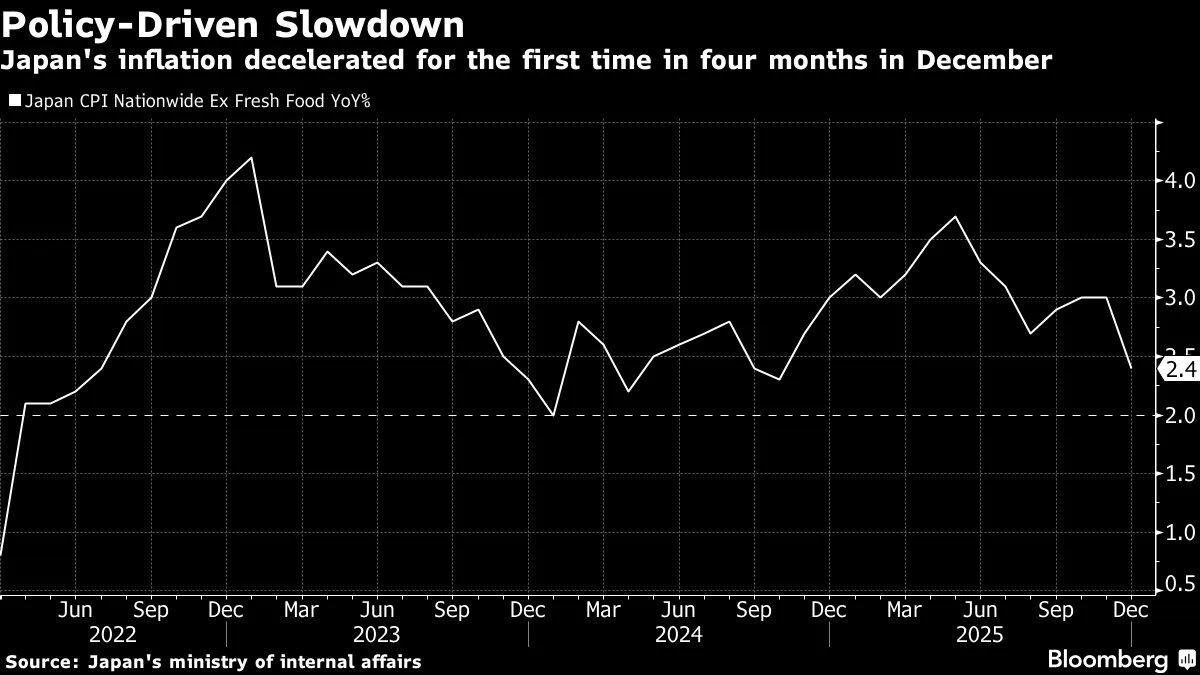
智通财经APP获悉,受政府补贴的影响,日本通胀率四个月来首次放缓。然而,在日本央行即将公布最新利率决议之际,该报告仍然强调了价格压力的潜在 强度。周五公布的数据显示,日本12月份剔除生鲜食品后的消费者物价指数(CPI)同比上涨2.4%,涨幅较11月份的3%有所放缓,这一数据与经济学家的预 期中值相符。12月整体CPI同比增速从上月的2.9%回落至2.1%,略低于预期的2.2%。 上个月的补贴政策产生了双重影响。一方面,高市早苗首相领导的政府在12月推出的汽油和柴油补贴政策降低了燃油价格;另一方面,原定于2024年12月取 消的能源补贴政策推高了价格,从而抑制了2025年同比价格上涨的速度。能源价格较上年同期下跌3.1%,扭转了11月份2.5%的涨幅。剔除能源价格影响的 核心通胀指数上涨2.9%,表明潜在的通胀压力依然强劲。 三菱日联研究咨询公司首席经济学家Shinichiro Kobayashi表示:"通胀放缓是由于政策效应以及物价上涨周期已结束。尽管年底增速有所放缓,但食品价格 全年仍以相当高的速度上涨,消费者对通胀的感受依然十分强烈。" 从长期来看,周五公布的数据表明物价上涨势头稳定,日本央行仍有望进一步 ...

国内商品期市收盘多数上涨,化工品涨幅居前
Zhong Xin Qi Huo· 2026-01-23 01:15
Report Industry Investment Rating - No information provided in the report Core Viewpoints - On January 22, 2026, most domestic commodity futures markets closed higher, with chemicals leading the gains [14]. - The US economy maintains a "slight to moderate" expansion, inflation continues to cool, and consumption shows a "K-shaped" characteristic [14]. - In 2025, China's consumer market scale exceeded 50 trillion yuan, with service retail sales growing faster. In 2026, consumption is expected to grow steadily [14]. - In the short term, risk assets may continue to adjust, but in the medium term, it is recommended to go long on stock indices, non - ferrous metals, gold, and silver [14]. Summary by Directory Financial Market Fluctuations - **Stock Index Futures**: On January 22, 2026, the CSI 300 futures price was 4719.4, down 0.26; the SSE 50 futures price was 3061.2, down 0.61; the CSI 500 futures price was 8400, up 0.25; the CSI 1000 futures price was 8292.6, up 0.56 [3]. - **Treasury Bond Futures**: The 2 - year treasury bond futures price was 102.408, down 0.02; the 5 - year was 105.835, down 0.04; the 10 - year was 108.15, down 0.04; the 30 - year was 112.17, down 0.03 [3]. - **Foreign Exchange**: The US dollar index was 98.7693, up 0.23; the US dollar central parity rate was 6.9646, down 57 pips [3]. - **Interest Rates**: The 7 - day inter - bank pledged repo rate was 1.4952%, up 0.04%; the 10 - year Chinese treasury bond yield was 1.8312%, down 0.14 bp; the 10 - year US treasury bond yield was 4.26%, down 4 bp [3]. Popular Industry Fluctuations - On January 22, 2026, industries such as national defense and military industry, steel, and petroleum and petrochemicals had relatively large daily increases, while industries such as food and beverage, non - bank finance, and banking had declines [6]. Overseas Commodity Fluctuations - **Energy**: On January 21, 2026, NYMEX WTI crude oil was at $59.52, up 0.3%; ICE Brent crude was at $64.62, up 0.67%; NYMEX natural gas was at $3.891, up 25.39%; ICE UK natural gas was at $105.29, up 12.07% [9]. - **Precious Metals**: COMEX gold was at $4769.1, up 3.78%; COMEX silver was at $94.46, up 6.69% [9]. - **Non - ferrous Metals**: LME copper was at $12810, up 0.44%; LME aluminum was at $3115, up 0.24%; LME zinc was at $3175, up 0.06% [9]. - **Agricultural Products**: CBOT soybeans were at $1053, down 0.45%; CBOT soybean oil was at $54.05, up 2.83%; CBOT corn was at $424, down 0.18% [9]. Domestic Commodity Fluctuations - On January 22, 2026, most domestic commodities rose. Chemicals, new energy materials, non - metal building materials, energy products, etc. all had increases, while precious metals had declines [14]. Macro Summary - **Today's Market**: Domestic commodity futures markets closed mostly higher, with chemicals leading the gains [14]. - **Overseas Macro**: The US economy maintains a "slight to moderate" expansion, inflation cools, and consumption shows a "K - shaped" characteristic. Attention should be paid to upcoming GDP and inflation data [14]. - **Domestic Macro**: In 2025, China's consumer market scale exceeded 50 trillion yuan, and in 2026, consumption is expected to grow steadily [14]. - **Asset Views**: The scenario of no interest rate cut in January is basically confirmed, and the first interest rate cut by the Fed within the year is expected to be postponed to June. Short - term risk assets may adjust, while in the medium - term, it is recommended to go long on certain assets [14]. Viewpoint Highlights - **Financial**: Stock markets continue to wait for the main line, and bond markets still have disturbing factors. The short - term judgments for stock index futures, index options, and treasury bond futures are oscillatory rise, oscillation, and oscillation respectively [15]. - **Precious Metals**: After oscillatory adjustment, they maintain an upward trend. Gold and silver are expected to rise oscillatory [15]. - **Shipping**: Pay attention to the resumption of voyages in the far - month. The short - term judgment for the container shipping European line is oscillation [15]. - **Black Building Materials**: Fundamentals are lackluster. Most varieties are expected to oscillate [15]. - **Non - ferrous Metals and New Materials**: Wait for the macro - situation to become clearer. Base metals are oscillating and consolidating. Some varieties are expected to rise oscillatory, while others are expected to oscillate [15]. - **Energy and Chemicals**: The trade tension eases slightly, but the supply - demand pattern is still under pressure. Most varieties are expected to oscillate [17]. - **Agriculture**: Sentiment warms up but trends diverge. Some varieties are expected to rise oscillatory, while others are expected to oscillate or decline oscillatory [17].
中国央行表态继续实施适度宽松货币政策
Dong Zheng Qi Huo· 2026-01-23 01:10
日度报告——综合晨报 [T报ab告le_日R期an:k] 2026-01-23 中国央行表态继续实施适度宽松货币政策 宏观策略(外汇期货(美元指数)) 美国消费者支出连续两个月稳步增长 美国最新的 11 月核心 pce 同比符合预期,通胀压力继续可控, 美元指数维持震荡。 黑色金属(螺纹钢/热轧卷板) Mysteel 五大品种库存周环比增加 10.07 万吨 综 本周五大品种库存再度累积,随着需求的季节性下滑,和产量 回升,建材累库较为明显。卷板整体小幅去库,需求仍有韧性。 短期矛盾尚不突出,仍建议反弹逢高套保。 合 宏观策略(国债期货) 晨 央行行长潘功胜:今年降准降息还有一定的空间 报 央行呵护流动性的态度较为明确,但预计短期内降准或是大幅 增加买债额度的必要性继续下降。 有色金属(铜) 韩国锌业称美国冶炼厂废料堆含 30 亿美元金属价值 短期宏观因素可能会加剧价格波动,基本面短期因素对铜价形 成抑制,预计盘面短期宽幅震荡可能性更大,策略上短线转观 望。 能源化工(苯乙烯) 苯乙烯周度产量数据 多头增仓意愿强烈,苯乙烯盘面大幅上扬 | 1、 金融要闻及点评 | 3 | | --- | --- | | 1. ...
日本12月核心通胀放缓但仍高于央行目标水平
Xin Hua Cai Jing· 2026-01-23 00:31
日本12月核心CPI年率录得2.4%,为2024年10月以来最小增幅,但仍高于央行2%的目标水平,这维持了 市场对未来加息的预期。 (文章来源:新华财经) 日本央行行长植田和男可能不会就下次加息时机给出太多线索,因为首相高市早苗决定下月提前大选引 发新一轮市场波动,使得这一决策变得复杂。日本央行一方面需要通过鹰派言论抑制日元空头,另一方 面又不能因为高市早苗政府可能大幅增加支出的预期而引发债券收益率进一步上升,目前处境微妙。 日本政府周四发布的经济报告基本维持了对经济的谨慎乐观态度,同时警告美国贸易政策带来的下行风 险。内阁府在1月份的月度经济评估报告中重申,作为世界第四大经济体的日本经济正在温和复苏,但 强调了美国政策可能对日本汽车行业造成的影响。报告还强调需要密切关注市场动向。 牛津经济研究院表示,如果日本央行仍落后于形势,期限溢价很可能会上升。日本国债收益率的上升将 使财政状况恶化,削弱日元,并加剧通胀预期,进而导致曲线进一步变陡的压力加大。市场预计日本央 行会先行采取行动,但结果可能会令他们失望。预计日本央行在2026年年中之前仅再加息一次,达到 1%的最终利率水平。 数据显示,12月份剔除生鲜食品的 ...
【环球财经】美国个人消费支出价格指数上涨 通胀压力持续
Xin Hua Cai Jing· 2026-01-22 22:52
Core Insights - The U.S. personal consumption expenditure (PCE) price index increased by 2.7% and 2.8% year-on-year in October and November 2025, indicating persistent inflationary pressures [1] - The core PCE price index, excluding volatile food and energy prices, also rose by 2.7% and 2.8% year-on-year in the same months, approaching the previous high of 2.9% in July and August [1] - Month-on-month, both the overall and core PCE price indices increased by 0.2% in October and November [1] Economic Indicators - The PCE price index is a key inflation indicator closely monitored by the Federal Reserve, serving as a primary reference for monetary policy decisions [1] - The Federal Reserve aims to reduce inflation to a target of 2%, with the latest data being crucial for assessing progress towards this goal [1] - Despite the inflation data aligning with market expectations, ongoing inflationary pressures suggest that the Federal Reserve is likely to maintain interest rates during the monetary policy meeting concluding on January 28 [1]