
产业链利润分配

Search documents
分析人士:铝产业链博弈进入僵持阶段
Qi Huo Ri Bao· 2026-02-05 01:36
Core Viewpoint - The aluminum industry is experiencing a significant divergence in the pricing and profitability of electrolytic aluminum and alumina, with electrolytic aluminum profits rising sharply while alumina prices remain under pressure, leading to a clear shift in profit distribution within the industry [1][5]. Group 1: Electrolytic Aluminum Market - Since late December last year, the price of electrolytic aluminum has significantly increased, with the Shanghai aluminum futures price reaching a historical high of 26,185 yuan/ton in January [1]. - The profitability of the electrolytic aluminum sector has been supported by rising futures prices, despite weak demand from downstream processing enterprises [2]. - The production capacity of electrolytic aluminum continues to increase slightly, with daily output around 12.3 million tons, while downstream demand has weakened due to seasonal factors and high prices [2][4]. Group 2: Alumina Market - The alumina sector is facing severe structural oversupply, with nominal production capacity nearing 110 million tons and operational capacity around 93 million tons, significantly exceeding the demand from electrolytic aluminum [4]. - The average price of alumina has dropped from 2,750 yuan/ton to 2,650 yuan/ton since mid-December, falling below the industry average cost [3]. - Despite some production cuts and maintenance in alumina plants, the average daily output remains above 260,000 tons, indicating persistent high levels of supply [3][4]. Group 3: Industry Dynamics - The divergence in pricing and profitability between electrolytic aluminum and alumina is attributed to differences in capacity constraints, demand structure, and the nature of the products [5][6]. - The lack of a profit-sharing mechanism within the aluminum industry means that even with high profits in electrolytic aluminum, aluminum smelters are reluctant to accept high-priced alumina [4][5]. - The current market structure and supply constraints suggest that the disparity in profitability between electrolytic aluminum and alumina will continue until there are substantial changes in production capacity and profit distribution mechanisms [6].
长江有色:23日铅价小涨 报价偏强节前备货刚需成交
Xin Lang Cai Jing· 2026-01-23 08:36
Core Viewpoint - The lead market is experiencing a slight decline in prices, influenced by supply constraints and demand dynamics, with expectations of a strong performance in the short term due to pre-holiday stocking and structural demand support [1][2][7]. Supply Constraints - The lead market is facing systemic tightening in supply due to continuous shortages in primary lead and low processing fees, which pressure smelter profits. Seasonal production halts and planned maintenance before the Spring Festival further limit output [3]. - The recycled lead sector is also constrained by difficulties in collecting waste batteries during winter, rising compliance costs, and stricter environmental policies, leading to reduced effective supply [3]. Demand Support - Short-term demand is driven by pre-holiday stocking as downstream distributors increase purchases to ensure sales after the holiday. Long-term demand is supported by traditional replacement needs for automotive starter batteries and rapid growth in the emerging energy storage battery sector [4]. Industry Chain Dynamics - In a tight supply-demand balance, profit distribution within the industry chain is shifting towards upstream resource providers, giving mining companies pricing power. Midstream smelting companies face a divided situation, with primary lead firms benefiting from by-product revenues, while recycled lead firms struggle with raw material shortages and high costs [5]. Leading Companies' Strategies - Leading companies are demonstrating strategic resilience by accelerating transitions to high-value areas such as lead-based new materials and resource recycling. They are building closed-loop supply chains to enhance raw material security and stabilize cost fluctuations [6]. Market Activity - The spot market is showing a strong trading atmosphere, characterized by firm pricing and transactions driven by essential demand. Sellers are reluctant to sell due to tight supply expectations, maintaining strong quotes despite limited acceptance of high prices from downstream enterprises [6]. Market Outlook - The lead price is expected to maintain a strong oscillating pattern in the short term, supported by supply constraints and pre-holiday demand. Key variables post-holiday will include the recovery pace of smelting operations and the sustainability of core demand from automotive and energy storage sectors [7].


工业硅、多晶硅日报(2026年1月9日)-20260109
Guang Da Qi Huo· 2026-01-09 05:39
Report Industry Investment Rating - No information provided Core Viewpoints of the Report - On the 8th, industrial silicon fluctuated weakly, with the main contract 2605 closing at 8,535 yuan/ton, a daily decline of 4.53%, and the open interest increasing by 15,797 lots to 261,000 lots. The spot reference price of industrial silicon from Baichuan remained stable at 9,628 yuan/ton compared to the previous trading day. The price of the lowest deliverable product was stable at 8,850 yuan/ton, and the spot changed from a discount to a premium of 315 yuan/ton. Polysilicon contracts hit the daily limit down, with the main contract 2605 closing at 53,610 yuan/ton, a daily decline of 9% reaching the limit, and the open interest decreasing by 9,751 lots to 58,000 lots. The price of N-type recycled silicon material for polysilicon from Baichuan rose to 55,500 yuan/ton, and the price of the lowest deliverable silicon material was 53,500 yuan/ton. The spot changed from a discount to a premium of 1,890 yuan/ton to the main contract [2]. - The main production area of industrial silicon continued to shift northward. Although there were production cuts due to environmental protection, it was difficult to offset the decline in demand. Polysilicon had limited production cuts, the silicone industry had collective production cuts, and the aluminum alloy industry had environmental - related production cuts. Industrial silicon had cost support but no continuous driving force, so a high - level short - selling strategy should be maintained. The core logic of polysilicon trading was about the establishment of a production capacity platform and supply - side production control through state reserves, but the reserve action had not been implemented, causing market concerns. In addition, the exchange had increased margin requirements several times, implemented risk - control position limits, and the pressure of low warehouse receipts had been greatly relieved, causing the over - speculative sentiment to dissipate. After the market re - discussed the issue of industrial chain profit distribution and downstream production cuts, the upside premium space for polysilicon was limited. Given the large market fluctuations, it was advisable to hold a light position and wait and see [2]. Summary Based on Relevant Catalogs Research Views - On the 8th, industrial silicon and polysilicon showed different market trends. Industrial silicon fluctuated weakly, and polysilicon contracts hit the daily limit down. The production areas of industrial silicon and polysilicon faced production cuts, and the market had concerns about polysilicon's state reserve plan. It was recommended to hold a light position and wait and see [2]. Daily Data Monitoring - **Industrial Silicon**: The futures settlement price of the main contract decreased by 445 yuan/ton to 8,535 yuan/ton, while the near - month contract increased by 35 yuan/ton to 8,930 yuan/ton. The spot prices of various grades remained stable. The current lowest deliverable product price was stable at 8,850 yuan/ton, and the spot changed from a discount of 130 yuan/ton to a premium of 315 yuan/ton. The inventory in Guangzhou Futures Exchange increased by 18,175 tons to 51,155 tons, and the total social inventory decreased by 7,750 tons to 448,400 tons [4]. - **Polysilicon**: The futures settlement price of the main contract decreased by 4,690 yuan/ton to 53,610 yuan/ton, and the near - month contract decreased by 3,450 yuan/ton to 54,550 yuan/ton. The price of N - type recycled silicon material increased by 2,000 yuan/ton to 55,500 yuan/ton. The current lowest deliverable product price increased by 2,000 yuan/ton to 55,500 yuan/ton, and the spot changed from a discount of 4,800 yuan/ton to a premium of 1,890 yuan/ton. The inventory in Guangzhou Futures Exchange increased by 81,000 tons to 120,900 tons, and the total social inventory increased by 26,000 tons to 308,000 tons [4]. - **Organic Silicon**: The price of dimethyldichlorosilane (DMC) in the East China market remained stable, and the price of dimethyl silicone oil increased by 1,000 yuan/ton to 15,200 yuan/ton [4]. Chart Analysis Industrial Silicon and Cost - Side Prices - Charts display the prices of different grades of industrial silicon, grade spreads, regional spreads, electricity prices, silica prices, and refined coal prices [6][9][11]. Downstream Product Prices - Charts show the prices of DMC, organic silicon products, polysilicon, silicon wafers, battery cells, and components [14][16][18]. Inventory - Charts present the futures inventories of industrial silicon and polysilicon, the weekly industry inventories of industrial silicon, the weekly inventory changes of industrial silicon, the weekly inventories of polysilicon, and the weekly inventory of DMC [21][22][24]. Cost and Profit - Charts illustrate the average cost and profit levels of industrial silicon, the weekly cost - profit of industrial silicon, the processing industry profit of polysilicon, the cost - profit of DMC, and the cost - profit of aluminum alloy [26][28][31]. Team Introduction - Zhan Dapeng is the director of non - ferrous research at Everbright Futures Research Institute, a senior precious metals researcher, and a gold intermediate investment analyst. He has over a decade of commodity research experience and has won many awards [34]. - Wang Heng is a non - ferrous researcher at Everbright Futures Research Institute, mainly researching aluminum and silicon. He has won relevant industry awards and provides in - depth research for clients [34]. - Zhu Xi is a non - ferrous researcher at Everbright Futures Research Institute, mainly researching lithium and nickel. She has won industry awards and focuses on the integration of non - ferrous metals and new energy [35].
光大期货:1月9日有色金属日报
Xin Lang Cai Jing· 2026-01-09 01:27
Copper - Copper prices experienced fluctuations and a decline, with domestic refined copper imports remaining unprofitable [3][12] - LME copper inventory decreased by 2,150 tons to 141,075 tons, while Comex inventory increased by 2,255 tons to 467,165 tons [3][12] - Demand for copper is slowing due to high prices, leading to a rigid procurement demand in the market [3][12] Nickel & Stainless Steel - LME nickel fell by 3.34% to $17,065 per ton, while SHFE nickel dropped by 4.48% to 136,510 yuan per ton [4][14] - LME nickel inventory increased by 666 tons to 276,300 tons, and SHFE warehouse receipts rose by 554 tons to 39,330 tons [4][14] - Indonesia plans to adjust nickel quotas based on industry demand to support local prices, but specific quota levels for 2026 remain undisclosed [4][14] Aluminum & Aluminum Alloys - Alumina prices showed a weak trend, with AO2605 settling at 2,797 yuan per ton, down 2.95% [6][15] - SHFE aluminum prices also declined, with AL2602 closing at 23,710 yuan per ton, a drop of 1.17% [6][15] - The market is facing inventory pressure due to increased shipments and reduced outflows from major sales areas [6][15] Industrial Silicon & Polysilicon - Industrial silicon prices weakened, with the main contract settling at 8,535 yuan per ton, down 4.53% [7][16] - Polysilicon contracts hit the limit down, with the main contract at 53,610 yuan per ton, a 9% drop [7][16] - The market is experiencing significant volatility, and a cautious approach is recommended due to concerns over production capacity and demand [7][16] Lithium Carbonate - Lithium carbonate futures rose by 2.46% to 145,000 yuan per ton, with battery-grade lithium carbonate prices increasing by 5,000 yuan to 138,500 yuan per ton [8][17] - Weekly production of lithium increased by 115 tons to 22,535 tons, with various sources contributing to the supply [8][17] - Concerns over actual supply and pricing mechanisms in the lithium market are prevalent, with expectations of continued demand despite potential price declines [8][17]

工业硅日报-20251231
Guang Da Qi Huo· 2025-12-31 05:30
Research Views - On December 30, industrial silicon showed a volatile and slightly stronger trend. The main contract 2605 closed at 8,915 yuan/ton, with an intraday increase of 1.08%. The open interest decreased by 4,845 lots to 216,000 lots. The reference price of industrial silicon spot from Baichuan was 9,603 yuan/ton, remaining stable compared to the previous trading day. The price of the lowest deliverable 421 grade remained stable at 8,850 yuan/ton, and the spot shifted from a premium to a discount of 65 yuan/ton [2]. - Polysilicon showed a volatile and slightly weaker trend. The main contract 2605 closed at 57,890 yuan/ton, with an intraday decrease of 0.19%. The open interest decreased by 12,300 lots to 83,000 lots. The price of N-type recycled polysilicon material from Baichuan was raised to 52,500 yuan/ton, and the price of the lowest deliverable silicon material was also raised to 52,500 yuan/ton. The spot discount to the main contract widened to 5,390 yuan/ton [2]. - Industrial silicon plants in the southwest region reduced production again. In the northwest region, there were both increases and decreases in production, and there were expectations of environmental - related production cuts in the future. Due to high - level hedging, the overall inventory pressure on silicon plants was limited. In the short term, industrial silicon continued to follow the logic of cost and production - cut - driven price increases [2]. - Battery cell production was cut and prices were raised again due to the sharp increase in silver prices. Silicon wafer manufacturers significantly raised their quotes. However, the price increase effect on the crystalline silicon end was not good, and several polysilicon plants reported production cuts in January. As the market feedback on the state reserve purchase weakened, the issues of industrial chain profit distribution and downstream production - cut pressure were re - discussed, and new warehouse receipts were registered to relieve pressure, the polysilicon futures price gradually corrected downward [2]. - There were still risks of disturbances in the futures market's capital situation. Investors were advised to be cautious about short - selling and focus on the implementation of production cuts by polysilicon plants [2]. Daily Data Monitoring Industrial Silicon - Futures settlement prices: The main contract increased from 8,715 yuan/ton on December 29 to 8,915 yuan/ton on December 30, up 200 yuan/ton; the near - month contract increased from 8,625 yuan/ton to 8,785 yuan/ton, up 160 yuan/ton [3]. - Spot prices of various grades remained mostly stable, with no change in most regions for不通氧553 and通氧553 and 421 silicon [3]. - The current lowest deliverable price remained at 8,850 yuan/ton, and the spot premium changed from 135 yuan/ton to a discount of 65 yuan/ton, a decrease of 200 yuan/ton [3]. - The industrial silicon warehouse receipts increased by 120 to 10,027 (daily), and the Guangzhou Futures Exchange inventory increased by 2,040 to 47,135 (weekly). The total social inventory of industrial silicon increased by 6,000 tons to 462,150 tons [3]. Polysilicon - Futures settlement prices: The main contract increased from 56,500 yuan/ton on December 29 to 57,890 yuan/ton on December 30, up 1,390 yuan/ton; the near - month contract increased from 57,750 yuan/ton to 58,350 yuan/ton, up 600 yuan/ton [3]. - The price of N - type recycled polysilicon material increased by 100 yuan/ton to 52,500 yuan/ton, and the current lowest deliverable price also increased by 100 yuan/ton to 52,500 yuan/ton. The spot discount widened from 4,100 yuan/ton to 5,390 yuan/ton, a decrease of 1,290 yuan/ton [3]. - The polysilicon warehouse receipts increased by 20 to 4,020 (daily), and the Guangzhou Futures Exchange inventory increased by 0.9 million tons to 11.91 million tons (weekly). The total social inventory of polysilicon increased by 0.2 million tons to 30.8 million tons [3]. Organic Silicon - The price of DMC in the East China market remained at 13,700 yuan/ton, and the prices of raw rubber and 107 glue remained stable. The price of dimethyl silicone oil increased by 1,000 yuan/ton to 15,200 yuan/ton [3]. Chart Analysis Industrial Silicon and Cost - Side Prices - Charts show the prices of different grades of industrial silicon, grade spreads, regional spreads, electricity prices, silica prices, and refined coal prices [5][8][10]. Downstream Product Prices - Charts display the prices of DMC, organic silicon products, polysilicon, silicon wafers, battery cells, and components [12][14][16]. Inventory - Charts present the futures inventory of industrial silicon and polysilicon, the weekly industry inventory of industrial silicon, the weekly inventory change of industrial silicon, the weekly inventory of polysilicon, and the weekly inventory of DMC [19][23]. Cost and Profit - Charts show the average cost and profit levels of industrial silicon, the weekly cost - profit of industrial silicon, the processing industry profit of polysilicon, the cost - profit of DMC, and the cost - profit of aluminum alloy [25][27][29]. Team Introduction - Zhan Dapeng, a science master, is the director of non - ferrous research at Everbright Futures Research Institute, a senior precious metals researcher, and a gold intermediate investment analyst. He has more than a decade of commodity research experience, serves many leading spot enterprises, and has published dozens of professional articles in public newspapers and magazines. His team has won the Best Metal Industry Futures Research Team Award from Futures Daily & Securities Times for four consecutive sessions [33]. - Wang Heng, a master of finance from the University of Adelaide, Australia, is a non - ferrous researcher at Everbright Futures Research Institute, mainly focusing on aluminum and silicon research. He won the 18th Best Green Finance New Material Futures Analyst Award from Futures Daily & Securities Times [33]. - Zhu Xi, a science master from the University of Warwick, UK, is a non - ferrous researcher at Everbright Futures Research Institute, mainly focusing on lithium and nickel research. She won the 18th Best Green Finance New Material Futures Analyst Award from Futures Daily & Securities Times [34].
工业硅&多晶硅日报(2025 年 12 月 30 日)-20251230
Guang Da Qi Huo· 2025-12-30 06:08
Group 1: Report's Investment Rating - No information about the industry investment rating is provided in the report. Group 2: Core Viewpoints of the Report - On December 29, industrial silicon fluctuated weakly. The main contract 2605 closed at 8,715 yuan/ton, with an intraday decline of 0.68%. The open interest decreased by 3,677 lots to 221,000 lots. The reference price of Baichuan's industrial silicon spot was 9,603 yuan/ton, remaining stable compared to the previous trading day. The price of the lowest deliverable 421 remained stable at 8,850 yuan/ton, and the spot changed from a discount to a premium of 135 yuan/ton [2]. - Polysilicon also fluctuated weakly. The main contract 2605 closed at 56,500 yuan/ton, with an intraday decline of 4.84%. The open interest decreased by 23,500 lots to 95,600 lots. The price of Baichuan's N-type recycled polysilicon material was raised to 52,400 yuan/ton, and the price of the lowest deliverable silicon material was also raised to 52,400 yuan/ton. The spot discount to the main contract narrowed to 4,100 yuan/ton [2]. - Industrial silicon plants in the southwest region cut production again, while those in the northwest had both increases and decreases, with expectations of environmental protection - related production cuts in the future. Due to high - level hedging, the overall inventory pressure of silicon plants was limited. In the short term, industrial silicon continued to follow the logic of cost and production - cut - driven price increases [2]. - Battery cell production was cut and prices were raised again due to the sharp rise in silver prices, and silicon wafer manufacturers significantly raised their quotes. However, the price increase effect at the crystalline silicon end was not good, and several polysilicon material plants reported production cuts in January. Due to the weakening market feedback on state reserves, the re - discussion of the industrial chain profit distribution and downstream production - cut pressure, and the emergence of new warehouse receipt registrations to relieve pressure, the polysilicon futures price gradually corrected downward. There were still risks of capital - side disturbances in the futures market, and investors were advised to be vigilant against short - chasing and focus on the implementation of production cuts by polysilicon material plants [2]. Group 3: Summary of Each Section According to the Table of Contents 1. Research Viewpoints - The research viewpoints section mainly analyzes the price trends of industrial silicon and polysilicon on December 29, 2025, including the changes in futures prices, open interest, and spot prices. It also analyzes the production - cut situation of silicon plants and the reasons for the price fluctuations in the polysilicon market, and provides investment suggestions [2]. 2. Daily Data Monitoring - **Industrial Silicon**: The futures settlement prices of the main and near - month contracts decreased, with the main contract dropping from 8,880 yuan/ton to 8,715 yuan/ton and the near - month contract dropping from 8,790 yuan/ton to 8,625 yuan/ton. Most of the spot prices of different grades and in different regions remained stable, and the spot changed from a discount to a premium of 135 yuan/ton compared to the previous day. The inventory of industrial silicon increased, with the daily warehouse receipt increasing by 480 tons to 9,907 tons, and the social inventory increasing by 6,000 tons to 462,150 tons [3]. - **Polysilicon**: The futures settlement prices of the main and near - month contracts decreased, with the main contract dropping from 58,955 yuan/ton to 56,500 yuan/ton and the near - month contract dropping from 59,500 yuan/ton to 57,750 yuan/ton. The spot prices of different types of polysilicon remained stable, and the spot discount to the main contract narrowed to 4,100 yuan/ton. The inventory of polysilicon increased, with the daily warehouse receipt increasing by 30 tons to 4,000 tons, and the social inventory increasing by 0.2 million tons to 30.8 million tons [3]. - **Organic Silicon**: The prices of most organic silicon products remained stable, except that the price of dimethyl silicone oil increased by 1,000 yuan/ton to 15,200 yuan/ton [3]. 3. Chart Analysis 3.1 Industrial Silicon and Cost - Side Prices - The section may include charts showing the prices of different grades of industrial silicon, grade spreads, regional spreads, electricity prices, silica prices, and refined coal prices, which help to analyze the price trends and cost - side factors of industrial silicon [5][8][10]. 3.2 Downstream Product Prices - It includes charts of the prices of downstream products such as DMC, organic silicon products, polysilicon, silicon wafers, battery cells, and components, which help to understand the price trends of the downstream industrial chain of industrial silicon [13][15][17]. 3.3 Inventory - The section presents charts of the futures inventory, weekly industry inventory, and weekly inventory changes of industrial silicon and polysilicon, as well as the weekly inventory of DMC, which helps to monitor the inventory situation of the industrial chain [20][21][23]. 3.4 Cost - Profit - It includes charts of the average cost level, average profit level, weekly cost - profit of industrial silicon, processing industry profit of polysilicon, cost - profit of DMC, and cost - profit of aluminum alloy, which helps to analyze the cost - profit situation of different industries in the industrial chain [25][27][29].
宏源期货品种策略日报:油脂油料-20250902
Hong Yuan Qi Huo· 2025-09-02 05:28
Report Industry Investment Rating - Not provided in the given content Core Viewpoints - Over the past week, the progress of the Russia-Ukraine issue has stalled or regressed, causing oil prices to decline slightly in a volatile market. The crude oil market remains in a state of multi - short stalemate, and the market is waiting for further clarity on the situation [2]. - After the hype of domestic PX device maintenance news, the price has returned to normal. Currently, PX inventory is at a historical low, providing strong support at the bottom. Whether PX profits can continue to rise depends on more unexpected factors [2]. - PX is in an advantageous position in the industrial chain, and social inventory is decreasing due to the rigid demand of new PTA production devices. As the downstream demand peak season approaches, polyester production is gradually increasing, and attention should be paid to when the positive feedback will occur [2]. - The PTA market has declined slightly. PTA spot inventory is decreasing, but the liquidity is sufficient, and the spot basis may continue to weaken. Although the PTA processing fee has entered a low - range, unplanned device maintenance is difficult to continuously boost prices [2]. - As the traditional peak season approaches, the polyester production load may increase, and the de - stocking volume is expected to expand. At the beginning of the month, downstream polyester factories consume long - term PTA supplies and are not very active in purchasing PTA spot [2]. - The polyester bottle - chip market remains stable. The prices of polyester raw materials PTA and bottle - chip futures fluctuate slightly, the supply - side quotations are mostly stable, and downstream terminals are cautious in their purchases [2]. - The current pricing logic is still cost - driven. It is expected that PX, PTA, and PR will operate in a volatile manner [2]. Summaries by Categories Price Information - WTI crude oil futures settlement price (continuous) on August 29, 2025, was $64.01 per barrel, down 0.91% from the previous value; Brent crude oil futures settlement price (continuous) on September 1, 2025, was $68.15 per barrel, up 0.04% [1]. - On September 1, 2025, the spot price of naphtha (CFR Japan) was $596.25 per ton, down 0.19%; the spot price of xylene (isomeric grade, FOB Korea) was $683 per ton, down 1.23% [1]. - The spot price of PX (CFR China Main Port) on September 1, 2025, was $848 per ton, down 0.08% [1]. - CZCE TA main - contract closing price on September 1, 2025, was 4,772 yuan per ton, down 0.25%; the settlement price was 4,770 yuan per ton, down 0.08% [1]. - The spot price of PTA in the domestic market on September 1, 2025, was 4,728 yuan per ton, down 0.17%; CCFEI PTA domestic price index was 4,727 yuan per ton, down 0.27% [1]. - CZCE PX main - contract closing price on September 1, 2025, was 6,866 yuan per ton, down 0.17%; the settlement price was 6,854 yuan per ton, up 0.15% [1]. - The spot price of PX in the domestic market on September 1, 2025, was 6,738 yuan per ton, unchanged; the spot price of PX (CFR Taiwan, China) on August 29, 2025, was $849 per ton, unchanged [1]. - CZCE PR main - contract closing price on September 1, 2025, was 5,950 yuan per ton, down 0.10%; the settlement price was 5,940 yuan per ton, down 0.24% [1]. - The mainstream market price of polyester bottle - chip in the East China market on September 1, 2025, was 5,890 yuan per ton, up 0.51%; in the South China market, it was 5,960 yuan per ton, unchanged [1]. - CCFEI price indices of polyester products such as polyester DTY, POY, FDY68D, FDY150D, and short - fiber remained unchanged on September 1, 2025 [2]. Device Information - A 2.2 - million - ton PTA device of Jiaxing Petrochemical restarted on August 22, 2025. Two 5 - million - ton PTA devices of Hengli Huizhou unexpectedly shut down from August 21 - 23, 2025, and the restart time is to be determined [2]. Production and Sales Information - On September 1, 2025, the operating rate of the PX in the polyester industry chain was 82.59%, unchanged; the PTA industry chain load rate of PTA factories was 72.55%, up 1.79%; the load rate of polyester factories was 87.99%, up 0.84%; the load rate of bottle - chip factories was 73.32%, up 0.23%; the load rate of Jiangsu and Zhejiang looms was 62.03%, unchanged [1]. - On September 1, 2025, the sales rate of polyester filament was 40.72%, down 0.90%; the sales rate of polyester staple fiber was 38.79%, down 7.07%; the sales rate of polyester chips was 64.55%, down 13.21% [1] Trading Strategy - The cost support has been weakened. The TA2601 contract closed at 4,772 yuan per ton (- 0.04%), with an intraday trading volume of 527,800 lots; the PX2511 contract closed at 6,866 yuan per ton (0.32%), with an intraday trading volume of 161,400 lots; the PR2511 contract closed at 5,950 yuan per ton (- 0.07%), with an intraday trading volume of 50,400 lots [2]. - It is expected that PX, PTA, and PR will operate in a volatile manner (PX view score: 0, PTA view score: 0, PR view score: 0) [2].
宏源期货品种策略日报:油脂油料-20250819
Hong Yuan Qi Huo· 2025-08-19 01:51
Report Industry Investment Rating - There is no information provided in the report regarding the industry investment rating. Core Viewpoints - PX market is strong, and its cost supports PTA. PTA market shows a slight increase with a minor fluctuation in the spot basis. PTA processing fees are in the low - range, and new device production expectations on the supply side and lackluster demand in the off - season make it difficult for unplanned device maintenance to boost prices. PTA will move in a volatile manner with cost as the dominant factor [2]. - Polyester bottle - chip market in Jiangsu and Zhejiang regions remains stable. The supply side of bottle - chips has low - level operations, with sufficient market spot supply. Downstream terminal procurement enthusiasm is average, and market sentiment is cautious [2]. - Without unexpected good news, it is expected that PX, PTA, and PR will operate in a volatile manner [2]. Summary by Related Catalogs Price Information - **Upstream** - On August 18, 2025, the futures settlement price of WTI crude oil was $63.42 per barrel, up 0.99% from the previous value; Brent crude oil was $66.60 per barrel, up 1.14%. The spot price of naphtha (CFR Japan) was $570.75 per ton, down 0.31%. The spot price of xylene (isomeric grade, FOB Korea) was $680.00 per ton, down 0.66% [1]. - **PTA Futures and Spot Prices** - On August 18, 2025, the closing price of CZCE TA main contract was 4746 yuan per ton, up 0.64%; the settlement price was 4726 yuan per ton, up 0.38%. The closing price of the near - month contract was 4696 yuan per ton, up 0.43%; the settlement price was 4680 yuan per ton, up 0.17%. The domestic spot price of PTA was 4659 yuan per ton, up 0.11% [1]. - **PX Futures and Spot Prices** - On August 18, 2025, the closing price of CZCE PX main contract was 6760 yuan per ton, up 1.08%; the settlement price was 6702 yuan per ton, up 0.30%. The closing price of the near - month contract was 6804 yuan per ton, up 0.71%; the settlement price was 6756 yuan per ton, up 0.24%. The domestic spot price of p - xylene was 6581 yuan per ton, unchanged [1]. - **PR Futures and Spot Prices** - On August 18, 2025, the closing price of CZCE PR main contract was 5928 yuan per ton, up 0.54%; the settlement price was 5896 yuan per ton, up 0.07%. The closing price of the near - month contract was 5856 yuan per ton, up 0.17%; the settlement price was 5844 yuan per ton, down 0.03%. The market price of polyester bottle - chips in the East China market was 5920 yuan per ton, up 0.34%; in the South China market, it was 5940 yuan per ton, up 0.17% [1]. - **Downstream Product Prices** - On August 18, 2025, the CCFEI price index of polyester staple fiber was 6475 yuan per ton, up 0.08%; the index of bottle - grade chips was 5920 yuan per ton, up 0.34%. Other downstream product price indices remained unchanged [2]. Operating Conditions - On August 18, 2025, the operating rate of PX in the polyester industry chain was 80.38%, unchanged; the PTA industry chain load rate of PTA plants was 77.67%, unchanged; the load rate of polyester plants was 87.30%, up 0.42%; the load rate of bottle - chip plants was 71.93%, unchanged; the load rate of Jiangsu and Zhejiang looms was 57.80%, unchanged [1]. Production and Sales - On August 18, 2025, the sales - to - production ratio of polyester filament was 45.74%, up 9.42%; the sales - to - production ratio of polyester staple fiber was 40.41%, down 9.21%; the sales - to - production ratio of polyester chips was 75.00%, up 21.43% [1]. Device Information - Ningbo Taihua's 1.5 - million - ton PTA device started maintenance on August 7, expected to last 2 months. Yisheng Dalian's 2.25 - million - ton PTA device started maintenance on August 8, expected to last 1 month. Yisheng Hainan's 2 - million - ton PTA device is planned for technical transformation from August 15 for 3 months. Two 800,000 - ton PX devices in South China will be restarted soon [2]. Important News - The US - Russia meeting ended on Friday. Although no substantial agreement was reached, the cease - fire between Russia and Ukraine is expected to accelerate, and the expectation of US sanctions against Russia has relaxed, reducing geopolitical risks. The PX supply is recovering, and the current PX inventory is at a historical low, with strong bottom support [2].
短期PTA产业链利润仍集中于上游PX环节
Xin Hua Cai Jing· 2025-08-18 06:20
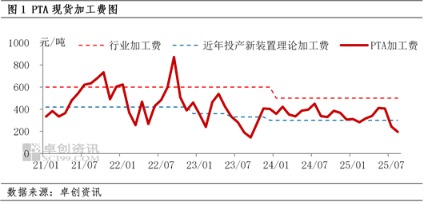
Core Viewpoint - The PTA industry is facing significant production losses due to new capacity coming online, while profits are concentrated in the upstream PX segment, with no planned maintenance for PTA facilities in the short term [1][6]. Group 1: PTA Industry Analysis - As of August 14, the average processing fee for PTA in August is 195 yuan/ton, down 19% from July, marking a 22-month low [1]. - The theoretical production loss for PTA companies is estimated at 305 yuan/ton, based on a processing cost line of 500 yuan/ton [1]. - The main reason for PTA's production losses is the new capacity coming online and the continued supply-demand mismatch in PX, which remains relatively strong [1][3]. Group 2: Supply and Demand Dynamics - The polyester industry chain's profits are currently concentrated in the upstream PX and downstream polyester filament POY segments [3]. - The theoretical profit for PX is 381 yuan/ton, up 41 yuan/ton from July, while polyester filament POY has turned profitable with a theoretical profit of 29 yuan/ton [3]. - Despite the severe losses faced by PTA, the supply pressure is expected to increase with the upcoming new PTA capacities, which may not be offset by any planned maintenance [3][4]. Group 3: Future Outlook - The PX supply-demand imbalance is expected to continue, with new PTA capacities potentially increasing PX demand by 34.7 thousand tons/month if they stabilize by October [4]. - Polyester inventory levels are relatively low, with POY at 17 days, FDY at 25 days, short fibers at 12 days, and polyester chips at 7.5 days as of August 14 [4]. - The anticipated demand recovery during the "Golden September and Silver October" period may support profit recovery for polyester products, while PTA continues to face supply pressure from new capacities [6].
反内卷下,钢铁盈利的修复从何而来?
Changjiang Securities· 2025-08-17 14:41
Investment Rating - The industry investment rating is Neutral, maintained [8] Core Viewpoints - The expectation for the recovery of steel profitability under the "anti-involution" trend is primarily driven by upstream iron ore concessions, contrasting with the previous cycle where concessions came from downstream [2][6] - The anticipated improvement in the steel industry's supply-demand balance could enhance long-term profitability, although there are ongoing doubts about the sustainability of this recovery [6][28] - The analysis indicates that the profit distribution within the industry chain has shifted significantly, with iron ore now having a stronger capacity to offer concessions, which could benefit the steel sector [7][29] Summary by Sections Demand and Supply Dynamics - Downstream demand has weakened, with apparent consumption of five major steel products increasing by 3.60% year-on-year but decreasing by 2.06% month-on-month [5] - Daily average pig iron production has slightly increased to 2.4066 million tons, with a year-on-year increase of 12.04% [5] - Total steel inventory has continued to accumulate, with a week-on-week increase of 3.01% but a year-on-year decrease of 18.13% [5] Price Trends - Recent price trends show Shanghai rebar dropping to 3,300 CNY/ton, a decrease of 30 CNY/ton, and hot-rolled steel at 3,430 CNY/ton, down 10 CNY/ton [5] - The estimated profit for rebar is 37 CNY/ton, while the profit based on a one-month lag in costs is 243 CNY/ton [5] Future Projections - The report projects that if the supply-demand gap improves by 50 million tons, the average price of rebar could increase by 164.87 CNY/ton [7] - A decrease in iron ore prices by 15 USD/ton could lead to a reduction in steel production costs by 210 CNY/ton [7] - The overall expectation is that iron ore price declines will primarily benefit the steel sector, with only a small portion passed on to downstream industries [7][29] Investment Opportunities - The report highlights four main investment lines: 1. Companies benefiting from cost reductions due to new capacities in iron and coke, such as Nanjing Steel and Baosteel [28] 2. Stocks with low price-to-book ratios that may see significant performance recovery, like New Steel and Fangda Special Steel [29] 3. Mergers and acquisitions under the state-owned enterprise reform initiative [29] 4. High-quality processing leaders and resource companies, particularly in the context of macroeconomic recovery expectations [29]