
化学纤维及橡胶塑料制品

Search documents
输入性通胀:推升成本压力
GUOTAI HAITONG SECURITIES· 2026-03-31 12:41
Group 1: Manufacturing Sector Insights - The manufacturing PMI for March 2026 is 50.4%, an increase of 1.4 percentage points from the previous month, marking a return to the expansion zone after two months[7] - The new orders index and production index are at 51.6% and 51.4%, respectively, both above the critical point, indicating strong demand recovery[13] - Small and medium-sized enterprises' PMIs have significantly improved, with small enterprises at 49.0% (up 1.5 percentage points) and medium enterprises at 49.3% (up 4.5 percentage points) from the previous month[10] Group 2: Price and Cost Pressures - The main raw material purchase price index is at 63.9%, up 9.1 percentage points, while the factory price index is at 55.4%, up 4.8 percentage points, indicating rising input costs due to geopolitical tensions[16] - The procurement volume index has risen to 50.9%, reflecting increased purchasing activity driven by demand recovery[18] - The inventory indices for raw materials and finished products are at 47.7% and 46.7%, respectively, indicating a slowdown in inventory depletion[18] Group 3: Non-Manufacturing Sector Performance - The non-manufacturing business activity index is at 50.2%, up 0.5 percentage points, with significant internal differentiation in the service sector[20] - The construction business activity index is at 49.3%, up 1.1 percentage points, but still indicates a low level of activity, with new orders at 43.5%[23] - Consumer services sectors such as retail and hospitality are below the critical point, suggesting a need for policy support to boost consumer confidence[20] Group 4: Risks and Future Outlook - Rising raw material prices may squeeze profit margins for downstream enterprises, potentially suppressing future investment and production willingness[26] - The ongoing geopolitical tensions in the Middle East remain a critical variable, with sustained high oil prices likely to exacerbate cost pressures in downstream industries[26] - Real estate demand needs to be stimulated, and geopolitical risks could disrupt market stability[27]
兼评3月PMI数据:PMI重回扩张,预计Q1GDP同比约5.0%
KAIYUAN SECURITIES· 2026-03-31 12:16
Manufacturing Sector - March manufacturing PMI improved to 50.4%, up 1.4 percentage points month-on-month, indicating a return to expansion[3] - The production index rose by 1.8 percentage points to 51.4%, while new orders increased by 3.0 percentage points to 51.6%[14] - Industrial raw material prices have rebounded significantly, with March PPI expected to rise by approximately 0.3% year-on-year[20] Non-Manufacturing Sector - Construction PMI increased by 1.1 percentage points to 49.3%, benefiting from the gradual resumption of projects post-holiday[22] - Service sector PMI rose to 50.2%, a 0.5 percentage point improvement, although new orders remain weak[30] Economic Outlook - Q1 GDP is projected to grow by approximately 5.0% year-on-year, supported by AI demand and fiscal spending[6] - The growth forecast includes primary, secondary, and tertiary industries at approximately 3.5%, 5.2%, and 5.0% respectively[34] - Input inflation may pressure profits in downstream enterprises, necessitating timely policy responses to support economic recovery[33] Risks - Potential risks include unexpected policy changes and a possible recession in the U.S. economy impacting domestic exports[35]
【权威解读】3月份中国采购经理指数重回扩张区间
中汽协会数据· 2026-03-31 09:13
Core Viewpoint - In March 2026, China's Purchasing Managers' Index (PMI) returned to the expansion zone, indicating a recovery in economic sentiment with manufacturing PMI at 50.4%, non-manufacturing business activity index at 50.1%, and composite PMI output index at 50.5% [1]. Group 1: Manufacturing PMI - The manufacturing PMI rose to 50.4% in March, reflecting increased market activity as companies resumed operations post-Spring Festival [2]. - Both production index and new orders index improved, reaching 51.4% and 51.6% respectively, indicating accelerated production activities and improved market demand [2]. - Large, medium, and small enterprises all saw a rise in PMI, with large enterprises at 51.6%, medium at 49.0%, and small at 49.3%, showing significant improvement in sentiment for smaller firms [2]. Group 2: Key Industries - High-tech manufacturing PMI stood at 52.1%, marking 14 consecutive months above the critical point, indicating a positive development trend [3]. - Equipment manufacturing and consumer goods industries also showed expansion with PMIs of 51.5% and 50.8% respectively [3]. - The price index for major raw materials surged, with purchasing price index at 63.9% and factory price index at 55.4%, reflecting a significant increase in market prices [3]. Group 3: Non-Manufacturing PMI - The non-manufacturing business activity index rose to 50.1%, indicating an improvement in the non-manufacturing sector [5]. - The service sector's business activity index reached 50.2%, with certain industries like telecommunications and financial services showing strong growth [5]. - The construction industry also saw an improvement, with a business activity index of 49.3%, reflecting a recovery in construction projects post-holiday [5]. Group 4: Composite PMI - The composite PMI output index increased to 50.5%, indicating an overall positive trend in production and business activities across sectors [6]. - The manufacturing production index and non-manufacturing business activity index contributed to this increase, standing at 51.4% and 50.1% respectively [6].


3月PMI数据解读
清华金融评论· 2026-03-31 08:00
Group 1: Manufacturing PMI Insights - In March, the Manufacturing Purchasing Managers' Index (PMI) rose to 50.4%, indicating a return to the expansion zone, driven by increased market activity post-Spring Festival [4] - Both production index and new orders index improved, reaching 51.4% and 51.6% respectively, reflecting accelerated production activities and improved market demand [4] - Large, medium, and small enterprises all showed PMI increases, with large enterprises at 51.6%, medium at 49.0%, and small at 49.3%, indicating a general improvement in economic conditions [4][5] Group 2: Sector-Specific Performance - High-tech manufacturing PMI reached 52.1%, marking 14 consecutive months above the critical point, indicating a positive development trend [5] - The equipment manufacturing and consumer goods sectors also saw PMIs of 51.5% and 50.8%, respectively, both entering the expansion zone [5] - The price indices for major raw materials and factory prices significantly increased to 63.9% and 55.4%, respectively, due to rising commodity prices and increased procurement activities [5] Group 3: Non-Manufacturing PMI Insights - The Non-Manufacturing Business Activity Index rose to 50.1%, showing an improvement in the non-manufacturing sector's economic conditions [7] - The service sector's business activity index reached 50.2%, with significant growth in sectors like rail transport and financial services, while retail and hospitality lagged behind [7] - The construction sector's business activity index improved to 49.3%, with a positive outlook for future activities as indicated by a business activity expectation index of 50.5% [7] Group 4: Comprehensive PMI Overview - The Comprehensive PMI Output Index increased to 50.5%, indicating an overall improvement in production and business activities across sectors [8] - The manufacturing production index and non-manufacturing business activity index contributed to this increase, standing at 51.4% and 50.1% respectively [8]

【权威解读】11月份制造业采购经理指数小幅回升 非制造业商务活动指数有所回落
中汽协会数据· 2025-12-01 12:41
Group 1: Manufacturing Purchasing Managers Index (PMI) - In November, the manufacturing PMI rose to 49.2%, indicating a slight improvement in economic conditions [2] - Both production index and new orders index improved, reaching 50.0% and 49.2% respectively, with production index crossing the critical point [2] - Small enterprises showed significant recovery with PMI at 49.1%, marking a 2.0 percentage point increase, the highest in six months [2][3] Group 2: Non-Manufacturing Business Activity Index - The non-manufacturing business activity index decreased to 49.5%, down 0.6 percentage points from the previous month, indicating a decline in non-manufacturing economic conditions [4] - The service industry index fell to 49.5%, influenced by the end of holiday effects, while certain sectors like railway transport and financial services remained robust [5] - The construction industry index improved to 49.6%, with a business activity expectation index of 57.9%, reflecting increased confidence in the sector [5] Group 3: Comprehensive PMI Output Index - The comprehensive PMI output index fell to 49.7%, a decrease of 0.3 percentage points, with manufacturing production index at 50.0% and non-manufacturing business activity index at 49.5% [6]

产需两端均有所改善 11月制造业PMI小幅回升 下阶段走势如何?
Xin Lang Cai Jing· 2025-11-30 23:52
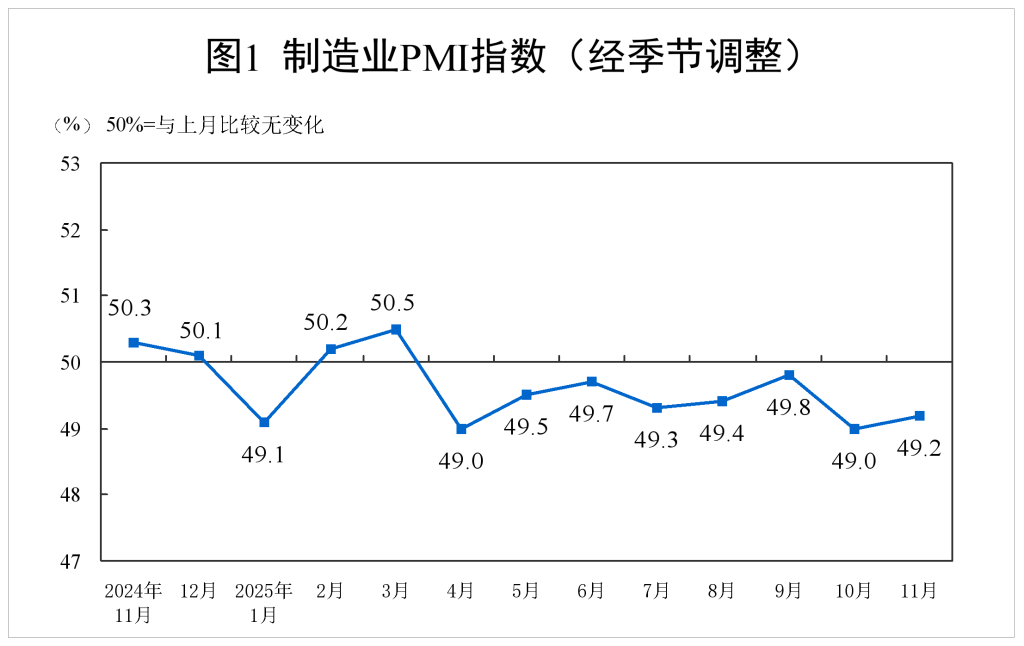
Group 1: Manufacturing Sector - The manufacturing Purchasing Managers' Index (PMI) for November is reported at 49.2%, showing a slight increase of 0.2 percentage points from the previous month, indicating a modest improvement in economic conditions [7][8] - The production index stands at 50.0%, up by 0.3 percentage points, while the new orders index is at 49.2%, increasing by 0.4 percentage points, suggesting a recovery in production and demand [8] - The new export orders index rose by 1.7 percentage points to 47.6%, driven by improved expectations from US-China trade negotiations and seasonal demand from overseas shopping [8] Group 2: Non-Manufacturing Sector - The non-manufacturing business activity index decreased to 49.5%, down by 0.6 percentage points, marking the first entry into contraction territory this year [11] - The service sector's business activity index fell to 49.5%, influenced by the end of holiday effects, while the construction sector's index improved to 49.6%, reflecting better conditions in construction activities [11] - The construction new orders index increased by 0.2 percentage points to 46.1%, indicating a gradual recovery in demand [11] Group 3: Economic Outlook - Analysts predict that the manufacturing PMI may decline to around 49.1% in December, based on historical trends, but there is potential for new growth measures to be introduced before year-end [13] - The service sector is expected to see a slight recovery in December due to upcoming holidays and the impact of consumption policies, although improvements in real estate and employment may be gradual [13] - Infrastructure investment is anticipated to rebound, providing support for the construction PMI, with increased funding from policy financial tools and local government bonds expected to enhance economic activity [13]
经济景气水平总体平稳(锐财经)
Ren Min Ri Bao Hai Wai Ban· 2025-11-30 22:20
Group 1: Manufacturing Sector - The manufacturing PMI for November is reported at 49.2%, a slight increase of 0.2 percentage points from the previous month, indicating an improvement in economic conditions [1] - The production index and new orders index are at 50.0% and 49.2%, respectively, both showing increases of 0.3 and 0.4 percentage points, suggesting a recovery in production and demand [1] - High-tech manufacturing PMI remains above the critical point at 50.1%, indicating continued growth in this sector [2] Group 2: Small and Medium Enterprises - The PMI for small enterprises has significantly increased to 49.1%, up by 2.0 percentage points, marking the highest level in six months [2] - Medium-sized enterprises show a slight improvement with a PMI of 48.9%, an increase of 0.2 percentage points from last month [2] - Large enterprises, however, experienced a decline in PMI to 49.3%, down by 0.6 percentage points, indicating a drop in economic activity [2] Group 3: Non-Manufacturing Sector - The non-manufacturing business activity index is at 49.5%, a decrease of 0.6 percentage points from the previous month, reflecting a decline in the sector's economic performance [1][4] - The service sector's business activity index has also dropped to 49.5%, down by 0.7 percentage points, influenced by factors such as the end of holiday effects [3][4] - The construction sector shows signs of recovery with a business activity index of 49.6%, an increase of 0.5 percentage points, and a business activity expectation index of 57.9%, indicating improved confidence among construction firms [4] Group 4: Market Expectations - The production and business activity expectation index for manufacturing is at 53.1%, up by 0.3 percentage points, indicating increased confidence among manufacturers regarding market developments [2] - The business activity expectation index for the service sector is at 55.9%, despite a slight decrease of 0.2 percentage points, suggesting that service sector firms remain optimistic about future market conditions [4] Group 5: Policy Impact - The implementation of new policy financial tools has resulted in the allocation of 500 billion yuan, supporting over 2,300 projects with a total investment of approximately 7 trillion yuan, focusing on key sectors such as digital economy and infrastructure [5] - The additional 500 billion yuan in special bonds allocated to local governments is expected to further stimulate investment in manufacturing and infrastructure, contributing to an overall improvement in manufacturing sentiment [5]
宏观点评:PMI连续8月处于线下的背后-20251130
GOLDEN SUN SECURITIES· 2025-11-30 13:26
Macro Overview - The manufacturing PMI for November 2025 is at 49.2%, a slight increase of 0.2 percentage points from the previous month, but still below the expansion threshold for the eighth consecutive month[1] - The non-manufacturing PMI decreased to 49.5%, down 0.6 percentage points, indicating a contraction in the service sector[2] Economic Signals - Supply and demand indicators show a rebound, with the production index at 50.0%, indicating a return to the expansion threshold[3] - New export orders index increased by 1.7 percentage points to 47.6%, reflecting a temporary easing in the US-China trade situation, although it remains in contraction territory[4] Price and Inventory Trends - The price indices for raw materials and factory output rose by 1.1 and 0.7 percentage points respectively, suggesting an improvement in overall market prices[5] - Finished goods inventory decreased by 0.8 percentage points, while raw material inventory remained stable, likely due to slight production recovery[5] Employment and Sector Performance - Large enterprises saw a PMI decline of 0.6 percentage points, while small and medium enterprises experienced a rise of 2.0 percentage points, indicating varying levels of economic pressure across company sizes[5] - The service sector PMI fell to 49.5%, influenced by the end of holiday effects, while the construction sector PMI increased to 49.6%[5] Future Outlook - Economic pressures are expected to persist into the fourth quarter, with a focus on upcoming policy meetings in December that will shape 2026 strategies[6] - Short-term policies are anticipated to provide support but may not significantly boost growth, as maintaining a GDP growth rate of 4.4% in Q4 is crucial for achieving the annual target of "keeping growth above 5%"[7]
11月PMI数据点评:弱势回升显现,景气修复仍待巩固
Tebon Securities· 2025-11-30 09:08
Manufacturing Sector - November Manufacturing PMI increased to 49.2%, up 0.2 percentage points from the previous month, but still below the previous year's level[3] - Production index at 50.0%, indicating slight improvement in production activities[4] - New orders index at 49.2%, showing marginal recovery but still below the expansion threshold[4] - Small enterprises PMI rose significantly by 2.0 percentage points to 49.1%, indicating temporary relief from operational pressures[3] Non-Manufacturing Sector - Non-manufacturing PMI fell to 49.5%, down 0.6 percentage points from last month, indicating a slowdown in expansion[4] - Service sector PMI at 49.5%, reflecting weakened activity in the service industry[4] - New orders index for non-manufacturing at 45.7%, down 0.3 percentage points, indicating insufficient demand recovery[4] - Business activity expectations index at 56.2%, showing a slight increase, suggesting some optimism for future operations[4] Economic Outlook - Current economic conditions show weak supply and demand, with structural divergence in economic performance persisting[3] - Future economic recovery may depend on policy directions from upcoming political meetings and external financial environment improvements[3]
兼评11月PMI数据:制造业和建筑业低位回升,服务业转弱
KAIYUAN SECURITIES· 2025-11-30 08:43
Group 1: Manufacturing Sector - November manufacturing PMI increased to 49.2%, up 0.2 percentage points from the previous month, but still below the seasonal average of 50.0%[14] - PMI for production rose by 0.3 percentage points to 50.0%; new orders improved by 0.4 percentage points to 49.2%[14] - Industrial raw material prices rebounded, with PMI purchase prices at 53.6% and factory prices at 48.2%, both up from previous values[22] Group 2: Non-Manufacturing Sector - November non-manufacturing PMI fell to 49.5%, down 0.7 percentage points, marking the first time this year below the expansion threshold[32] - Construction PMI improved slightly to 49.6%, with new orders index rising by 0.2 percentage points[24] - Policy-driven financial tools are less effective than in 2022, impacting service sector performance negatively[24] Group 3: Economic Indicators - Special bond issuance progress reached approximately 91.0% by the end of November, a significant increase of 10.1 percentage points from October[24] - Small enterprises showed a notable recovery in PMI, increasing by 2.0 percentage points, benefiting from improved US-China trade relations[22] - PPI is expected to narrow its year-on-year decline to around -2.0% in November, with a month-on-month increase of approximately 0.2%[22]