媒体娱乐

Search documents
美股本轮财报季最大关键词——AI焦虑
硬AI· 2026-03-04 10:13
编辑 | 硬 AI 这是一个基本面与市场情绪严重背离的财报季。高盛认为,本轮财报季的核心矛盾在于: 企业基本面的强 劲与市场对AI颠覆的恐慌之间存在显著背离 。盈利超预期、营收稳健增长,但市场的定价逻辑已经被AI叙 事所主导。 高盛经济研究团队在最新发布的研报中,标普500指数第四季度财报季接近尾声,从纯粹的业绩角度看, 这是一个相当亮眼的季度——企业盈利同比增长13%(季初预期仅为7%),剔除能源板块后的实际营收 同比增长4.6%,高于过去五十年经济扩张期3.5%的均值。 然而,这一切都被一个词所笼罩:AI焦虑(AI- nxiety)。 该行在研报中系统梳理了本轮财报季的三大核心主题—— AI生产力落地、AI对就业的冲击预期、以及超大 规模科技公司资本开支的爆炸式增长 。与此同时, "K型经济"叙事再度升温,但实际销售数据显示分化程 度并未如市场担忧的那般严峻。 高盛称,AI相关的不确定性正在重塑市场定价逻辑—— 被认为高度暴露于AI自动化风险的行业(软件、金 融服务、媒体娱乐等)年初至今已出现明显跑输 ;而超大规模科技公司的资本开支预期被大幅上调,带动 整体商业投资成为2026年GDP增长最强劲的分项。投 ...


成交飙回2.56万亿!周期强势接棒科技,融资资金重燃A股战火【周观A股2.24-2.27】
和讯· 2026-03-01 04:08
以下文章来源于掘金Post ,作者和讯市场研究 掘金Post . 谈常识,盘逻辑,掘真金 本周 A 股在节后情绪修复基础上放量上行,成交规模跃升,市场风格出现显著切换,周期资源品成为新主线,中小盘维持高弹性表现,杠杆资金重回 市场。 01 涨跌速览:中证 1000 领跑,弹性行情启动 本周市场较节前一周明显放量,中证 500 、中证 1000 、中证 2000 等中小盘指数显著跑赢大盘蓝筹,市场资金继续向高弹性标的集中,延续节后 风险偏好修复趋势。 行业层面,市场主线发生明显变化。 材料板块周涨幅 8.03% ,能源板块上涨 6.31% ,双双位居涨幅榜前列,成为绝对领涨方向。 周期资源品强势 崛起, " 煤飞色舞 + 钢花四溅 " 格局重现,市场风格由此前的 " 科技成长 " 向 " 周期价值 " 切换。 在 35 个 Wind 二级行业中,仅 5 个子行业出现负收益,反映出市场整体呈现普涨格局。 前期强势的科技成长板块出现明显回调,媒体娱乐板块周跌 4.46% , AI 应用端、传媒、游戏等方向遭遇 " 杀估值 " 。 在阶段性估值修复完成后,资金开始进行风格再平衡。 大盘指数: 放量上行,情绪回暖 中小 ...

新浪财经隔夜要闻大事汇总:2026年2月28日
Xin Lang Cai Jing· 2026-02-27 23:39
一、市场: ●2月28日收盘:美股收跌道指跌逾500点 三大股指本周均录得跌幅 周五美股成交额靠前的公司表现不一。英伟达收跌4.16%,虽业绩超预期,但投资者担忧人工智能支出可持续性。特斯拉收跌1.49%,多家联邦机构对xAI工 具有安全担忧,而五角大楼允许其聊天机器人用于机密环境。微软收跌2.24%,重申与OpenAI合作稳固。苹果收跌3.21%,同意提高三星存储芯片价格。奈 飞收高13.77%,退出竞购被视为注重财务纪律。闪迪收跌2.54%,遭做空机构质疑估值。戴尔收高21.93%,业绩超预期且下季营收预测强劲。 ●2月28日热门中概股多数下跌 金山云涨6.98%,蔚来跌4.32% 周五油价上涨逾2%,交易商在美国与伊朗延长核谈判后,对潜在供应中断保持警惕。布伦特原油期货和纽约商品交易所4月交割的西得州中质原油期货均有 涨幅。不确定性及恐惧情绪推高油价,受伊朗核谈判及美可能军事行动影响。美伊周四间接会谈,期间因美要求伊朗零铀浓缩讨论陷入僵局致油价上涨,后 阿曼调解人表示取得进展,油价回落。双方计划下周在维也纳恢复技术讨论。因担心冲突中断供应,油价有地缘政治风险溢价。此外,阿联酋、沙特计划增 产,沙特或提高 ...

新浪财经隔夜要闻大事汇总:2026年2月26日
Xin Lang Cai Jing· 2026-02-25 23:45
Market - US stock market closed higher for the second consecutive day, with AI concept stocks rising broadly. The Dow Jones, Nasdaq, and S&P 500 all increased. Nvidia and Salesforce are set to release earnings reports, leading investors to reassess tech stock valuations amid concerns about the sustainability of AI capital expenditures. Nvidia's stock rose, but its recent performance has been poor, raising market concerns about AI spending being unsustainable. Some investors believe current market fears are excessive [2][4][5] Company - Nvidia reported fourth-quarter earnings that exceeded expectations, with core data center revenue growing 75% year-over-year, becoming a major driver. Adjusted earnings per share and total revenue also surpassed expectations, with net profit nearly doubling. The company expects first-quarter revenue of $78 billion, significantly outperforming other large tech stocks this year [25][26] - Microsoft shares rose 2.98% despite facing an antitrust investigation by Japan for potential unfair competition in the cloud services market [55] - Salesforce's fourth-quarter revenue was $11.2 billion, a 12% year-over-year increase, marking the fastest growth in two years. However, the company's guidance for fiscal year 2027 indicates a growth of only 10%-11%, which is below Wall Street's expectations. Salesforce has allocated $50 billion for stock buybacks [31] - Samsung launched its Galaxy S26 series, with prices increasing by $100 for two models. The average smartphone price is expected to rise by 6.9% in 2026 due to a shortage of storage chips [22] - Ctrip reported a 60% year-over-year increase in international OTA bookings for Q4 2025, serving approximately 20 million inbound tourists throughout the year [29]





迪士尼乐园狂赚100亿美元,新任CEO敲定!
Ge Long Hui· 2026-02-04 12:34
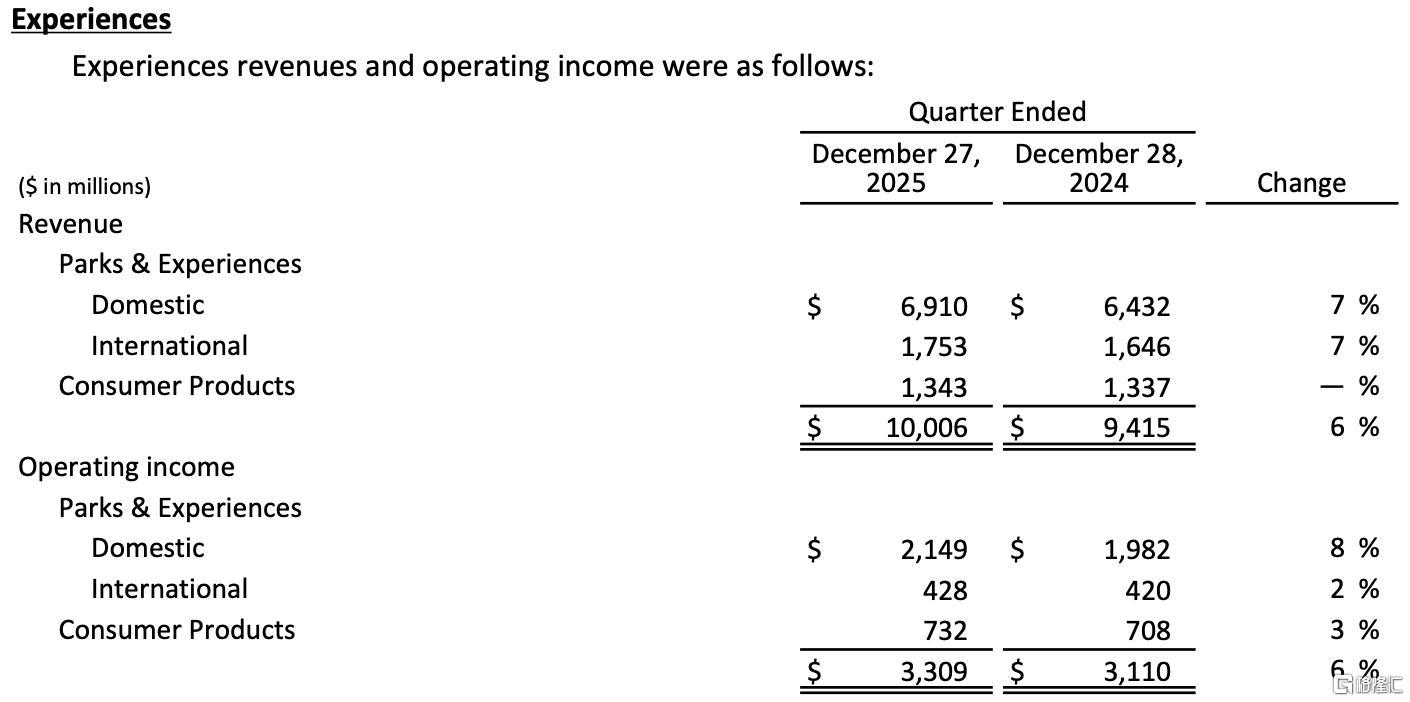
Core Insights - Disney's latest earnings exceeded Wall Street expectations, driven by its theme parks and media businesses, with Q1 FY2026 revenue reaching $25.98 billion, a 5% year-over-year increase [1][7][6] Financial Performance - The experience segment, which includes theme parks, resorts, and cruises, achieved a record revenue of over $10 billion for the quarter [2] - Operating profit for the experience segment declined by 9%, indicating some pressure on profitability despite revenue growth [3] - The company reported a pre-tax profit of $3.693 billion, remaining stable year-over-year, with adjusted earnings per share of $1.63, surpassing market expectations of $1.56 [8] Future Outlook - Disney plans to repurchase $7 billion in stock and anticipates double-digit growth in adjusted earnings per share for FY2026, with operational cash flow expected to reach $19 billion [10][13] - The growth drivers for the company include the experience segment's theme parks and cruise businesses, as well as streaming subscription revenues [10] Leadership Changes - Disney's board announced that Josh D'Amaro, the current chairman of the experience segment, will succeed Bob Iger as CEO on March 18 [4][15] - Iger will remain as a senior advisor and board member until his retirement at the end of the year [4][15] - D'Amaro's compensation package is valued at $38 million, designed to incentivize growth in theme park expansion, streaming platform stability, and theatrical releases [16][17] Strategic Initiatives - D'Amaro's leadership reflects Disney's focus on its experience business, with plans to expand its cruise fleet to 13 ships and launch a new theme park and resort in Abu Dhabi as part of a $60 billion investment in theme parks [20][21]

打赢消费者注意力之战
麦肯锡· 2026-01-29 09:11
Core Insights - The article emphasizes the importance of measuring the quality of consumer attention in the media industry, rather than just the quantity of time spent on content [3][4] - A new analytical framework called the "Attention Equation" is introduced to better understand the true value of attention and its impact on revenue generation [5][15] Consumer Attention Landscape - There is a growing disparity between the explosive growth in content supply and the stagnation in consumer time spent on media, which has only increased by about 1% to 2% annually over the past decade [6][7] - The media landscape is characterized by an overwhelming abundance of content, leading to diluted consumer attention and challenges in converting engagement into revenue [7][11] Attention Value Discrepancies - Different media types exhibit significant variations in the value generated per hour of consumer attention, with live sports events commanding the highest value at $33 per hour, while digital media like podcasts generate much lower values [11][14] - The article highlights that traditional media still holds a relatively high monetization capability compared to digital media, despite the latter's growing consumption time [11][14] Attention Quality Factors - The "Attention Quality" (AQ) is identified as a critical factor influencing monetization differences across media types, comprising consumer focus levels and the specific tasks consumers aim to accomplish through media consumption [15][19] - Higher consumer focus correlates with increased spending, with a 10% increase in focus leading to a 17% rise in media spending [21][28] Consumer Segmentation - The article identifies three high-value consumer segments: "Content Enthusiasts," "Interactive Enthusiasts," and "Community Trendsetters," who exhibit both high attention and commercial value [23][24] - Approximately 40% of consumers fall into these high-value categories, while the remaining 60% have lower attention and commercial value [27][28] Implications for Media Stakeholders - The findings suggest that media companies should focus on the quality of attention rather than just the quantity, as this will drive better engagement and revenue outcomes [30][34] - Advertisers and content creators are encouraged to align their strategies with the attention quality metrics to enhance the effectiveness of their campaigns and content [31][33]

马斯克称特斯拉FSD最快下个月将在中国获批?特斯拉中国回应;银行账户被关,特朗普起诉摩根大通索赔50亿美元;三大期指齐跌【美股盘前】
Mei Ri Jing Ji Xin Wen· 2026-01-23 10:30
Market Overview - Major U.S. stock index futures are showing slight declines, with Dow futures down 0.07%, S&P 500 futures down 0.05%, and Nasdaq futures down 0.16% [1] Semiconductor Sector - Storage chip stocks are experiencing a pre-market decline, with Western Digital down 1.54%, Micron Technology down 1.02%, and Seagate Technology down 1.02% [2] Biotechnology Sector - Moderna's CEO announced plans to cut investment in late-stage vaccine trials due to increasing opposition to vaccination in the U.S., resulting in a 4.09% drop in the company's stock [2] Automotive Sector - Tesla's CEO Elon Musk indicated that the Full Self-Driving (FSD) system may receive approval in China as early as next month, although Tesla China stated there is no new information to share, leading to a slight increase of 0.19% in Tesla's stock [2] Media and Entertainment Sector - Netflix's co-CEO expressed optimism that the proposal to acquire Warner Bros. studios will gain shareholder support, while criticizing Paramount's bid as unfeasible, resulting in a 0.18% increase in Netflix's stock [3] E-commerce Sector - Amazon is reportedly planning a second round of layoffs, similar in scale to the previous cut of approximately 14,000 white-collar jobs last October, which has led to a 0.38% increase in Amazon's stock [3] Technology Sector - Intel reported Q4 2025 revenue of $13.67 billion, a 4.1% year-over-year decline, and provided a weak Q1 2026 revenue guidance of $12.2 billion, below analyst expectations, causing a significant drop of 13.38% in Intel's stock [4] Cloud Computing Sector - Amazon Web Services (AWS) has raised prices for its machine learning capacity blocks by approximately 15%, breaking a long-standing trend of price reductions [5] Legal Issues - Former President Trump has filed a lawsuit against JPMorgan Chase seeking $5 billion in damages, alleging that the bank closed accounts for him and his businesses due to political motivations [5]

中金公司:欧美贸易摩擦给“全球欧洲”的盈利修复带来不确定性
Jin Rong Jie· 2026-01-23 00:19
Group 1 - The report from CICC indicates that in the short term, the euro may be negatively impacted by tariffs and geopolitical tensions, which could further weaken economic growth in Europe [1] - Conversely, rising uncertainty in U.S. policies may lead to questions about the reliability of the U.S. as an investment destination, which could negatively affect the dollar [1] - The report highlights that the market's trading contradictions during this trade friction may be more focused on the latter point regarding the dollar [1] Group 2 - From an equity market perspective, sectors such as biopharmaceuticals, media and entertainment, and food and beverages in Europe may face pressure due to their exposure to U.S. sales [1] - Absolute export values show that pharmaceuticals, transportation equipment, machinery, chemicals, and aircraft have high export values to the U.S. [1] - While companies may adjust supply chains and localize production to cope with these challenges, there remains uncertainty regarding the profitability recovery for "global Europe" [1] Group 3 - In this context, the report expresses a relatively positive outlook on "self-reliant" themes in domestic demand industries such as banking and utilities [1] - For sectors exposed to external demand, it is recommended to focus on those with reasonable valuations and profit expectations, where policy headwinds are relatively small [1]

TP:2026年出海全球展望报告
Sou Hu Cai Jing· 2026-01-03 13:16
Core Insights - The report highlights that 2026 will be a pivotal year for Chinese companies' globalization, transitioning from "scale-driven" to a new phase characterized by refined operations, forward-looking strategies, and sustainable growth [1][7] - Chinese outbound investment continues to expand, diversifying from traditional manufacturing and infrastructure to technology, e-commerce, and digital services, with a more balanced global distribution towards emerging markets like ASEAN, the Middle East, and Latin America [1][12][27] Group 1: Key Forces Shaping the 2026 Outbound Landscape - Six key forces are identified that will shape the outbound landscape in 2026, including the integration of AI into core operations, which is expected to see global spending on AI core systems exceed $300 billion by 2026, with a 40% year-on-year growth in AI deployment among Chinese outbound enterprises [2][13] - Customer experience is emerging as a new growth currency, with companies excelling in customer experience seeing revenue growth rates more than double those of their competitors [2][14] - Compliance is evolving into a competitive advantage, with a focus on "trust by design" becoming essential in operational frameworks [2][15] Group 2: Industry Trends and Performance - Cross-border e-commerce continues to lead, with exports reaching 1.83 trillion RMB in 2023, and the electric vehicle sector accounting for 40% of global exports [2][18] - The media and entertainment industry is experiencing strong growth, highlighting the core value of customer experience and brand trust across three key sectors [2][18] - The TP Outbound Confidence Index (CCI) for 2026 scores 7.8, indicating a high level of confidence, with cross-border e-commerce and digital content identified as significant growth engines [2][19] Group 3: Strategic Recommendations for Success - Future success for Chinese outbound brands hinges on combining intelligence with empathy, innovation with trust, and deepening localized operations while enhancing AI-enabled customer experiences [3][19] - Companies must establish a forward-looking compliance framework and leverage ecosystem collaboration for efficient expansion [3][19] - The report emphasizes that the next wave of outbound growth will be built on closer cooperation with international ecosystems, service partners, and digital platforms [2][19] Group 4: Localization as a Growth Engine - Deep cultural localization is crucial for enhancing retention and reputation in overseas markets, requiring brands to align with local audience expectations beyond mere translation [4][55] - Successful localization involves systematic adjustments across product experience, communication methods, service expectations, and community engagement [4][56] - A multi-language global delivery framework supports Chinese clients in over 170 markets, integrating local insights and cultural understanding [4][56]

DiamondLake Wants To Tokenize Your Business
International Business Times· 2025-12-18 19:54
Core Insights - Diamond Lake Minerals Inc. (DLMI) aims to leverage its long-standing history and new leadership to enhance ethical business growth in the digital age [2][3] Company Strategy - The new CEO, Brian J. Esposito, brings over 20 years of experience and aims to create new revenue streams through security tokens backed by real management and companies [4][6] - DLMI is adopting a traditional approach by adhering to banking regulations while developing a digital currency [5] - The company is transforming into a multi-strategy operating entity, utilizing its historical securities to market to existing companies under the Esposito Intellectual Enterprises (EIE) umbrella [6] Advisory Board - DLMI has established a strong advisory board featuring industry leaders from various sectors, including finance, entertainment, and technology, to guide its strategic direction [7][10] - The board's expertise spans multiple industries, ensuring tailored support for DLMI's diverse client base [8][9] Market Potential - The digital securities market is projected to grow from $10 billion in 2022 to $1 trillion by 2028, indicating a compound annual growth rate (CAGR) of 45% [12] - The global blockchain market is expected to increase from $3 billion in 2020 to $39.7 billion by 2025, reflecting a CAGR of 67.3% [12] - The investment management market is projected to rise from $100 trillion in 2020 to $178 trillion by 2025, representing a CAGR of 7.2% [13] Client Engagement - DLMI selectively partners with companies that align with its values and can benefit from its expertise in sustainable growth [14][18] - The company is positioned to facilitate the tokenization of numerous businesses, especially as regulatory barriers for U.S. citizens are lifted [17][19] Challenges and Opportunities - The primary challenge for DLMI is navigating the evolving regulatory landscape, particularly with the SEC's role in developing a cryptocurrency framework [15] - DLMI's hybrid approach of combining traditional finance with cryptocurrencies allows it to engage a broad range of investors and businesses [15]