
汽车等

Search documents
106只股收盘价创历史新高
Zheng Quan Shi Bao Wang· 2025-08-15 10:19
Market Overview - The Shanghai Composite Index rose by 0.83%, with 106 stocks closing at historical highs [1] - Among the tradable A-shares, 4,625 stocks increased in price, accounting for 85.46% of the total, while 644 stocks decreased, representing 11.90% [2] Historical Highs - A total of 106 stocks reached historical closing highs today, with 44 from the main board, 34 from the ChiNext board, and 20 from the Sci-Tech Innovation board [2] - The industries with the most stocks hitting historical highs include machinery equipment (21 stocks), electronics (19 stocks), and basic chemicals (11 stocks) [2] Stock Performance - Stocks that reached historical highs had an average increase of 8.43% today, with notable gainers including HaiNeng Technology, Henghe Precision, and Zhongfu Circuit [2] - The stock with the highest closing price was Tonghuashun at 367.20 yuan, up by 16.27%, followed by Chunfeng Power and Oulu Technology at 285.93 yuan and 248.50 yuan respectively [2] Capital Flow - The total net inflow of main funds into stocks reaching historical highs was 3.764 billion yuan, with 62 stocks experiencing net inflows [3] - The stocks with the highest net inflows included Zhinan Zhen, Tonghuashun, and Shengyi Technology, with net inflows of 1.414 billion yuan, 512 million yuan, and 445 million yuan respectively [3] Market Capitalization - The average total market capitalization of stocks reaching historical highs was 39.238 billion yuan, with an average circulating market capitalization of 34.881 billion yuan [3] - Stocks with the highest total market capitalization included Industrial Fulian, Zijin Mining, and China Pacific Insurance, with market caps of 890.896 billion yuan, 438.334 billion yuan, and 271.748 billion yuan respectively [3] Innovation High Frequency - Stocks that frequently hit new highs include Siquan New Materials with 15 new highs in the past month, followed by Dingtai High-Tech and Industrial Fulian with 12 each [3]

数字服务正惠及更多百姓
Zhong Yang Ji Wei Guo Jia Jian Wei Wang Zhan· 2025-08-14 11:28
Core Insights - The number of internet users in China has reached 1.123 billion, with an internet penetration rate of 79.7% [1][3] - Significant advancements in digital infrastructure and services have been achieved during the "14th Five-Year Plan" period, including a fivefold increase in 5G base stations and a 34-fold increase in gigabit broadband users [2][3] Digital Infrastructure Development - By June 2025, the total number of 5G base stations is expected to reach 4.55 million, a fivefold increase compared to 2020 [2] - The number of gigabit broadband users has grown to 226 million, marking a 34-fold increase [2] Digital Services and Public Welfare - Digital services are becoming more accessible, with over 1 billion annual services provided by internet hospitals and more than 1.2 billion users of the national medical insurance code [3][4] - The use of electronic social security cards has expanded to 1.07 billion people, covering over 75% of the population [3] Smart Living and Community Services - The digital transformation of 5A-level scenic spots has reached 100%, enhancing the accessibility of cultural heritage through new technologies [3] - Community services have become more intelligent, with features like "one-click" elderly assistance and remote health management improving quality of life [3] Social Governance and Efficiency - The "one-stop" government service model is being deepened, improving the efficiency of public services [4][5] - Urban governance is transitioning from fragmented control to comprehensive collaboration, enhancing smart governance and resilience [5]
20家北交所公司接受机构调研
Zheng Quan Shi Bao Wang· 2025-08-14 09:06
Group 1 - In the past month (from July 15 to August 14), 20 companies listed on the Beijing Stock Exchange (BSE) were investigated by institutions, with Minshida being the most notable, attracting 96 participating institutions [1][2] - The types of institutions conducting the research included 16 brokerages, 9 funds, 9 private equity firms, 3 insurance companies, and 2 overseas institutions [1] - The companies that received the most attention after Minshida were Tonghui Electronics, Huami New Materials, and Taihu Snow, with 65, 55, and 40 participating institutions respectively [1] Group 2 - The most frequently investigated companies included Taihu Snow, Hanwei Technology, and Hengli Drilling Tools, each receiving two rounds of institutional research [2] - On average, the companies that were investigated saw an increase of 11.22% in their stock prices over the month, with Hengli Drilling Tools, Huami New Materials, and Guangxin Technology leading the gains at 139.87%, 56.60%, and 31.30% respectively [2] - The average market capitalization of all companies on the BSE was 3.092 billion yuan, while the average market capitalization of the investigated companies was 3.988 billion yuan [2] Group 3 - The average daily turnover rate for the investigated companies was 7.40%, with Hengli Drilling Tools, Wanyuantong, and Guangxin Technology having the highest turnover rates at 21.71%, 16.81%, and 14.96% respectively [2] - A detailed list of investigated companies includes Minshida, Tonghui Electronics, Huami New Materials, and others, with their respective stock prices and percentage changes noted [2][3]

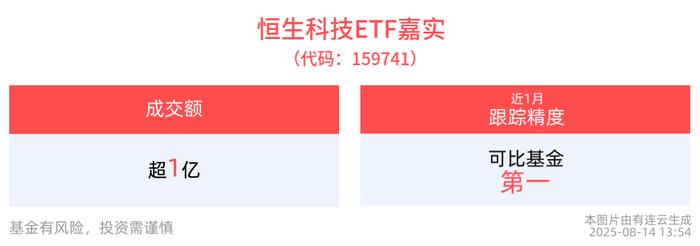
恒生科技指数年内涨超21%超额收益显著,恒生科技ETF嘉实(159741)盘中交投活跃
Xin Lang Cai Jing· 2025-08-14 06:28
Group 1 - The Hang Seng Technology Index decreased by 0.87% as of August 14, 2025, with mixed performances among constituent stocks [1] - Leading stocks included Hua Hong Semiconductor, which rose by 3.42%, and Horizon Robotics, which increased by 2.31%, while BYD Electronics, Lenovo Group, and NetEase-S experienced declines [1] - The Hang Seng Technology ETF (嘉实) underwent a downward adjustment [1] Group 2 - The Hang Seng Technology ETF (嘉实) recorded a turnover of 12.5% during trading, with a transaction volume of 106 million yuan, indicating active market trading [2] - Over the past year, the average daily transaction volume for the Hang Seng Technology ETF (嘉实) was 151 million yuan [2] - Leveraged funds have been actively investing, with the latest financing purchase amounting to 7.03 million yuan and a financing balance of 13.33 million yuan [2] Group 3 - The Hang Seng Technology ETF (嘉实) has seen a net value increase of 33.50% over the past three years [2] - The highest single-month return since inception was 33.67%, with the longest consecutive monthly gains being four months and a maximum increase of 23.28% [2] - The average return during rising months was 7.43% [2] Group 4 - In the past two years, the Hang Seng Technology Index has achieved significant excess returns both in China and globally, with a 21.7% increase in 2025, outperforming the CSI 300 and NASDAQ 100 [2] - Market expectations for core internet stocks' earnings have become more fully priced, shifting focus to guidance for the next fiscal year during the interim report phase [2] - The outlook for the next three years suggests resilience and sustainability in the fundamentals of core stocks, with a high probability of excess returns in the coming year due to improved valuation, robust fundamentals, and the ongoing impact of AI themes on valuations [2] Group 5 - The top ten weighted stocks in the Hang Seng Technology Index account for 69.1% of the index, with Tencent Holdings, NetEase-S, and Alibaba-W being the top three [4] - As of August 13, 2025, the top ten stocks included Xiaomi Group-W, Meituan-W, and BYD Co., with varying performance [4]
专精特新上市公司市值战略研究报告(2024年报)-和君咨询
Sou Hu Cai Jing· 2025-08-12 08:16
Group 1 - In 2024, specialized and innovative listed companies demonstrate unique development trends amidst a complex environment, serving as core forces for innovation-driven and industrial upgrading, while facing internal competition pressure and declining fixed asset turnover rates [1][21][24] - The number of specialized and innovative listed companies accounts for 34.36% of A-shares, with a market value of 11.02 trillion yuan, and the index continues to outperform the broader market and mid-cap stocks, having risen by 10.71% as of August 5, 2025, compared to early 2021 [1][27][28] - Market value management is fundamentally about "creating value and raising expectations," with scores for value creation, value shaping, and value operation indicating areas needing improvement [1][2][36] Group 2 - The overall score for market value management of specialized and innovative listed companies in 2024 is 46.56, which is lower than the A-share average, indicating a critical window for achieving high-quality development [2] - Value creation scores at 44.78, indicating underperformance, while value shaping scores at 38.51 reflect short-sightedness and unclear investment logic [1][36] - The market value management process consists of three stages: diagnosis, strategic planning, and implementation, with recommendations to enhance value creation and increase interaction with capital markets [1][36][53] Group 3 - The specialized and innovative listed companies are primarily concentrated in manufacturing sectors such as machinery, electronics, pharmaceuticals, and chemicals, playing a crucial role in China's economic transformation from "scale expansion" to "quality breakthrough" [17][18] - The fixed asset turnover rate for these companies has been declining since 2020, reaching a historical low in 2024, signaling potential issues such as demand shrinkage and overcapacity [21][22] - The market is willing to grant a significant valuation premium to specialized and innovative companies, with a price-to-earnings ratio (TTM) of 67.20, compared to lower ratios for other indices [28][33]

出口再超预期后:风险与韧性并存
Haitong Securities International· 2025-08-11 07:14
Export and Import Growth - In July 2025, China's export growth rate was 7.2% (previous value 5.9%), while import growth was 4.1% (previous value 1.1%) [5] - Month-on-month, July exports decreased by 1.1% compared to June, slightly below seasonal levels but higher than the same period in 2024 [5] - The trade surplus decreased in July 2025 [5] Country-Specific Trends - Exports to ASEAN and Latin America saw significant increases, with growth rates of 16.6% and 7.7% respectively, likely due to preemptive shipments before August tariffs [11] - Exports to the United States decreased by 21.7%, while exports to the EU and other regions increased by 9.2% and 19.3% respectively [11] Product-Specific Insights - In the machinery and electronics sector, equipment exports remained strong, while consumer electronics showed a decline due to previous over-shipments [18] - Labor-intensive imports decreased, while grain imports saw a notable increase [23] Future Outlook and Risks - Export growth is expected to moderate, with key risks including the implementation of Section 232 tariffs and increased scrutiny on transshipments [29] - The resilience of capital goods exports is noteworthy, as geopolitical tensions may lead to increased demand for Chinese equipment [29]
企业可持续披露准则体系建设取得重要进展
Jin Rong Shi Bao· 2025-08-08 08:02
Group 1 - The Ministry of Finance and the Ministry of Ecology and Environment have jointly released the "Corporate Sustainable Disclosure Guidelines No. 1 - Climate (Trial) (Draft for Comments)," marking significant progress in the establishment of sustainable information disclosure standards in China [1][2] - The draft aims to standardize the disclosure of climate-related risks, opportunities, and impacts by companies, providing essential information to investors, creditors, and other stakeholders for economic decision-making [1][2] - The climate guidelines are the first specific guidelines following the release of the basic guidelines, indicating a rapid advancement in the overall work of sustainable disclosure standards [2][3] Group 2 - The climate guidelines consist of six chapters and 47 specific provisions, aligning with the four core elements of sustainable information outlined in the basic guidelines [3][4] - Companies are required to disclose both qualitative and quantitative information regarding the financial impacts of climate-related risks and opportunities, including current and expected future effects [3][4] - The draft allows for certain exemptions in information disclosure, such as national secrets or commercially sensitive information, and provides flexibility in the level of detail required [4] Group 3 - The draft aligns with international standards, particularly the ISSB's climate-related disclosure standards (S2), while also considering China's unique circumstances [5][6] - The overall approach of the Ministry of Finance is to create a unified national sustainable disclosure standard that reflects international best practices while being tailored to China's context [5][6] - Companies, especially those listed in Hong Kong, are encouraged to prepare for climate-related disclosures in line with the new guidelines, as they will be required to comply with similar standards starting in the 2025 fiscal year [6][7] Group 4 - Specific industries, including finance, electricity, steel, coal, oil, fertilizer, aluminum, hydrogen, cement, and automotive, are urged to pay particular attention to the climate guidelines [7] - The Ministry of Finance is working on developing application guidelines for these industries, which will be released after the climate guidelines are finalized [7]

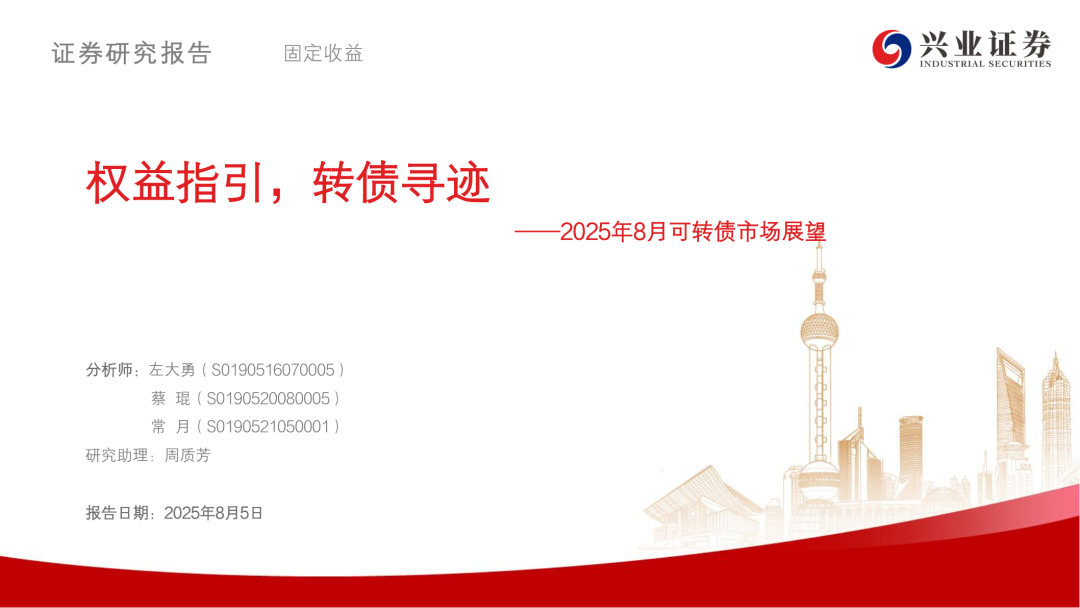
【兴证固收.转债】权益指引,转债寻迹——2025年8月可转债市场展望
Xin Lang Cai Jing· 2025-08-05 13:41
Core Viewpoint - The convertible bond market is currently positioned close to the valuation peaks of 2022 and January 2015, indicating a high valuation environment with potential for adjustments in line with equity market movements [4][65][66]. Group 1: Market Outlook - The current positioning of convertible bonds is nearing the high valuation levels seen in 2022 and January 2015, suggesting a potential for adjustments [4][65]. - Historical patterns indicate that convertible bonds typically adjust in sync or lag behind the equity market, with the adjustment pace and magnitude being difficult to precede the equity market [4][66]. - The strong market conditions of previous bull markets (2007, 2009, 2015) saw convertible bond valuations significantly higher than current levels, highlighting the unique circumstances of those periods [4][65][66]. Group 2: Investment Strategy - Convertible bonds are viewed as the only viable option for pure bond investors transitioning to equity investments, with a sustained demand expected due to profit-making effects [4][66]. - A recommended strategy includes a focus on high-quality convertible bonds with a scale of over 1.5 billion yuan and a rating of AA or above, as well as low-priced convertible bonds that still present investment opportunities [9][66]. - The report suggests a monthly review and adjustment of the recommended convertible bond portfolio to maintain flexibility and responsiveness to market conditions [9][66]. Group 3: Valuation Metrics - The median price of convertible bonds is reported at approximately 127.63 yuan, close to the highest points seen in 2021-2022, with premium rates indicating a historical high for bond valuations [16][22]. - New issuances are generally priced above 130 yuan, reflecting a strong market sentiment and high valuation levels similar to previous peaks [22][66]. - The current premium rates for convertible bonds are significantly elevated, with many bonds trading at premiums exceeding 30%, indicating a robust demand despite high valuations [16][22][66].
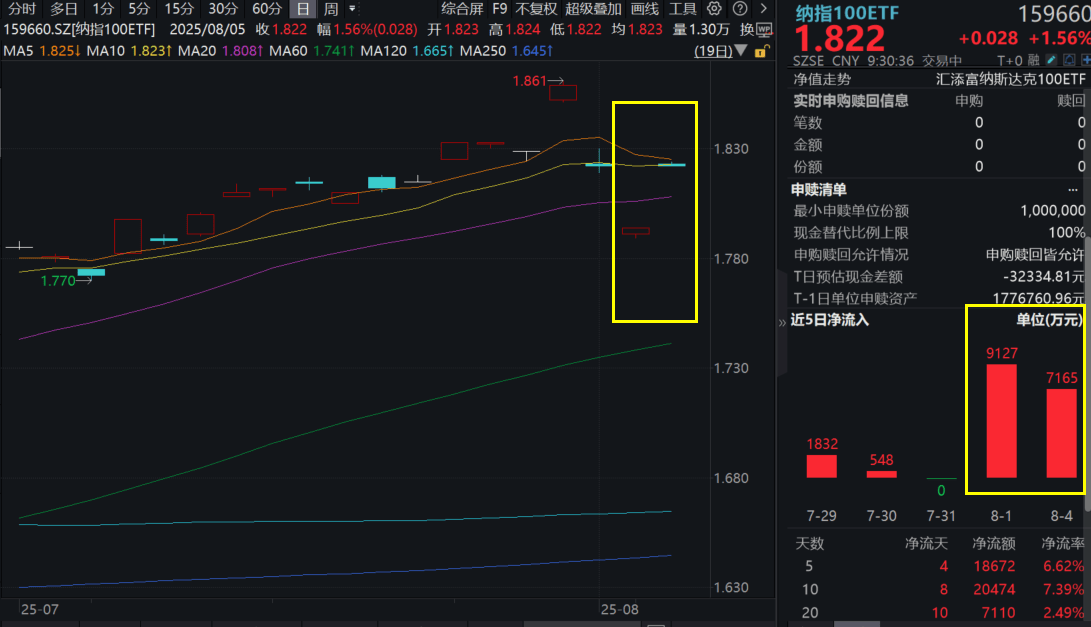
降息交易开启?美股重挫后强劲反弹,纳指100ETF(159660)涨1.56%连续两日大举吸金1.6亿!震荡时刻,美股将何去何从?灵魂三问,全面解读!
Sou Hu Cai Jing· 2025-08-05 01:47
Market Overview - On August 4, US and European stock markets collectively rose, with the Dow Jones and S&P 500 both increasing by over 1%, and the Nasdaq 100 rising by 1.87% [1] - On August 5, the Nasdaq 100 ETF (159660) opened with a gap up, rising by 1.56%, attracting over 160 million yuan in two consecutive days [1][3] Performance of Major Tech Stocks - Major tech stocks within the Nasdaq 100 ETF saw significant gains, with Nvidia, Facebook, Google, and Broadcom all rising over 3%, while Microsoft and Tesla increased over 2% [3][4] - The top ten components of the Nasdaq 100 ETF include Nvidia (3.62% increase), Microsoft (2.20% increase), and Apple (0.48% increase), with Nvidia holding a weight of 9.99% in the index [4] Economic Indicators and Market Sentiment - The market's optimistic sentiment is largely driven by rising expectations for a Federal Reserve interest rate cut, despite recent economic data indicating a slowdown in manufacturing and the job market [4][5] - The US added 73,000 non-farm jobs in July, significantly below the expected 104,000, with the unemployment rate rising to 4.248%, the highest since November 2021 [5][6] Federal Reserve's Interest Rate Outlook - The probability of a Federal Reserve rate cut in September has surged to nearly 90% following the employment data release, although inflation remains a concern [7][8] - The upcoming employment report and inflation data will be critical in determining the Fed's decision on whether to adopt a cautious approach or implement a more aggressive rate cut [8] Long-term Market Outlook - The long-term outlook for the US stock market remains positive, driven by earnings growth and macroeconomic stability, with a recommendation for investors to buy on dips [8][9] - The Nasdaq 100 ETF is expected to benefit from the strong performance of tech giants and their anticipated capital expenditures, with a management fee of 0.5% per year, which is lower than the market average [9][10]




情绪与估值 8 月第 1 期:成交活跃度下降,沪深300估值领跌
GUOTAI HAITONG SECURITIES· 2025-08-04 11:44
Core Insights - The report indicates a decline in trading activity, with the CSI 300 index experiencing the largest drop in valuation [1] - Overall valuations have decreased across indices, with the CSI 300 leading the decline [1][4] - Consumer services have shown resilience in PE valuation, while banks have led in PB valuation [4][5] Index Valuation - The CSI 300 index has seen a PE-TTM historical percentile drop of 6.5 percentage points, while the PB-LF historical percentile has decreased by 7.5 percentage points [4][5] - All major indices have experienced a comprehensive decline in valuations, with the CSI 300 index leading the downturn [4][5] Industry Valuation - In terms of PE valuation, consumer services have increased by 1.0 percentage point, while banks have led in PB valuation with a 0.5 percentage point increase [4][5] - The automotive sector is noted for its cost-effectiveness in the PE-G comparison [4] Market Sentiment - Trading activity has decreased, with turnover rates and transaction volumes declining across most indices, except for the ChiNext index, which saw an increase of 2.3% in turnover rate and 8.2% in transaction volume [4][5] - The margin trading balance has risen to 1.98 trillion yuan, reflecting a 2.30% increase [4][5] Risk Premium - The equity risk premium (ERP) for the entire A-share market has slightly increased to 4.71%, up by 0.12 percentage points from the previous week [4][5]