
金属矿业

Search documents
每日解盘:市场冲高回落,贵金属概念全天领涨,芯片产业链爆发-1月21日
Sou Hu Cai Jing· 2026-01-22 01:04
Market Overview - The three major indices collectively rose on January 21, 2026, with the Shanghai Composite Index up 0.08% at 4116.94 points, the Shenzhen Component Index up 0.70% at 14255.13 points, and the ChiNext Index up 0.54% at 3295.52 points. The total trading volume in the two markets was 26,003 billion yuan, a decrease of approximately 1,771 billion yuan compared to the previous trading day [2]. Market Performance - The overall market experienced a rise and subsequent pullback, with core broad-based indices showing more gainers than losers. The STAR 50 and STAR ChiNext 50 led the gains, while the CSI Dividend and Dividend Index lagged [3]. - In terms of sector performance, the non-ferrous metals, electronics, and machinery equipment sectors saw increases, while the banking, coal, and food and beverage sectors declined [5]. Sector Performance - Non-ferrous metals sector rose by 2.8%, electronics by 2.6%, and machinery equipment by 1.5%. Conversely, the banking sector fell by 1.6%, and food and beverage sector dropped by 1.5% [6][8]. - The performance of various sectors over different time frames indicates a strong year-to-date performance for non-ferrous metals and electronics, with increases of 15.9% and 12.8% respectively [6]. Concept Themes - Key concept themes included significant gains in lead, zinc, and gold concepts, with increases of 5.0%, 4.8%, and 3.8% respectively. In contrast, the duty-free shop and trust concepts saw declines of 1.2% and 1.1% [7]. - The non-ferrous metals market is expected to face a potential supply shortage due to new mining regulations in Indonesia, which could lead to a price rebound for nickel, a metal that has underperformed compared to other industrial metals [8]. Industry Insights - The Ministry of Housing and Urban-Rural Development emphasized the need to stabilize the real estate market and support reasonable financing needs of real estate companies, indicating a proactive approach to market stabilization [8]. - The Ministry of Industry and Information Technology announced plans to promote humanoid robot technology and accelerate breakthroughs in key technologies such as training chips and heterogeneous computing [8].


中信建投:2026年金价或弱于2025年,值得期待的是铜
Mei Ri Jing Ji Xin Wen· 2026-01-22 00:16
每经AI快讯,中信建投(601066)最新研报指出,未来市场将见证构筑美元潮汐循环的基础之一—— 科技吸引力,不再是美国一枝独秀。届时美元循环持续性将受质疑,黄金仍涨,这是黄金看涨的中期逻 辑。展望短期,2026年美国大概率AI发展持续,全球经历资本开支增扩的短暂繁荣,铜金将完成教科 书般完美接力,2026年金价或弱于2025年,值得期待的是铜。直到新秩序框架明朗,新的强势国际货币 走向台前,届时黄金的"黄金"时代迎来真正句号,这是黄金的长期逻辑。 ...

对冲AI泡沫完美组合:清洁能源、关键金属、基建和国防?
Hua Er Jie Jian Wen· 2026-01-21 08:57
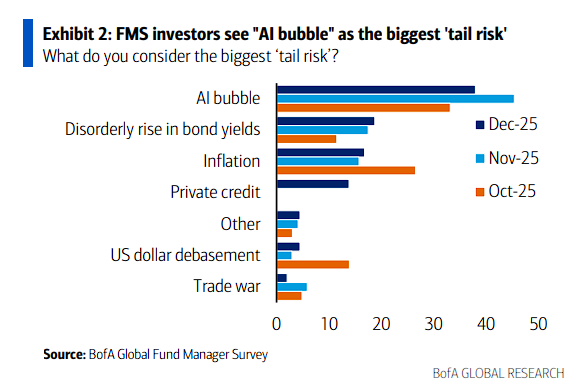
Core Viewpoint - The current AI market is characterized by high valuations and uncertainty, leading to vulnerabilities. Bank of America suggests that true investment opportunities lie in the "hard assets" that support AI's physical operations as the AI hype fades [1][3]. Group 1: Transition Investing Strategy - Bank of America proposes a "perfect hedge" strategy that focuses on "transition investing" rather than shorting AI stocks. This involves investing in physical infrastructure essential for the AI revolution, such as clean energy, grid infrastructure, critical metals, and national defense [3]. - The bank predicts that global capital expenditure related to AI will exceed $1.2 trillion by 2030, with significant investments flowing into energy, metals, and defense sectors that support data centers [3][10]. Group 2: Clean Energy's Role - Clean energy is transitioning from a supporting role to a central role in the AI ecosystem. The correlation between clean energy and AI has surged from -10% to 65% within a year, indicating a growing recognition of this relationship [4]. - Major cloud service providers dominate the clean energy market, accounting for about 70% of transactions. The energy intensity of AI is becoming a structural theme, with each new generation of Nvidia chips consuming 1.5 to 2 times more energy than the previous one [6]. Group 3: Infrastructure and Grid Investments - The bottlenecks in electricity transmission and distribution infrastructure are critical constraints on AI and overall electrification. The International Energy Agency estimates that 80 million kilometers of transmission lines will need to be deployed or upgraded by 2040, effectively doubling the global grid [14]. - U.S. electric utilities are projected to see capital expenditures grow at a compound annual growth rate of 9% from 2019 to 2025, with European grid investment plans increasing significantly [14]. Group 4: Demand for Critical Metals - The demand for metals such as copper, aluminum, nickel, and tin is expected to rise due to the construction of data centers and upgrades to power infrastructure. This demand is driven more by structural trends in energy infrastructure than by cyclical factors [15]. - Specifically, copper demand is projected to increase significantly, with data centers alone expected to contribute an additional 600,000 tons of copper demand by 2028 [15]. Group 5: National Defense and Security Investments - In the context of increasing global instability, national security has become a long-term theme, with governments prioritizing advanced defense technologies. The U.S. defense budget proposal for FY2027 is projected to reach $1.5 trillion, a 50% increase [17]. - The European Union plans to allocate €800 billion for defense over the next decade, while Japan's defense budget for FY2026 is expected to be approximately ¥9 trillion, reflecting a 4% increase [18][19]. Group 6: Risks of Overinvestment - Despite the emphasis on transition investing, there are concerns about potential overinvestment in AI-related infrastructure. If AI demand stagnates, companies may face a crisis similar to the dot-com bubble, leading to excess capacity [20].
金价上半年或冲击5000美元 白银和铜价结构性支撑渐强
Sou Hu Cai Jing· 2026-01-20 23:05
Group 1: Gold Market Insights - The gold market is experiencing structural changes, with diversification becoming the core driver of price increases, as various demand sources, including institutional investors, retail investors, and central banks, are increasing their gold holdings to mitigate macroeconomic uncertainties [2][3] - UBS predicts a baseline gold price of $4,500 per ounce by year-end, but current prices have already surpassed this level. The upward momentum is expected to continue in the first half of the year, potentially reaching $5,000 per ounce if concerns about the Federal Reserve's independence persist [2][3] - Political uncertainties and weaker-than-expected U.S. economic data are significant risk factors that could trigger new buying in the gold market [2][3] Group 2: Silver Market Dynamics - Silver prices are primarily driven by gold prices, but the influence of supply and demand fundamentals is gradually increasing. The market is currently experiencing the longest period of supply-demand gap on record, with declining inventories [4][5] - UBS sets a year-end target price for silver at $75 per ounce, with potential for greater elasticity in the first half of the year. If gold reaches $5,000 per ounce, silver could also challenge the $100 per ounce mark [4][5] - The silver market is characterized by higher volatility, and investors are advised to maintain flexibility in their positions due to the lack of central bank support [5] Group 3: Copper Market Outlook - The copper market is expected to see tightening supply-demand dynamics, with demand growth projected at 2.5% to 3% by 2026, while supply growth is anticipated to be less than 1% [6][7] - Energy transition and infrastructure development are key drivers of copper consumption growth, with sustainable demand trends expected to continue [6][7] - Recent price increases in copper have been partially driven by speculative funds, and a potential pullback could lead to a market correction, which may ultimately strengthen the foundation for future price movements [6][7]
中国五矿集团:2025年利润总额同比增长10.2% 重点矿产品产量同比增长67%
Zhong Zheng Wang· 2026-01-20 11:38
Core Insights - China Minmetals Group held its 2026 work conference, emphasizing the continuation of its operational management system and the implementation of the "Amoeba" business model, resulting in a significant increase in operational performance with a profit growth of 10.2% year-on-year and a 67% increase in key mineral product output [1] - During the 14th Five-Year Plan period, China Minmetals achieved high-quality completion of planning indicators, with an average profit increase of 93.7% compared to the 13th Five-Year Plan, and maintained a top 100 position in the Global Fortune 500 [2] - The company aims to enhance its core functions in ensuring national metal mineral resource supply and security, and to strengthen its competitive edge in integrated development during the 15th Five-Year Plan period [3] Summary by Sections Operational Performance - In 2025, China Minmetals reported a profit increase of 10.2% year-on-year and a 67% rise in key mineral product output, showcasing significant growth in its core metal mining functions [1] Strategic Achievements - The company has consolidated its full industry chain development advantage, integrating resource exploration, design, construction, operation, smelting, trade logistics, technology, and finance, achieving a 93.7% increase in average profit during the 14th Five-Year Plan [2] - China Minmetals has been recognized with an A-grade in performance assessments for five consecutive years and has added 25 national-level specialized "little giant" enterprises and 13 manufacturing champions [2] Future Development Goals - For 2026 and the 15th Five-Year Plan, the company plans to enhance its core functions in resource supply and security, and to focus on integrated high-level development, emphasizing safety and resource consolidation [3] - The company aims to strengthen its management system, promote quality and reasonable growth, and advance technological and industrial innovation, while also modernizing its governance capabilities through state-owned enterprise reforms [3]
北水动向|北水成交净买入36.63亿 泡泡玛特(09992)时隔两年回购 北水抢筹超3亿港元
智通财经网· 2026-01-20 10:01
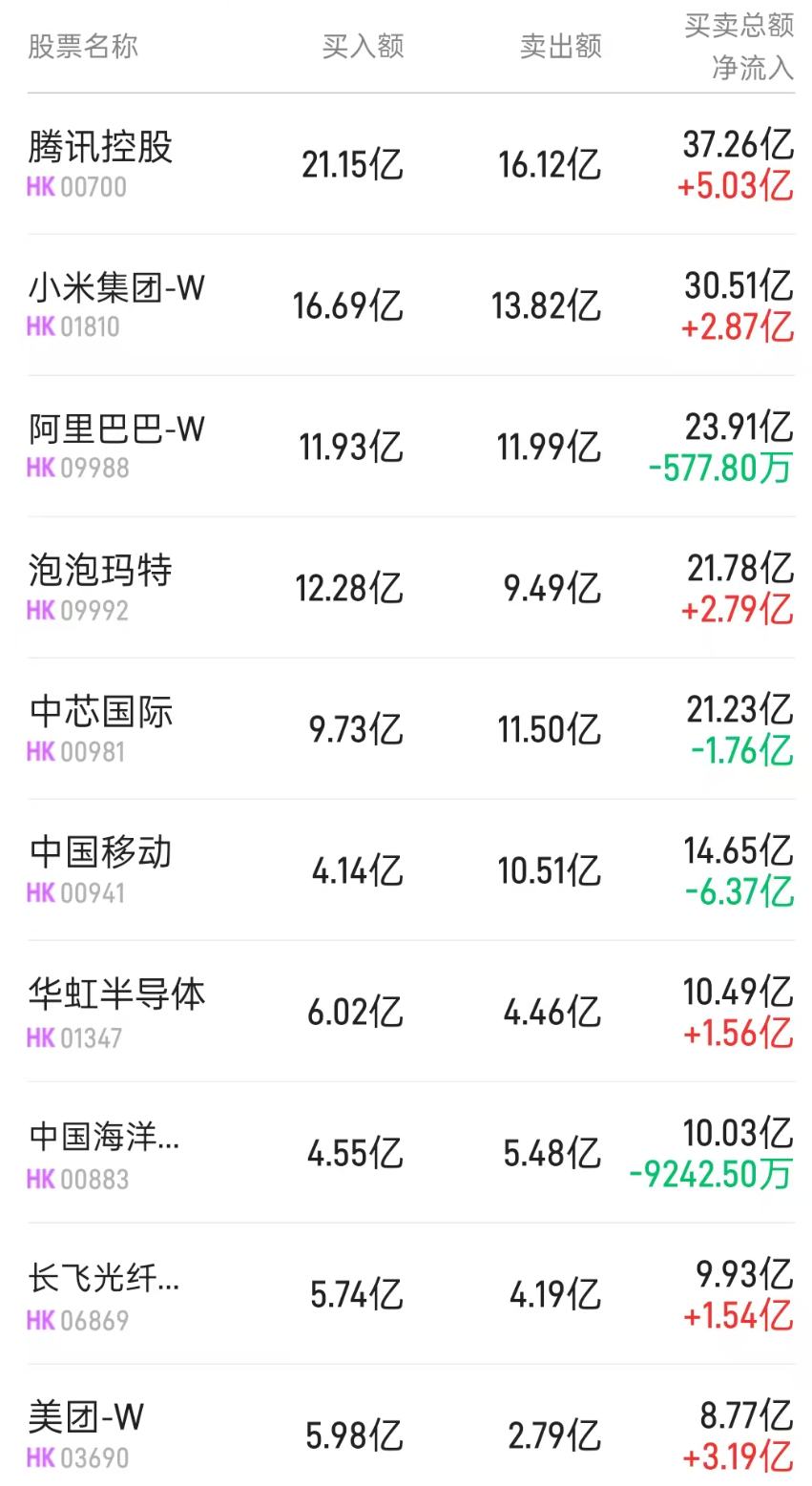
Core Viewpoint - The Hong Kong stock market experienced significant net inflows from northbound trading, with a total net buy of HKD 36.63 billion on January 20, 2023, indicating strong investor interest in certain stocks [1]. Group 1: Net Buying and Selling Activities - Tencent (00700) received the highest net buy of HKD 21.15 billion, with a total trading volume of HKD 37.26 billion, reflecting a net inflow of HKD 5.03 billion [2]. - Meituan-W (03690) saw a net buy of HKD 16.69 billion, with a total trading volume of HKD 30.51 billion, resulting in a net inflow of HKD 2.87 billion [2]. - Xiaomi Group-W (01810) had a net buy of HKD 3.95 billion, contributing to the overall positive sentiment in the tech sector [7]. - Conversely, SMIC (00981) faced the largest net sell of HKD 9.73 billion, with a total trading volume of HKD 21.23 billion, indicating a net outflow of HKD 1.76 billion [2]. - China Mobile (00941) also experienced significant net selling, with a net outflow of HKD 6.37 billion [7]. Group 2: Sector Insights and Market Trends - The technology sector, particularly companies like Tencent, Meituan, and Alibaba, is seeing increased investment interest, driven by expectations of growth in AI and cloud computing [4]. - The semiconductor sector showed divergence, with Hua Hong Semiconductor (01347) receiving a net buy of HKD 2.45 billion, while SMIC faced a net sell of HKD 7.17 billion, reflecting varying investor confidence [5]. - The optical fiber and cable industry is experiencing a price recovery, with Longi Optical Fiber (06869) receiving a net buy of HKD 1.54 billion, supported by rising market prices for G.652.D optical fibers [5]. - The mining sector, particularly Zijin Mining (02899) and Luoyang Molybdenum (03993), faced net selling pressures, attributed to changing market sentiments regarding metal demand and supply dynamics [6].





必和必拓上调铜产量指引 钾肥项目成本再次上升
Xin Lang Cai Jing· 2026-01-20 01:09
Core Viewpoint - BHP Group has raised its annual copper production forecast amid record-high copper prices, while also announcing cost overruns in its Canadian potash project [1][3]. Group 1: Copper Production - BHP now expects to produce between 1.9 million to 2 million tons of copper for the fiscal year ending in June, up from a previous estimate of 1.8 million to 2 million tons [1][3]. - The increase in copper production is attributed to strong performance at the Escondida copper mine in Chile, which will help the company capitalize on record prices [1][3]. - U.S. copper futures have surged to historic highs due to investor speculation about potential shortages of the metal, which is widely used in construction, electronics, and automotive manufacturing [1][3]. Group 2: Potash Project Cost Overruns - BHP has announced that the first phase of the Jansen potash project in Saskatchewan, Canada, is now expected to cost $8.4 billion, including contingency costs [2][4]. - The company attributes the latest cost overruns to previously unaccounted construction hours and material quantities in earlier cost estimates [2][4].

宏观波动加剧,坚定看好金属行情
Zhong Guo Neng Yuan Wang· 2026-01-19 02:12
Group 1: Market Overview - COMEX gold price increased by 2.26% to $4620.5 per ounce, influenced by geopolitical risks, resulting in a strong market fluctuation [4] - LME copper price rose by 1.41% to $13148.5 per ton, while Shanghai copper decreased by 0.63% to ¥100,800 per ton [2] - LME aluminum price increased by 0.71% to $3171.5 per ton, while Shanghai aluminum fell by 1.66% to ¥23,900 per ton [3] Group 2: Supply and Demand Dynamics - Copper inventory in major regions increased by 17.2% week-on-week, with a year-on-year increase of 212,800 tons [2] - Domestic aluminum oxide production capacity reached 110.32 million tons per year, with an operating rate of 80.82% [3] - Rare earth exports in November increased by 12% month-on-month and 28% year-on-year, reaching a historical high for the same period [5] Group 3: Price Movements - The price of praseodymium and neodymium oxide rose by 8.01% this week [5] - Tungsten concentrate price increased by 6.33% due to tight supply conditions [5] - Lithium carbonate price rose by 20.1% to ¥158,300 per ton, while lithium hydroxide price increased by 21.2% to ¥153,700 per ton [5] Group 4: Industry Insights - The copper wire and cable industry is expected to see a decrease in operating rates due to weak downstream consumption [2] - High aluminum prices are suppressing downstream consumption and industry operating rates [3] - The demand for enameled wire is supported by the peak season effect in the home appliance industry [2]
算力芯片“吃尽”铜坨铝锭,有色金属行情走到哪一步了?
第一财经· 2026-01-18 13:38
Core Viewpoint - The cyclical commodities industry is at a turning point, with significant price increases expected in 2026 due to supply constraints and global demand recovery after a three-year inventory destocking phase [3]. Group 1: Market Trends - The global metal futures market has seen a strong start in 2026, with LME copper prices reaching historical highs and LME tin hitting $54,760 per ton, reflecting an over 18% increase year-to-date [3][5]. - The supply-side dynamics for copper, aluminum, and lithium are entering a "tight supply" phase, with projected supply-demand gaps for 2026 of 670,000 tons for copper, 990,000 tons for aluminum, and 120,000 tons for lithium [5][6]. Group 2: Demand Drivers - AI is expected to significantly increase copper demand through upgrades in old power grids and new data centers, with estimates suggesting a compound annual growth rate of 0.7% for AI-related copper demand from 2026 to 2030, resulting in a cumulative increase of 3.8% [7]. - Traditional infrastructure, new energy vehicles, photovoltaics, and data center construction are also contributing to increased demand for copper and aluminum [8]. Group 3: Supply Constraints - The aluminum market is expected to shift from surplus to a 34% shortage by 2025, influenced by production constraints in domestic and international markets [6]. - The lithium market is anticipated to face a sharp reduction in new production capacity starting in 2026, leading to increased scarcity post-2028 [6]. Group 4: Investment Outlook - The resource allocation logic is being rewritten, with expectations of a prolonged boom cycle for resource commodities due to structural demand increases and supply constraints [6][8]. - Despite the positive outlook, there are warnings about potential short-term volatility in industrial metals, with forecasts suggesting that copper prices above $13,000 per ton may not be sustainable in the long term [8].

算力芯片“吃尽”铜坨铝锭,有色金属行情走到哪一步了?
Di Yi Cai Jing· 2026-01-18 10:30
Core Viewpoint - The cyclical commodities industry is at a turning point, with supply constraints and global demand expected to drive price increases significantly by 2026 [1] Group 1: Market Trends - The global metal futures market has seen a strong start in 2026, with LME copper prices reaching historical highs and LME tin hitting $54,760 per ton, reflecting an over 18% increase year-to-date [1] - The prices of aluminum and copper have also reached new highs, with domestic aluminum futures peaking at ¥250,700 per ton and copper at ¥105,600 per ton [2] Group 2: Supply and Demand Dynamics - The copper, aluminum, and lithium markets are entering a "tight supply" phase, with projected supply-demand gaps for copper, aluminum, and lithium expected to reach 670,000 tons, 990,000 tons, and 120,000 tons respectively by 2026 [2] - The supply of copper is expected to transition from a surplus of 11,000 tons in 2024 to a deficit of 340,000 tons in 2026, influenced by AI demand [2][3] Group 3: Investment Insights - The industrial metal market has been primarily driven by supply-side disruptions over the past three years, with a lack of new large-scale projects contributing to price support [3] - The domestic industrial enterprise inventory cycle is at a bottoming phase, with expectations for replenishment rising, driven by new production capabilities and energy structure transitions [3] Group 4: Global Macro Perspective - The combination of U.S. fiscal expansion and a low-interest-rate environment is expected to lead to a revaluation of major assets globally, with traditional safe-haven assets like gold gaining renewed attention [4] Group 5: AI and Infrastructure Demand - AI is rapidly increasing copper consumption through upgrades to old power grids and new data centers, with significant copper requirements projected for these developments [5][6] - The overall demand for copper, aluminum, and other metals is expected to be supported by traditional infrastructure, new energy vehicles, and energy storage developments [6] Group 6: Price Volatility and Risks - Short-term volatility risks in industrial metals have been highlighted, with predictions of copper prices potentially falling to $11,200 per ton by Q4 2026 [6] - Concerns over potential high tariffs on copper could exacerbate short-term shortages and lead to extreme price fluctuations [7]