
电商

Search documents
阿里巴巴-W(09988):3QFY26前瞻:关注云出海表现,电商受宏观影响表现疲软
Guoxin Securities· 2026-01-13 09:27
Investment Rating - The investment rating for Alibaba-W (09988.HK) is "Outperform" [1][6][4] Core Views - The report anticipates a revenue growth of 2% year-on-year for 3QFY26, with an expected revenue of 285.8 billion yuan. The adjusted EBITA margin is projected to be 11.7%, reflecting a decline of 7.8 percentage points year-on-year [3][5] - The international digital commerce group and cloud intelligence revenue are expected to grow by 8% and 35% year-on-year, respectively, indicating continued acceleration in cloud revenue growth [3][10] - The report highlights the ongoing investment in AI and model training, which is expected to impact profitability in the short term but may enhance competitive positioning in the long run [11][22] Summary by Sections Financial Performance - For 3QFY26, Alibaba is projected to achieve a revenue of 285.8 billion yuan, with a year-on-year increase of 2%. The adjusted EBITA is expected to be 33.5 billion yuan, down 39% year-on-year [3][5] - The adjusted EBITA margin is forecasted at 11.7%, a decrease of 7.8 percentage points compared to the previous year [5][3] Cloud Business - The cloud segment is expected to see a revenue increase of 35% year-on-year in FY26Q3, with a stable EBITA margin. The Qwen model is anticipated to enhance the company's market share in overseas markets [10][11] E-commerce Performance - The e-commerce group's GMV is expected to grow by 3% year-on-year in FY26Q3, influenced by a weak retail environment. The report notes that the monetization rate is expected to align closely with GMV growth [19][21] - Instant retail is projected to incur losses of approximately 20-25 billion yuan, with a focus on maintaining market share through increased investment [21][22] Financial Forecasts - Revenue forecasts for FY2026-FY2028 have been slightly adjusted to 1,030.7 billion, 1,149.4 billion, and 1,275.1 billion yuan, reflecting a decrease of 1.5%, 2.8%, and 1.4%, respectively, due to a soft consumer environment [4][23] - Adjusted net profit forecasts for FY2026-FY2028 are revised to 101.6 billion, 135.4 billion, and 165.5 billion yuan, with adjustments of -9.1%, -6.6%, and -3.7% respectively [4][23]

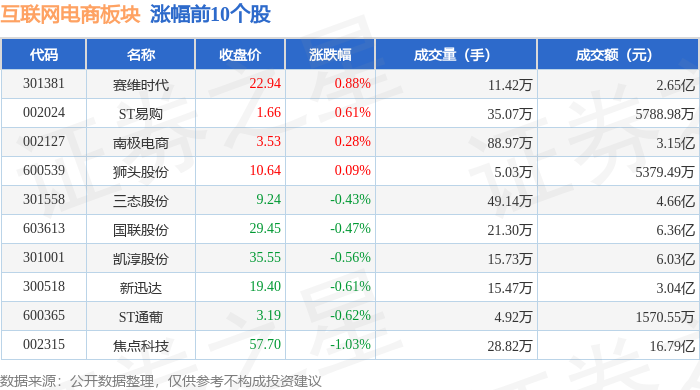
互联网电商板块1月13日跌1.46%,青木科技领跌,主力资金净流出5.06亿元
Zheng Xing Xing Ye Ri Bao· 2026-01-13 09:06
Market Overview - The internet e-commerce sector experienced a decline of 1.46% on January 13, with Qingmu Technology leading the drop [1] - The Shanghai Composite Index closed at 4138.76, down 0.64%, while the Shenzhen Component Index closed at 14169.4, down 1.37% [1] Stock Performance - Notable stock performances included: - Saiwei Times (301381) closed at 22.94, up 0.88% with a trading volume of 114,200 shares and a transaction value of 265 million [1] - ST Yigou (002024) closed at 1.66, up 0.61% with a trading volume of 350,700 shares and a transaction value of 57.89 million [1] - Qingmu Technology (301110) closed at 93.10, down 5.97% with a trading volume of 126,800 shares and a transaction value of 1.239 billion [2] Capital Flow - The internet e-commerce sector saw a net outflow of 506 million from main funds, while retail investors contributed a net inflow of 508 million [2] - Detailed capital flow for selected stocks showed: - Liren Lizhuang (605136) had a main fund net inflow of 14.37 million, while retail investors had a net inflow of 1.06 million [3] - ST Yigou (002024) had a main fund net inflow of 7.48 million, but a significant retail outflow of 1.40 million [3]



格隆汇2026“下注中国”十大核心资产之阿里巴巴
Ge Long Hui· 2026-01-13 08:51
Core Insights - Alibaba has been recognized as a core asset in the digital economy for 2026, reflecting its significant role in China's digital landscape and its potential to participate in the AI infrastructure wave [1] - The company has undergone a strategic organizational restructuring, focusing on two main pillars: "AI + Cloud" technology platform and "Shopping + Lifestyle Services" consumer platform, indicating a shift from a diversified expansion model to a more focused approach [1][4] - Alibaba's leadership has stabilized after multiple adjustments since 2021, with a clear governance structure and a younger executive team, transitioning from an "expansion-oriented platform" to a "focused technology and consumer group" [1][6] Organizational and Governance Changes - The restructuring aims to enhance efficiency by reducing complexity, with clear roles assigned to key leaders: Daniel Zhang as Group CEO, Wu Yongming overseeing technology and cloud, and Jiang Fan leading the core consumer business [4] - The number of partners in the organization has decreased from 26 to 17, marking a significant shift in management and a focus on execution and business results [6] - The business teams are being rejuvenated, with new leadership in key areas to optimize organizational structure and enhance collaboration between e-commerce and local services [6] E-commerce Fundamentals - E-commerce remains Alibaba's core revenue driver, contributing approximately 58.4% of total group revenue, with the Chinese e-commerce group accounting for 56.6% [9] - Customer Management Revenue (CMR) has shown an upward trend since FY25Q3, indicating a recovery in performance driven by improved take rates rather than just GMV growth [13] - The take rate is expected to increase from 4% to 4.6%, reflecting Alibaba's ability to restore profit margins even in a stable GMV environment [17] Instant Retail Strategy - Alibaba is investing in instant retail through platforms like Taobao Flash and Ele.me, which, while incurring short-term losses, are strategically important for long-term market positioning [18] - The company anticipates significant growth in the instant retail market, with projections indicating a potential market size of 3 trillion yuan by 2030 [20] AI and Cloud as Growth Engines - The AI and cloud segments are crucial for Alibaba's long-term valuation, with the global public cloud market expected to exceed $1 trillion by 2025, driven by AI demand [21] - Alibaba Cloud holds about one-third of the Chinese public cloud market, with AI becoming a key growth driver, as evidenced by triple-digit revenue growth over eight consecutive quarters [22] - The company is entering a new capital expenditure expansion phase, with plans to invest 380 billion yuan in AI infrastructure over the next three years [22] Redefining Core Asset Value - Alibaba is evolving from a pure e-commerce company to a hybrid enterprise with stable cash flows and high-growth technology businesses [24] - The company's overall valuation is projected to reach approximately 3.55 trillion yuan by 2026, with a potential stock price target of 200 HKD [27] - The strategic focus on AI infrastructure positions Alibaba as a key player in defining the digital economy in the AI era [27]

格隆汇2026“下注中国”十大核心资产之阿里巴巴
格隆汇APP· 2026-01-13 08:25
Core Insights - Alibaba has been selected as a core asset in the digital economy for 2026, reflecting its significant role in China's digital landscape and its potential in the AI infrastructure wave [2] - The company is undergoing a strategic transformation, focusing on two main pillars: "AI + Cloud" technology platform and "Shopping + Lifestyle Services" consumer platform [2][3] - Since 2021, Alibaba has made multiple organizational and executive adjustments, stabilizing its governance structure and strategic focus [4] Organizational and Governance Changes - The recent organizational restructuring aims to shift from a "complex and diverse" model to a "focused and efficient" execution model, centering around consumption and AI cloud [7] - Leadership roles have been clarified, with key figures like Daniel Zhang and Wu Yongming taking on specific responsibilities to enhance strategic execution [7][8] - The number of partners in the company has decreased from 26 to 17, marking a significant management transition and a new phase focused on execution efficiency [8][9] E-commerce Business Stability - E-commerce remains Alibaba's core pillar, contributing approximately 58.4% of total revenue as of FY26Q1, with the Chinese e-commerce group accounting for 56.6% [13] - Customer Management Revenue (CMR) has shown an upward trend since FY25Q3, indicating a recovery in the core cash flow engine [17] - The improvement in CMR is attributed to product and structural optimizations rather than simple price increases, with a focus on service value [18][19] Instant Retail Strategy - Alibaba is investing in instant retail through platforms like Taobao Flash and Ele.me, which has led to significant order growth despite short-term losses [24][25] - The strategic importance of instant retail is highlighted by its potential to drive e-commerce synergy and defend market share, with projections indicating a market size of 3 trillion yuan by 2030 [26] AI + Cloud as a Growth Engine - The "AI + Cloud" segment is crucial for Alibaba's long-term valuation, with the global public cloud market expected to exceed $1 trillion by 2025 [28] - Alibaba Cloud holds about one-third of the Chinese public cloud market, with AI becoming a key growth driver, evidenced by triple-digit growth in AI-related revenue over eight consecutive quarters [28][29] - The company is entering a new capital expenditure expansion cycle, with plans to invest 380 billion yuan in AI infrastructure over the next three years [28] Redefining Core Asset Value - Alibaba is evolving from a pure e-commerce company to a hybrid enterprise with stable cash flow and high-growth technology businesses [31] - The company's overall valuation is projected to reach approximately 3.55 trillion yuan by 2026, with potential stock price targets around 200 HKD [34] - The strategic focus and organizational restructuring position Alibaba as a key player in defining the digital infrastructure of the AI era in China [39]

3.64万亿元 A股成交额创历史新高
Xin Lang Cai Jing· 2026-01-13 07:26
Group 1 - The A-share market is experiencing a strong upward trend, with the Shanghai Composite Index rising over 1% and achieving a "17 consecutive days of gains" [1] - The total trading volume in the A-share market reached a record high of 3.64 trillion yuan, surpassing the previous record of 3.45 trillion yuan set on October 8, 2024 [1] - Over 4,100 stocks rose in the market, with commercial aerospace and AI applications leading the gains, while e-commerce and short drama gaming sectors also showed active performance [1] Group 2 - Analysts suggest that the high trading volume indicates heightened market enthusiasm, but caution that the market may experience increased volatility following the surge in trading volume [1] - There is a general consensus that the strong performance of the A-share market is expected to continue, with a forecast of net capital inflow into the A-share market potentially reaching 1.56 trillion yuan by 2026 [1] - The 2026 market outlook suggests an expansion of the rally to include consumer blue-chip stocks, leading new energy stocks, non-ferrous metals, and military industry sectors, enhancing investment opportunities and investor satisfaction [2]
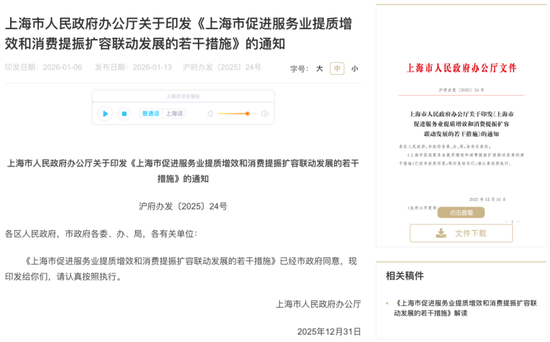
利好来了!刚刚,上海重大发布!28条举措,涉及消费
Xin Lang Cai Jing· 2026-01-13 07:20
Core Viewpoint - The Shanghai Municipal Government has issued a set of measures aimed at enhancing service quality and boosting consumption, focusing on the interconnection between service industries and consumer demand through 28 specific initiatives [1][8]. Group 1: Policy Measures - The measures support the innovation and development of comprehensive platform enterprises, including e-commerce and life service platforms, while promoting specialized consumption platforms in areas such as maternal and child care, housekeeping, and elderly care [1][8]. - The government aims to optimize the automotive loan process by relaxing application conditions and determining reasonable loan issuance ratios, terms, and interest rates [2][9]. - The measures encourage financial institutions to innovate consumer financial services tailored to new consumption characteristics, including holiday, night, nostalgic, and subculture economies [4][10]. Group 2: Financial Support and Infrastructure - There is a focus on enhancing financial support for consumer infrastructure, encouraging financial institutions to back key projects in commercial facilities and community service upgrades [4][10]. - The measures promote the issuance of real estate investment trusts (REITs) for consumer infrastructure and support eligible projects in applying for local government special bonds [4][10]. Group 3: Cultural and Entertainment Sector - The measures aim to invigorate the cultural and entertainment sectors by enhancing the supply of cultural performances and exhibitions, supporting high-level paid exhibitions, and developing cultural products [6][12]. - There is an emphasis on leveraging the spillover effects of sports events by attracting well-known brand events and creating proprietary sports event IPs, with incentives based on the economic impact of these events [6][12]. Group 4: Gaming and Short Video Content - The government plans to promote the development of the gaming and esports industry by establishing a globally influential proprietary event system and supporting high-quality original games and esports projects [7][13]. - Support for the creation of quality micro-short films is included, with initiatives to attract creators and provide rewards for outstanding projects [7][13]. Group 5: Health Services - The measures encourage the development of high-end medical services and diversified health industries, including medical tourism and various health insurance products [7][13].
利好来了!刚刚,上海重大发布!28条举措,涉及消费
券商中国· 2026-01-13 07:19
Core Viewpoint - The article discusses the recent policy measures introduced by the Shanghai Municipal Government aimed at enhancing service quality and boosting consumption through a series of initiatives that focus on innovation, financial support, and infrastructure development [1][3][4]. Group 1: Policy Measures Overview - The Shanghai Municipal Government has issued 28 specific measures to promote the quality and efficiency of the service industry and stimulate consumption [1]. - The measures emphasize the importance of quality supply, new growth areas, and addressing weak links in the service sector [1]. Group 2: Financial Support and Innovation - The measures include optimizing auto loan processes, relaxing application conditions, and promoting diverse credit products in large consumption areas like green smart home and home decoration [3]. - Financial institutions are encouraged to innovate consumer financial services tailored to new consumption trends, including holiday and night economies [3]. Group 3: Insurance and Infrastructure - The policy supports innovation in insurance products, enhancing coverage for specific groups and small businesses in the service sector [4]. - There is a focus on strengthening financial support for consumer infrastructure projects, including the issuance of real estate investment trusts (REITs) and local government bonds [4]. Group 4: Cultural and Sports Sector Development - The measures aim to invigorate the cultural and sports sectors by supporting high-level exhibitions and events, as well as enhancing the commercial viability of public sports venues [7]. - There is a push to develop a globally influential esports brand and support for original gaming IPs and high-profile gaming events [8]. Group 5: Health and Wellness Services - The initiatives encourage the development of high-end medical services and diverse health insurance products, promoting international medical services and medical tourism [8].

2026快手年货节全域激励政策公布,锁定内容、货架与爆品增长路径
Sou Hu Wang· 2026-01-13 07:02
Core Insights - The 2026 Kuaishou New Year Festival has entered a critical preparation phase, with the theme "Good New Year Goods, Real Savings" and aims to create a comprehensive growth pathway for merchants and influencers through dual-channel efforts in content and merchandise [1] Group 1: Content Strategy - The content arena is identified as the primary demand engine for the New Year Festival, with tiered participation thresholds based on historical transaction capabilities of influencers and merchants [4] - Incentives include full-cycle large events for influencers with over 1 million in single transaction capability, peak-breaking incentives for those with over 200,000, and themed category days for those with over 50,000 [4] - New influencers with transaction capabilities between 10,000 and 50,000 can participate in a "Red Packet Rain" initiative to help them achieve initial conversions [4] Group 2: Merchandise Strategy - The merchandise arena is crucial for merchants to achieve explosive business growth during the festival, catering to user demand and managing long-tail content traffic [5] - Key channels for sharing merchandise traffic include "Big Brand Subsidies," "Official Discounts," and "Daily Flash Sales," which provide exposure and promotional support for approved products [6] Group 3: Product Policy - The focus on "explosive products" aims to drive scalable growth, with plans to support high-demand product categories and provide tiered subsidies and influencer distribution support [7] - The "Super Link" initiative will enhance product conversion by linking quality goods with merchant supply and fulfillment, targeting key New Year product categories [7] - A "Fuyou Plan" is introduced to help influencers achieve significant growth in their sales performance, thereby enhancing overall GMV [7] Group 4: Overall Objective - Kuaishou e-commerce is committed to collaborating with merchants and influencers to promote authentic New Year flavors nationwide [9]


美银:AI仍为中国互联网最大增长亮点,腾讯控股为行业首选!阿里巴巴仍是中国人工智能领域的最佳投资标的,亦是中国电商股首选
Sou Hu Cai Jing· 2026-01-13 06:40
Core Viewpoint - The report from Bank of America Securities indicates that stock performance will continue to diverge this year, with the artificial intelligence sector expected to outperform the market again, while virtual consumption in entertainment and travel will continue to excel over physical e-commerce [2] Group 1: Market Trends - The macroeconomic environment remains weak, putting pressure on consumer spending (e-commerce) and corporate spending (advertising), which continues to be a drag on the industry [2] - Chinese internet stocks are seen as having attractive valuations, providing a buffer against downside risks, with a forecasted price-to-earnings ratio of 18 times, lower than the ten-year average of 23 times, the Nasdaq 100's 26 times, and the "Big Seven" of US stocks at 31 times [2] Group 2: Stock Preferences - The company prefers stocks in artificial intelligence and online gaming over e-commerce, with Tencent Holdings (00700) being the top choice due to its growth driven by AI applications, stable market competition, excellent shareholder returns, and attractive valuation [2] - Alibaba (09988) is identified as the best investment target in China's artificial intelligence sector and the preferred choice among Chinese e-commerce stocks [2] - Baidu Group-SW (09888) is considered attractive in the AI field, with value release on the right track [2] - In the digital entertainment sector, the company favors online gaming, recommending Bilibili-W (09626) and Tencent Music-SW (01698) [2] - Within specific segments, JD Health (06618) and Trip.com Group-S (09961) are viewed positively [2]



第一创业晨会纪要-20260113
First Capital Securities· 2026-01-13 06:25
Macro Economic Group - The U.S. Department of Justice has initiated a criminal investigation into Federal Reserve Chairman Jerome Powell, focusing on the $2.5 billion renovation project at the Fed's headquarters and whether Powell lied to Congress about project details. Powell responded strongly, claiming the investigation is a pretext to undermine the Fed's independence in setting interest rates based on public interest rather than presidential preferences [2][3] - The investigation was approved in November 2022 and is seen as a move to establish rules for current and future Fed officials, potentially impacting the Fed's independence [2] - The upcoming midterm elections on November 3, 2022, and Trump's concerns about impeachment following potential election losses indicate a need for favorable economic conditions to boost his approval ratings. This pressure on Powell may lead to further interest rate cuts or his resignation [3] Industry Comprehensive Group - The Ministry of Commerce announced progress in negotiations regarding the export of electric vehicles to the EU, which could significantly benefit China's new energy vehicle exports. The reduction of export tax rebates for battery products in 2026 and their complete cancellation in 2027 is expected to stimulate battery export orders [7] - NVIDIA plans to invest $1 billion with Eli Lilly over the next five years to establish an AI drug laboratory, aiming to accelerate drug discovery through robotics and AI. This collaboration is likely to enhance market expectations for AI applications, particularly in the AI chip sector [7] Advanced Manufacturing Group - Research indicates that the price difference in renewable energy is widening, with wind power at about 80% of long-term contract prices and solar power at 60-70%. The profitability of the energy storage market currently relies on capacity subsidies and peak-shaving fees, with future profitability expected to shift towards arbitrage based on peak and valley price differences [9] - The focus in 2026 is expected to shift from scale expansion to system value, emphasizing the ability to manage and predict fluctuations in energy supply and demand [9] Consumer Group - Google and Walmart have announced a deepened collaboration on AI shopping features, marking a significant step towards the commercialization of AI in e-commerce. This partnership aims to enhance the capabilities of AI assistants in product discovery, recommendations, and transactions [11][12] - Fast Retailing reported strong performance for FY26Q1, with revenues of 1,027.7 billion yen, a year-on-year increase of 14.8%. The core brand Uniqlo showed robust growth, particularly in international markets, which is expected to drive demand in the upstream supply chain [13]



