非银金融

Search documents
【盘中播报】沪指跌0.16% 电力设备行业跌幅最大
Zheng Quan Shi Bao Wang· 2025-10-10 03:03
Core Points - The Shanghai Composite Index fell by 0.16% as of 10:28 AM, with a trading volume of 735.02 million shares and a total transaction value of 1,234.705 billion yuan, a decrease of 6.53% compared to the previous trading day [1] Industry Performance - The top-performing industries included: - Building Materials: Increased by 1.81% with a transaction value of 96.06 billion yuan, up 31.22% from the previous day, led by Jinju Group with a rise of 10.00% [1] - Coal: Increased by 1.71% with a transaction value of 90.86 billion yuan, up 104.06% from the previous day, led by Baotailong with a rise of 10.10% [1] - Non-Bank Financials: Increased by 1.65% with a transaction value of 428.40 billion yuan, up 4.73% from the previous day, led by Guosen Securities with a rise of 7.73% [1] - The worst-performing industries included: - Electric Power Equipment: Decreased by 2.68% with a transaction value of 1,588.88 billion yuan, down 6.13% from the previous day, led by XianDao Intelligent with a drop of 10.67% [2] - Electronics: Decreased by 2.57% with a transaction value of 2,559.26 billion yuan, down 12.26% from the previous day, led by Yandong Micro with a drop of 12.00% [2] - Computers: Decreased by 2.12% with a transaction value of 927.89 billion yuan, down 6.01% from the previous day, led by Danghong Technology with a drop of 10.83% [2]
104股获融资客大手笔净买入
Zheng Quan Shi Bao Wang· 2025-10-10 02:00
Summary of Key Points Core Viewpoint - As of October 9, the total market financing balance reached 2.43 trillion yuan, reflecting an increase of 508.05 billion yuan from the previous trading day, indicating a positive trend in market financing activity [1]. Financing Activity - The financing balance for the Shanghai Stock Exchange was 1.23 trillion yuan, up by 246.32 billion yuan, while the Shenzhen Stock Exchange saw a balance of 1.19 trillion yuan, increasing by 260.78 billion yuan. The Beijing Stock Exchange's financing balance was 75.13 billion yuan, with a rise of 9.57 million yuan [1]. - On October 9, a total of 2,571 stocks received net financing purchases, with 1,008 stocks having net purchases exceeding 10 million yuan, and 104 stocks exceeding 100 million yuan [1]. Top Stocks by Net Financing - ZTE Corporation led the net financing purchases with 1.45 billion yuan, followed by Xinyi Technology and Northern Rare Earth with 1.33 billion yuan and 1.17 billion yuan, respectively. Other notable stocks included Seres, Cambricon Technologies, and CITIC Securities [1][2]. Industry Distribution - The industries with the highest concentration of stocks receiving net financing over 100 million yuan included electronics, electrical equipment, and non-ferrous metals, with 32, 16, and 13 stocks respectively [1]. - Among the stocks with significant net purchases, the main board had 67 stocks, the ChiNext board had 22 stocks, and the Sci-Tech Innovation board had 15 stocks [1]. Financing Balance to Market Value Ratio - The average ratio of financing balance to circulating market value for stocks with significant net purchases was 3.98%. The stock with the highest ratio was Jiejia Weichuang at 8.08%, followed by Dingjie Zhizhi, Dongfang Caifu, and Beijing Junzheng with ratios of 7.79%, 7.74%, and 7.67% respectively [2].






华泰证券:关注“反内卷”相关周期型高股息及部分潜力型高股息品种
Di Yi Cai Jing· 2025-10-10 00:14
Core Viewpoint - The market risk appetite continued to recover in September, with the current All A ERP below the rolling 5-year average, indicating a potential for further market improvement [1] Group 1: Market Performance - The overall performance of high dividend sectors weakened, with internal valuation differentiation increasing due to the influence of the banking sector [1] - "Anti-involution" related cyclical high dividend stocks performed relatively well this month, while banks and non-bank financials showed weakness [1] Group 2: Outlook for October - The trend of market risk appetite recovery is expected to continue into October, with TMT and high-end manufacturing sectors likely to outperform high dividend sectors due to favorable fundamental factors [1] - It is recommended to focus on "anti-involution" related cyclical high dividend stocks and some potential high dividend stocks in the investment strategy [1]

兴业证券:国庆假期后市场窗口期 结构上科技成长占优
智通财经网· 2025-10-09 23:31
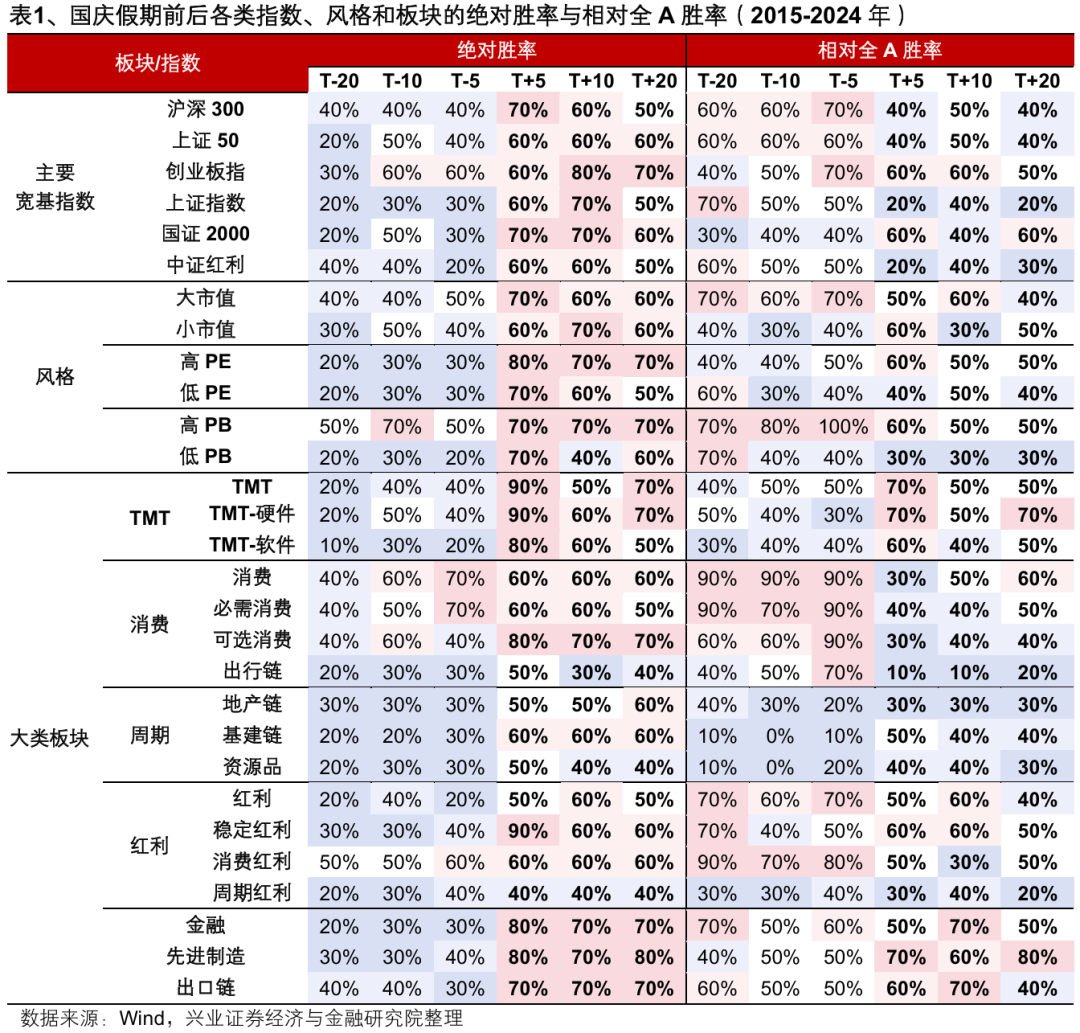
Group 1 - The core viewpoint is that the period after the National Day holiday is a traditional window for risk appetite to rise, with a significant increase in market win rates, particularly favoring technology growth sectors [1][2] - Historically, after the National Day holiday, the broad market indices show a notable increase in win rates, with growth styles being more dominant, especially in sectors represented by TMT, advanced manufacturing, and export chains [1][2] Group 2 - In October, the hardware segment within TMT is expected to outperform due to earnings disclosures, the concentration of new product launches, and the upcoming Double Eleven sales season [4] - The effectiveness of investment in sectors with favorable economic conditions is expected to increase in October, as the correlation between stock price movements and earnings growth improves as the third-quarter report disclosure period approaches [6] Group 3 - Since September, the industries with upward revisions in profit expectations are primarily concentrated in AI (gaming, computer equipment, communication devices, components), advanced manufacturing (motorcycles, aerospace equipment, home appliance components, batteries, medical services), cyclical sectors (non-ferrous metals, glass fiber, steel, agricultural chemicals), consumption (beverages, dairy products, seasoning and fermentation products, pet economy, jewelry), and finance (brokerage, insurance, city commercial banks) [7][9] - The profit revision ratios and expected profit growth rates for various sectors indicate a strong performance in technology, advanced manufacturing, and cyclical sectors, with notable companies highlighted in each category [9] Group 4 - The intensity of industry rotation is expected to converge in October, with a consensus forming around the economic growth themes as the market focuses on the clues from the third-quarter reports [10][11] - October is identified as a traditional window for the convergence of industry rotation intensity and market consensus, suggesting a structural focus on key themes for trading [10][11]


招商基金研究部首席经济学家李湛:资本市场结构性机遇与挑战并存
Zheng Quan Shi Bao· 2025-10-09 18:23
Group 1 - The current economic situation in China shows a divergence between strong external demand and weak internal demand, with macroeconomic data showing marginal slowdown in July and August, and the GDP growth rate for the third quarter declining compared to July [1] - Consumer employment index is at a low level since the second half of 2024, leading to weak income and consumption willingness; the "old-for-new" policy has generated approximately 1.9 trillion yuan in sales with subsidy funds consumed nearing 264 billion yuan, indicating a need for additional subsidies in the fourth quarter to sustain consumption recovery [1] - Fixed asset investment in August only grew by 0.5% year-on-year, down 1.1 percentage points from the previous month, with all three investment categories facing downward pressure, making effective support unlikely in the short term [1] Group 2 - The capital market is showing signs of stabilization and recovery due to multiple supporting factors, although the funding structure and risk points still require vigilance; since the third quarter, market liquidity has been ample, with non-bank financial institutions' deposits increasing by 194 billion yuan year-on-year [2] - External risks are easing, with extended US-China tariff negotiations and a 25 basis point rate cut by the Federal Reserve in September, which may lead to an additional 50 basis points cut within the year, improving international capital liquidity [2] - The funding structure indicates that private equity, speculative funds, and leveraged funds are the main sources of new capital, with private equity securities investment fund registrations in July increasing 22 times compared to the low point in 2024, while resident willingness to invest directly in the market remains weak [2]
主力资金动向 53.61亿元潜入有色金属业
Zheng Quan Shi Bao Wang· 2025-10-09 14:13
Core Insights - The largest net inflow of funds was observed in the non-ferrous metals industry, with a net inflow of 5.361 billion yuan and a price change of 7.60% [1] - The non-bank financial sector experienced the largest net outflow of funds, totaling -6.725 billion yuan, with a price change of 0.10% [1] Industry Summary - Non-ferrous metals industry: - Net inflow: 5.361 billion yuan - Price change: 7.60% - Turnover rate: 4.93% - Trading volume change: 25.63% compared to the previous trading day [1] - Non-bank financial industry: - Net outflow: -6.725 billion yuan - Price change: 0.10% - Turnover rate: 1.56% - Trading volume change: 3.18% compared to the previous trading day [1]
2025年四季度A股投资策略:行情换挡,由流动性叙事迈向盈利驱动
Yintai Securities· 2025-10-09 12:04
Group 1 - The core viewpoint of the report indicates that the A-share market is transitioning from a liquidity-driven narrative to one driven by earnings, with the market expected to face increased macro constraints in the fourth quarter of 2025 [4][8][63] - In the third quarter of 2025, the A-share market strengthened significantly, with the Shanghai Composite Index closing at 3882.78, reflecting a quarterly increase of 12.7%, while the Shenzhen Component Index rose by 29.3% [15][4] - The TMT sector was a major contributor to the index's rise, with notable increases in electronic, communication, and media sectors, which rose by 47.6%, 48.6%, and 20.3% respectively [16][4] Group 2 - Domestic economic growth momentum has slowed, with GDP growth in the third quarter expected to be around 4.8%, influenced by factors such as declining export growth and adjustments in the real estate market [5][29] - The report anticipates that the policy support for economic growth will strengthen, with measures including loan interest subsidies and early issuance of local government debt limits [5][39] - A-share earnings are stabilizing, with overall earnings growth expected to achieve mid-single-digit growth in 2025, supported by enhanced policy measures and resilient exports [7][41] Group 3 - The influx of incremental capital is expected to continue supporting the A-share market, driven by improved investor confidence and favorable economic conditions [48][7] - The "15th Five-Year Plan" is set to provide new guidance for the capital market, focusing on industrial development, economic structure adjustments, and fiscal reforms [53][56] - The report suggests that investment strategies should focus on structural opportunities, particularly those related to the "15th Five-Year Plan," core asset value reassessment, and various thematic opportunities [66][66]
两融季节性卖出,北上与 ETF 阶段成为主要增量资金
SINOLINK SECURITIES· 2025-10-09 11:24
Group 1: Macro Liquidity - The US dollar index has declined, and the degree of "inversion" in the China-US interest rate spread has narrowed. The nominal and real yields of 10Y US Treasuries have both decreased, indicating a drop in inflation expectations [1][14]. - Offshore dollar liquidity has tightened, while the domestic interbank funding situation remains balanced. The term spread (10Y-1Y) has widened [1][18]. Group 2: Market Trading Activity - Overall market trading activity continues to decline, with major indices showing reduced volatility. More than half of the sectors, including real estate, automotive, electronics, and chemicals, have trading heat above the 80th percentile [2][23]. - The volatility of major indices has mostly decreased, although the communication sector remains above the 80th historical percentile [2][30]. Group 3: Institutional Research - The sectors with the highest research activity include electronics, pharmaceuticals, communications, non-ferrous metals, and food and beverages. The research activity in power and utilities, light industry, and machinery sectors has also increased [3][42]. Group 4: Analyst Forecasts - The net profit forecasts for the entire A-share market for 2025/2026 have been adjusted, with increases in sectors such as computers, machinery, banking, and consumer goods. The forecasts for the Shanghai 50, ChiNext Index, and CSI 300 have been raised, while the CSI 500 has seen a decrease [4][21]. - The proportion of stocks with upward revisions in net profit forecasts for 2025/2026 has decreased/increased, indicating a mixed outlook across different sectors [4][17]. Group 5: Northbound Trading Activity - Northbound trading activity has decreased, but there has been a net buying of A-shares overall. The buying ratio in sectors like electronics and non-banking has increased, while the ratio in communications and pharmaceuticals has decreased [5][31]. - Northbound trading primarily net bought sectors such as computers, electronics, and pharmaceuticals, with slight net selling in home appliances and transportation [5][33]. Group 6: Margin Financing Activity - Margin financing activity has approached the highest point since July 2020, with significant net buying in non-banking and consumer goods sectors, while electronics and communications saw net selling [6][35]. - The trading heat of the "Dragon and Tiger List" continues to decline, with automotive, chemicals, and computers showing relatively high trading volumes [6][41]. Group 7: Fund Positioning - Active equity funds have increased their positions in non-banking, automotive, and electronics sectors, while reducing positions in TMT, pharmaceuticals, and consumer services [7][46]. - ETFs have continued to see net subscriptions, particularly in sectors like electronics, new energy, and computers, while non-banking sectors experienced net selling [7][52].
9.06亿元主力资金今日抢筹钢铁板块
Zheng Quan Shi Bao Wang· 2025-10-09 09:39
Core Viewpoint - The Shanghai Composite Index rose by 1.32% on October 9, with 23 industries experiencing gains, particularly in non-ferrous metals and steel, which increased by 7.60% and 3.38% respectively [1] Industry Summary Non-Ferrous Metals - The non-ferrous metals industry saw the highest net inflow of funds, totaling 5.36 billion yuan, contributing to its 7.60% increase [1] Steel Industry - The steel industry increased by 3.38%, with a net inflow of 906 million yuan. Out of 44 stocks in this sector, 38 rose, and 2 hit the daily limit [2] - The top three stocks by net inflow were: - Baogang Co., with an inflow of 880 million yuan and a rise of 8.40% - Hebei Steel Resources, with an inflow of 92.96 million yuan and a rise of 9.99% - Jiuli Special Materials, with an inflow of 59.17 million yuan and a rise of 8.04% [2][3] - The steel industry had 19 stocks with net outflows, with the largest being: - Hangang Co., with an outflow of 165 million yuan - Maanshan Steel, with an outflow of 29.82 million yuan - Shougang Co., with an outflow of 29.49 million yuan [2][3]


10月9日主力资金流向日报
Zheng Quan Shi Bao Wang· 2025-10-09 09:38
Market Overview - On October 9, the Shanghai Composite Index rose by 1.32%, the Shenzhen Component Index increased by 1.47%, the ChiNext Index went up by 0.73%, and the CSI 300 Index gained 1.48% [1] - Among the tradable A-shares, 3,115 stocks rose, accounting for 57.48%, while 2,186 stocks declined [1] Capital Flow - The main capital saw a net outflow of 19.966 billion yuan throughout the day [1] - The ChiNext experienced a net outflow of 11.198 billion yuan, while the STAR Market had a net outflow of 4.835 billion yuan, and the CSI 300 constituents saw a net outflow of 9.622 billion yuan [1] Industry Performance - Out of the 23 first-level industries classified by Shenwan, the top-performing sectors were non-ferrous metals and steel, with increases of 7.60% and 3.38%, respectively [1] - The sectors with the largest declines were media and real estate, which fell by 1.43% and 1.39% [1] Industry Capital Inflow - Twelve industries saw net inflows of main capital, with the non-ferrous metals sector leading at a net inflow of 5.361 billion yuan and a daily increase of 7.60% [1] - The construction and decoration industry followed with a daily increase of 2.17% and a net inflow of 1.868 billion yuan [1] Industry Capital Outflow - Nineteen industries experienced net outflows, with the non-bank financial sector leading at a net outflow of 6.725 billion yuan, despite a slight increase of 0.10% [1] - The automotive sector had a decline of 0.39% and a net outflow of 4.325 billion yuan, with significant outflows also seen in media, electronics, and banking sectors [1] Individual Stock Performance - A total of 2,264 stocks saw net inflows, with 913 stocks having inflows exceeding 10 million yuan, and 153 stocks with inflows over 100 million yuan [2] - The stock with the highest net inflow was ZTE Corporation, which rose by 9.51% with a net inflow of 3.753 billion yuan, followed by Northern Rare Earth and Hikvision with net inflows of 2.969 billion yuan and 1.417 billion yuan, respectively [2] - Stocks with net outflows exceeding 100 million yuan included Sailis, CITIC Securities, and SMIC, with outflows of 2.351 billion yuan, 2.197 billion yuan, and 2.053 billion yuan, respectively [2]