
潮玩

Search documents
18亿北京潮玩新贵,开始凶猛放量出货
Xin Lang Cai Jing· 2025-12-03 13:24
Core Insights - Qimeng Island, a rising player in the trendy toy market, has begun scaling its operations significantly [2][29] - The company reported a revenue of 127 million yuan for the third quarter, marking a 93.3% increase quarter-over-quarter, but incurred an operational loss of approximately 29 million yuan [3][30] Company Overview - Originally known as Quantum Song, Qimeng Island shifted its focus from online education to trendy toys after acquiring Letsvan (Shenzhen Yiqi Culture) [4][30] - The company aims to leverage the booming cultural and creative industry, with a target of achieving annual sales exceeding 300-500 million yuan for its IPs [6][34] Product and IP Development - Qimeng Island has developed a portfolio of 11 proprietary IPs, including WAKUKU and ZIYULI, along with 6 licensed IPs, managing over 40 blind box product lines and 30 plush card products [8][35] - The WAKUKU brand has become a significant revenue driver, contributing around 60% of the revenue in the second quarter and approximately 80% in the third quarter [11][38] - The newly launched IP SIINONO generated 12.89 million yuan in revenue within two months of its release, while ZIYULI brought in 20.76 million yuan [14][41] Sales and Distribution Channels - In the third quarter, Qimeng Island's online sales reached a GMV of 44.6 million yuan, with a 97.2% increase in GMV from its Douyin flagship store [17][44] - The company has expanded its offline presence to over 10,000 retail locations, including partnerships with MINISO, KKV, and Sanfu, and plans to open four direct stores by early January [18][45] Financial Projections - Qimeng Island anticipates revenue between 150-160 million yuan for the fourth quarter and projects its main business to generate 750-800 million yuan in the next full fiscal year (July 2025 - June 2026) [21][48] - Despite rapid growth, the core business has not yet achieved profitability, with significant sales and management expenses leading to a net loss exceeding 25 million yuan in the third quarter [22][50] Investor Sentiment - As of December 2, Qimeng Island's market capitalization is approximately 250 million USD (around 1.8 billion yuan), reflecting a decline of two-thirds from its peak three months ago, indicating a lack of investor confidence [27][55]

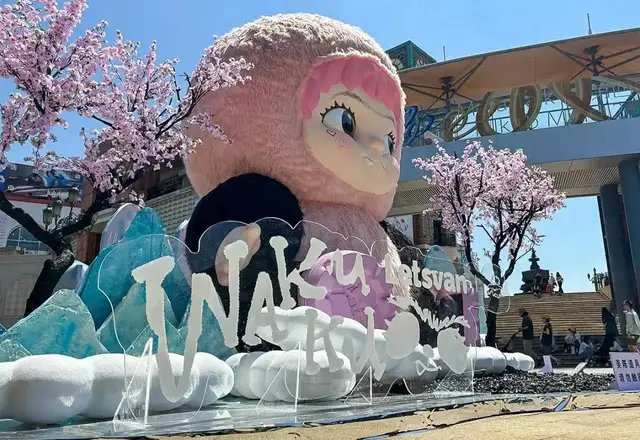
瑞银:中国消费正在发生结构性变化,关注板块 “阿尔法”投资机会
Xin Hua Cai Jing· 2025-12-03 12:06
Group 1 - The Chinese consumer market is showing significant "differentiation" characteristics, with new consumption sectors like trendy toys, chain tea drinks, high-end gold jewelry, and pet consumption emerging as bright spots despite an overall weak consumption environment [1] - The trendy toy industry has evolved into a "global emotional consumer product" aimed at adults, with Chinese companies facing challenges in leveraging supply chain advantages and localizing products for global markets [1] - The pet economy has maintained double-digit growth in recent years, with a clear trend of consumption upgrading, and despite recent profit pressures from online competition, there remains long-term growth potential for Chinese pet industry companies [1] Group 2 - There is a structural change in Chinese consumption, with some service sectors like high-end tourism and elderly care still facing supply shortages, indicating that consumers are changing their consumption methods rather than reducing consumption [2] - The home appliance sector is one of the fastest-growing areas in consumption, benefiting from subsidy policies implemented since last year, although the effectiveness of these subsidies may be diminishing [2] - The "takeout war" has had a significant impact on the restaurant industry, with leading tea drink companies experiencing substantial order growth in the first half of the year, but the marginal impact of takeout has begun to weaken, leading to some companies facing "increased revenue without increased profit" [2] - Smaller restaurant businesses are more negatively affected by the "takeout war," as they lack bargaining power in negotiations with delivery platforms, resulting in cost pressures that some are unable to sustain [2]
奥飞娱乐主办,WSA飓风战魂世界锦标赛赛事引领青少年运动新潮流
Zheng Quan Shi Bao· 2025-12-03 11:03
Group 1 - The WSA Hurricane Battle World Top Tournament, organized by Aofei Entertainment's subsidiary, showcases a new trend in youth engagement through physical activities, moving away from screen time [1] - The tournament features a multi-tiered competition system, including ranking matches and city competitions, with the inaugural event set for October 2025 in Zhengzhou, marking the start of the 2025-2026 season [1] - The event has generated significant interest among spinning top enthusiasts, with additional competitions planned in cities like Jinan, Xi'an, and Chengdu in December [1] Group 2 - Aofei Entertainment links the success of the WSA tournament to its strategic focus on the young trendy toy market, targeting young consumers through its "Unlimited Play" brand [2] - The company collaborates with well-known brands such as Mihayou, NetEase, Tencent, and TapTap to develop various trendy toy products, including blind boxes and candy figures [2] - Aofei Entertainment aims to concentrate on key business areas such as IP content, trendy toy peripherals, toy derivatives, and infant products while staying attuned to industry trends and opportunities in niche markets [2]

大行评级丨交银国际:明年内地消费市场有望延续温和增长趋势 建议采取攻守兼备策略
Ge Long Hui· 2025-12-03 08:20
Core Insights - The mainland consumer market is expected to continue a moderate growth trend through 2026, with slow overall demand growth but structural differentiation driven by rational consumption and demand upgrading [1] - The market is undergoing multi-dimensional transformation, evolving to be more consumer-centric, emphasizing operational efficiency [1] - Investment strategies in the consumer sector should balance defensive and offensive approaches, focusing on stable cash flow and resilient demand while also targeting high-growth structural opportunities [1] Company Focus - Companies benefiting from supply-demand improvements and expected to enhance profitability through efficiency gains include Shenzhou International and Yili [1] - Fast-growing segment leaders that are adept at capturing consumer trends include Pop Mart and Miniso [1] - Industry leaders with solid growth foundations, strong competitive advantages, and cyclical resilience include Anta and China Resources Beer [1] Related Events - Anta Sports reported strong Q3 performance, indicating resilience from its multi-brand strategy and easing pressure on sportswear sales as weather cools [2] - Miniso's Q3 revenue grew by 28% year-on-year, with continued improvement in same-store performance [2] - Yili maintains a "buy" rating from multiple securities firms, highlighting its leading position and growth potential in functional nutrition and deep processing [2] - Shenzhou International emphasizes long-term commitment with improving demand and showcasing its leading advantages [2] - Pop Mart is strengthening its operations in the U.S. market, with expectations for a strong performance in the upcoming peak season [2] - China Resources Beer appointed Xu Lin as an executive director and signed a three-year business travel service agreement with China Resources Digital Technology [2]



从泡泡玛特看潮流性消费的生意逻辑
Jing Ji Guan Cha Wang· 2025-12-03 07:17
Core Insights - The article highlights the booming trend of trendy consumption, particularly focusing on the success of Pop Mart's LABUBU toys, which have seen global demand and significant price appreciation in the secondary market [2][3][4] - The nature of trendy consumption is characterized by unpredictable demand and short-lived popularity, necessitating a different operational logic compared to traditional brand marketing [2][11][23] Group 1: Trendy Consumption Characteristics - Trendy toys, or "Art Toys," originated in the late 1990s and are designed for adult collectors, distinguishing them from traditional children's toys [3][4] - Pop Mart transitioned from a general trendy goods retailer to a focused trendy toy company, leveraging industrialization to scale production and reach millions in sales [4][5] - The company has developed a closed-loop business model encompassing IP incubation, design, production, and sales, while continuously attracting influential artists [5][12] Group 2: Operational Strategies - Pop Mart's success is attributed to its ability to convert artistic creativity into marketable products, while also adhering to the operational logic of trendy brands to manage demand uncertainty [12][16] - The company employs a flexible, responsive business model that allows for rapid adjustments based on market feedback and consumer preferences [16][17] - Pop Mart has established a comprehensive sales system, including physical stores, online platforms, and social media engagement, to maximize product visibility and consumer interaction [18] Group 3: Market Dynamics - The demand for trendy products is highly unpredictable, often influenced by social trends and peer behavior, leading to a "winner-takes-all" market dynamic [8][23] - The company has successfully capitalized on the viral nature of trendy products, with significant sales spikes driven by social media exposure and celebrity endorsements [19][20] - Despite the potential for high sales, the transient nature of consumer interest necessitates continuous product innovation and brand refreshment to maintain relevance [22][24]


热点话题探析丨国潮崛起(下)
Jing Ji Ri Bao· 2025-12-03 03:53
Core Viewpoint - The rise of "Guochao" (national trend) reflects the improvement in Chinese consumer capability and cultural confidence, showcasing the ascent of Chinese manufacturing and brands, transitioning from "unable to produce" to "able to produce well" [1] Group 1: Transformation of Chinese Manufacturing - Chinese manufacturing has evolved from imitation to innovation, focusing on enhancing product quality and establishing domestic brands, ultimately aiming to set global technical standards [1][2] - The initial phase of Chinese manufacturing was characterized by a lack of industrial foundation, but with favorable policies and a large market, it successfully attracted global manufacturing to shift to lower-end production in China [2][3] - The transition from low-cost, low-quality products to high-quality offerings has reshaped consumer perceptions, allowing domestic brands to compete effectively with foreign brands [3][4] Group 2: Quality and Design Enhancement - The core of the "Guochao" movement is the diversification of product offerings and the improvement of quality, which aligns with the personalized consumption demands of younger consumers [2][4] - The revival of craftsmanship and stringent quality control measures have become essential for Chinese brands, enabling them to shed the "low-price, low-quality" image and establish a reputation for excellence [4][5] Group 3: Brand Creation and Cultural Integration - Strong design and brand creation are pivotal for Chinese manufacturing to evolve from merely having quality to possessing cultural significance, enhancing consumer engagement [5][6] - The shift from OEM (Original Equipment Manufacturer) to self-branded products has been emphasized since 2014, marking a significant turning point in the quality development of Chinese manufacturing [6][7] Group 4: Industry Collaboration and Market Dynamics - The synergy between upstream and downstream sectors has fostered the growth of Chinese brands, with e-commerce platforms facilitating connections between new domestic brands and consumers [7][8] - The rise of domestic beauty brands illustrates the rapid growth potential of Chinese manufacturing, showcasing the quality and appeal of local products to younger demographics [7][8] Group 5: Global Standards and Competitive Edge - Participation in international standard-setting is crucial for the global expansion of "Guochao" brands, allowing them to integrate Chinese technology and cultural elements into global industry norms [9][10] - The recognition of Chinese standards on the international stage enhances the competitiveness of Chinese manufacturing, facilitating smoother market entry and establishing a clearer path for standard output [10][11] Group 6: Future Prospects - The ongoing upgrade of Chinese manufacturing is intertwined with the rise of "Guochao," representing a significant leap from manufacturing to creation, reflecting both cultural confidence and industrial strength [11]
奇梦岛发布2026财年Q1财报:收入环比增长93.3%
Huan Qiu Wang· 2025-12-03 02:59
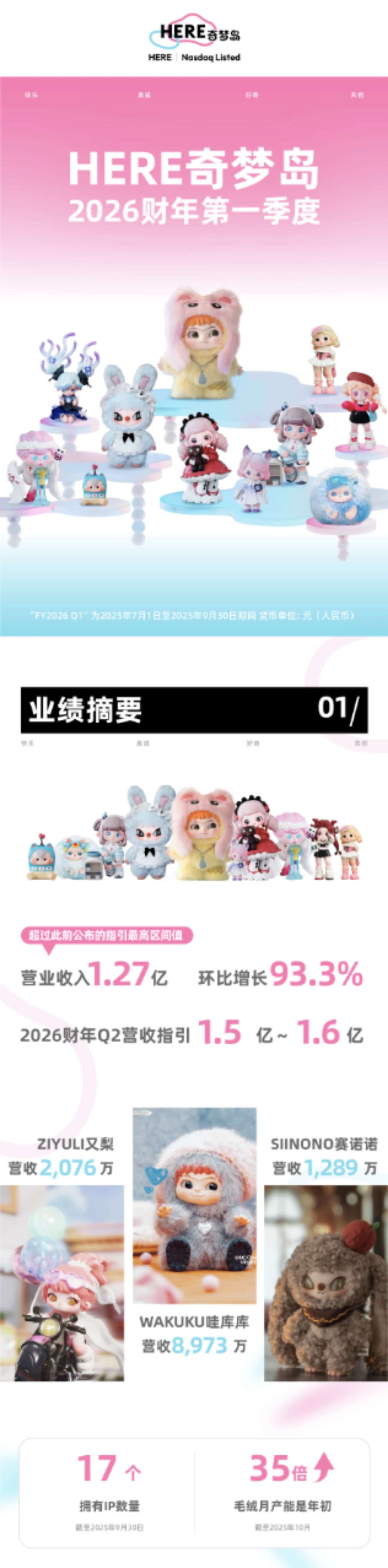
Core Insights - The company reported significant quarter-over-quarter revenue growth in Q1 FY2026, marking a successful transition into a strategic acceleration phase after completing its business restructuring focused on the pure toy market [1][16]. Financial Performance - The company achieved a total revenue of 127 million yuan in Q1 FY2026, representing a remarkable 93.3% increase compared to the previous quarter, exceeding the upper limit of the revenue guidance of 100 to 110 million yuan [9][16]. - The revenue guidance for Q2 FY2026 is projected to be between 150 million and 160 million yuan [9]. Strategic Focus - The company has fully concentrated its resources on the IP toy market by divesting non-toy businesses, leading to substantial performance improvements [16]. - As of September 30, the company owns 11 proprietary IPs, including WAKUKU and ZIYULI, and has 4 exclusive licensed IPs and 2 non-exclusive licensed IPs [16]. IP Development and Brand Strategy - The company’s star IPs have shown strong performance, with WAKUKU generating 89.73 million yuan, ZIYULI generating 20.76 million yuan, and SIINONO generating 12.89 million yuan since its launch in mid-July [16]. - The launch of the new "Instant Power Up" product series by WAKUKU demonstrates the company's strong brand and product innovation capabilities [16]. Supply Chain Efficiency - The company achieved a monthly production of over 1 million plush blind boxes in August 2025, a more than 20-fold increase from the beginning of the year, and in October, production surged to 35 times the January levels, showcasing its scalable and flexible manufacturing capabilities [17]. Collaborative Initiatives - The company has successfully partnered with major events, such as becoming the first official toy brand partner of the China Open Tennis Tournament, enhancing brand visibility through event exposure and collaborations with top athletes [17]. - Strategic partnerships with Beijing TV and Hong Kong's Bauhinia Cultural Group have been established to promote cultural and creative products, further enhancing brand positioning [17]. Online and Offline Growth - The company's online GMV surpassed 44.6 million yuan in Q1 FY2026, driven by brand popularity and channel expansion, with significant engagement on social media platforms [19]. - The offline network has expanded to cover over a hundred key channels, with plans for more flagship and pop-up stores in major cities [19]. International Expansion - The company is steadily advancing its international market presence through both online and offline strategies, having entered nearly 20 countries, including North America and Europe, indicating strong overseas market potential [19]. Leadership Perspective - The chairman emphasized the significant revenue growth and positive core operational indicators, affirming the effectiveness of the company's focus on the toy market and its dual-engine strategy of IP development and multi-channel expansion [20].
《疯狂动物城2》线下潮玩争夺战比电影更“疯狂”
Huan Qiu Wang· 2025-12-03 02:37
Core Insights - The movie "Zootopia 2" has achieved a box office of over 2 billion yuan within six days of its release, indicating strong market performance and consumer interest [1] - The film has led to a surge in IP collaborations, with over 70 brands in China partnering with the movie, particularly in the collectible toy sector [2][6] - The competition among toy brands is intense, with many products showing signs of homogenization, leading to concerns about quality control and consumer fatigue [4][7] Box Office Performance - "Zootopia 2" has surpassed 2 billion yuan in box office revenue within just six days of its release [1] - The film's success is expected to drive further growth in IP licensing, with Disney projecting a threefold increase in licensing business in the Greater China region since December 2023 [6] IP Collaborations - More than 70 brands have launched products in collaboration with "Zootopia 2," including notable names like Pop Mart, Miniso, and 52TOYS [2][4] - The types of products range from collectible cards to plush toys, with price points varying from 10 yuan to 799 yuan [2][3] Market Competition - The current market is characterized by a "wide net" approach to IP licensing, resulting in many similar products that may dilute individual brand market share [4][7] - Brands with physical retail channels, such as Pop Mart and Miniso, have a competitive advantage due to their ability to enhance consumer experience and drive immediate purchases [5] Consumer Insights - Consumers have reported issues with product quality, noting that some plush toys lack detail and have quality control problems despite the higher prices associated with the IP [4][6] - The price differences among similar products, such as plush blind boxes, highlight the impact of distribution channels on pricing strategies [5][3] Future Considerations - Companies are advised to focus on "positioning" rather than just profit during the current IP licensing window, as this can help them build a foundation for future self-developed IPs [7] - The industry faces potential inventory risks as the popularity of IPs may wane, leading to unsold products [6][7] - To stand out in a crowded market, brands should consider innovative product designs and strategies that cater to diverse consumer preferences [7]
“纳斯达克潮玩第一股”诞生,奇梦岛(HERE.US)加速冲刺行业第一梯队
Zhi Tong Cai Jing· 2025-12-03 01:29
Core Insights - The company, HERE.US, is recognized as a leading player in the trendy toy industry with its IP "WAKUKU" launching a new product series that emphasizes quality and design at an affordable price point [1][2] - The company has reported significant revenue growth, with Q1 FY2026 revenue reaching 127 million yuan, a 93.3% increase compared to the previous quarter, driven by strong performance from its IPs [1][2] - The company aims to transition from a toy manufacturer to a global cultural brand, indicating a strategic shift in its business model [2][11] Revenue and Growth Projections - The company has provided a revenue guidance of 150 to 160 million yuan for Q2 FY2026, indicating continued high growth [2] - The overall revenue guidance for FY2026 is projected to be between 750 million to 800 million yuan, showcasing the company's strong market position [5] Market Trends and Industry Insights - The global trendy toy market is expected to grow from $20.3 billion in 2020 to $41.8 billion by 2024, with a compound annual growth rate (CAGR) of approximately 20% [3] - The Chinese trendy toy market is particularly strong, with a projected market size of 763 billion yuan by 2024 and a CAGR of 35.1% from 2020 to 2024 [3] - The second-hand market for trendy toys in China is also booming, with significant increases in order volume and transaction value reported [3] Competitive Landscape - The trendy toy industry is characterized by high growth potential, product premiumization, and high repurchase rates, making it an attractive sector for investment [4] - The market is highly fragmented, with the top five players holding less than 25% market share, leading to intense competition and challenges in IP lifecycle management [4][5] Company Strategy and IP Development - The company focuses on creating emotional connections with users through original IP development, avoiding trends that prioritize short-term gains [6][10] - The company has developed a diverse portfolio of IPs, including 11 proprietary IPs and several licensed IPs, which supports its growth strategy [6] - The company has successfully integrated its marketing and community management capabilities to enhance brand and sales power [7][10] International Expansion and Cultural Branding - The company is expanding its international presence, having entered North American and Southeast Asian markets, and is building a distribution network in nearly 20 countries [9] - The recent rebranding to "奇梦岛" signifies a strategic shift towards becoming a cultural brand, aiming to connect designers, artists, and consumers globally [11][12] - Collaborations with cultural institutions and media outlets are part of the company's strategy to enhance its brand recognition and cultural significance [12][13] Future Outlook - The company is positioned for explosive growth, with expectations of entering the top tier of the industry as it capitalizes on its unique strengths and market opportunities [15] - The strategic elevation towards a comprehensive cultural brand is expected to enhance the company's long-term value and market position [15]
国潮崛起(下)
Jing Ji Ri Bao· 2025-12-02 22:22
Core Insights - The rise of "Guochao" (national trend) reflects the improvement in Chinese consumer spending power and cultural confidence, showcasing the ascent of Chinese manufacturing and brands [1][11] - The transformation of Chinese manufacturing from low-end to high-quality production is a fundamental aspect of the Guochao phenomenon [3][11] Group 1: Manufacturing Evolution - Chinese manufacturing has evolved from "unable to produce" to "able to produce" and now to "able to produce well," marking a significant upgrade in quality and capability [1][3] - The diversification of product offerings and improvement in quality are key foundations for the rise of Guochao, meeting the personalized and experiential consumption needs of younger consumers [2][8] Group 2: Brand Development - The shift from OEM (Original Equipment Manufacturer) to creating independent brands is crucial for enhancing the emotional and cultural value of products, allowing consumers to connect with the brand on a deeper level [5][8] - The establishment of "China Brand Day" and the recognition of Guochao as a cultural movement have contributed to the growth of brand value and market presence for Chinese companies [6][8] Group 3: Quality and Design - The focus on high-quality manufacturing and innovative design has allowed Chinese brands to compete effectively with international counterparts, providing products that are not only functional but also aesthetically appealing [4][5] - The integration of traditional cultural elements with modern aesthetics has transformed products from being merely functional to being culturally resonant and visually attractive [5][6] Group 4: International Standards and Globalization - Participation in the formulation of international standards is a critical step for Chinese brands to gain global recognition and assert their influence in the global market [9][10] - The ability to set and adhere to international standards enhances the competitiveness of Chinese manufacturing, facilitating smoother entry into global markets [10][11] Group 5: Market Dynamics - The collaboration between manufacturing enterprises and e-commerce platforms has created a robust ecosystem for promoting Guochao brands, enabling them to reach younger consumers effectively [7][8] - The emphasis on quality and innovation, combined with effective storytelling, has allowed Chinese brands to resonate with consumers and establish a strong market presence [8][11]