
能源

Search documents
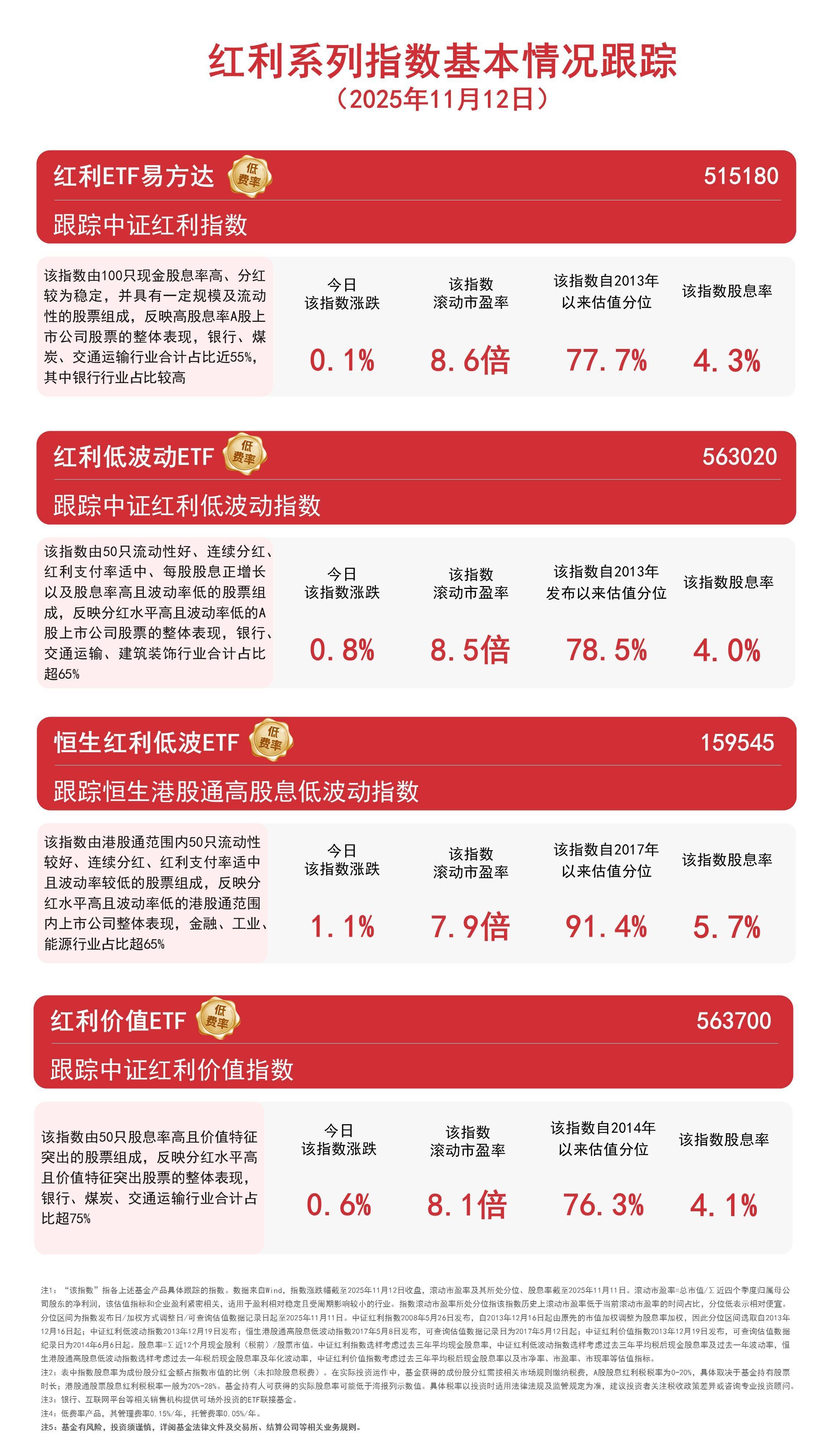
红利资产延续涨势,恒生红利低波ETF(159545)、红利低波动ETF(563020)连续“吸金”
Sou Hu Cai Jing· 2025-11-12 11:02
Group 1 - The Hang Seng High Dividend Low Volatility Index increased by 1.1%, while the CSI Dividend Low Volatility Index rose by 0.8%, and the CSI Dividend Value Index grew by 0.6% [1][9] - The Hang Seng Dividend Low Volatility ETF (159545) saw a net subscription of over 150 million units throughout the day, with a total net inflow of 270 million yuan and 580 million yuan for the past week in the Hang Seng Dividend Low Volatility ETF (159545) and the Dividend Low Volatility ETF (563020) respectively [1][2] - The Hang Seng Dividend Low Volatility ETF (159545) announced its fourth dividend distribution of the year, with a dividend of 0.1 yuan per 10 fund shares, with the record date on November 11 and the cash distribution date on November 14 [1] Group 2 - The index consists of 50 stocks with good liquidity, continuous dividends, moderate dividend payout ratios, positive growth in earnings per share, and low volatility, reflecting the overall performance of A-share listed companies with high dividend levels and low volatility, with banking, transportation, and construction industries accounting for over 65% [3] - The index tracks stocks within the Hong Kong Stock Connect that have good liquidity, continuous dividends, moderate dividend payout ratios, and low volatility, reflecting the overall performance of listed companies in the Hong Kong Stock Connect, with finance, industry, and energy sectors making up over 65% [7]

晶科科技(601778):储能业务加速布局,持续深化综合能源供给能力
China Post Securities· 2025-11-12 10:27
Investment Rating - The report maintains an "Accumulate" rating for the company [6][8]. Core Views - The company has accelerated its layout in the energy storage business, enhancing its comprehensive energy supply capabilities [4]. - For the first three quarters of 2025, the company reported revenue of 3.12 billion yuan, a year-on-year decrease of 19.7%, while the net profit attributable to shareholders increased by 61.8% to 360 million yuan [4]. - The operating cash flow has significantly improved, with a net cash flow from operating activities of 3.27 billion yuan compared to 590 million yuan in the same period last year [4]. - The energy storage business is expected to continue expanding, with several large independent energy storage projects planned to commence soon [4][5]. Financial Summary - Revenue projections for 2025-2027 are estimated at 5.49 billion, 5.53 billion, and 5.41 billion yuan, respectively, with corresponding net profits of 510 million, 520 million, and 550 million yuan [6][7]. - The company’s PE ratios for the same period are projected to be 26, 26, and 24 times [6][7]. - The company’s asset-liability ratio is currently at 62.5%, expected to rise to 65.5% by 2025 [9].

摩根士丹利证券钱菁:中企跨境并购呈现多元新趋势,战略与整合成成功关键
Xin Lang Zheng Quan· 2025-11-12 10:05
Core Insights - The Shanghai Stock Exchange International Investor Conference highlighted the evolving landscape of Chinese enterprises' overseas mergers and acquisitions (M&A), emphasizing a dual-driven model of state-owned and private enterprises [1][2] - The "Belt and Road" initiative has significantly guided cross-border M&A activities, with notable examples of large-scale transactions by state-owned enterprises [1] - Private enterprises, particularly in the renewable energy sector, are increasingly active in overseas M&A, supported by diverse capital sources [2] Group 1: Trends in Overseas M&A - Chinese enterprises are experiencing a multi-dimensional evolution in overseas M&A, with both state-owned and private enterprises playing crucial roles [1] - The participation of foreign capital in China's advanced industries is on the rise, particularly in biopharmaceuticals and renewable energy [2] - Middle Eastern capital is actively seeking investment opportunities in China's petrochemical and technology sectors, enhancing cross-border capital flows [2] Group 2: Success Factors in Cross-Border M&A - Four core elements for successful cross-border M&A include strategic planning, cultural compatibility, timing, and valuation [3] - Clear strategic planning is essential for M&A success, requiring companies to define target selection criteria and strategic goals [3] - Cultural compatibility is often overlooked but is critical for governance efficiency and post-merger integration [3] Group 3: Enhancing M&A Capabilities - Companies should build internal M&A teams with expertise in industry knowledge, valuation analysis, and legal compliance [4] - The importance of professional intermediary institutions is emphasized for effective process management and negotiation support [4] - Regulatory bodies are encouraged to enhance institutional supply and align approval processes with international practices [4]
巴菲特「隐退」
36氪· 2025-11-12 09:10
Core Insights - Warren Buffett, at the age of 95, announced his retirement from writing Berkshire Hathaway's annual reports and participating in the annual shareholder meetings, marking the end of an era for the company [5][10][17] - Under Buffett's leadership, Berkshire Hathaway achieved an extraordinary total return of 5,502,284% from 1964 to 2024, significantly outperforming the S&P 500's return of 39,054% during the same period [5][10] - Buffett's investment philosophy evolved over the decades, transitioning from a focus on undervalued companies to prioritizing high-quality investments, influenced by his long-time partner Charlie Munger [8][15] Company Performance - In the third quarter, Berkshire Hathaway reported a strong operating profit of $13.49 billion, a 34% increase year-over-year, and a net profit of $30.8 billion, up 17% from the previous year [10] - Despite the impressive financial performance, Berkshire's stock price has declined over 10% since reaching a historical high earlier in the year [10][11] - The company's cash reserves reached a record $381.7 billion by the end of the third quarter, following a trend of net stock sales over the past 12 quarters [10][11] Investment Strategy - Buffett's investment strategy has been characterized by a shift from "cigar butt" investing, which focuses on cheap stocks, to a more quality-oriented approach, seeking undervalued but high-quality companies [8][15] - The top five holdings of Berkshire Hathaway accounted for 66% and 71% of the total fair value of equity investments as of September 30, 2025, and December 31, 2024, respectively, with major investments in American Express, Apple, Bank of America, Coca-Cola, and Chevron [14] - Buffett's recent actions, including significant selling of Apple shares, reflect a flexible investment approach that adapts to changing market conditions and industry trends [15][16] Leadership Transition - Greg Abel is set to succeed Buffett as CEO, with Buffett expressing confidence in Abel's management style and ability to lead Berkshire Hathaway's diverse portfolio of over 60 subsidiaries [12][17] - Buffett's retirement marks a significant transition for the company, as he plans to remain involved in a limited capacity while stepping back from daily operations [12][17]

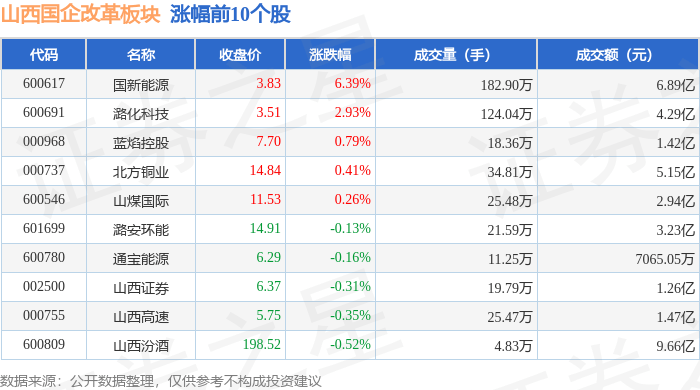
山西国企改革板块11月12日跌0.37%,华阳新材领跌,主力资金净流出1057.42万元
Sou Hu Cai Jing· 2025-11-12 08:56
Market Overview - The Shanxi state-owned enterprise reform sector experienced a decline of 0.37% on November 12, with Huayang New Materials leading the drop [1] - The Shanghai Composite Index closed at 4000.14, down 0.07%, while the Shenzhen Component Index closed at 13240.62, down 0.36% [1] Stock Performance - Notable gainers included: - Guo New Energy (600617) with a closing price of 3.83, up 6.39% and a trading volume of 1.829 million shares, totaling 689 million yuan [1] - Luohua Technology (600691) closed at 3.51, up 2.93% with a trading volume of 1.2404 million shares, totaling 429 million yuan [1] - Significant decliners included: - Huayang New Materials (600281) closed at 6.26, down 2.03% with a trading volume of 77,300 shares, totaling 48.545 million yuan [2] - Shanxi Coking (600740) closed at 4.37, down 2.02% with a trading volume of 389,800 shares, totaling 171 million yuan [2] Capital Flow - The Shanxi state-owned enterprise reform sector saw a net outflow of 10.5742 million yuan from institutional investors, while retail investors experienced a net outflow of 35.7534 million yuan [2] - Conversely, speculative funds recorded a net inflow of 46.3276 million yuan [2] Individual Stock Capital Flow - Guo New Energy (600617) had a net inflow from institutional investors of 66.6112 million yuan, while retail investors saw a net outflow of 70.3735 million yuan [3] - Luohua Technology (600691) experienced a net inflow of 34.6259 million yuan from institutional investors, but a net outflow of 28.8624 million yuan from retail investors [3] - Shanxi Fenjiu (600809) had a net inflow of 10.4316 million yuan from institutional investors, while retail investors saw a net outflow of 28.8380 million yuan [3]


《国家碳达峰试点(成都)实施方案》印发 绿色低碳产业竞争力到2030年处于全国前列
Si Chuan Ri Bao· 2025-11-12 06:48
Core Points - Chengdu government has issued the "Implementation Plan for National Carbon Peak Pilot (Chengdu)" to effectively promote carbon peak initiatives before 2030 [1][2] - The overall goal is to reduce energy consumption and carbon emissions per unit of GDP, enhance the competitiveness of green low-carbon industries, and establish a robust policy framework for green low-carbon development by 2030 [1] Group 1: Key Areas of Focus - The plan outlines eight key areas of work, including promoting clean and efficient energy use and optimizing industrial structure [2] - Specific initiatives include the construction of low-carbon and zero-carbon parks, enhancing green building standards, and implementing energy consumption limits for public buildings [2] Group 2: Policy Innovations - The plan proposes the exploration of a dual control system for carbon emissions and the establishment of a product carbon footprint management system [2] - Tasks include developing a rapid reporting system for carbon emissions in industrial enterprises and creating a carbon budget management system [2]
能源化工期权策略早报:能源化工期权-20251112
Wu Kuang Qi Huo· 2025-11-12 05:40
Group 1: Report Summary - The report is an energy and chemical options strategy morning report, covering energy, polyolefins, polyesters, alkali chemicals, and other energy and chemical options [1][2] - The recommended strategy is to construct an option portfolio strategy mainly as a seller, as well as a spot hedging or covered strategy to enhance returns [2] Group 2: Underlying Futures Market Overview - The latest prices, price changes, price change rates, trading volumes, volume changes, open interests, and open interest changes of various option underlying futures contracts are provided [3] Group 3: Option Factor - Volume and Open Interest PCR - The trading volume, volume change, open interest, open interest change, trading volume PCR, volume PCR change, open interest PCR, and open interest PCR change of various options are presented [4] Group 4: Option Factor - Pressure and Support Levels - The at - the - money strike price, pressure point, pressure point offset, support point, support point offset, maximum call option open interest, and maximum put option open interest of various options are given [5] Group 5: Option Factor - Implied Volatility - The at - the - money implied volatility, weighted implied volatility, weighted implied volatility change, annual average implied volatility, call option implied volatility, put option implied volatility, 20 - day historical volatility, and implied - historical volatility difference of various options are reported [6] Group 6: Option Strategy Analysis - Energy Options Crude Oil - Fundamental analysis shows that U.S. refinery demand has stabilized and rebounded, shale oil production has slightly increased, OPEC exports have increased, European refinery demand is about to enter the peak season, and diesel crack spreads remain high [7] - The market trend shows a short - term weak oscillation in August, a weak and bearish trend followed by a rebound in September, a sharp decline followed by a rebound in October, and a continuous oscillation followed by a rebound in November [7] - Option factor research indicates that the implied volatility fluctuates around the average, the open interest PCR is below 0.80, the pressure level is 470, and the support level is 450 [7] - Recommended strategies include constructing a short - biased call + put option combination strategy for the volatility strategy and a long collar strategy for the spot long - position hedging strategy [7] Liquefied Petroleum Gas (LPG) - Fundamental analysis shows that the cost - end crude oil is under pressure from oversupply and geopolitical issues, and OPEC maintains an increasing production state [9] - The market trend shows a rapid decline followed by a rebound and then a decline since August, a rise - fall - rise - fall pattern in September, a weak - strong - rebound - oscillation pattern in October, and a continuous slight oscillation in November [9] - Option factor research indicates that the implied volatility has dropped significantly to around the lower - than - average level, the open interest PCR is around 0.80, the pressure level is 4550, and the support level is 4200 [9] - Recommended strategies include constructing a neutral - biased call + put option combination strategy for the volatility strategy and a long collar strategy for the spot long - position hedging strategy [9] Group 7: Option Strategy Analysis - Alcohol Options Methanol - Fundamental analysis shows that port inventory is 151.71 million tons, a month - on - month increase of 1.06 million tons, and enterprise inventory is 38.64 million tons, a month - on - month increase of 1.04 million tons [9] - The market trend shows a weakening and bearish trend since August, a low - level consolidation followed by a rebound in September, and a continuous weak and bearish trend since October [9] - Option factor research indicates that the implied volatility fluctuates around the historical average, the open interest PCR is below 0.80, the pressure level is 2500, and the support level is 2000 [9] - Recommended strategies include constructing a bear spread combination strategy of put options for the directional strategy, a short - biased call + put option combination strategy for the volatility strategy, and a long collar strategy for the spot long - position hedging strategy [9] Ethylene Glycol - Fundamental analysis shows that port inventory is 56.2 million tons, a year - on - year increase of 15.3 million tons, and downstream factory inventory days are 13.2 days, a year - on - year increase of 0.7 days. It is expected that port inventory will continue the accumulation cycle [10] - The market trend shows a slight weak consolidation in August, a continuous weak and bearish trend since September, and a continuous weak trend in November [10] - Option factor research indicates that the implied volatility fluctuates around the lower - than - average level, the open interest PCR is around 0.70, the pressure level is 4500, and the support level is 4050 [10] - Recommended strategies include constructing a bear spread combination strategy of put options for the directional strategy, a short - volatility strategy for the volatility strategy, and a long collar strategy for the spot long - position hedging strategy [10] Group 8: Option Strategy Analysis - Polyolefin Options Polypropylene - Fundamental analysis shows that PE and PP production enterprise inventories, trade inventories, and port inventories have different trends of accumulation or de - accumulation [10] - The market trend shows a weak and slight fluctuation in August, a continuous weak and bearish trend since September, and a continuous weak and bearish decline in November [10] - Option factor research indicates that the implied volatility has dropped to around the average level, the open interest PCR is around 0.70, the pressure level is 7000, and the support level is 6300 [10] - Recommended strategies include constructing a bear spread combination strategy of put options for the directional strategy and a long collar strategy for the spot long - position hedging strategy [10] Group 9: Option Strategy Analysis - Rubber Options Rubber - Fundamental analysis shows that exchange rubber warehouse receipts are at a ten - year low, and there is an expectation of inventory accumulation in the later stage [11] - The market trend shows a warming and rising followed by a range - bound oscillation in August, a continuous weak and bearish trend since September, and a low - level weak oscillation in November [11] - Option factor research indicates that the implied volatility has decreased to around the lower - than - average level after a rapid increase, the open interest PCR is below 0.60, the pressure level has dropped significantly to 16000, and the support level is 14500 [11] - Recommended strategies include constructing a short - biased call + put option combination strategy for the volatility strategy [11] Group 10: Option Strategy Analysis - Polyester Options PTA - Fundamental analysis shows that the overall social inventory of PTA (excluding credit warehouse receipts) is 225.1 million tons, a month - on - year increase of 11.4 million tons, and it is expected that inventory will continue to accumulate [11] - The market trend shows a decline followed by a small consolidation and then a rapid rebound and then a decline in August, a continuous weak and bearish trend since September, and a rebound and rise in November [11] - Option factor research indicates that the implied volatility fluctuates at a higher - than - average level, the open interest PCR is around 0.70, the pressure level is 4700, and the support level is 4300 [11] - Recommended strategies include constructing a neutral - biased call + put option combination strategy for the volatility strategy [11] Group 11: Option Strategy Analysis - Alkali Chemical Options Caustic Soda - Fundamental analysis shows that the average capacity utilization rate of Chinese caustic soda sample enterprises with a capacity of 200,000 tons or more is 84.8%, a week - on - week increase of 0.5% [12] - The market trend shows a rapid decline followed by a rebound and then a high - level oscillation in August, a continuous decline since September, an accelerated decline in October, and a low - level weak oscillation in November [12] - Option factor research indicates that the implied volatility fluctuates at a relatively high level, the open interest PCR is below 0.80, the pressure level is 3000, and the support level is 2000 [12] - Recommended strategies include constructing a bear spread combination strategy for the directional strategy and a long collar strategy for the spot long - position hedging strategy [12] Soda Ash - Fundamental analysis shows that as of November 7, 2025, the in - plant inventory of soda ash is 171.42 million tons, a month - on - month increase of 1.22 million tons [12] - The market trend shows a continuous weak consolidation since August, a low - level weak fluctuation in September, a continuous weak trend in October, and a decline - rise pattern in November [12] - Option factor research indicates that the implied volatility fluctuates at a relatively high historical level, the open interest PCR is below 0.60, the pressure level is 1860, and the support level is 1100 [12] - Recommended strategies include constructing a bear spread combination strategy for the directional strategy, a short - volatility combination strategy for the volatility strategy, and a long collar strategy for the spot long - position hedging strategy [12] Group 12: Option Strategy Analysis - Urea Options - Fundamental analysis shows that enterprise inventory is 157.81 million tons, a month - on - month increase of 2.38 million tons, and port inventory is 7.9 million tons, a month - on - month decrease of 3.1 million tons [13] - The market trend shows a wide - range and large - amplitude fluctuation in August, a continuous weakening in September, a low - level weak oscillation in October, and a rebound and rise in November [13] - Option factor research indicates that the implied volatility fluctuates slightly around the historical average, the open interest PCR is below 0.60, the pressure level is 1800, and the support level is 1600 [13] - Recommended strategies include constructing a neutral - biased call + put option combination strategy for the volatility strategy and a long collar strategy for the spot long - position hedging strategy [13]
宏观日报:中游开工分化-20251112
Hua Tai Qi Huo· 2025-11-12 05:06
Industry Overview Upstream - Black: Iron ore and rebar prices declined [2] - Agriculture: Egg prices rebounded [2] - Energy: International oil prices declined and fluctuated recently [2] Midstream - Chemical: PTA operating rate decreased, urea operating rate increased slightly, and PX operating rate remained stable at a high level [2] - Energy: Coal consumption of power plants was at a low level [2] - Infrastructure: Asphalt operating rate was at a low level [2] Downstream - Real estate: Seasonal rebound in commercial housing sales in second - and third - tier cities [3] - Services: Domestic flight frequencies increased slightly [3] Key Events Production Industry - From November 10, 2025, to November 9, 2026, the US will suspend the implementation of the export control penetration rule [1] Service Industry - The People's Bank of China requires the implementation of a moderately loose monetary policy to maintain a relatively loose social financing environment [1] Key Price Indicators | Industry | Indicator | Price | YoY | | --- | --- | --- | --- | | Agriculture | Spot price of eggs | - | +5.69% | | | Spot price of palm oil | 8714.0 yuan/ton | +0.32% | | | Average wholesale price of pork | 18.1 yuan/kg | +0.61% | | | Spot price of zinc | 22558.0 yuan/ton | +1.03% | | Non - ferrous metals | Spot price of aluminum | 21503.3 yuan/ton | +0.25% | | | Spot price of nickel | 122233.3 yuan/ton | +0.01% | | Black metals | Spot price of rebar | 3133.0 yuan/ton | -1.42% | | | Spot price of iron ore | 789.4 yuan/ton | -3.25% | | Non - metals | Spot price of natural rubber | 14675.0 yuan/ton | +0.69% | | Energy | Spot price of WTI crude oil | 59.8 dollars/barrel | -2.02% | | | Spot price of Brent crude oil | 63.6 dollars/barrel | -2.21% | | | Spot price of liquefied natural gas | 4242.0 yuan/ton | -1.81% | | | Coal price | 826.0 yuan/ton | +1.10% | | Chemical | Spot price of PTA | 4645.7 yuan/ton | +1.91% | | | Spot price of urea | 1627.5 yuan/ton | +2.36% | | | Spot price of soda ash | 1207.9 yuan/ton | +0.30% | | Real estate | Building materials composite index | 112.0 points | -0.88% | | | Concrete price index | 90.9 points | -0.10% | [37]
中国华能、中国中化、中国大唐、中国华电、中核集团、中国石油……能源央企加快向雄安集聚
中国能源报· 2025-11-12 04:04
Core Viewpoint - The article highlights the accelerated gathering of energy state-owned enterprises (SOEs) in Xiong'an New Area, driven by supportive services and the need for transformation towards clean energy and integrated energy services [1][3]. Group 1: Energy SOEs Migration - Major energy SOEs such as China Huaneng and China Sinochem have relocated their headquarters to Xiong'an New Area, while others like China Datang and China Huadian are fast-tracking their headquarters construction [1][3]. - Over 100 secondary and tertiary subsidiaries or innovative business units of energy SOEs have established operations in Xiong'an, indicating a significant shift in the energy industry landscape [3]. Group 2: Clean Energy Projects - The Hebei Huadian Xiong'an Wild Park 3MW distributed photovoltaic project is the first initiative by China Huadian in Xiong'an, showcasing a blend of zero-carbon education and landscape integration [3]. - The project has generated over 4.5 million kilowatt-hours of electricity, providing stable clean energy support while harmonizing with the natural scenery [3]. Group 3: Market-Oriented Service Innovations - Xiong'an New Area has implemented innovative market-oriented service measures to streamline the decision-making process for SOEs, establishing regular strategic department meetings to enhance communication [5]. - A comprehensive service system has been created to support the entire lifecycle of SOE projects, integrating various policies into a dedicated service package for the energy industry [5].






银河期货每日早盘观察-20251112
Yin He Qi Huo· 2025-11-12 03:14
Report Industry Investment Rating No relevant content provided. Report's Core View The report provides a daily morning observation of various futures markets, including financial derivatives, agricultural products, black metals, and non - ferrous metals. It analyzes the market conditions, important news, trading logic, and offers corresponding trading strategies for each sector. Summary by Related Catalogs Financial Derivatives Stock Index Futures - Market situation: The stock market showed high - low switching and index fluctuations. The main stock index futures contracts fell, with different changes in trading volume and positions. The market is expected to remain volatile until a consensus is formed [17][19][20]. - Trading strategy: For unilateral trading, high - low trading in a high - level range; for arbitrage, IM\IC long 2512 + short ETF cash - and - carry arbitrage; for options, bull spread at low prices [21]. Treasury Futures - Market situation: Treasury futures closed mostly flat. The spot bond yields fluctuated slightly, and the market lacked clear incremental positive drivers, limiting the upward space of futures bonds [22][23]. - Trading strategy: For unilateral trading, wait and see; for arbitrage, hold short 30Y - 7Y term spread positions and consider long T - contract inter - delivery spread at an appropriate time [23]. Agricultural Products Protein Meal - Market situation: The domestic supply pressure has improved, and the inventory has decreased slightly. The CBOT soybean index rose slightly, while the CBOT index fell [25]. - Trading strategy: For unilateral trading, wait and see; for arbitrage, wait and see; for options, sell a wide - straddle strategy [26]. Sugar - Market situation: International sugar prices fluctuated, and domestic sugar prices were slightly stronger. Global sugar production in major producing areas is increasing, while domestic sugar production is expected to increase, but import policies and high costs support the price [27][28][29]. - Trading strategy: For unilateral trading, conduct range trading; for arbitrage, short foreign sugar and long Zhengzhou sugar; for options, wait and see [30]. Oilseeds and Oils - Market situation: In October, Malaysian palm oil inventories increased as expected, and the oil market is in a bottom - grinding phase. Different oils have different supply and demand situations [31][32]. - Trading strategy: For unilateral trading, wait and see; for arbitrage, wait and see; for options, wait and see [33]. Corn/Corn Starch - Market situation: The spot price rebounded, and the futures market was strongly volatile. The US corn market is expected to be in a narrow - range shock, while the domestic corn spot price is short - term strong [34][35]. - Trading strategy: For unilateral trading, short - long on dips for the December US corn; wait and see for the January domestic corn, and consider short - selling at high prices with a stop - loss; wait for dips for the May and July contracts; for arbitrage, wait and see; for options, wait and see [36]. Live Hogs - Market situation: The pressure of hog slaughter increased, and the price declined slightly. The overall supply pressure remains due to high inventory [37][38]. - Trading strategy: For unilateral trading, lightly short; for arbitrage, wait and see; for options, sell a wide - straddle strategy [38]. Peanuts - Market situation: Peanut spot prices are strong, and the short - term market is strongly volatile. The price of imported peanuts is stable, and the oil mill has not made large - scale purchases [39][40]. - Trading strategy: For unilateral trading, the January contract is expected to be in a bottom - range shock, and lightly short - long the May contract with a stop - loss; for arbitrage, wait and see; for options, sell the pk601 - P - 7600 option [40]. Eggs - Market situation: Egg demand has improved, and the price has slightly rebounded. The inventory of laying hens is still high, and the short - term price increase space is limited [42][43][44]. - Trading strategy: For unilateral trading, close previous short positions and wait and see; for arbitrage, wait and see; for options, wait and see [44]. Apples - Market situation: New apples are being stored, and the price is mainly stable. The apple production has decreased this year, and the cold - storage inventory is expected to be low [45][46][47]. - Trading strategy: For unilateral trading, consider going long on dips; for arbitrage, wait and see; for options, wait and see [47]. Cotton - Cotton Yarn - Market situation: Cotton picking is nearing completion, and the price is mainly volatile. The new cotton supply is increasing, but the production increase may be lower than expected, and the demand is in the off - season [49][50][51]. - Trading strategy: For unilateral trading, the US cotton is expected to be volatile, and Zhengzhou cotton is slightly stronger in the short - term; for arbitrage, wait and see; for options, wait and see [51]. Black Metals Steel - Market situation: Raw material costs are under pressure, and steel prices are in a range - bound shock. The supply and demand structure suppresses steel prices, but cost support exists [54]. - Trading strategy: For unilateral trading, maintain range - bound trading; for arbitrage, hold long roll - screw spread positions; for options, wait and see [55]. Coking Coal and Coke - Market situation: Market sentiment has cooled, and the market is in an adjustment phase. After a sharp decline, the market is expected to oscillate and sort out in the near term [59]. - Trading strategy: For unilateral trading, wait and see in the short - term and consider going long on dips in the medium - term; for arbitrage, short the 1/5 coking - coal spread; for options, wait and see [60]. Iron Ore - Market situation: Adopt a bearish mindset. The supply is high in the fourth quarter, while the domestic demand is weak [63]. - Trading strategy: For unilateral trading, mainly short; for arbitrage, wait and see; for options, wait and see [63]. Ferroalloys - Market situation: Costs provide some support, and previous short positions can be reduced. The supply and demand of silicon - iron and manganese - silicon have weakened marginally, but costs are supportive [65]. - Trading strategy: For unilateral trading, reduce previous short positions on dips; for arbitrage, wait and see; for options, sell an out - of - the - money straddle option combination [67]. Non - Ferrous Metals Precious Metals - Market situation: Market liquidity expectations boost precious metals, which are strongly volatile. The US government's situation and economic data affect market sentiment [69][70]. - Trading strategy: For unilateral trading, hold long positions based on the 5 - day moving average; for arbitrage, wait and see; for options, use a collar - call option strategy [70][71]. Copper - Market situation: Short - term volatility. The supply and demand situation and macro - economic data affect the copper market [72]. - Trading strategy: For unilateral trading, wait and see, and consider long - term long positions; for arbitrage, the ratio may rebound; for options, wait and see [74]. Alumina - Market situation: The supply and demand are still significantly surplus. Spot prices have rebounded, but the pressure of basis - driven selling exists [78]. - Trading strategy: For unilateral trading, short - term narrow - range rebound, but beware of basis - driven selling pressure; for arbitrage, wait and see; for options, wait and see [80][81]. Electrolytic Aluminum - Market situation: Overseas supply concerns persist, and aluminum prices are strongly volatile. Macro - economic factors and supply - demand fundamentals affect the market [82][83]. - Trading strategy: For unilateral trading, maintain a bullish view after dips; for arbitrage, wait and see; for options, wait and see [85]. Cast Aluminum Alloy - Market situation: Overseas interest - rate cut expectations increase, and the alloy price is strongly volatile with aluminum prices. Cost support and demand - side factors co - exist [86]. - Trading strategy: For unilateral trading, the alloy price is strongly volatile with aluminum prices; for arbitrage, wait and see; for options, wait and see [86]. Zinc - Market situation: Pay attention to the export volume. The supply may improve due to potential smelter production cuts and export opportunities, but the upward space is limited [89]. - Trading strategy: For unilateral trading, wait and see; for arbitrage, hold long SHFE and short LME arbitrage positions; for options, wait and see [89]. Lead - Market situation: Range - bound trading. The supply may improve, while the demand may weaken [91]. - Trading strategy: For unilateral trading, short - term range - bound trading, and the price may decline with inventory accumulation; for arbitrage, wait and see; for options, sell an out - of - the - money call option [91]. Nickel - Market situation: The cost is loosening, and nickel prices are weakly volatile. The supply is relatively abundant, and the price is under pressure [93]. - Trading strategy: For unilateral trading, short on rebounds; for arbitrage, wait and see; for options, sell an out - of - the - money call option [94][95]. Stainless Steel - Market situation: Both supply and demand are weak, and raw materials are under pressure. The market is in a low - season, and prices are expected to continue to decline [96]. - Trading strategy: For unilateral trading, short on rebounds; for arbitrage, wait and see [96]. Industrial Silicon - Market situation: No detailed market situation description provided. - Trading strategy: Close long positions and realize profits in time [97].