
新能源

Search documents
科士达:2025年预盈6-6.6亿,同比增超50%
Sou Hu Cai Jing· 2026-01-30 03:39
Core Viewpoint - Keda's 2025 annual performance forecast indicates a significant increase in net profit, projected to reach between 600 million to 660 million yuan, representing a growth of 52.21% to 67.43% compared to the previous year [1] Group 1: Financial Performance - The expected net profit for 2025 is between 600 million to 660 million yuan [1] - This reflects a year-on-year growth of 52.21% to 67.43% [1] Group 2: Business Segments - The company is focusing on the "data center + new energy" business layout, which is contributing to increased orders and shipment volumes [1] - The data center segment is benefiting from a new round of infrastructure investment [1] - The new energy business is experiencing a recovery in demand from the European market and growth in emerging markets [1]

碳酸锂:延续区间震荡,聚焦供需边际,成材:重心下移偏弱运行
Hua Bao Qi Huo· 2026-01-30 03:29
1. Report Industry Investment Rating - No information provided 2. Core View of the Report - The lithium carbonate market will undergo range - bound consolidation, with a focus on marginal supply and demand changes [3] 3. Summary by Relevant Catalogs 3.1 Lithium Carbonate Futures and Spot Market - The main contract of lithium carbonate futures oscillated within a range, closing at 164,820 yuan/ton. The net short position of the main force in the capital market continued, the long - short ratio decreased month - on - month, and the warehouse receipts increased slightly by 245 tons to 30,211 tons. The average price of SMM electric carbon in the spot market was 168,000 yuan/ton. The market sentiment showed obvious game characteristics, and the market transactions were divided. Upstream scattered orders' quotes shrank, and the willingness to ship became more cautious. Downstream material factories increased scattered order purchases at relatively low prices due to rigid demand and February stocking [1] 3.2 Supply Side - Last week, the raw material market was divided. Overseas lithium spodumene remained stable with a slight increase, while domestic spot lithium ore prices declined. This week, the total weekly operating rate of SMM lithium carbonate was 49.5% (-1.49%), and the operating rates of all processes except for salt lakes decreased. The total SMM output was 21,569 tons (-648 tons), a month - on - month decrease of 2.92% [2] 3.3 Demand Side - There was a significant structural differentiation in demand. This week, the output of SMM lithium iron phosphate increased by 1.0% month - on - month, and inventory accumulation increased. The output of ternary materials decreased by 1.1% month - on - month, and inventory gradually decreased. Last week, the output of power cells decreased slightly. As of January 18, the penetration rate of new energy vehicle sales in SMM rose to 55.6%. The production and sales of energy - storage cells were booming, with low inventory, and the production schedule increased slightly, supporting demand [2] 3.4 Inventory - Last week, the social inventory of SMM's four - location samples increased by 2% (+860 tons) month - on - month. This week, the weekly sample inventory decreased by 1.3% (-1,414 tons) month - on - month. The total inventory days were 28.5 days. The inventory days of downstream increased to 10.8 days, while the inventory days of upstream and other links decreased, showing a significant inventory structure differentiation [2] 3.5 Macro Policy - On the demand side, multiple incentives such as subsidies for automobile trade - ins and battery export tax rebates stimulate terminal consumption and improve macro - liquidity. On the supply side, on January 15, the National Development and Reform Commission proposed to introduce management measures for the comprehensive utilization of new energy vehicle power batteries, which will optimize the domestic supply structure in the long term and raise the cost support center. Industrial plans, such as the Qinghai Salt Lake Industry Plan, the key points of the "15th Five - Year Plan" for energy storage, and a series of deployments in the Central Economic Work Conference, form synergistic benefits to support long - term supply - demand balance. The central bank's structural interest rate cut indirectly strengthens the long - term macro - positive atmosphere [3]
万亿GDP之城扩容,城市价值重估的信号已经出现
3 6 Ke· 2026-01-30 01:52
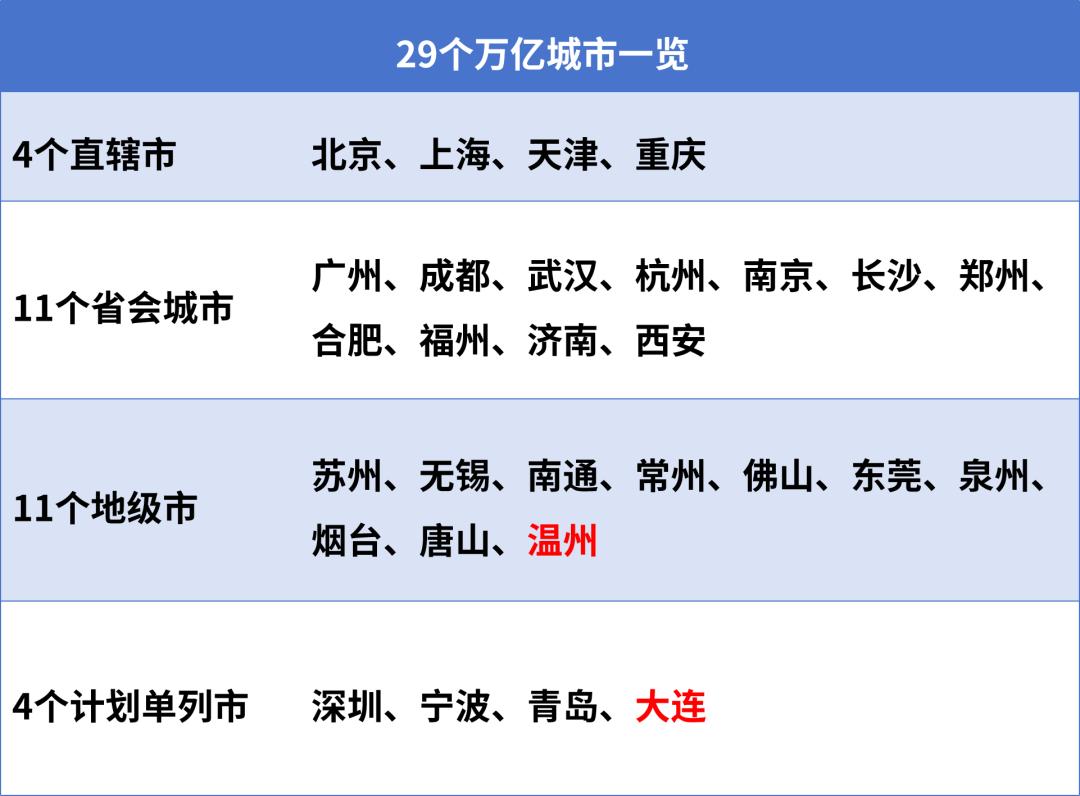
Core Insights - The GDP data for 2025 has been released across various cities, revealing significant milestones such as Guangdong and Jiangsu surpassing 14 trillion yuan, and Shandong becoming the first northern province to reach 10 trillion yuan [1] - The Yangtze River Delta region's GDP totals nearly 35 trillion yuan, accounting for about one-quarter of the national total, with all provinces showing growth rates exceeding the national average [1] - The number of cities with GDP exceeding 1 trillion yuan has increased to 29, with Wenzhou and Dalian recently joining this elite group [1][2] GDP Milestones - Wenzhou officially announced its GDP surpassed 1 trillion yuan, reaching 10,213.9 million yuan, making it the third trillion-yuan city in Zhejiang [1] - Dalian also declared its entry into the trillion-yuan club, becoming the first in Northeast China [1] - Xuzhou is projected to become the 30th trillion-yuan city, with a growth estimate of 5.8% for 2024 [2] Economic Distribution - Jiangsu leads with six trillion-yuan cities, while Guangdong has four, and both Zhejiang and Shandong have three each [9] - The Yangtze River Delta's "cluster advantage" is evident, with 11 trillion-yuan cities, representing over one-third of the total [9] Real Estate Market Insights - GDP remains a key metric for city development, but real estate market capacity is emerging as a crucial indicator of urban vitality [10] - The top five cities in terms of GDP growth also lead in real estate market performance, with Chengdu showing the highest growth rate [10] - Shanghai leads in real estate transaction volume, with a total of 12,816 million yuan in transactions, significantly surpassing other cities [10][12] City Rankings and Performance - Shanghai's GDP for 2025 is projected at 56,708.71 million yuan, with a growth rate of 5.4% [6][12] - Beijing's GDP is expected to reach 52,073.4 million yuan, also growing at 5.4% [6][12] - The real estate market in Shenzhen and Suzhou, despite high GDP, shows lower transaction volumes, categorizing them as second-tier cities [11]

协同推进180个重点项目建设 累计形成161项制度创新成果 长三角示范区GDP年均名义增速7.3%
Jie Fang Ri Bao· 2026-01-30 01:49
Core Insights - The Yangtze River Delta Ecological Green Integrated Development Demonstration Zone has achieved an average nominal GDP growth rate of 7.3% since its establishment in November 2019, with a projected GDP of 571.6 billion yuan by 2025 [1] - The demonstration zone's industrial output and investment growth rates are above the average levels of the Yangtze River Delta region, indicating strong economic performance [1] Group 1: Economic Performance - Qingpu District is expected to achieve a GDP growth of 7.3% by 2025, ranking second in Shanghai [1] - During the 14th Five-Year Plan period, Qingpu's GDP is projected to grow at an average rate of 5.9%, with retail sales increasing by 6.8% annually and total fixed investment reaching 320 billion yuan [1] - Wujiang District's GDP is anticipated to exceed 270 billion yuan by 2025, with a year-on-year growth of 5.7%, maintaining a leading position in Suzhou [1] Group 2: Innovation and Development - The demonstration zone has seen a significant increase in high-tech enterprises, with the number rising to 3,713, which is 2.4 times the number at its inception [2] - The region has established key innovation platforms, including a national key laboratory for water pollution control and resource recycling, enhancing its innovation capabilities [2] - The collaboration between innovation and industry has been strengthened, with over 53.3% of service contracts from the Xiangfu Laboratory's pilot projects serving cross-regional clients in Shanghai and Jiangsu [2] Group 3: Project Development and Future Plans - The demonstration zone is advancing 180 key projects, having completed investments of 56.43 billion yuan last year, exceeding the annual plan by 111.3% [3] - A total of 161 institutional innovation results have been formed, with 61 experiences being replicated nationwide, showcasing the zone's commitment to reform and innovation [3] - The focus for 2026 will include deepening reform and innovation, enhancing ecological advantages, ensuring resource support for key projects, promoting technology and industry integration, and improving public services [3]
跨越周期:中国企业出海东南亚的系统化攻坚指南
Jin Tou Wang· 2026-01-30 00:13
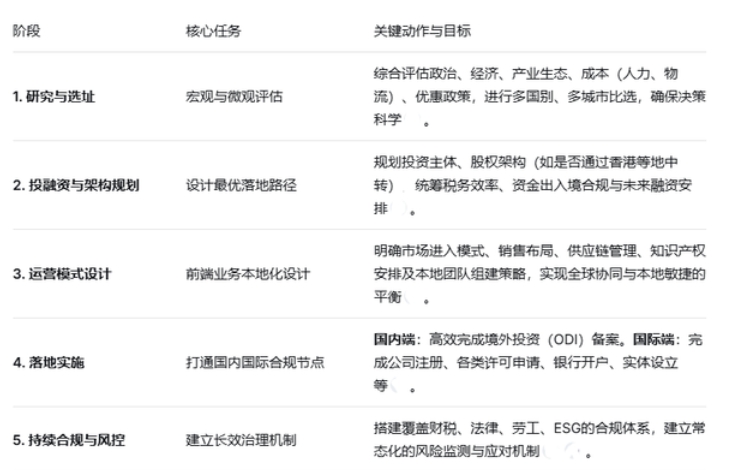
Core Insights - The shift of Chinese companies going abroad has evolved from an optional strategy to a necessity for long-term development, particularly in Southeast Asia, which is becoming a core area for globalization efforts due to its economic growth and strong trade ties with China [1] Group 1: Trends in Chinese Companies Going Abroad - The current trend of Chinese companies going abroad shows a clear upgrade, with a focus on brand establishment, technology cooperation, and long-term market share rather than just short-term orders [2] - The modes of going abroad have diversified from primarily goods trade to include greenfield investments, cross-border mergers and acquisitions, and localized R&D and operations [2] - Factors driving this transformation include domestic industrial upgrades, the Belt and Road Initiative, and investment incentives from Southeast Asian countries [2] Group 2: Opportunities and Challenges in Southeast Asia - Southeast Asia presents a diverse opportunity landscape, with different countries offering unique entry points for various types of businesses, such as manufacturing hubs in Vietnam, Thailand, and Indonesia, and digital innovation centers in Singapore and Indonesia [3] - However, challenges such as increased compliance requirements, geopolitical risks, and difficulties in local integration must be addressed [4] Group 3: Systematic Approach for Successful Expansion - A successful overseas expansion requires a systematic approach involving five key stages: research and site selection, investment and structural planning, operational model design, implementation, and ongoing compliance and risk management [5][6] - The Overseas Direct Investment (ODI) filing is a critical legal prerequisite for initiating overseas actions, and professional assistance can significantly streamline this process [6] Group 4: Building Resilience Against Uncertainties - Companies need to build resilience by prioritizing compliance, diversifying supply chains and markets, utilizing policy financial tools, and cultivating local leadership [7] Group 5: Future Outlook - Southeast Asia is expected to remain a vibrant testing ground and growth engine for Chinese companies' globalization efforts, with successful companies adopting a long-term mindset and viewing overseas expansion as an organizational capability upgrade [8]
一名「回购顾问」的自白丨入局
36氪· 2026-01-30 00:10
Core Viewpoint - The article discusses the emerging crisis in the Chinese venture capital market, particularly focusing on the implications of buyback agreements for founders and investors as the market transitions from a boom in hard technology investments to a potential wave of failures and personal bankruptcies for many entrepreneurs [4][14]. Group 1: Buyback Agreements and Market Dynamics - The capital market is expected to show signs of recovery by 2025, but the underlying issues related to buyback agreements remain unresolved, with many founders facing severe financial and reputational risks [4][14]. - A significant number of founders (over 80%) are personally liable for buybacks, leading to a situation where business failures could escalate into personal financial crises [14][20]. - The period from 2017 to 2019 marked a shift towards hard technology investments, with many companies now facing the reality that 98% may not go public or be acquired, thus activating buyback clauses as a common exit strategy [13][14]. Group 2: Legal and Financial Implications - Traditional legal approaches to enforcing buybacks have led to systemic waste, with many founders unable to repay due to prior investments in R&D and operations, resulting in a cycle of litigation without financial recovery for investors [10][11]. - The article highlights the absurdity of the current legal framework, where aggressive enforcement of buyback clauses can lead to the collapse of companies and loss of jobs, ultimately failing to recover any funds for investors [10][11]. Group 3: New Role of Buyback Advisors - The emergence of the "buyback advisor" role aims to facilitate communication between founders and investors, providing structured solutions rather than resorting to litigation [16][17]. - Customized strategies may include partial cash repayments and adjustments in equity to extend repayment timelines, allowing companies to stabilize and potentially recover [18][19]. - The goal is to create a "dignified exit" for founders, preserving their reputation and future opportunities while managing the financial fallout of business failures [21][22]. Group 4: Future Considerations - The article raises questions about whether the current market rules are prepared to handle the anticipated wave of failures as buybacks become more prevalent [22][23]. - It emphasizes the importance of recognizing failure as a part of the innovation process, advocating for a shift in societal attitudes towards entrepreneurship and risk-taking [21][22].

从“申报热”到“赎回潮” 5单公募REITs叫停
2 1 Shi Ji Jing Ji Bao Dao· 2026-01-29 23:36
Core Viewpoint - The domestic public REITs market in China has experienced a significant turning point, with several leading companies voluntarily withdrawing their public REITs issuance or expansion applications after years of preparation, raising concerns about the market's future prospects [1][15]. Group 1: Market Overview - Public REITs, or Real Estate Investment Trusts, are financial instruments that raise funds through issuing shares to invest in income-generating real estate, distributing most of the profits to investors [1][15]. - The REITs market was once a hot financing innovation in China's infrastructure sector, rapidly growing to a market size exceeding 100 billion, and was characterized by high demand and oversubscription [2][15]. - The recent wave of withdrawals from the REITs market has shifted the perception from a "hot" investment to a more rational correction phase, indicating a potential end to the market's previous high point [1][15]. Group 2: Withdrawn Projects - The withdrawn projects include: - Jianxin Jianrong Home Rental Housing REIT - Chuangjin Hexin Electronic City Industrial Park REIT - Huaxia Wanwei Warehousing Logistics REIT - Jianxin Jinfeng New Energy REIT - Fuguo Shouchuang Water REIT's expansion application [1][2][16]. - These projects were submitted between September 2022 and May 2025, covering various asset types such as affordable rental housing, industrial parks, warehousing logistics, new energy wind power, and water treatment [2][16]. Group 3: Reasons for Withdrawals - The withdrawals are attributed to two significant changes in the market environment: - The overall cooling of the REITs secondary market, leading to decreased investor willingness to subscribe to new products due to pricing pressures and potential risks of breaking below par [8][21]. - Challenges in the operational quality of underlying assets, such as declining rental income and rising vacancy rates in logistics real estate, which necessitate downward adjustments in cash flow forecasts [8][21]. - Specific concerns raised during the review process included compliance issues, rental stability, and the impact of policy changes on cash flows [6][20]. Group 4: Regulatory Environment - Recent policy signals have emerged to promote the standardized development of the REITs market, including a notice from the National Development and Reform Commission in September 2025 to encourage regular applications [9][23]. - The China Securities Regulatory Commission's "Document No. 63" issued in December 2025 sets a new tone for "high-quality development," marking a significant step towards the market's expansion and regulatory compliance [10][23]. Group 5: Future Outlook - Despite the short-term adjustments, favorable long-term factors for market development remain, with the potential for REITs to play an irreplaceable role in the macroeconomy [11][24]. - The market is expected to continue experiencing a "market dividend period," with ongoing demand for "fixed income plus" assets, particularly in early 2026 [12][25]. - Investors are advised to focus on the fundamental performance of projects, asset scarcity, and dividend yield while enhancing their understanding of REITs products [12][25].
湖南科力远新能源股份有限公司关于调整公司部分高级管理人员的公告
Shang Hai Zheng Quan Bao· 2026-01-29 19:44
证券代码:600478 证券简称:科力远 公告编号:2026-010 湖南科力远新能源股份有限公司 关于调整公司部分 高级管理人员的公告 本公司董事会及全体董事保证本公告内容不存在任何虚假记载、误导性陈述或者重大遗漏,并对其内容 的真实性、准确性和完整性承担个别及连带责任。 湖南科力远新能源股份有限公司(以下简称"公司")于2026年1月29日召开第八届董事会第二十五次会 议,审议通过了《关于调整公司部分高级管理人员的议案》。 因公司经营管理与发展需要,经公司总经理提名,并经公司董事会提名委员会审议通过,对部分高级管 理人员职务进行调整。具体情况如下: 1、公司人力资源总监陈丹女士岗位调整,拟聘任陈丹女士任公司执行总经理,陈丹女士不再担任公司 人力资源总监职务。 2、公司公共事务总监陈思女士岗位调整,拟聘任陈思女士任公司副总经理,陈思女士不再担任公司公 共事务总监职务。 3、免去余兴华先生总经理助理职务,另有任用。 上述高级管理人员任期自公司董事会通过之日起至第八届董事会届满为止,个人简历附后。 特此公告。 湖南科力远新能源股份有限公司董事会 2026年1月30日 1、陈丹:女,1987年生,中国国籍,本科学 ...

开年以来多家A股公司更新赴港IPO进度条
Zheng Quan Ri Bao Zhi Sheng· 2026-01-29 17:19
Group 1 - As of early 2026, A-share companies are actively listing in Hong Kong, with three companies successfully listed and several others in the process of IPOs [1] - Notable companies such as Dongpeng Beverage and Muyuan Foods are currently in the IPO process, while others like Lanke Technology and Wuxi XianDao have passed hearings [1] - A total of 357 companies are in the IPO queue in Hong Kong, with nearly 30% being A-share companies from strategic emerging industries like new energy and semiconductors [1] Group 2 - Various domestic venture capital institutions and state-owned funds are emerging as cornerstone investors in Hong Kong IPOs, indicating strong interest from institutional investors [2] - Notable cornerstone investors include major insurance companies and state-owned funds, which typically favor large, mature companies with reasonable valuations [2] - The "national team funds" are strategically investing in emerging industries, enhancing market confidence and risk pricing [2] Group 3 - The "A+H" share model has reached a total of 167 companies, with expectations for a new wave of listings starting in Q4 2024, particularly among large-cap companies [3] - Many A-share companies are initiating "A+H" plans, indicating a trend towards dual listings [3] Group 4 - International long-term funds, including sovereign wealth funds and family offices, are increasingly participating as cornerstone investors in Hong Kong IPOs [4] - High-profile international investors such as Abu Dhabi Investment Authority and UBS Global Asset Management are backing several IPOs, reflecting a growing interest in quality projects [4] - The participation of international long-term funds has significantly increased, with many institutions actively seeking to invest in quality A-share companies [4] Group 5 - The involvement of foreign investment banks with a deep understanding of long-term funds' interests facilitates the matching of suitable investment opportunities [5] - These banks have established relationships with Middle Eastern sovereign funds, allowing them to recommend appropriate investment targets [5] Group 6 - International long-term funds tend to focus on long-term holdings rather than short-term trading, indicating a preference for quality investments with a 2-3 year horizon [6] - The investment strategy of these funds emphasizes long-term returns, which aligns with their investment criteria [6]

“能源绿色低碳转型”看山东之济南新旧动能转换起步区:场景创新和产业导入协同推进
Zhong Guo Fa Zhan Wang· 2026-01-29 14:53
Core Viewpoint - The Jinan New and Old Kinetic Energy Conversion Pilot Zone is committed to promoting green, low-carbon, and high-quality development by focusing on the "dual carbon" goals and exploring innovative reforms in the energy sector [1] Group 1: Energy Transition Initiatives - The pilot zone is recognized as the only pilot unit in Jinan for energy green and low-carbon transition, establishing a collaborative work mechanism among multiple departments to ensure the implementation of pilot projects [1] - A detailed construction plan for the energy green low-carbon transition pilot for 2025 has been issued, outlining annual goals, key tasks, and project lists to enhance policy support and resource allocation [1] Group 2: Collaborative Development Models - The green low-carbon vehicle network interactive charging and swapping demonstration station has been developed through collaboration between Jinan Power Supply Company and local government, featuring advanced technology and comprehensive facilities [2] - The station includes 123 charging and swapping spots, with 104 charging piles, and integrates various elements such as photovoltaic, energy storage, and V2G technologies [2] Group 3: Clean Energy Utilization - The pilot zone is actively promoting photovoltaic power generation integrated with buildings, achieving a total installed capacity of approximately 49,000 kW and an annual power generation of 57 million kWh [3] - Geothermal energy utilization projects have been developed, covering a heating area of about 220,000 square meters, leveraging the region's rich geothermal resources [3] - Hydrogen energy applications are being expanded, with over 100 hydrogen-powered vehicles promoted for urban construction and logistics [3] Group 4: Advanced Technology and Equipment - The Aiko Solar high-efficiency battery module project has been established, with a production capacity of 3 GW and an expected full production by 2026, featuring innovative ABC photovoltaic battery components [4] - A 350 million yuan investment project for perovskite solar cells is underway, focusing on high-efficiency and stable production processes [4] Group 5: Comprehensive Smart Energy Development - A "1+4" planning system has been established to manage electricity supply, heating, and comprehensive smart energy services, with a draft plan already in progress [5] - A multi-energy integrated management system is being constructed, incorporating various energy forms and advanced technologies for better control and visibility [5] Group 6: Project Implementation - Ongoing projects include the construction of integrated heating and cooling systems, green electricity supply for industrial parks, and hydrogen energy pilot projects, leveraging the demonstration effects of the low-carbon vehicle network interactive charging station [6]
