
家居

Search documents
惠民服务工程
Xin Lang Cai Jing· 2026-01-25 20:19
Core Insights - The article discusses the implementation of various consumer promotion activities aimed at boosting consumption and enhancing public welfare, including events like "Double Product Online Shopping Festival" and "New Year Goods Festival" [2][3] Group 1: Objectives - The goal is to implement special actions to stimulate consumption, including organizing over 200 promotional events and ensuring the free or low-cost opening of more than 70 public sports venues [2] - The initiative also includes the construction of at least 3,000 electric bicycle charging ports in residential areas [2] Group 2: Progress - The promotion of consumption is combined with improving people's livelihoods, focusing on major consumer goods such as automobiles, home appliances, and home furnishings [2] - A total of 95 public sports venues across the province are now open for free or at low cost, and 6,426 electric bicycle charging ports have been established [2] Group 3: Public Response - Citizens express satisfaction with the consumer promotion activities, highlighting significant savings on home appliances and the convenience of free access to sports facilities [3] - The availability of charging ports has resolved previous issues related to electric bicycle charging, enhancing the quality of life for residents [3]

耐用消费产业行业研究:关注潮玩节日催化,新型烟草日本上新,AI消费多款新品上市
SINOLINK SECURITIES· 2026-01-25 14:24
Investment Rating - The report provides a positive outlook on several sectors, indicating a recovery or growth potential in areas such as new tobacco, packaging, and AI-related products [6][11][15]. Core Insights - The report highlights the importance of seasonal marketing strategies in the collectible toy sector, particularly around Chinese New Year and Valentine's Day, with companies like Pop Mart and Blokus launching limited edition products [7][8]. - In the new tobacco sector, there is a strong push for innovation and international expansion, with major players increasing their investments in heated tobacco products (HNB) and electronic cigarettes [11][12]. - The home furnishing market is experiencing a downturn in domestic sales, but there are signs of recovery in exports, particularly to Southeast Asia [13][14]. - The packaging industry is expected to benefit from a steady recovery in downstream demand, supported by growth in consumer goods sectors [15][16]. - The pet food industry is facing increased competition, leading to higher sales expense ratios, but there are opportunities for consolidation among listed companies [21]. Summary by Sections 1.1 Collectible Toys - Focus on seasonal marketing and the integration of AI in toys, with companies like Pop Mart and Blokus leading the charge [7][8]. - The industry is seeing a shift towards cross-industry collaborations and enhanced IP value [7]. 1.2 New Tobacco - The report notes a projected decline in electronic cigarette exports in 2025, with a focus on the need for innovation in the domestic market [11]. - Major tobacco companies are increasing their investments in HNB products, indicating a significant growth potential in this segment [12]. 1.3 Home Furnishing - Domestic sales are under pressure, with a notable decline in new and second-hand home transactions [13]. - Export growth is observed, particularly to Southeast Asia, suggesting a potential recovery in international demand [14]. 1.4 Packaging - The packaging sector is expected to see a steady recovery in demand, supported by growth in consumer goods [15][16]. - Price adjustments in raw materials like aluminum may impact packaging companies' operations [16]. 1.5 Personal Care and AI Glasses - The personal care sector is focusing on high-end products and international expansion, with companies like Procter & Gamble seeing mixed results [17]. - The AI glasses market is shifting focus from VR to AI wearable technology, with major companies like Apple and Meta adjusting their strategies [17]. 1.6 Xiaomi Group - Xiaomi is initiating a share buyback program, reflecting confidence in its business outlook [18]. - The company is also focusing on its smartphone and automotive segments, with a strong emphasis on high delivery targets for 2026 [19][20]. 1.7 Pet Food and Supplies - Increased competition in the pet food sector is leading to higher sales expenses, but opportunities for consolidation exist among listed companies [21]. - New developments in pet healthcare services are emerging, indicating growth potential in this area [21]. 1.8 Silver Economy - The government is implementing a subsidy program for elderly care services, which may boost demand in the silver economy sector [25][26]. 1.9 AI and 3D Printing - The 3D printing industry is experiencing significant growth, with exports increasing substantially [27]. - Innovations in 3D printing technology are expected to drive further expansion in this sector [27]. 1.10 AI Mattresses - A new startup focusing on sleep health technology is gaining attention, with plans to develop a range of AI-integrated sleep products [32]. 1.11 Two-Wheel Vehicles - The two-wheeler market is recovering as major manufacturers comply with new regulations, leading to a resurgence in product offerings [33][34].


地产预期改善,关注家居估值修复弹性
Huafu Securities· 2026-01-25 11:15
Investment Rating - The report maintains an "Outperform" rating for the industry [4] Core Insights - The home furnishing sector is currently at a historical low in valuation, with expectations for recovery driven by improving real estate sentiment and policy expectations [3][5] - The report highlights specific companies for investment, including Gujia Home, Oppein Home, and Sophia, while also suggesting attention to undervalued stocks like Minda Holdings and Zhibang Home [3] - The report anticipates profit growth for Minda Holdings with projected net profits of HKD 2.07 billion, HKD 2.12 billion, and HKD 2.21 billion for FY2026 to FY2028, corresponding to PE ratios of 9X and 8X [3] - For Goodbaby International, projected net profits for 2025 to 2027 are HKD 150 million, HKD 344 million, and HKD 385 million, with a current valuation suggesting a potential for recovery [3] Summary by Sections Home Furnishing - The report notes a 14.6% year-on-year increase in retail sales of furniture for 2025, with a 2.2% decline in December [5] - Residential construction area decreased by 20.2% year-on-year for 2025, with a 20.6% decline in December [5] - The report emphasizes the low valuation and institutional holdings in the home furnishing sector, suggesting a potential for valuation recovery [5] Paper and Packaging - As of January 23, 2026, prices for various paper products have shown a decline, with white cardboard down by 5 CNY/ton and boxboard down by 52.8 CNY/ton [8] - The report indicates that major paper companies are planning to increase prices by 200 CNY/ton in late February to early March [8] - The report recommends companies with strong domestic production capabilities, such as Nine Dragons Paper and Sun Paper, for investment [8] Consumer Goods - The report highlights a 9.0% year-on-year increase in retail sales for sports and entertainment products in December [5] - The consumer goods sector is expected to benefit from expanding channels and product price increases, particularly in oral care and medical products [5] - The report suggests investment opportunities in companies like Anta, Li Ning, and 361 Degrees, which are expected to perform well in the current market [5]
耐用消费周报:关注潮玩节日催化,新型烟草日本上新,AI消费多款新品上市-20260125
SINOLINK SECURITIES· 2026-01-25 11:02
Investment Ratings - The report provides a positive outlook on the new tobacco industry, indicating a steady upward trend, while the home furnishing and packaging sectors are stabilizing at the bottom [6][11][15]. Core Insights - The report highlights the marketing strategies around the Spring Festival and Valentine's Day for trendy toys, with companies like Pop Mart and Blok launching limited series to enhance IP value and collectability [7][8]. - In the new tobacco sector, the necessity for domestic development is emphasized, with major players increasing investments in heated tobacco products (HNB) and innovative marketing strategies [11][12]. - The home furnishing market is experiencing a contraction in sales, with significant declines in both new and second-hand property transactions, but there are signs of potential recovery driven by policy support [13][14]. - The packaging industry is expected to benefit from a steady recovery in downstream demand, supported by growth in consumer goods sectors [15][16]. - The pet food industry is facing increased competition, leading to higher sales expense ratios, but listed companies are leveraging their financial advantages for mergers and acquisitions [21]. Summary by Sections Trendy Toys - Focus on marketing strategies for key holidays, with companies like Pop Mart and Blok launching special editions to enhance brand value [7]. - The integration of AI in toys is gaining traction, with companies like Kid King and JD.com developing AI products to meet family needs [8][9]. New Tobacco - The report notes a projected decline in electronic cigarette exports, with a focus on the need for innovation in the domestic market [11]. - Major tobacco companies are increasing their investments in HNB products, indicating a significant growth potential in this segment [12]. Home Furnishing - The report indicates a significant drop in property transactions, with new home sales down 29.23% year-on-year and second-hand home sales down 8.94% [13]. - Despite current challenges, there is optimism for recovery in the home furnishing sector due to supportive policies [14]. Packaging - The packaging sector is expected to see a recovery in demand, with growth in consumer goods contributing positively to the industry [15][16]. - The report highlights price fluctuations in raw materials, particularly in the paper and aluminum sectors, which could impact packaging costs [15]. Pet Food - Increased competition in the pet food industry is leading to higher sales expenses, but established companies are positioned to benefit from consolidation opportunities [21]. - The report suggests focusing on companies with strong brand recognition and those actively pursuing mergers and acquisitions [21].




轻工制造:地产预期改善,关注家居估值修复弹性
Huafu Securities· 2026-01-25 07:48
行 轻工制造 2026 年 01 月 25 日 业 研 究 关轻注 工制造 地产预期改善,关注家居估值修复弹性 投资要点: 行 业 定 期 报 【周观点】①我们近期周报持续提示"家居板块估值处于历史低位,进入 2026 年,建议关注政策预期升温带动估值修复",本周地产链情绪回暖, 家居龙头率先迎估值修复,持续推荐顾家家居、欧派家居、索菲亚、悍高 集团,建议关注低估值敏华控股、志邦家居。②1 月外盘浆价上涨,白卡 头部纸企发布年后涨价函,计划 2 月底 3 月初涨价 200 元/吨。 告 【周研究】①本周发布《敏华控股(1999.HK):关注内外销积极的边际变 化》,我们预计 FY2026-FY2028 归母净利润分别为 20.7 亿港元、21.2 亿 港元、22.1 亿港元,目前股价对应 FY26、FY27 财年 PE 为 9X、8X,首 次覆盖给予"买入"评级。②《好孩子国际(1086.HK):全球化婴童品牌 龙头,关注业绩改善弹性》,我们预计 2025-2027 年归母净利润分别为 1.50 亿港元、3.44 亿港元、3.85 亿港元,目前市值对应 25 年、26 年 PE 约 12X、 5X,公司当前估 ...


2025中国消费品牌智能创新白皮书
Sou Hu Cai Jing· 2026-01-25 03:22
Core Insights - The 2025 China Consumer Brand Intelligent Innovation White Paper highlights a systemic transformation in the Chinese consumer industry, driven by intelligent innovation and the integration of AI technologies, shifting from scale-driven growth to value-oriented high-quality growth [1][2][7]. Supply Side Summary - AI technologies are permeating the entire value chain of enterprises, enhancing product development through high-throughput screening and trend modeling, leading to shorter development cycles and higher success rates for new products [1][2][14]. - Smart factories and flexible production lines are becoming widespread, utilizing digital twins and intelligent scheduling to break traditional supply chain efficiency limits [1][2][14]. - Generative AI is revolutionizing marketing by automating the generation of marketing materials and enabling precise targeting, thus transforming brand-user interactions from traffic-driven to algorithmic empathy [1][2][14]. - Companies are building innovation ecosystems through mergers, acquisitions, and partnerships with research institutions to accelerate technology implementation [1][2][14]. Demand Side Summary - Consumer demands are evolving, with practicality and health safety becoming core priorities; 83.1% of consumers are willing to pay a premium for technological innovations, but they are increasingly cautious, prioritizing performance improvements and new experiences [2][12]. - The consumption landscape is shifting from single product offerings to comprehensive solutions across various domains such as home, office, health, and beauty, creating a new normal that balances "invisible technology" with "precise services" [2][12]. - Distinct consumer segments are emerging, such as "aesthetic experiencers" and "efficiency pragmatists," driving the market towards personalization and segmentation [2][12]. Industry Trends Summary - The deep integration of AI with the real economy, the scaling of green consumption technologies, and the fusion of globalization with localization in innovation are identified as three major directions for the industry [2][12][27]. - The application of technology is extending from applied innovation to foundational infrastructure innovation, while business models are evolving from online-offline integration to "online-integration" [2][12][27]. - The competitive logic is shifting from cost-performance ratio to "value-performance ratio," necessitating a balance between technological innovation and humanistic care [2][12][27]. Future Outlook Summary - The intelligent innovation revolution is redefining the relationships between people, goods, and venues in the consumer industry, necessitating a focus on user needs, continuous technological iteration, and collaborative ecosystems for companies to thrive in global competition [2][12][27]. - The report emphasizes the importance of understanding the essence of user needs and maintaining a commitment to innovation and evolution to succeed in the rapidly changing market landscape [2][12][27].

深夜利空!65家A股年报预亏,四大龙头暴亏500亿,3家终止上市
Sou Hu Cai Jing· 2026-01-24 12:41
Core Viewpoint - A significant number of companies in the A-share market have reported substantial losses, leading to a collective loss of 500 billion yuan, indicating a severe financial crisis within the industry [1][20]. Group 1: Company Losses - 65 companies disclosed their financial troubles, with major players like Red Star Macalline, Jindi Group, and Jianfa Holdings reporting massive losses of 225 billion, 135 billion, and 100 billion yuan respectively [4][10]. - The losses from these three companies alone could have been sufficient to acquire an entire medium-sized sector, highlighting the scale of the financial damage [5]. - The losses are attributed to asset impairment and the devaluation of previously overvalued properties, leading to a collapse in investor confidence [8][20]. Group 2: Market Reactions - The market appears to be in a state of denial, with indices showing resilience while individual stocks suffer severe declines, indicating a disconnect between market perception and reality [3][10]. - The financial reports have led to a significant drop in stock prices, undermining the belief in "core assets" and revealing the fragility of the market [10][20]. Group 3: Financial Strategies - The phenomenon of "financial big washing" is observed, where companies are using accounting flexibility to report massive losses in one go, potentially to reset their financial baselines for future reporting [17][20]. - This strategy allows companies to clear hidden liabilities and prepare for a potential recovery, but it also risks eroding investor trust [20][21]. Group 4: Regulatory Environment - The current regulatory environment, including the new registration system, has increased the pressure on companies to maintain transparency and avoid continuous losses, which could lead to delisting [21][22]. - Companies are advised to focus on fundamental performance rather than speculative trading, as the market is becoming increasingly unforgiving towards those with deteriorating fundamentals [21].



美凯龙调整投资性房地产价值,让核心业务盈利能力真实可见
Nan Fang Du Shi Bao· 2026-01-24 03:00
Core Viewpoint - Meikailong (601828.SH, 01528.HK) anticipates a net profit loss for the fiscal year 2025, primarily due to significant fair value adjustments on investment properties, estimated between 12.6 billion to 21.5 billion yuan [1][3] Group 1: Financial Performance and Adjustments - The company is adjusting the value of its investment properties in response to the ongoing downturn in the real estate and home improvement sectors, leading to a notable decline in rental income and management fees [3][4] - In December, the sales revenue of large-scale building materials and home furnishing markets in China fell by 4.4% year-on-year, with a total sales revenue of 1,179.6 billion yuan [4] - Meikailong's self-operated mall occupancy rate reached 84.72% in Q3 2025, reflecting a 0.52% increase from the previous quarter, while the net cash flow from operating activities improved to 643 million yuan, compared to a negative figure in the same period last year [5] Group 2: Strategic Initiatives and Future Outlook - Under new management, Meikailong is actively pursuing strategic upgrades, aiming to transform into a "new commercial operator of home life and service provider for the home industry ecosystem" [6][7] - The company plans to enhance its "3+Star Ecosystem" strategy by integrating home, real estate, and supply chain elements, thereby expanding its service offerings beyond just home furnishings [7][8] - Analysts believe that if Meikailong successfully implements its new strategy, it could shift the home furnishing industry from fragmented price competition to a high-quality competition focused on service and design, positively impacting the entire supply chain [8]
商务部:提质增效实施消费品以旧换新
Zhong Guo Zheng Quan Bao· 2026-01-23 20:54
Core Viewpoint - The Ministry of Commerce emphasizes the importance of boosting consumption and market operations, aiming for a significant increase in retail sales and consumer spending by 2026, with a focus on the "Buy in China" initiative [1][2] Group 1: Consumption Goals and Strategies - By 2025, the total retail sales of consumer goods are projected to reach 50.1 trillion yuan, marking the first time surpassing 50 trillion yuan [1] - Consumption is expected to contribute 52.0% to GDP growth, reinforcing its role as a primary driver of economic development [1] - The implementation of a consumption upgrade program, including trade-in initiatives for major consumer goods like automobiles and home appliances, is prioritized [2] Group 2: New Consumption Trends - Rapid growth in new consumption patterns is noted, with online retail sales of physical goods increasing by 5.2% [1] - The service retail sector is also expanding, with a growth rate of 5.5% [1] - The concept of "Buy in China" is gaining traction, supported by a significant increase in tax refunds for outbound consumers [1] Group 3: Policy and Activity Initiatives - The meeting outlines a dual approach of "policy + activities" to stimulate consumption, including the organization of special events like "Buy in China" city showcases and the "Happy Shopping Spring Festival" [2] - There is a focus on developing new growth points in service consumption and fostering digital, green, and health-oriented consumption [2] - Monitoring and ensuring the supply of essential goods is emphasized as a critical task for local commerce departments [2]
红星美凯龙2025年度预亏超150亿元,主因投资物业减值及资产计提
Xin Lang Cai Jing· 2026-01-23 17:51
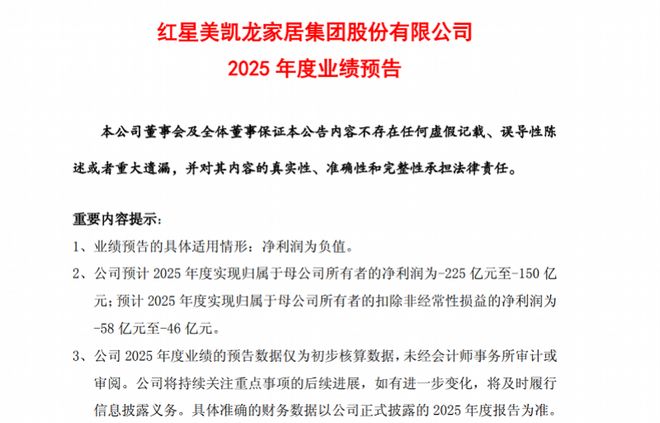
中访网数据 红星美凯龙家居集团股份有限公司(证券代码:601828)于2026年1月24日发布2025年度业 绩预告。预告显示,公司预计2025年度归属于母公司所有者的净利润将出现大幅亏损,区间为-225亿元 至-150亿元;扣除非经常性损益后的净利润预计为-58亿元至-46亿元。业绩预亏主要源于非现金性损 失。受地产及家居行业需求持续下滑影响,公司为稳商留商采取了租金优惠等措施,导致租金收入下 降,并因此调整了未来租金预期。基于此,公司对持有的投资性房地产公允价值进行了重估,预计将产 生126亿元至215亿元的价值下调。同时,公司对与房地产市场关联紧密的各类资产进行了减值测试,初 步预计计提减值准备约45亿元至57亿元。公司强调,上述公允价值变动及减值不影响其物业创造现金流 的能力和经营基本面,并表示已升级战略定位为"家居生活新商业运营商与家居产业生态服务商",旨在 聚焦主业升级并拓展产业生态服务。本次业绩预告数据仅为初步测算结果,具体财务数据以公司正式披 露的2025年年度报告为准。 ...