
美妆

Search documents
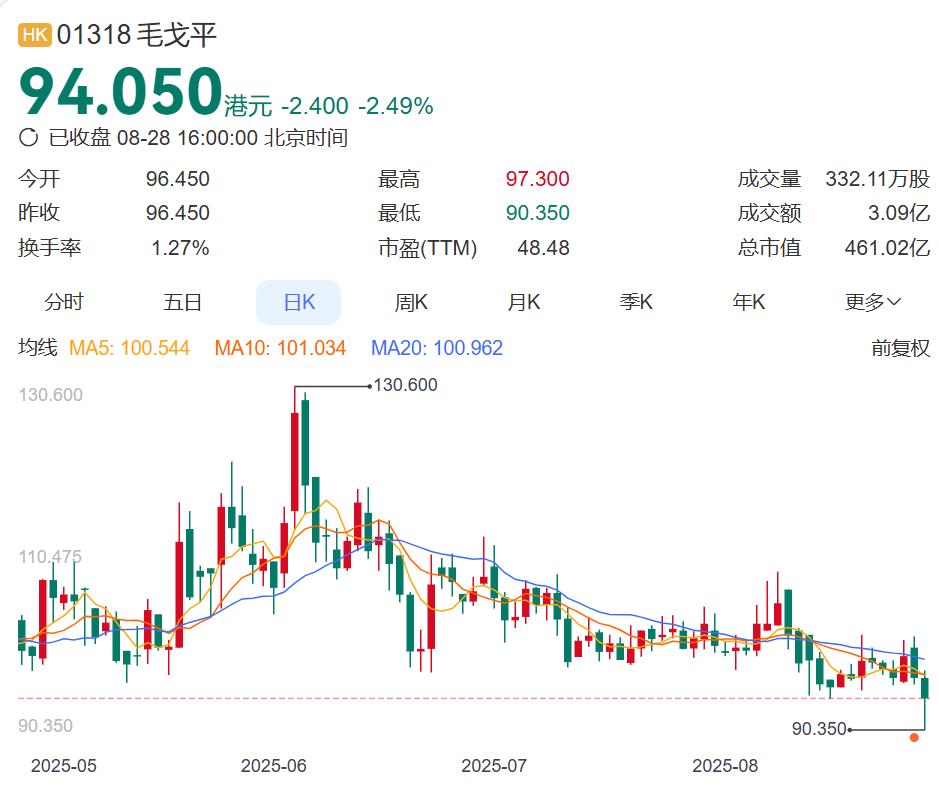
毛戈平(1318.HK):业绩如期靓丽增长 高端美妆定位不断强化
Ge Long Hui· 2025-08-29 03:02
Core Viewpoint - The company reported strong financial performance for the first half of 2025, with significant revenue and profit growth driven by effective cost management and operational efficiency [1][5]. Financial Performance - The company achieved a revenue of 2.59 billion yuan in H1 2025, representing a year-on-year increase of 31.3%, and a net profit attributable to shareholders of 670 million yuan, up 36.1% year-on-year [1]. - The net profit margin for H1 2025 was 25.9%, an increase of 0.9 percentage points compared to the previous year, attributed to ideal revenue growth and effective cost control [1]. Product and Channel Performance - Major product categories showed robust growth, with color cosmetics, skincare, and makeup training contributing 55%, 42%, and 2.6% to total revenue, respectively. The newly launched fragrance category accounted for 0.4% of total revenue [1]. - Online and offline channel revenues grew by 39% and 26.6%, respectively, with online direct sales and sales to online distributors making up 40.6% and 10.8% of total revenue [2]. Cost and Efficiency Metrics - The gross margin for H1 2025 was 84.2%, a slight decrease of 0.7 percentage points year-on-year. The gross margins for color cosmetics, skincare, fragrance, and makeup training were 82.7%, 87.5%, 77.6%, and 62.9%, respectively [3]. - The operating expense ratio decreased by 3.9 percentage points to 50.5%, with sales, management, and financial expense ratios showing respective declines [3]. Inventory and Cash Flow - Inventory increased by 23.9% year-on-year to 390 million yuan, with inventory turnover days improving to 156 days, a reduction of 42 days [3]. - Operating net cash flow reached 830 million yuan, reflecting a year-on-year increase of 34.2% [3]. Brand and Market Positioning - The company continues to strengthen its high-end beauty positioning, launching new fragrance lines and enhancing its brand image through strategic store placements in premium retail locations [4]. - Membership numbers increased, with online and offline members reaching 13.4 million and 5.6 million, respectively, and the overall repurchase rate improved to 26.8% [4]. Future Outlook - The company is optimistic about maintaining its high-end beauty positioning and expects continued growth in both online and offline channels. Profit forecasts for 2025-2027 have been adjusted upward due to improved expense ratios [5].
毛戈平(01318.HK):国货高端美妆业绩高增 品牌势能强劲上扬
Ge Long Hui· 2025-08-29 03:02
Core Viewpoint - The company reported strong performance in the first half of 2025, with significant revenue and profit growth, indicating a positive outlook for the business. Group 1: Overall Performance - In H1 2025, the company achieved revenue of 2.59 billion yuan, representing a year-on-year increase of 31% [1] - Net profit for H1 2025 reached 670 million yuan, up 36% year-on-year [1] - Gross margin stood at 84.2%, slightly down by 0.7 percentage points year-on-year, while net margin improved to 25.9%, up 0.9 percentage points [1] Group 2: Segment Performance - Makeup segment revenue in H1 2025 was 1.42 billion yuan, growing by 31.1% year-on-year, driven by strong sales of key products [2] - Skincare segment revenue reached 1.09 billion yuan, with a year-on-year increase of 33.4%, supported by high-performing products [2] - Fragrance segment generated revenue of 11.41 million yuan, showing strong performance from the "Wen Dao Dong Fang" series [2] - Makeup training revenue declined by 5.9% year-on-year to 67.31 million yuan [2] Group 3: Channel Performance - Offline revenue in H1 2025 was 1.224 billion yuan, up 26.6% year-on-year, with a total of 437 stores [3] - Online revenue reached 1.297 billion yuan, growing by 39% year-on-year, accounting for 51.4% of total revenue [3] - The company has 19 million members, a 53% increase year-on-year, with a repurchase rate of 26.8% [3] Group 4: Growth Drivers - The company is focusing on product innovation and international expansion, with new skincare and makeup lines launched in mid-2025 [3] - Plans for a research and development center in Hangzhou by the end of 2026 aim to support product diversification and market penetration [3] - The company is prioritizing entry into European and Asia-Pacific markets with localized teams and high-end channels [3] Group 5: Brand Positioning - The company is positioned as a leading domestic beauty brand, focusing on the mid-to-high-end makeup segment [4] - Strong brand premium and unique positioning in Oriental aesthetics contribute to long-term growth potential [4] - Profit forecasts for 2025-2027 are 1.184 billion, 1.542 billion, and 1.953 billion yuan, with corresponding PE ratios of 37, 29, and 23 [4]
均价超300元的香水卖出上千万元,知名国货品牌股价却跌了,两个月市值缩水超百亿元,境外产品销售收入大增500%
3 6 Ke· 2025-08-29 01:44
Core Viewpoint - The company, Mao Geping, reported a strong revenue growth of 31.3% year-on-year for the first half of 2025, but the growth rate has slowed compared to over 40% in the same period of 2024 [1][4]. Financial Performance - Revenue for the first half of 2025 reached 2.588 billion yuan, with a net profit of 670 million yuan, reflecting a year-on-year increase of 36.1% [1]. - The overall gross margin was 84.2%, showing a slight decline compared to the same period last year [1]. - Product sales remained the core driver of performance, generating 2.521 billion yuan in revenue, a 32.7% increase year-on-year, accounting for 97.4% of total revenue [4]. Market Expansion - The company has entered the fragrance market, launching two high-end perfume series, which achieved sales of 35,000 units in just over a month, contributing 11.41 million yuan to total sales [6]. - International sales saw a significant increase of 503.1% year-on-year, although they still represent a small portion of total revenue at only 0.05% [4]. Sales Channels - Online and offline sales were relatively balanced, with cosmetic sales of 1.224 billion yuan online and 1.297 billion yuan offline, reflecting year-on-year growth of 26.6% and 39.0%, respectively [5]. - The company has established over 405 self-operated counters and 32 distributor counters across more than 120 cities in China [5]. Industry Context - The overall growth of the Chinese beauty market is slowing, with high-end and differentiated products becoming the focus of competition [7]. - The fragrance market is seen as a key growth area, with a projected compound annual growth rate of 15% from 2018 to 2023, indicating significant potential for expansion [6][7]. - The company aims to develop a second growth curve through its fragrance and international market strategies, which are crucial for its future development [8].

申万宏源证券晨会报告-20250829
Shenwan Hongyuan Securities· 2025-08-29 00:44
Group 1: Snow Peak Technology (603227) - The company is positioned as a leader in the civil explosives and chemical industry in Xinjiang, with a dual business layout of "civil explosives + chemicals" [10][12] - Revenue forecasts for 2025-2027 are projected at 6.582 billion, 7.665 billion, and 8.613 billion yuan, with corresponding net profits of 545 million, 820 million, and 1.035 billion yuan, indicating growth rates of -19%, 51%, and 26% respectively [12] - The company benefits from a significant regional advantage in Xinjiang, where the scarcity of ammonium nitrate is highlighted, and the entry of Guangdong Hongda is expected to facilitate the scale-up of explosives production [12] Group 2: Meituan (03690) - The company maintains a "buy" rating despite a decrease in profits due to increased competition in the food delivery and instant retail sectors, with adjusted net profits for 2025-2027 revised to -4.5 billion, 38.5 billion, and 57.6 billion yuan [11][15] - The core local business revenue grew by 7.7% year-on-year to 65.3 billion yuan, but operating profit fell by 75.6% to 3.7 billion yuan, indicating significant pressure on profit margins [13][15] - The company is actively expanding its logistics network and enhancing service quality, with a peak daily order volume exceeding 150 million in July [13][15] Group 3: Banking Sector Insights - Industrial Bank (601166) reported a revenue of 110.5 billion yuan in 1H25, a decrease of 2.3%, but net profit increased by 0.2% to 43.1 billion yuan, indicating a recovery in profitability [17][19] - CITIC Bank (601998) achieved a revenue of 105.8 billion yuan in 1H25, down 3%, while net profit rose by 2.8% to 36.5 billion yuan, reflecting stable asset quality [21][23] - Su Nong Bank (603323) reported a slight revenue increase of 0.2% to 2.28 billion yuan in 1H25, with net profit growing by 5.2% to 1.18 billion yuan, showcasing a robust fundamental performance [25][26]



上美股份中期股东应占溢利同比增加30.65%
Zheng Quan Shi Bao Wang· 2025-08-29 00:34
其中,韩束品牌对集团收入的贡献为33.44亿元人民币,较2024年上半年(29.27亿元人民币)增长14.3%。 这主要归因于韩束品牌的整体升级、品类扩充以及各渠道的持续增长。 上美股份公布截至2025年6月30日止六个月的中期业绩。报告期内,公司实现收入41.08亿元人民币,同 比增长17.29%;股东应占溢利为5.24亿元人民币,同比增长30.65%;每股基本盈利为1.32元人民币。公 司拟派发中期股息每股0.5元人民币。 在2025年上半年,韩束在线上渠道保持美妆行业的领先地位,尤其在抖音平台,其总成交额(GMV)月均 排名美妆品牌第一,并荣获"抖音电商护肤品牌总榜H1"第一名。 ...
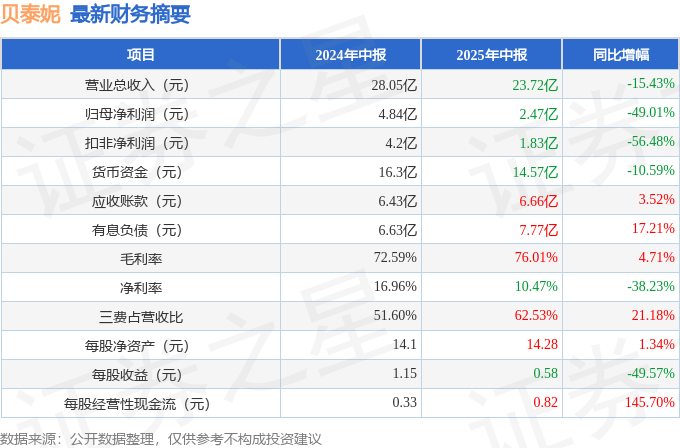
贝泰妮2025年中报简析:净利润同比下降49.01%,公司应收账款体量较大
Zheng Quan Zhi Xing· 2025-08-28 23:06
Core Viewpoint - Betaini (300957) reported a decline in revenue and net profit for the first half of 2025, indicating potential challenges in its financial performance and operational efficiency [1][2]. Financial Performance - Total revenue for the first half of 2025 was 2.372 billion yuan, a year-on-year decrease of 15.43% [1]. - Net profit attributable to shareholders was 247 million yuan, down 49.01% year-on-year [1]. - In Q2 2025, revenue was 1.423 billion yuan, a decline of 16.67% compared to the same quarter last year [1]. - Q2 net profit attributable to shareholders was 218 million yuan, a decrease of 28.87% year-on-year [1]. - Gross margin was 76.01%, an increase of 4.71% year-on-year, while net margin was 10.47%, down 38.23% [1]. - Total selling, administrative, and financial expenses amounted to 1.483 billion yuan, representing 62.53% of revenue, an increase of 21.18% year-on-year [1]. - Earnings per share were 0.58 yuan, a decrease of 49.57% year-on-year [1]. Accounts Receivable - The company has a significant accounts receivable issue, with accounts receivable amounting to 132.3% of the latest annual net profit [1][2]. Return on Investment - The company's return on invested capital (ROIC) for the previous year was 7.43%, indicating average capital returns [2]. - Historical median ROIC since the company went public is 41.16%, suggesting better investment returns in the past [2]. Business Model - The company's performance is primarily driven by marketing efforts, necessitating a deeper analysis of the underlying factors [2]. Fund Holdings - Major funds holding Betaini include CITIC Jiantou Value Growth A, Guofu China Income Mixed A, and others, indicating interest from institutional investors [3]. Brand Positioning - The Aikeman brand is positioned as a mid-to-high-end domestic product, initially benchmarking against international beauty brands, with strengths in R&D and supply chain management [4].
从单打独斗到集体出海,新消费品牌掀起一场"中国潮流"风暴
Sou Hu Cai Jing· 2025-08-28 18:07
Core Insights - A new wave of Chinese brands is rapidly expanding in Southeast Asia, driven by a collective approach to market entry, contrasting with the previous individualistic strategies [3][4][9] - The success of brands like KKV and Mixue Ice City highlights the effectiveness of this "group army" strategy, allowing for shared resources and reduced entry barriers [4][10][16] Group 1: Market Dynamics - Southeast Asia is experiencing a "new consumption boom," with Chinese brands redefining market rules through collective efforts [3][4] - The region's young population, with a median age below 30, presents significant consumer potential, as these individuals are more open to new brands and products [21][23] - Cultural similarities, particularly in areas with large Chinese communities, lower the adaptation costs for Chinese brands entering these markets [23][24] Group 2: Brand Success Stories - Mixue Ice City has opened nearly 5,000 stores in Southeast Asia within two years, showcasing a rapid expansion strategy that resonates with local consumers [4][6] - Bubble Mart's LABUBU character has gained popularity in Thailand, indicating a shift in local consumer habits towards Chinese trendy products [6][8] - Brands like KKV are facilitating the entry of over 100 Chinese brands into Southeast Asia, significantly increasing their market presence and sales [9][10] Group 3: Innovative Business Models - KKV's model includes zero entry fees and comprehensive support for product certification and logistics, making it easier for brands to enter the market [10][16] - The establishment of a unified certification service and shared marketing strategies among brands enhances operational efficiency and reduces costs [16][17] - Data-driven decision-making through KKV's retail management system allows brands to quickly adapt to consumer preferences and optimize their offerings [17] Group 4: Strategic Advantages - The RCEP agreement has facilitated trade by reducing tariffs and improving logistics, further benefiting Chinese brands in Southeast Asia [25][26] - The ongoing infrastructure development in Southeast Asia provides ample opportunities for retail brands to establish a strong presence [27] - The rise of social media and e-commerce platforms has created new marketing channels, allowing brands to engage with consumers effectively [27][28] Group 5: Future Outlook - The success of Chinese brands in Southeast Asia is seen as a stepping stone for global expansion, with plans to replicate successful models in other regions [28][36] - The anticipated growth of KKV and its associated brands could lead to a significant increase in their international market share by 2027-2028 [32] - The overall trend indicates a shift from "Made in China" to "Created in China," emphasizing cultural influence alongside commercial success [36]

上美股份发布中期业绩:净利润同比增长34.7%,主力品牌韩束实现稳健增长
Ge Long Hui A P P· 2025-08-28 15:48
Core Insights - The company reported a revenue of 4.108 billion yuan for the first half of 2025, representing a year-on-year growth of 17.3% [1] - Net profit reached 556 million yuan, showing a year-on-year increase of 34.7% [1] - Gross profit was 3.102 billion yuan, with a year-on-year growth of 15.8% and a gross margin increase of 1.7 percentage points to 75.5% [1] Revenue Breakdown - The main brand, Han Shu, achieved a revenue of 3.344 billion yuan, reflecting a year-on-year growth of 14.3% [1] - Han Shu ranked first in GMV among beauty brands on Douyin, and also topped the overall skincare brand list on Douyin for the first half of the year [1] - The super product, Han Shu Red Waist, sold over 15 million units across all channels [1] - The second growth curve, Newpage, experienced exponential growth with a revenue of 397 million yuan, marking a year-on-year increase of 146.5% [1] R&D Investment - The company invested over 103 million yuan in R&D during the first half of the year, which is a year-on-year increase of 31.7% [1] - The company holds nearly 200 patent achievements and has published in over 40 global core journals [1] - The company is enhancing its global technological influence in the beauty industry through a "research-industry-regulation" integrated ecological layout [1]
上美股份(02145)发布中期业绩 股东应占溢利5.24亿元 同比增加30.65%
智通财经网· 2025-08-28 15:41
Core Viewpoint - The company reported a significant increase in revenue and profit for the first half of 2025, driven by brand upgrades and channel growth [1] Financial Performance - The company achieved a revenue of 4.108 billion RMB for the six months ending June 30, 2025, representing a year-on-year increase of 17.29% [1] - Shareholder profit attributable to the company was 524 million RMB, reflecting a year-on-year increase of 30.65% [1] - Basic earnings per share were reported at 1.32 RMB, with an interim dividend proposed at 0.5 RMB per share [1] Brand Performance - The brand "韩束" contributed 3.344 billion RMB to the group's revenue in the first half of 2025, up 14.3% from 2.927 billion RMB in the first half of 2024 [1] - The revenue growth was attributed to overall brand upgrades and the expansion of product categories, along with sustained growth across various channels [1] - 韩束 maintained its leading position in the online beauty industry, ranking first in total transaction value (GMV) among beauty brands on the Douyin platform each month [1] - 韩束 achieved the top position in the "Douyin E-commerce Skincare Brand Overall Ranking H1" [1]
上美股份发布中期业绩 股东应占溢利5.24亿元 同比增加30.65%
Zhi Tong Cai Jing· 2025-08-28 15:41
上美股份(02145)发布截至2025年6月30日止六个月中期业绩,收入41.08亿元(人民币,下同),同比增加 17.29%;股东应占溢利5.24亿元,同比增加30.65%;每股基本盈利1.32元;拟派发中期股息每股0.5元。 公告称,2025年上半年,韩束应占集团的收入为33.44亿元,相比2024年上半年的29.27亿元增加 14.3%,主要是由于韩束品牌的整体升级和扩充品类带来的收入增长,及各渠道收入持续增长。 2025年上半年,韩束继续保持线上渠道美妆行业的领先地位。2025年上半年,韩束在抖音平台总成交额 (GMV)每月均位居美妆品牌第一,并取得"抖音电商护肤品牌总榜H1"第一的亮眼成绩。 ...