
银行

Search documents
国泰海通|2026年政府工作报告行业联合解读
国泰海通证券研究· 2026-03-06 12:27
Group 1: Consumer and Service Sector - The 2026 government work report emphasizes the importance of expanding domestic demand and boosting consumption as a strategic core, with policies characterized by stability, strong tools, efficiency, and structural optimization [6][7] - The report introduces a new 100 billion yuan fiscal and financial collaborative fund to promote domestic demand, alongside 250 billion yuan in special bonds to support consumption upgrades [6][7] - Key investment themes include service sector recovery, consumer spending driven by income growth, new consumption scenarios, and emotional consumption as consumer expectations improve [8][6] Group 2: Real Estate Market - The government work report focuses on stabilizing the real estate market, emphasizing the need to improve and guarantee livelihoods while balancing short-term market stability and long-term institutional construction [13][15] - Demand-side policies will continue to be city-specific, with a focus on optimizing housing policies for first-time homebuyers and families with multiple children [14][15] - The report highlights the need to control new land supply and promote the disposal of existing inventory to improve market supply-demand relationships [15][13] Group 3: Technology and Innovation - The report stresses the acceleration of high-level technological self-reliance, promoting the commercialization and large-scale application of artificial intelligence [26][27] - New emerging industries such as integrated circuits, aerospace, and future energy are highlighted as key areas for development, with a focus on fostering innovation and original achievements [27][26] - The government aims to support technology-driven enterprises through regularized financing and mergers and acquisitions green channels [26][27] Group 4: Environmental and Energy Transition - The report outlines a comprehensive green transition strategy, aiming for a 3.8% reduction in carbon emissions per unit of GDP, indicating a shift towards collaborative governance and green growth models [32][33] - Emphasis is placed on ecological environment governance, including air quality improvement, water body treatment, and solid waste management [33][34] - The establishment of a national low-carbon transition fund is proposed to support the development of hydrogen energy and green fuels, benefiting leading companies in these sectors [34][35] Group 5: Banking Sector - The report indicates a continuation of moderately loose monetary policy, with expectations for 1-2 rate cuts within the year to align with economic growth targets [40][41] - A new issuance of 800 billion yuan in policy financial instruments is planned to stimulate investment, alongside 4.4 trillion yuan in local government bonds to support major projects [41][40] - The report highlights the importance of risk prevention in key areas such as real estate and local government debt, with measures to mitigate potential defaults [42][41] Group 6: Machinery and Equipment - The government work report emphasizes the cultivation of new momentum in strategic emerging industries, focusing on advanced manufacturing and the integration of modern service industries [45][47] - Key sectors include semiconductor equipment and humanoid robotics, with a focus on domestic production capabilities and technological advancements [48][49] - The report encourages the development of low-altitude economy infrastructure and applications, with a growing demand for related technologies and services [49][48]


东兴证券晨报-20260306
Dongxing Securities· 2026-03-06 11:28
Group 1 - The government work report emphasizes the importance of stabilizing domestic demand and prioritizing consumption enhancement initiatives [6][12][13] - The GDP growth target for 2026 is set at 4.5%-5%, aligning with the long-term goal of doubling per capita GDP by 2035 [6][20] - Fiscal policy remains proactive, with a deficit rate planned at around 4% and a total deficit scale of 5.89 trillion yuan, an increase of 230 billion yuan from the previous year [7][20][21] Group 2 - The report highlights the introduction of new industries such as "smart economy," focusing on large-scale computing clusters and satellite internet [2][6] - The government plans to issue special bonds totaling 3 trillion yuan to support the capital replenishment of state-owned commercial banks [6][20] - The report indicates a commitment to stabilizing the real estate market and preventing debt default risks through various measures [9][22] Group 3 - The report outlines a dual approach to investment, emphasizing both consumption and infrastructure projects, with significant funding allocated for new infrastructure and equipment updates [12][13][20] - The focus on "new quality productivity" aims to integrate high-end manufacturing with emerging industries such as electric vehicles and robotics, with a planned investment of 200 billion yuan over the next five years [5][14] - The report anticipates a continued emphasis on structural monetary policy tools to support economic stability and growth, with expectations of 1-2 interest rate cuts throughout the year [8][21] Group 4 - The report indicates a strong focus on technological innovation and support for key sectors, including semiconductor and biotechnology, to drive economic transformation [14][16] - The investment strategy suggests a structural bull market, with opportunities in technology growth, domestic consumption recovery, and high-end manufacturing upgrades [15][16] - The report emphasizes the importance of policy coherence and collaboration between macroeconomic policies and reforms to enhance overall policy effectiveness [12][21]





恒生科技见底了吗?| 谈股论金
水皮More· 2026-03-06 11:09
Market Overview - The A-share market saw a collective slight increase today, with the Shanghai Composite Index rising by 0.38% to close at 4124.19 points, the Shenzhen Component Index increasing by 0.59% to 14172.63 points, and the ChiNext Index up by 0.38% to 3229.30 points. The total trading volume in the Shanghai and Shenzhen markets was 2.22 trillion, a decrease of 193.4 billion compared to the previous day [3]. Hong Kong Market Dynamics - The Hong Kong stock market experienced a significant decline yesterday, with a record outflow of 27.7 billion from the Stock Connect, which is closely related to the large-scale withdrawal of funds. This outflow exceeded market expectations and was primarily driven by three major funds: the Tracker Fund of Hong Kong, the China Enterprise Index Fund, and the Southern Hang Seng Technology Fund, along with Alibaba, totaling approximately 24 billion [5]. - The market typically sees important bottoms formed when funds sell stocks, while tops are formed when funds buy stocks. The recent large outflow from the Stock Connect suggests that a potential market bottom may be near [5]. Technology Sector Recovery - Today, the market rebounded significantly, with the Hang Seng Index rising by 1.72% and the Hang Seng Technology Index increasing by approximately 3.15%. This rebound was largely driven by JD.com, which saw its stock price surge by 9.95% following the release of its annual report, indicating a positive growth outlook [6]. - Other major tech stocks also experienced gains, with Alibaba rising by 3.48%, Meituan showing strong performance, Xiaomi increasing by nearly 4%, Tencent rising over 3%, and Baidu reaching close to a 3% increase, indicating a comprehensive rebound in the Chinese internet sector [6]. A-share Market Support - The positive performance of the Hang Seng Index and the Hang Seng Technology Index provided strong support for the A-share market. The Shanghai Composite Index rose by 0.38%, and the Shenzhen Component Index increased by approximately 0.58%, with a broad-based increase in individual stocks, as 4114 stocks rose while only about a thousand declined [7]. - The median increase in the market today was around 1.5%, significantly higher than the increases in major indices, reflecting that large-cap stocks played a role in suppressing the market. Notably, the "three barrels of oil" and certain tech stocks experienced larger declines [7].


——2026年政府工作报告精神学习之联合报告:\开局之年\行稳致远,孕育资本市场新机遇
EBSCN· 2026-03-06 11:08
Macroeconomic Overview - The 2026 economic growth target is set at 4.5%-5%, indicating a pragmatic approach to economic recovery amidst complex external and internal challenges[12] - The government aims to stabilize prices, with a focus on reversing negative price trends and promoting moderate consumer price recovery[12] - A fiscal expansion of 230 billion yuan is planned, with an emphasis on investment and consumption support[13] Banking Sector - The banking sector is expected to maintain a certain level of balance sheet expansion, with a projected revenue growth of approximately 2% for listed banks in 2026[47] - Credit growth is estimated at 16.5 trillion yuan, with a year-end growth rate around 6.1%[34] - The total social financing (TSF) is projected to increase by 35 trillion yuan, maintaining a year-end growth rate of about 7.9%[34] Real Estate Market - The government emphasizes stabilizing the real estate market through targeted policies, including inventory reduction and supply optimization[47] - The report encourages the acquisition of existing properties for affordable housing, reflecting a shift towards quality over quantity in housing development[48] - Recent policies in major cities like Shanghai aim to stimulate the housing market, with significant changes in purchase restrictions and financing options[49] Investment and Consumption - A special bond issuance of 2.5 trillion yuan is allocated to support consumer goods replacement programs, benefiting sectors like automotive and home appliances[16] - The government plans to enhance investment in new economic drivers, focusing on emerging industries such as integrated circuits and aerospace[13] - The report highlights the importance of domestic demand and innovation as core themes for economic growth[15] Risks and Challenges - Potential risks include geopolitical tensions and the pace of domestic economic recovery, which may affect overall market performance[24] - The report identifies the need for ongoing risk management in key areas such as real estate and local government debt[41]
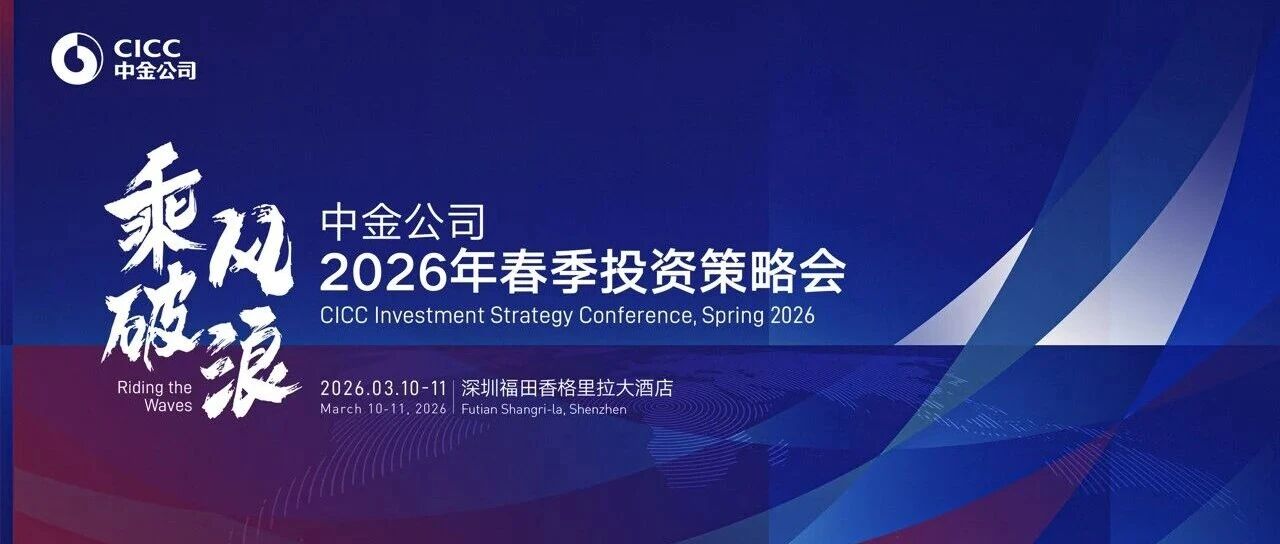
乘风破浪 | 中金公司2026年春季投资策略会
中金点睛· 2026-03-06 11:03
Core Insights - The article discusses the upcoming CICC Investment Strategy Conference scheduled for March 10-11, 2026, in Shenzhen, focusing on macroeconomic outlooks and investment opportunities across various sectors [2][3]. Group 1: Keynote Speakers and Topics - Notable speakers include Wei Lun Professor of Economics at The Chinese University of Hong Kong, the Chief Economist of CICC, and the Senior Managing Director & Chief Strategist of CICC [5][8][11]. - The conference will feature a keynote speech on the macroeconomic outlook for China and the United States, highlighting the global economic landscape [16]. Group 2: Market Outlook Sessions - Sessions will cover A-share market outlook, Hong Kong and overseas market perspectives, and major asset class forecasts [18]. - Specific discussions will address the real estate market trends, fixed income market developments, and the growth of multinational enterprises in a globalized context [19]. Group 3: Sector-Specific Discussions - The conference will include breakout sessions focusing on various sectors such as AI, telecommunications, consumer goods, and renewable energy [20][21][22]. - Topics will explore investment opportunities in the automotive industry, logistics, and the impact of AI on different sectors [21][22][31]. Group 4: Participating Companies - A range of companies from different sectors will participate, including banks, non-bank financial institutions, and technology firms [23][24][26]. - Notable participants include major banks like CITIC Bank and Minsheng Bank, as well as companies in the energy and materials sectors [23][24].
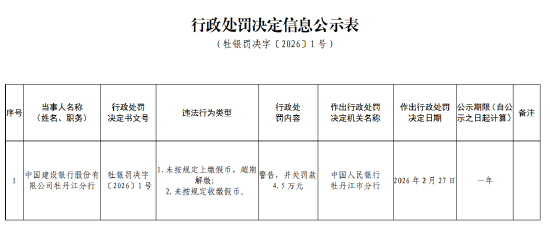
建设银行牡丹江分行被罚4.5万元:未按规定上缴假币,超期解缴,未按规定收缴假币
Xin Lang Cai Jing· 2026-03-06 10:38
Core Viewpoint - China Construction Bank's Mudanjiang branch was penalized for failing to properly handle counterfeit currency, resulting in a warning and a fine of 45,000 yuan [1][4]. Group 1 - The administrative penalty was issued by the People's Bank of China Mudanjiang branch [1][3]. - The violations included not submitting counterfeit currency as required and failing to collect counterfeit currency in accordance with regulations [1][3]. - The penalty decision was made on February 27, 2026, and the public disclosure period for the decision is one year [3].

银行行业深度报告:如何理解存贷款增速缺口的持续收敛,以及对银行债券配置力量的影响?
Orient Securities· 2026-03-06 10:24
Investment Rating - The report maintains a "Positive" outlook for the banking sector in 2026, indicating a return to fundamental narratives supported by policy financial tools and resilient asset expansion [6][35]. Core Insights - The banking sector is expected to stabilize net interest margins and recover due to the ongoing repricing cycle of deposits, with structural risks anticipated to receive policy support [3][35]. - The report highlights two main investment lines: 1. High-quality small and medium-sized banks with solid fundamentals, including Nanjing Bank, Chongqing Rural Commercial Bank, Ningbo Bank, Shanghai Bank, and Hangzhou Bank [3][36]. 2. Large state-owned banks with stable fundamentals and defensive value, including Bank of Communications and Industrial and Commercial Bank of China [3][36]. Historical Review of Loan and Deposit Growth Gap - The report constructs a loan and deposit growth gap indicator, defined as "bank deposit growth - bank loan growth," with an upward trend indicating convergence and a downward trend indicating expansion [9][12]. - Historical analysis shows: 1. From 2016 to 2018, the gap deepened due to a faster decline in deposit growth, primarily influenced by deleveraging and regulatory impacts [14][18]. 2. Between 2019 and 2020, the gap narrowed, driven by a faster decline in loan growth due to stricter real estate regulations and the pandemic [18][19]. 3. From the second half of 2021 to 2022, the gap steeply narrowed due to dual drivers from both deposits and loans, with a significant shift in household liquidity dynamics [19][21]. 4. In 2023 to Q1 2024, the gap expanded again, primarily due to a sharper decline in deposit growth influenced by early mortgage repayments and policy-driven debt restructuring [21][24]. Understanding Recent Convergence of Loan and Deposit Growth Gap - The continuous narrowing of the loan and deposit growth gap in recent years is attributed to high-interest deposit adjustments and accelerated debt restructuring, with a projected scale of 3.2 trillion yuan in 2024 [24][26]. - The report anticipates that the gap will likely stabilize marginally but is less likely to trend towards expansion, contingent on the credit supply positioning of the household sector [31][31]. Relationship Between Loan and Deposit Growth Gap and Bank Bond Allocation - The convergence of the loan and deposit growth gap suggests relative redundancy of deposits within the banking system, which should enhance banks' bond allocation capabilities [33][34]. - Statistical analysis indicates that changes in the loan and deposit growth gap serve as a leading indicator for stable bond investment growth, particularly for large state-owned banks [33][34].





渣打集团(02888)3月5日斥资1506.54万英镑回购87.24万股
Zhi Tong Cai Jing· 2026-03-06 10:09
(原标题:渣打集团(02888)3月5日斥资1506.54万英镑回购87.24万股) 智通财经APP讯,渣打集团(02888)发布公告,于2026年3月5日,该公司斥资1506.54万英镑回购87.24万 股股份,每股回购价16.895-17.585英镑。 ...
行业比较研究系列之七:交易面新思考:均线有效性视角下的三类行业
EBSCN· 2026-03-06 08:48
Group 1 - The report emphasizes that moving averages (MAs) are effective tools for investment decisions, with daily MAs being more effective than weekly and monthly MAs [1][15][20] - Historical data indicates that shorter MAs yield better investment performance, with daily MAs outperforming weekly and monthly MAs in terms of Sharpe ratios [1][20][21] - The effectiveness of MAs is influenced by the duration of market trends and the volatility of stock prices, with longer-lasting and more volatile trends enhancing the reliability of MAs [2][27][30] Group 2 - Industries can be categorized based on their suitability for different types of MAs: 1. Industries suitable for long-term MAs typically exhibit high volatility and sustained trends, primarily found in growth sectors such as electronics, computing, and pharmaceuticals [3][41][56] 2. Industries suitable for short-term MAs have moderate volatility and trend duration, including cyclical sectors like light industry and retail [3][42][97] 3. Industries unsuitable for MAs are characterized by low volatility and short trend durations, often found in value and high-dividend sectors like utilities and transportation [4][43][63] Group 3 - The report identifies specific industries that benefit from long-term MAs, including electronics, computing, media, and power equipment, which tend to have significant price fluctuations and prolonged market trends [3][41][56] - Short-term MAs are recommended for industries with moderate price volatility and trend duration, such as light manufacturing and automotive sectors, which can capture gains more effectively [3][42][97] - Industries with low price volatility and short trend durations, such as utilities and household appliances, are advised against using MAs due to the potential for misleading signals [4][43][63]
如何理解存贷款增速缺口的持续收敛,以及对银行债券配置力量的影响?
Orient Securities· 2026-03-06 08:44
Investment Rating - The report maintains a "Positive" outlook for the banking sector in 2026, indicating a return to fundamental narratives supported by policy financial tools and resilient asset expansion [6][35]. Core Insights - The banking sector is expected to stabilize net interest margins and recover due to the ongoing repricing cycle of deposits, with structural risks anticipated to receive policy support [3][35]. - The report highlights two main investment themes: 1. High-quality small and medium-sized banks with solid fundamentals, including Nanjing Bank, Chongqing Rural Commercial Bank, Ningbo Bank, Shanghai Bank, and Hangzhou Bank [3][36]. 2. State-owned large banks with stable fundamentals and defensive value, including Bank of Communications and Industrial and Commercial Bank of China [3][36]. Historical Analysis of Loan and Deposit Growth Gap - The report constructs a loan and deposit growth gap indicator, defined as "bank deposit growth - bank loan growth," with an upward trend indicating convergence and a downward trend indicating expansion [9][12]. - Historical analysis shows: 1. From 2016 to 2018, the gap deepened due to a faster decline in deposit growth, primarily influenced by deleveraging and regulatory impacts [14][18]. 2. Between 2019 and 2020, the gap narrowed, driven by a faster decline in loan growth due to stricter real estate regulations and the pandemic [18][19]. 3. From the second half of 2021 to 2022, the gap steeply narrowed due to dual drivers from both deposits and loans, with a significant shift in household liquidity dynamics [19][21]. 4. In 2023 to Q1 2024, the gap expanded again, primarily due to a sharper decline in deposit growth influenced by early mortgage repayments and policy-driven debt restructuring [21][24]. Understanding Recent Convergence of Loan and Deposit Growth Gap - The continuous narrowing of the loan and deposit growth gap in recent years is attributed to high-interest deposit adjustments and accelerated debt restructuring, with a projected scale of 3.2 trillion yuan in 2024 [24][26]. - The report anticipates that the gap will likely stabilize marginally but is less likely to trend towards expansion, contingent on the credit supply dynamics of the household sector [31][33]. Relationship Between Loan and Deposit Growth Gap and Bank Bond Allocation - The convergence of the loan and deposit growth gap suggests relative redundancy of deposits within the banking system, which should enhance banks' bond allocation capabilities [33][34]. - Statistical analysis indicates that changes in the loan and deposit growth gap serve as a leading indicator for stable bond investment growth, particularly for state-owned banks [33][34].