
交通运输

Search documents
百日千万招聘专项行动推出行业招聘专场
Ren Min Ri Bao· 2025-09-17 22:22
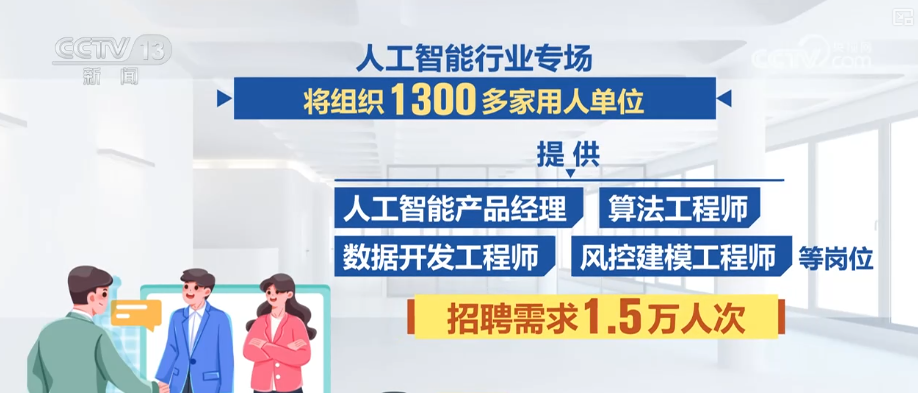
Core Viewpoint - The "Hundred Days of Millions of Recruitment" initiative is launching online recruitment events across seven sectors, with over 49,000 employers participating and a total recruitment demand exceeding 134,000 positions [1][2]. Group 1: Industry-Specific Recruitment - The artificial intelligence sector will have over 1,300 employers offering positions such as product managers, algorithm engineers, and data developers, with a recruitment demand of 15,000 positions [1]. - The education and training sector will feature over 1,000 employers looking to fill roles including teachers, course consultants, and administrative staff, with a demand of 34,000 positions [1]. - The new energy sector will involve over 600 employers seeking to hire wind power inspection engineers, operation engineers, and photovoltaic engineers, with a recruitment demand of 17,000 positions [1]. - The electrical machinery manufacturing sector will have over 1,800 employers offering roles such as electrical engineers and automation technicians, with a demand of 64,000 positions [1]. - The transportation sector will include over 150 employers looking for infrastructure managers and logistics administrators, with a recruitment demand of over 1,700 positions [1]. Group 2: Large Enterprises and Social Organizations - The large and medium-sized enterprises sector will feature over 70 employers offering positions such as R&D engineers and financial managers, with a recruitment demand of over 3,000 positions [2]. - The social organizations sector will involve over 40 employers seeking to fill roles including legal specialists and financial officers, with a recruitment demand of over 200 positions [2]. Group 3: Recruitment Platforms - Employers and job seekers can participate in the recruitment events through platforms such as the China Public Recruitment Network and the National Talent Network [2].
人工智能、教育培训、新能源…… 百日千万招聘专项行动推出行业招聘专场
Ren Min Ri Bao· 2025-09-17 21:53
Group 1 - The "Hundred Days of Millions of Recruitment" initiative launched online recruitment events for seven sectors, including artificial intelligence, education and training, new energy, electrical machinery manufacturing, transportation, large and medium-sized enterprises, and social organizations, with over 4,900 participating employers and a recruitment demand exceeding 134,000 positions [1][2] - The artificial intelligence sector will have over 1,300 employers offering positions such as product managers, algorithm engineers, data development engineers, and risk modeling engineers, with a recruitment demand of 15,000 positions [1] - The education and training sector will feature over 1,000 employers providing roles like teachers, university counselors, course consultants, and academic affairs specialists, with a recruitment demand of 34,000 positions [1] - The new energy sector will involve over 600 employers offering positions such as wind power inspection engineers, operation and maintenance engineers, photovoltaic engineers, and equipment engineering technicians, with a recruitment demand of 17,000 positions [1] - The electrical machinery manufacturing sector will have over 1,800 employers providing roles like electrical engineers, mechanical engineers, process engineers, equipment engineers, and automation technicians, with a recruitment demand of 64,000 positions [1] - The transportation sector will feature over 150 employers offering positions such as infrastructure managers, logistics operation managers, supply chain managers, and safety managers, with a recruitment demand of over 1,700 positions [1] Group 2 - The large and medium-sized enterprises sector will involve over 70 employers providing roles such as research and development engineers, financial managers, research assistants, administrative specialists, and supply chain specialists, with a recruitment demand of over 3,000 positions [2] - The social organizations sector will feature over 40 employers offering positions like legal specialists, academic specialists, financial specialists, and new media operators, with a recruitment demand of over 200 positions [2] - Employers and job seekers can participate in the recruitment events through platforms such as the China Public Recruitment Network, the National Talent Network, and the "Employment Online" initiative main event page [2]
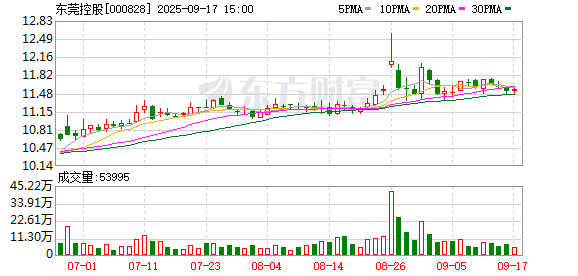
东莞控股:2025年半年度权益分派实施公告
Zheng Quan Ri Bao· 2025-09-17 14:09
(文章来源:证券日报) 证券日报网讯 9月17日晚间,东莞控股发布公告称,本公司2025年半年度权益分派方案为:以公司总股 本为基数,向全体股东每10股派1.500000元(含税),股权登记日为2025年9月23日,除权除息日为 2025年9月24日。 ...


延续上涨,北交所代码切换有望提高整体关注度
Western Securities· 2025-09-17 13:02
Investment Rating - The report indicates a positive outlook for the industry, with the North Exchange 50 Index closing up 0.63% at 1617.13 points, reflecting a strong market activity level [4][8]. Core Insights - The North Exchange market continues to rise, with a trading volume of 25.9 billion yuan on September 16, 2025, despite a slight decrease from the previous trading day [4][8]. - The automotive parts sector is leading the market, showing significant capital accumulation effects, as funds shift from high-position themes to industries with strong performance certainty, such as the automotive supply chain and high-end manufacturing [4]. - The upcoming "920" code switching policy on October 9 is expected to enhance market standardization and improve long-term liquidity [4]. - The report highlights a structural differentiation in the market, with 122 stocks rising and 148 falling among the 275 companies listed on the North Exchange [4][18]. Summary by Sections Market Review - On September 16, the North Exchange A-shares trading volume reached 25.9 billion yuan, a decrease of 0.11 billion yuan from the previous day, with the North Exchange 50 Index closing at 1617.13, up 0.63% [8][4]. - The North Exchange specialized index closed at 2809.54, increasing by 1.57% [8]. Stock Performance - Among the 275 companies, 122 stocks increased, 5 remained flat, and 148 declined. The top five gainers were: - Kaiter Co., Ltd. (14.8%) - Huaguang Source Sea (14.3%) - Bond Co., Ltd. (12.5%) - Huayuan Co., Ltd. (11.9%) - Meizhigao (10.7%) - The top five decliners were: - Chicheng Co., Ltd. (-7.8%) - Hongyu Packaging (-5.4%) - Guoyi Bidding (-4.7%) - Gaisi Food (-4.5%) - Kexin New Materials (-4.5%) [18][20]. Important News - The Ministry of Commerce and nine other departments issued policies to expand service consumption, proposing 19 measures to stimulate economic growth [2]. - Tencent Cloud announced full adaptation to mainstream domestic chips, with its international customer base doubling within a year [2][22]. Key Company Announcements - Tongxin Transmission plans to increase the registered capital of its subsidiary by 2 million yuan, with the company contributing 1.02 million yuan [3]. - Yeguangming announced the use of 4.3 million yuan of its own funds to purchase fixed-income financial products from Taizhou Bank, with an expected annual yield of 3.61% [3][24].
专访张人禾:1.5℃温控下,气候变化重塑行业格局|首席气候官
2 1 Shi Ji Jing Ji Bao Dao· 2025-09-17 11:15
Core Insights - Extreme weather is becoming a new economic variable, with 2024 projected to be the first year to exceed the 1.5℃ target set by the Paris Agreement [1][6] - Human activities are directly linked to the significant rise in carbon dioxide concentrations and climate warming over the past century [4][5] - The energy sector is the most affected by climate change, with fossil fuel combustion accounting for over 80% of total carbon emissions [8][9] Group 1: Climate Change and Economic Impact - The global average temperature is expected to reach new highs, with 2025 potentially seeing further increases [1] - The urgency for enhanced emission reduction measures is emphasized to meet temperature control and carbon neutrality goals [6] - Climate change is influencing various industries, particularly energy, transportation, retail, and manufacturing [8][9] Group 2: Industry-Specific Impacts - The energy sector is transitioning towards clean energy as a response to climate change [8] - The transportation industry is also under pressure due to its reliance on fossil fuels, necessitating urgent transformation [9] - Retail and manufacturing sectors are adapting to changing demands driven by extreme weather, such as increased air conditioning needs during heatwaves [9] Group 3: Technological Developments - Monitoring technologies are crucial for accurately assessing carbon levels in the atmosphere and oceans [10] - Forecasting technologies need to improve to predict not only weather but also carbon changes and extreme weather events [10] - Enhanced forecasting is vital for the clean energy sector, impacting solar and wind energy utilization [10]

【盘中播报】沪指涨0.37% 电力设备行业涨幅最大
Zheng Quan Shi Bao Wang· 2025-09-17 06:52
Market Overview - The Shanghai Composite Index increased by 0.37% with a trading volume of 1,231.67 million shares and a transaction amount of 19,435.79 billion yuan, representing a 3.06% increase compared to the previous trading day [1] Industry Performance - The top-performing industries included: - **Electric Power Equipment**: Increased by 2.52% with a transaction amount of 2,240.46 billion yuan, up 5.24% from the previous day, led by Zhejiang Hengwei with a rise of 19.99% [1] - **Automobile**: Increased by 1.90% with a transaction amount of 1,277.96 billion yuan, up 0.71%, led by Haon Automotive with a rise of 14.21% [1] - **Coal**: Increased by 1.79% with a transaction amount of 126.73 billion yuan, up 21.96%, led by Lu'an Environmental Energy with a rise of 7.13% [1] - The worst-performing industries included: - **Petroleum and Petrochemicals**: Decreased by 1.12% with a transaction amount of 83.90 billion yuan, up 5.09%, led by *ST Xinchao with a decline of 2.58% [2] - **Retail Trade**: Decreased by 0.85% with a transaction amount of 313.00 billion yuan, up 0.92%, led by Sanjiang Shopping with a decline of 6.63% [2] - **Agriculture, Forestry, Animal Husbandry, and Fishery**: Decreased by 0.81% with a transaction amount of 172.79 billion yuan, down 15.67%, led by Bangji Technology with a decline of 7.64% [2]
@求职者,“职”等你来!招聘需求超13.4万人次 岗位清单请查收↓
Yang Shi Wang· 2025-09-17 04:59
Core Insights - The "Hundred Days of Millions of Recruitment" initiative has launched seven online recruitment events from September 15 to September 20, with over 4,900 employers participating and a recruitment demand exceeding 134,000 positions [1] Industry Summaries - **Education and Training Sector**: Over 1,000 employers will participate, offering positions such as teachers, university counselors, course consultants, and academic administrators, with a recruitment demand of 34,000 positions [3] - **Artificial Intelligence Sector**: More than 1,300 employers will provide roles including AI product managers, algorithm engineers, data development engineers, and risk control modeling engineers, with a recruitment demand of 15,000 positions [4] - **New Energy Sector**: Approximately 600 employers will offer positions such as wind power inspection engineers, operation and maintenance engineers, and photovoltaic engineers, with a recruitment demand of 17,000 positions [6] - **Electrical and Mechanical Manufacturing Sector**: Over 1,800 employers will provide roles including electrical engineers, mechanical engineers, and process engineers, with a recruitment demand of 64,000 positions [8] - **Transportation Sector**: Around 150 employers will offer positions such as infrastructure managers, logistics operation managers, supply chain managers, and safety managers, with a recruitment demand of over 1,700 positions [10] - **Large and Medium Enterprises Sector**: More than 70 employers will provide roles including research and development engineers, financial managers, research assistants, and administrative specialists, with a recruitment demand of over 3,000 positions [12] - **Social Organizations Sector**: Approximately 40 employers will offer positions such as legal specialists, academic specialists, financial specialists, and new media operators, with a recruitment demand of over 200 positions [14] Participation Channels - Employers and job seekers can participate through platforms such as China Public Recruitment Network, China National Talent Network, and Employment Online [16]
上市方式持续创新 “A+H”扩容潮起
Zhong Guo Zheng Quan Bao· 2025-09-16 20:20
潮宏基9月12日向香港联交所递交了发行境外上市股份(H股)并在香港联交所主板挂牌上市的申请; 千里科技9月12日召开董事会审议通过《关于公司申请首次公开发行境外上市股份(H股)并在香港联 合交易所有限公司主板上市的议案》等相关议案;海澜之家9月8日召开董事会会议,审议通过了《关于 授权公司管理层启动公司境外发行股份(H股)并在香港联合交易所有限公司上市相关筹备工作的议 案》…… 安永北京主管合伙人杨淑娟认为,"A+H"模式有助于推动港股市场机制持续优化,提升其国际吸引力, 而A股上市公司通过"A+H"的双平台能够不断强化国际化布局,开辟新增长曲线。 ● 本报记者 昝秀丽 Wind数据显示,截至9月16日,今年以来已有11家A股公司在港股上市。 业内人士分析,与此前不同,本轮"A+H"扩容潮,涉及硬科技、新消费、生物医药等多个新兴领域,国 际长线资金参与度提升,基石投资者阵容强大。上市方式持续创新,除传统递表方式外,换股吸收合 并、私有化等创新方案接连出现,为企业拓展融资渠道和优化资源配置提供了新路径。 市场人士预期,未来监管部门有望继续加大对企业境外上市的支持力度,更多具备国际竞争力的中国企 业有望通过"A+ ...
美股异动 | 百度(BIDU.US)涨逾3% 与招商局签署战略合作协议
Zhi Tong Cai Jing· 2025-09-16 14:29
Core Viewpoint - Baidu (BIDU.US) shares rose over 3% to $118.54 following the announcement of a strategic cooperation agreement with China Merchants Group, focusing on advanced AI technologies and various industries [1] Group 1: Strategic Cooperation - On September 15, China Merchants Group and Baidu signed a strategic cooperation framework agreement in Shenzhen [1] - The collaboration will focus on cutting-edge AI technologies such as large models and cloud computing, targeting sectors like sci-tech industry, transportation logistics, comprehensive finance, and real estate [1] - The agreement signifies a new phase in the partnership between the century-old state-owned enterprise and the globally leading AI company, aiming for resource sharing and mutual development [1] Group 2: Industry Impact - The strong alliance between Baidu and China Merchants Group is expected to promote the deep integration of advanced AI technologies with the real economy [1] - This partnership is anticipated to inject significant momentum into the intelligent upgrade of China's industries [1]

9 月票息资产挖掘图谱:聚焦回调后中短端票息价值
GUOTAI HAITONG SECURITIES· 2025-09-16 13:28
Report Industry Investment Rating No relevant content provided. Core View of the Report - After the bond market correction, seize the credit coupon allocation opportunities, and the strategy of "short - to medium - term coupon + moderate credit spread widening" has high certainty. The coupon income - to - risk ratio of short - to medium - term (within 3 years) credit bonds has significantly improved, while long - term (over 5 years) credit bonds face triple pressures and weak trading opportunities [1][4][30]. Summary by Directory 1. Urban Investment Bonds: There is Still a Large Space for Coupon Asset Mining - As of September 11, 2025, the scale of outstanding urban investment bonds was about 15.48 trillion yuan, with public urban investment bonds accounting for 53%. The scale of urban investment bonds with a valuation above 2.3% was 4.42 trillion yuan, accounting for 28.54% of the total [4][8]. - In public urban investment bonds, provinces like Qinghai, Guizhou, Liaoning, Yunnan, and Shaanxi have high weighted average valuation yields. In private urban investment bonds, Guizhou, Qinghai, and Yunnan have weighted average valuation yields above 2.9% [8][9]. - Based on the distribution of public urban investment bonds with a valuation above 2.3%, different regions are divided into four categories according to the proportion of high - valuation bonds. From the perspective of the coupon strategy, different regions are recommended for different durations [10][11][12]. 2. Financial Bonds: Focus on Bank Subordinated Bonds and Insurance Perpetual Bonds - As of September 11, 2025, the scale of outstanding financial bonds was about 15.18 trillion yuan. The scale of financial bonds with a valuation above 2.3% was 1.68 trillion yuan, accounting for 11% of the total [4][18]. - Bank subordinated bonds and insurance perpetual bonds are recommended. High - valuation bonds in bank secondary capital bonds are concentrated in 3 - 5 - year AA+/AA/AA - and over - 5 - year AAA/AAA - varieties; in bank perpetual bonds, they are concentrated in 3 - 5 - year AA+/AA and within - 5 - year AA - varieties; in insurance perpetual bonds, they are concentrated in 3 - 5 - year AA+/AA varieties [18][19]. 3. Industrial Bonds: The Utilities and Transportation Sectors Can Try Longer Durations - As of September 11, 2025, the scale of outstanding non - default industrial bonds was about 13.99 trillion yuan. The scale of industrial bonds with a valuation above 2.3% was 2.85 trillion yuan, accounting for 20.36% of the total [4][22]. - Industries such as transportation, utilities, non - bank finance, comprehensive, real estate, and building decoration have a bond stock scale of over one trillion yuan. Real estate and non - bank finance industries have relatively high average valuation yields. In terms of liquidity, industries such as commerce and retail, transportation, coal, and utilities are more active [22]. - Real estate has the highest proportion and largest absolute scale of high - valuation bonds, mainly concentrated in within - 3 - year AA/AA(2) varieties. Long - term (over 7 years) high - valuation industrial bonds are mainly concentrated in AAA+/AAA/AAA - grades, with more stocks in industries such as comprehensive, utilities, and transportation [22]. 4. Credit Bond Selection Strategy: Focus on the Value of Short - to Medium - Term Coupons after the Correction - After the market correction, the yield of some credit bonds has fallen to a more attractive range. The coupon income - to - risk ratio of short - to medium - term (within 3 years) varieties has significantly improved, and the "short - to medium - term coupon + moderate credit spread widening" strategy has high certainty [30]. - Long - term (over 5 years) credit bonds face triple pressures of "low trading volume, weak liquidity, and concentrated disturbing factors", and the market sentiment is cautious. Some credit bonds with a remaining term of 1 - 3 years/3 - 5 years and a valuation greater than 2.3% are selected for investors' reference [30][31].