电力设备

Search documents
【十大券商一周策略】短期热度有望延续,A股估值有望继续提升
券商中国· 2026-01-11 14:55
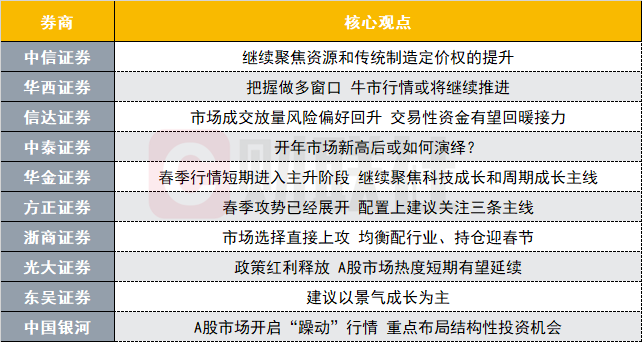
Group 1 - The market is currently experiencing a high level of enthusiasm, with a focus on theme stocks and small-cap stocks, while traditional investment funds are more cautious [2] - The expectation is that the market will continue to show a pattern of oscillation and upward movement until the National People's Congress, driven by improved domestic demand expectations [2] - There is a recommendation to focus on resources and traditional manufacturing sectors, as well as to increase allocation in non-bank financials to reduce portfolio volatility [2] Group 2 - A-share valuations are expected to continue to rise, with a potential rebound in overall ROE by 2026, influenced by factors such as increased profits from emerging industries and a slowdown in PPI [3] - The influx of certain types of funds, including regulatory, insurance, and bank wealth management funds, is seen as a solid foundation for the A-share market [3] - The market is likely to see a continuation of the spring rally, with a focus on small-cap stocks and potential adjustments providing good entry points for investors [3] Group 3 - The current market environment suggests limited downside risk and significant potential for upward movement, particularly in the commercial aerospace sector, which is experiencing positive changes [5] - The market is characterized by a concentration of themes and strong trading sentiment, with upcoming earnings reports expected to drive structural adjustments [5] - There is a focus on sectors such as AI, semiconductor, and resource price increases as key areas for investment [9] Group 4 - The spring rally is supported by improved liquidity and a favorable economic environment, with expectations of continued strong performance in the A-share market [6] - The focus on technology and growth sectors is expected to provide significant investment opportunities, particularly in AI applications and commercial aerospace [11] - The market is likely to remain strong leading up to the Spring Festival, with a focus on sectors benefiting from policy support and economic recovery [14]


重点布局结构性机会,六大机构研判A股后市
Zhong Guo Zheng Quan Bao· 2026-01-11 14:16
Group 1: Market Trends and Opportunities - A-shares continue to show a trend of oscillating upward, with a focus on structural investment opportunities as the market may experience increased short-term volatility [1] - Investors are encouraged to seize opportunities during market fluctuations, particularly before the Spring Festival, and to pay attention to the performance forecasts of listed companies as the reporting window opens in January [1] - Key sectors to watch include AI applications, robotics, controllable nuclear fusion, and quantum technology, along with a clear recovery path in manufacturing and resource sectors, particularly in non-ferrous metals, basic chemicals, and power equipment [1][5] Group 2: Regulatory and Policy Developments - The China Securities Regulatory Commission (CSRC) emphasizes the importance of deepening comprehensive reforms in investment and financing, focusing on risk prevention, strong regulation, and promoting high-quality development [2] - The Ministry of Commerce outlines key work for 2026, prioritizing actions to boost consumption, including the promotion of the "Buy in China" brand and the development of new growth points in service consumption [3] Group 3: Sector-Specific Insights - China Galaxy Securities highlights the potential for structural investment opportunities in AI, embodied intelligence, new energy, controllable nuclear fusion, quantum technology, and aerospace, as well as a clear recovery path in manufacturing and resource sectors [5] - Zhongtai Securities recommends focusing on the robotics sector, which has seen consistent capital inflow and remains a key area of interest [6] - Bank of China Securities notes that AI applications offer a high cost-performance ratio, with the AI industry experiencing various phases of market rotation since 2025 [7] - Yongying Fund anticipates that AI technology will continue to be a market driving force, with a shift in market narrative expected towards fundamental improvements [8] - Huaxia Fund observes an increase in the investment potential of Hong Kong stocks, with improved valuation compared to the U.S. Nasdaq index [9] - Industrial and Commercial Bank of China Fund reports a sustained high level of activity in the engineering machinery sector, with domestic demand and export growth contributing to an upward trend [10]
一周主力丨银行、传媒等板块获资金青睐 中际旭创遭抛售超80亿元
Di Yi Cai Jing· 2026-01-11 14:12
Group 1 - The banking sector received significant attention from main funds, with a net inflow of 4.298 billion yuan during the week from January 5 to January 9 [1] - The media, oil and petrochemical, and coal sectors also attracted main fund investments [1] - The electronics sector faced substantial selling pressure, with over 26 billion yuan in net outflows [1] Group 2 - Among individual stocks, XianDao Intelligent saw the highest net inflow of 1.216 billion yuan, with a weekly increase of 16.85% [1] - YunNan ZheYe and BOE Technology Group also experienced notable net inflows of 1.071 billion yuan and 1.068 billion yuan, respectively [1] - In contrast, ZhongJi XuChuang, XinYiSheng, and LiXun Precision faced significant net outflows of 8.243 billion yuan, 5.632 billion yuan, and 3.866 billion yuan, respectively [1]

银行、传媒等板块获资金青睐 中际旭创遭抛售超80亿元
Xin Lang Cai Jing· 2026-01-11 14:05
Group 1 - The banking sector attracted significant net inflow of 4.298 billion yuan during the week from January 5 to January 9 [1] - The media, oil and petrochemical, and coal sectors also received attention from major funds [1] - The electronics sector experienced a substantial net outflow exceeding 26 billion yuan, indicating a trend of selling pressure [1] Group 2 - Leading stocks included XianDao Intelligent with a net inflow of 1.216 billion yuan and a weekly increase of 16.85% [1] - Yunnan Zhenye and BOE Technology Group saw net inflows of 1.071 billion yuan and 1.068 billion yuan, respectively [1] - On the outflow side, stocks such as Zhongji Xuchuang, New Yisheng, and Luxshare Precision faced significant sell-offs of 8.243 billion yuan, 5.632 billion yuan, and 3.866 billion yuan, respectively [1]





A股春季行情短期进入主升阶段?券商策略来了
Feng Huang Wang· 2026-01-11 13:06
Core Viewpoints - The latest strategies from top brokerages indicate a bullish sentiment in the A-share market, with a focus on sectors like technology, traditional manufacturing, and resource pricing power [1][2][3][4][5][6][7][8][9][10][11][12][13][14] Group 1: Market Trends - The A-share market is experiencing a "rally" phase, with significant trading volume and a risk appetite resurgence, as evidenced by the Shanghai Composite Index surpassing 4100 points [4][6] - The market is expected to maintain its upward trajectory until the Spring Festival, driven by favorable macroeconomic indicators and increased participation from institutional investors [3][4][11][13] Group 2: Sector Focus - Brokerages recommend focusing on technology sectors, particularly AI applications, commercial aerospace, and robotics, which are anticipated to benefit from policy support and market trends [3][7][12][14] - Traditional manufacturing and resource sectors are highlighted for their potential in pricing power enhancement, with suggestions to increase allocations in non-bank financials [2][4][8] Group 3: Investment Strategies - Investment strategies emphasize a balanced approach, suggesting a mix of growth-oriented and cyclical sectors, with a focus on themes like "anti-involution" and price recovery in industries such as chemicals and metals [7][8][14] - The importance of monitoring market sentiment and performance metrics is stressed, particularly as the market enters a period of earnings announcements and potential volatility [12][13]



境外权益(港美股)周度策略报告-20260111
Guo Tai Jun An Qi Huo· 2026-01-11 11:55
Report Overview - The report is a weekly strategy report on overseas equity (Hong Kong and US stocks) by Guotai Junan Futures, dated January 11, 2026 [1][2] 1. Investment Ratings - No specific industry investment ratings are provided in the report 2. Core Views - For US stocks, maintain an optimistic outlook, continue with the technology + cyclical allocation strategy, and expect a more balanced market style in 2026 with a "shrinking circle" structure in the technology sector [3] - For Chinese stocks, in the short term, A-shares have better profit - making effects than Hong Kong stocks, and attention should be paid to the subsequent catch - up opportunities in Hong Kong stocks. In the medium term, Hong Kong stocks maintain a barbell strategy [4][7] 3. Summary by Sections US Stocks - **Market Performance and Outlook**: This week, cyclical sectors led the rise in US stocks, and the technology sector continued its "shrinking circle" structure. Next week, the US stock market will face earnings season and inflation data. The outlook remains optimistic, and the technology + cyclical allocation strategy continues [3] - **2026 Allocation Ideas**: The market style will be more balanced, and the K - shaped divergence between technology and non - technology, large - cap and small - cap stocks is expected to converge. Focus on AI technology, healthcare, utilities, finance, materials, and consumer sectors. Prioritize upstream infrastructure in AI technology over downstream software, and pay attention to theme investment opportunities in physical AI [3] - **Valuation**: US stock valuations are still relatively high overall [14] - **AI Bubble**: It is a local rather than a systematic bubble. The market is punishing individual companies with aggressive capital expenditures. Currently, it may be close to the 1997 position from the perspective of the technology industry's ROIC. Monitor the "ROIC - WACC" convergence trend and the divergence between "financing growth" and "profit growth" [20][22] Chinese Stocks - **Market Performance and Outlook**: This week, A - shares outperformed Hong Kong stocks. A - shares' performance was strong in some sectors with high performance certainty and theme - concept sectors. Southbound funds' entry momentum increased, and the pattern may be A - shares leading and Hong Kong stocks catching up. February is the month with the highest winning rate for A - shares historically [4][6][7] - **Short - term Allocation**: Defensively allocate sectors with high performance certainty (AI hardware, new energy leaders, and non - ferrous metals), and offensively allocate valuation - driven sectors (Hang Seng Technology, Hong Kong innovative drugs, commercial aerospace, and robotics) [7] - **Medium - term Allocation for Hong Kong Stocks**: Adopt a barbell strategy, focusing on technology assets with clear industrial trends supported by policies, some new energy sectors with supply - side clearance and demand - side improvement, and non - ferrous sectors benefiting from supply shortages, strong structural demand, and interest rate cuts [7] Odds Analysis - **Hong Kong Stocks**: The forward PE of the Hang Seng Index is 11.8 times, approaching the mean + 1STD since 2015. The forward PE of the Hang Seng Tech Index is 21.4 times, approaching the mean of the past 5 years. The Hang Seng Index ERP is 4.9%, and the Hang Seng Tech Index ERP is 1.1% [9][10]
机构论后市丨把握做多窗口;短期内市场或延续上行趋势
Di Yi Cai Jing· 2026-01-11 09:45
Group 1: Market Trends and Predictions - The A-share market has shown significant gains this week, with the Shanghai Composite Index up 3.82%, the Shenzhen Component up 4.40%, the ChiNext Index up 3.89%, and the Sci-Tech Innovation Board Index up 10.19% [1] - Institutions expect the market's momentum to continue in the short term, but caution is advised regarding a potential cooling period after mid-January leading up to the Spring Festival [1] - The improvement in market liquidity has been a direct driver of the A-share rally since late December 2025, with a notable increase in margin trading balances and overall trading volume [3] Group 2: Sector Focus and Investment Opportunities - Key sectors to watch include electronics, power equipment, and non-ferrous metals, with different sectors favored depending on market style (growth vs. defensive) [1] - The commercial aerospace sector has seen substantial gains and remains a focus for investors, despite potential profit-taking pressures [2] - The robotics sector has attracted significant capital inflow, indicating strong investor interest, while the commercial aerospace sector is transitioning to a "theme expansion" phase [4] - Recommendations include focusing on resources and traditional manufacturing sectors, with an emphasis on enhancing pricing power [6]
策略周末谈(0111):康波的凝视:油价一触即发
Western Securities· 2026-01-11 08:08
Group 1 - The report identifies the second round of the commodity supercycle driven by the expansion of dollar credit cracks during the Kondratiev depression phase, suggesting that this phase will enhance the monetary attributes of commodities, particularly gold and industrial metals, as safe assets amid increasing geopolitical uncertainties [1][9][10] - Historical patterns indicate a rotation in the commodity supercycle: gold rises first, followed by industrial metals, oil, and finally agricultural products, with each phase influenced by geopolitical factors and economic conditions [2][14][16] - Current oil prices are deemed undervalued due to strategic oil inventories reaching historical lows, and a potential increase in oil prices is anticipated if the geopolitical situation, particularly the Russia-Ukraine conflict, eases by 2026 [3][21][23] Group 2 - The report outlines three key signals to watch for a potential reversal in oil prices: willingness of major oil-producing countries to negotiate production cuts, effective execution of production cuts, and strengthening of reduction agreements over time [4][27][28] - The analysis predicts that 2026 will mark a turning point towards prosperity, with a significant rise in global oil prices expected if the geopolitical tensions ease, leading to a renewed focus on commodities as safe assets [5][37] - Industry allocation recommendations include focusing on metals (gold, silver, copper, lithium), consumer sectors benefiting from wealth return and improved consumption tendencies, and high-end manufacturing sectors with export advantages [5][39]
十大机构看后市:大多数产业主线没有明显过热迹象,行情仍有空间,依然可以加仓,科技仍是牛市主线
Xin Lang Cai Jing· 2026-01-11 07:43
Group 1 - The major indices have shown significant increases, with the Shanghai Composite Index rising by 3.82%, the Shenzhen Component by 4.40%, and the ChiNext by 3.89% [1][16] - Most industry main lines are not showing obvious overheating signs and remain in a position where accumulation is possible [2][17] - The A-share ROE is expected to rise for the first time in five years after 14 consecutive quarters of decline, which is a prerequisite for stabilizing valuations [2][17] Group 2 - The spring market is characterized by a lack of major downside risks, with only short-term adjustments expected after sufficient market performance [3][18] - The market is likely to continue its upward trend, with a focus on technology as the main line of the bull market [5][20] - The current market structure shows a significant increase in trading volume, indicating sustained market activity [29] Group 3 - The upcoming policy catalysts, including the review of the 14th Five-Year Plan and potential improvements in Sino-US trade relations, are expected to stabilize market expectations [4][19] - The market is experiencing a "rotation + broad rise" state, with small-cap growth indices performing particularly well [7][22] - Investors are advised to focus on sectors such as AI applications, traditional consumption benefiting from policy support, and undervalued real estate [21][24] Group 4 - The short-term market may continue its upward trend, with significant inflows into sectors like robotics and commercial aerospace [8][24] - The commercial aerospace sector has shown strong capital inflows, although it is currently at a historically high trading density [8][25] - The overall market sentiment is improving, supported by macroeconomic factors and policy measures [28][29]
大涨!他们调仓了 多只基金净值异动
天天基金网· 2026-01-11 07:30
Core Viewpoint - The article highlights significant discrepancies between the actual net asset values and estimated net asset values of several funds since the beginning of the year, indicating that fund managers may have adjusted their portfolios towards popular sectors such as technology growth and commercial aerospace. However, some fund managers are now warning of increased investment difficulties and the risks of excessive speculation in concept stocks [2][10]. Fund Performance Analysis - Since the start of the year, the market has experienced a volatile upward trend, with certain hot concept stocks surging. For instance, the Guangfa Zhaoli Mixed Fund saw its net value increase by 6.99% on January 8, despite seven of its top ten holdings declining in value on the same day [3][4]. - The Guangfa Zhaoli Mixed Fund's net value rose again by 5.29% on January 9, indicating a potential significant adjustment in its holdings since the end of the third quarter of 2025 [3]. - Similarly, the Zhongjia Advantage Enterprise Mixed Fund's net value increased by 6.21% on January 8, while nine of its top ten holdings also saw declines that day [5][6]. - The Guangfa Yuanshi Zhixuan Mixed Fund experienced a net value increase of 4.83% on January 7, with six of its top ten holdings declining in value [7][9]. - The Huitianfu Competitive Advantage Mixed Fund reported a net value increase of 7.2% on January 7, despite seven of its top ten holdings declining, with the highest performer being Dongfang Tieta, which rose by 3.04% [10]. Sector Focus and Investment Strategy - Recent market trends suggest that the aforementioned funds hold a significant number of technology growth-related assets, with several semiconductor equipment-themed ETFs rising over 7% on January 7 [10]. - The first quarterly reports for 2025 have begun to reveal the specific paths of institutional portfolio adjustments, with new top holdings emerging in various funds, including Jie Rui Co., Xiaopeng Motors-W, and Tianfu Communication [10][11]. - Fund managers are increasingly cautious about the commercial aerospace sector, emphasizing the need for thorough evaluations based on technological barriers, order scale, and application progress. They warn against overvalued "pseudo-commercial aerospace" stocks lacking clear application scenarios [12]. - Investment difficulty is reportedly increasing, necessitating deeper understanding and research into listed companies, with some managers adjusting their portfolios to include more balanced and lower-valued assets [12][13].