美元信用裂痕

Search documents
张津镭:黄金站上4800美元详解 新避险时代操作策略
Xin Lang Cai Jing· 2026-01-21 11:00
Group 1 - The gold market is experiencing a significant bull run, with prices opening above $4,660 and reaching a closing price of $4,762, marking a strong bullish trend [1][5] - On January 21, gold prices surged past the psychological barrier of $4,800 for the first time, amidst a broader sell-off in U.S. assets, including stocks and bonds [6][1] - The current market sentiment has shifted from concerns over Federal Reserve interest rates to deep worries about the credibility of the U.S. dollar and government bonds, driven by geopolitical tensions and policy actions [2][6] Group 2 - Technical analysis indicates a focus on the long-term trend line resistance around $4,830, with recent price movements breaking through key mid-term and long-term trend lines [7] - The narrative surrounding the gold market has evolved into one driven by a "credit crisis," positioning gold as a primary tool for global capital to hedge against the perceived cracks in dollar credibility and the collapse of the old order [2][7] - Suggested trading strategy includes buying gold at $4,815-$4,810 with a stop loss at $4,800 and a target of $4,860-$4,870, while also considering short positions if prices drop below $4,800 [8]
康波的凝视-油价一触即发
2026-01-13 01:10
Summary of Conference Call Records Industry Overview - The current analysis focuses on the commodities market, particularly oil, and its cyclical behavior driven by the Kondratiev wave theory, indicating a supercycle lasting approximately four years due to the expansion of dollar credit cracks [1][3][6]. Key Points and Arguments - **Commodity Supercycle**: The current supercycle is characterized by a rotation in commodity prices: gold, industrial metals, oil, and finally agricultural products. This cycle is expected to continue until around 2026, particularly influenced by geopolitical factors such as the Russia-Ukraine conflict [1][3][6]. - **Oil Price Signals**: The reversal of oil prices is anticipated to be signaled by three core indicators: 1. Major oil-producing countries expressing willingness to negotiate production cuts. 2. Effective execution of joint production cuts by these countries. 3. Continuous strengthening of the production cut agreements in terms of extent and duration. The emergence of the third signal is expected to lead to a rapid increase in oil prices [4][10]. - **Strategic Oil Reserves**: Global strategic oil inventories have reached historical lows, which, combined with a decade-long contraction in oil capital expenditures, supports the potential for future oil price increases [4][7]. - **Investment Opportunities**: The current international oil price has fallen below $60, nearing the breakeven point for the U.S. shale gas industry, suggesting limited downside risk and significant upside potential for investments in the petrochemical sector [2][11]. Additional Important Insights - **Kondratiev Wave Characteristics**: The supercycle during the Kondratiev depression phase is primarily driven by currency credit issues rather than demand. Since 2016, the global demand for the dollar has decreased, enhancing the reserve value of commodities, especially gold [6]. - **Historical Context**: Historical geopolitical events have shown that actions against Russia often lead to significant drops in oil prices, as seen in 1986 and 2014. The current situation reflects similar dynamics following the 2022 Russia-Ukraine conflict [9]. - **Future Economic Predictions**: For 2026, it is predicted that China's economy will enter a phase of prosperity, with the A-share market likely to reach new highs. Key sectors to watch include non-ferrous metals, new consumption, high-end manufacturing, and domestic computing chains with competitive advantages [12]. Conclusion - The analysis indicates a complex interplay of geopolitical factors, market dynamics, and historical patterns that shape the commodities market, particularly oil. Investors are advised to consider these elements when making strategic decisions in the coming years.
矿业ETF(561330)连续10日净流入超5.7亿元,有色板块企稳后或延续景气逻辑
Mei Ri Jing Ji Xin Wen· 2026-01-12 06:58
Core Viewpoint - The mining ETF (561330) has seen a net inflow of over 570 million yuan for 10 consecutive days, indicating a potential continuation of the positive trend in the non-ferrous metal sector as it stabilizes [1] Industry Summary - The non-ferrous metal industry is facing multiple opportunities due to a globally loose liquidity environment that supports metal prices [1] - Rapid development in emerging fields such as artificial intelligence and high-end equipment manufacturing is expected to accelerate the growth in demand for non-ferrous metals [1] - The upward trend in geopolitical security premiums is likely to lead to a reassessment of commodity prices, with major countries elevating the strategic importance of key minerals [1] - China's initiatives to promote the storage of rare earths further enhance the strategic value of resource products [1] Precious Metals Summary - In the precious metals sector, a loose monetary environment combined with expanding cracks in U.S. dollar credit and ongoing high debt levels has resulted in gold prices exhibiting characteristics of being easy to rise but difficult to fall [1] ETF Performance Summary - The mining ETF (561330) tracks the non-ferrous mining index (931892), which selects securities from companies involved in the development of mineral resources such as copper, aluminum, lead, zinc, and rare metals [1] - According to Wind data, the mining ETF (561330) is projected to have the third-highest annual growth among all market ETFs in 2025, and the highest among non-ferrous ETFs, with a higher concentration of "gold + copper + rare earths" [1]
策略周末谈(0111):康波的凝视:油价一触即发
Western Securities· 2026-01-11 08:08
Group 1 - The report identifies the second round of the commodity supercycle driven by the expansion of dollar credit cracks during the Kondratiev depression phase, suggesting that this phase will enhance the monetary attributes of commodities, particularly gold and industrial metals, as safe assets amid increasing geopolitical uncertainties [1][9][10] - Historical patterns indicate a rotation in the commodity supercycle: gold rises first, followed by industrial metals, oil, and finally agricultural products, with each phase influenced by geopolitical factors and economic conditions [2][14][16] - Current oil prices are deemed undervalued due to strategic oil inventories reaching historical lows, and a potential increase in oil prices is anticipated if the geopolitical situation, particularly the Russia-Ukraine conflict, eases by 2026 [3][21][23] Group 2 - The report outlines three key signals to watch for a potential reversal in oil prices: willingness of major oil-producing countries to negotiate production cuts, effective execution of production cuts, and strengthening of reduction agreements over time [4][27][28] - The analysis predicts that 2026 will mark a turning point towards prosperity, with a significant rise in global oil prices expected if the geopolitical tensions ease, leading to a renewed focus on commodities as safe assets [5][37] - Industry allocation recommendations include focusing on metals (gold, silver, copper, lithium), consumer sectors benefiting from wealth return and improved consumption tendencies, and high-end manufacturing sectors with export advantages [5][39]
现货黄金持续上行,黄金基金ETF(518800)午后涨超3.5%,规模突破250亿元,连续5日净流入超28亿元
Sou Hu Cai Jing· 2025-10-17 05:16
Core Viewpoint - Western Securities indicates that gold prices are currently in the early stages of the "third wave," and as the cracks in U.S. dollar credit continue to expand, a long-term bull market for gold will commence [1] Group 1: Market Analysis - The resumption of interest rate cuts implies a loss of independence for the Federal Reserve, which will continue to be undermined in the future, enhancing the reserve value of gold [1] - The current phase is identified as the early stage of a major upward trend in gold prices, referred to as the third wave [1] - Attention should be paid to the potential pullback risks due to speculative funds taking profits [1] Group 2: Investment Vehicle - The gold ETF (518800) holds underlying assets that are gold spot contracts traded on the Shanghai Gold Exchange (AU99.99), directly corresponding to physical gold stored in the Shanghai Gold Exchange vaults [1] - Investing in the gold ETF essentially equates to direct investment in physical gold, as its price fluctuations closely follow the AU9999 spot contract, which reflects domestic gold prices [1] - According to the fund contract, the proportion of physical gold held must not be less than 90% of the fund's assets [1]
金价突破4300美元,创历史最佳表现年份
Sou Hu Cai Jing· 2025-10-17 04:18
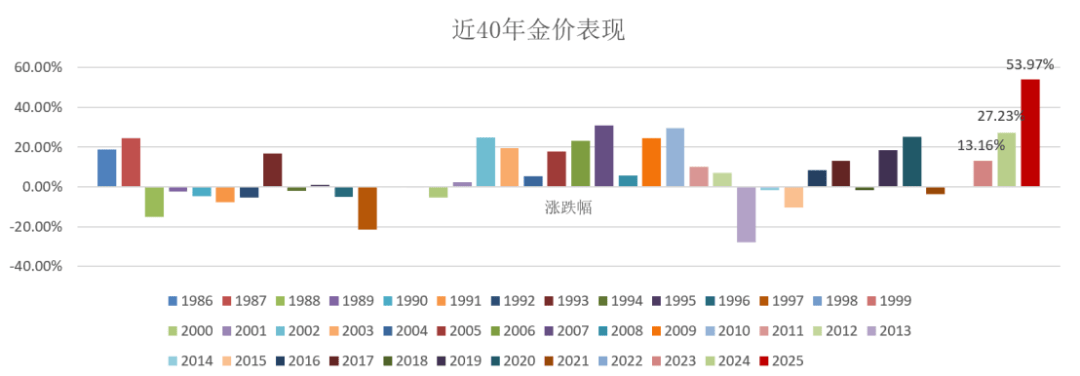
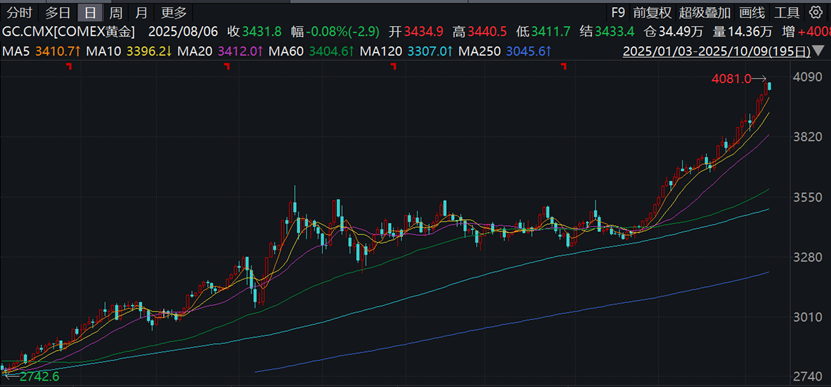
Group 1: Gold Price Surge - Gold prices have surged, with spot prices exceeding $4,059.3 per ounce on October 8, marking a 53.97% increase year-to-date, the best performance in nearly 40 years [1] - By October 16, gold prices further surpassed $4,300, with gold stock ETFs (159562) doubling in value this year and the 华夏 gold ETF (518850) rising over 50% [1] Group 2: U.S. Government Shutdown - The U.S. government has entered a shutdown due to a lack of funding, marking the first shutdown in nearly seven years, caused by fundamental disagreements between Republicans and Democrats over a temporary funding bill [3] - The shutdown is expected to have limited direct economic impact but will increase political uncertainty and market volatility, particularly if it lasts more than two months [4] Group 3: Employment Data and Interest Rate Expectations - The ADP employment data for September showed an unexpected decline of 32,000 jobs, contrary to market expectations of an increase of 51,000, indicating a weakening labor market [5] - Following the ADP report, the probability of the Federal Reserve cutting interest rates has significantly increased, with a 99% chance of a 25 basis point cut in October [6] Group 4: Global Trade Policy Uncertainty - President Trump announced a 25% tariff on medium and heavy trucks imported to the U.S. starting November 1, 2025, indicating ongoing trade tensions [7] - Discussions between the U.S. and Canada regarding tariffs and trade issues continue, with potential implications for U.S.-China trade negotiations [7] Group 5: China's Gold Reserves - China's State Administration of Foreign Exchange reported an increase in gold reserves to 74.06 million ounces as of the end of September, marking the 11th consecutive month of gold accumulation [8] Group 6: Future Gold Price Predictions - Goldman Sachs has raised its gold price forecast for December 2026 to $4,900 per ounce, citing structural changes in gold buying behavior driven by central banks and individual investors [9] - UBS predicts a bullish trend for gold, forecasting prices to reach $4,200 per ounce by mid-2026, supported by a weaker dollar and increased central bank purchases [9] Group 7: Investment Products - The 华夏 gold ETF (518850) allows investors to track gold prices directly, offering T+0 trading and low management fees, making it attractive for conservative investors [10] - The gold stock ETF (159562) provides exposure to the gold industry, with higher volatility and potential returns, suitable for aggressive investors [11] - The diversified metals ETF (516650) focuses on various metals, including gold, and offers a balanced investment approach [12]

黄金:第三浪,启动!
2025-10-09 02:00
Summary of Key Points from the Conference Call on Gold Market Industry Overview - The discussion centers around the gold market and its current trends, particularly in relation to macroeconomic factors and geopolitical events. Core Insights and Arguments 1. **Interest Rate Expectations**: The deterioration of the U.S. ADP employment data has strengthened market expectations for a potential 50 basis point rate cut by the end of the year, which could further drive up gold prices [1][2][3] 2. **De-dollarization Trend**: The challenge to the independence of the Federal Reserve by Trump has accelerated the de-dollarization process, impacting gold's reserve value. The potential firing of Fed Governor Cook could lead to significant increases in gold prices [1][2][4] 3. **Technical Breakthrough**: Gold prices have surpassed $3,500 per ounce, marking a significant technical breakthrough with a 15% increase since then. Although the momentum may weaken, short-term adjustment pressure remains low [1][2][6] 4. **Gold Pricing Model**: The most critical factor in gold pricing is its reserve value rather than its trading or consumption value. Since 2016, gold prices have increasingly reflected the cracks in U.S. dollar credit rather than being tied to the dollar index or U.S. Treasury yields [3][4] 5. **Historical Context**: The current market is compared to historical events, such as the collapse of the Bretton Woods system in 1971, suggesting that gold could see significant long-term growth, potentially exceeding tenfold increases over the next decade [6][8] Important but Overlooked Content 1. **Future Events to Monitor**: Key events to watch include the appointment of a compliant Federal Reserve Chair and the Supreme Court's decision regarding Cook's status, as these could further impact the independence of the Fed and, consequently, the credibility of the dollar [4][5] 2. **External Factors**: The ongoing Russia-Ukraine conflict and fluctuations in oil prices are highlighted as external factors that could influence gold prices in the short term [5][7] 3. **Investment Strategy**: Investors are advised to hold significant positions in gold and to be prepared for potential adjustments based on market signals, particularly regarding geopolitical developments and economic recovery indicators [8][9] Conclusion - The current gold market is characterized by a bullish trend driven by interest rate expectations, geopolitical tensions, and technical factors. Investors are encouraged to adopt a long-term holding strategy while remaining vigilant to market changes that could present buying opportunities.
西部证券晨会纪要-20251009
Western Securities· 2025-10-09 02:00
Group 1 - The report highlights the impact of high-interest deposit repricing on the banking sector, indicating that the inversion between the 10-year government bond yield and bank funding costs may gradually disappear [1][7][11] - It estimates that the total amount of fixed-term deposits maturing in the second half of this year will be approximately 59.52 trillion yuan, with expected declines in funding costs of about 8.3 basis points this year and 9.8 basis points in 2026 [10][11] - The report suggests that the repricing of high-interest deposits could alleviate the pressure of yield inversion, thereby enhancing banks' willingness to invest in bonds [11][12] Group 2 - The report on the TOC fintech sector indicates that the market is expected to benefit from improved liquidity and risk appetite, with technology and traffic remaining core competitive drivers [3][24] - It notes that the total revenue of six major TOC financial information service companies reached 12.182 billion yuan in the first half of 2025, reflecting a year-on-year growth of 47% [25] - The report recommends focusing on companies with strong fundamentals and platform advantages, such as Dongfang Caifu and Xiangcai Co., which are expected to gain market share [26] Group 3 - The report on Youjia Innovation forecasts revenue growth from 1 billion yuan in 2025 to 2.16 billion yuan in 2027, with a compound annual growth rate of 53% [4][28] - It emphasizes the company's strategic partnerships with major automotive manufacturers, which are expected to accelerate project delivery and enhance market presence [29] - The report highlights the potential of the L4 autonomous minibus business as a significant growth driver for the company [29] Group 4 - The report on the energy sector indicates that China Power Construction has signed 3,579 energy and power projects with a total contract value of 516.24 billion yuan in the first eight months of 2025, representing a year-on-year increase of 14.3% [51] - It notes that the company's overseas business has also seen rapid growth, with new contracts amounting to 179.841 billion yuan, up 21.9% year-on-year [52] - The report projects that the company will achieve a net profit of 12.301 billion yuan in 2025, reflecting a growth of 2.4% [53] Group 5 - The report on Sanxia Energy highlights that the company has a cumulative installed capacity of 49.9366 million kilowatts, with wind power accounting for 22.9702 million kilowatts, representing a market share of 4.01% [55] - It indicates that the company's solar power business has also shown strong growth, with a cumulative installed capacity of 25.9055 million kilowatts [56] - The report maintains a "buy" rating for the company, projecting a net profit of 6.125 billion yuan for 2025, reflecting a slight increase [57] Group 6 - The report on Miniso indicates that the company's domestic revenue grew by 11.4% in the first half of 2025, with a focus on optimizing store quality rather than quantity [58] - It highlights the strategic shift towards self-owned IP development, which is expected to enhance brand value and customer loyalty [58] - The report anticipates that the company's self-owned IP will contribute significantly to future revenue growth, targeting a GMV of 1 billion yuan for the year [58]
国际金价再创新高,外媒归因于远离美元过度依赖战略
Huan Qiu Wang· 2025-10-09 01:02
Core Insights - International gold prices have continued to rise, with COMEX gold futures increasing by 1.40% to $4060.60 per ounce and silver futures rising by 1.95% to $48.44 per ounce [1][3] - The domestic gold market is also experiencing growth, with several gold ETFs surpassing 10 billion yuan in scale, driven by expectations of Federal Reserve rate cuts and ongoing concerns about the dollar's credibility [3] - UBS forecasts central bank demand for gold to remain between 900-950 tons by 2025, while Goldman Sachs sees further upside potential for gold prices, predicting $4200 per ounce in the coming months [3] - The IMF president noted that the current monetary gold holdings exceed one-fifth of global official reserves, and China's foreign exchange reserves increased by $16.5 billion in September, with gold reserves rising for the 11th consecutive month [3] Market Sentiment - Historical trends indicate that rising gold prices often reflect investor panic, with gold viewed as a safe haven during economic downturns [4] - Concerns about international instability and potential central bank panic, as well as fears of a collapse in the AI boom, are contributing to current market anxieties [4] - Gold is perceived as a hedge against market volatility and economic recession, with central banks increasing their gold purchases to reduce reliance on U.S. Treasury securities and the dollar [8]
疯涨!金价持续上涨的原因是什么?
Zhong Guo Jing Ying Bao· 2025-10-08 23:54
Core Viewpoint - International gold prices have been rising significantly, reaching historical highs during the National Day holiday, with COMEX gold futures hitting $4000.1 per ounce and spot gold at $3958.71 per ounce [2][4]. Group 1: Gold Price Trends - As of October 7, 2023, the price of gold jewelry in China has also increased, with Chow Tai Fook's gold jewelry price rising to 1155 yuan per gram, up 26 yuan from 1129 yuan on October 1 [2][3]. - The demand for investment gold has surged, with reports indicating that gold bars sold out quickly at 877 yuan per gram, leaving only panda gold coins available [3]. Group 2: Central Bank Actions and Predictions - The People's Bank of China reported an increase in gold reserves, reaching 74.06 million ounces by the end of September, marking a 40,000-ounce increase from August and the 11th consecutive month of accumulation [2]. - Analysts expect continued upward momentum for gold prices, with Goldman Sachs predicting that central banks in emerging markets will increase gold holdings, forecasting an average purchase of 80 tons in 2025 and 70 tons in 2026, raising the 2026 gold price forecast to $4900 per ounce [2][4]. Group 3: Market Dynamics and Future Outlook - The current gold bull market is attributed to factors such as potential U.S. government shutdowns and ongoing geopolitical tensions, which are driving investors towards gold as a safe haven [4][5]. - Analysts from West Securities suggest that the ongoing expansion of dollar credit cracks will lead to a long-term bull market for gold, with the current phase being the early stage of a third wave of upward movement [5]. - The expectation of interest rate cuts by the Federal Reserve is seen as a key driver for gold prices, with potential implications for increased private investment in gold, further amplifying price increases [6].