调味品

Search documents
从烟台地标到厨房餐桌:味达美“烟台海肠季”塑造城市新名片
Zhong Guo Shi Pin Wang· 2025-08-13 06:26
Core Insights - The "Yantai Sea Intestine Season" launched by the well-known Shandong condiment brand, Xinhao Weidamei, in collaboration with Yantai Cultural Tourism, aims to promote local culinary culture and attract tourists through a unique gastronomic experience [1][16]. Group 1: Event Overview - The event features "100 Ways to Eat Sea Intestine" and has become a popular destination in Shandong since its inception in August [1]. - Key landmarks in Yantai, such as Fisherman's Wharf and Yantai Mountain, have transformed into food hotspots with pop-up stalls offering various sea intestine dishes [3]. Group 2: Culinary Offerings - Xinhao Weidamei has prepared multiple sea intestine dishes, including sea intestine rice and scallion oil mixed sea intestine, showcasing the freshness from the Bohai Bay [6][10]. - The brand emphasizes the unique taste of sea intestine, a rare delicacy caught only twice a year, and its historical significance in royal cuisine [10][13]. Group 3: Interactive Experience - Visitors can participate in interactive activities, such as free tastings and a stamp collection game, enhancing their engagement with the event [8][15]. - The stamp collection rewards participants with themed gifts, creating a personalized culinary map of the event [8]. Group 4: Collaboration with Local Businesses - The event extends beyond pop-up stalls, as Xinhao Weidamei collaborates with local restaurants and hotels to offer high-quality sea intestine themed meals [14]. - Many diners are using platforms like Dazhong Dianping to find participating restaurants and enjoy limited-time offers [14]. Group 5: Marketing and Promotion - The marketing strategy includes a comprehensive approach with themed advertisements at airports, train stations, and public transport, ensuring widespread visibility [15]. - The integration of local cultural resources aims to foster emotional connections between the city and visitors, enhancing the overall experience [15][16]. Group 6: Cultural Significance - The "Yantai Sea Intestine Season" not only highlights local culinary flavors but also represents an innovative practice of connecting consumers with the city's cultural tourism [16]. - The event successfully merges local delicacies with brand philosophy, offering a rich experience that reflects the city's heritage and culinary excellence [16].


四川成都举办“走进企业看质量”专题活动
Zhong Guo Zhi Liang Xin Wen Wang· 2025-08-13 04:31
Core Viewpoint - The event "Entering Enterprises to See Quality" held by the Chengdu Market Supervision Administration aims to promote high-quality development through quality management and brand enhancement, emphasizing the importance of quality in enterprise growth [1][2]. Group 1: Event Overview - The event attracted over a hundred participants, including quality work leaders from various districts and representatives from enterprises, focusing on exploring new paths for high-quality development [1]. - The theme "Quality Foundation, Brand Leadership" was central to the discussions, aligning with the implementation of national and provincial quality enhancement policies [1]. Group 2: Company Practices and Innovations - Sichuan Tianwei Food Group's Chief Quality Officer shared insights on how the seasoning industry can enhance brand value through a digital quality traceability system from farm to table, thereby upgrading quality management [2]. - Tongwei Solar (Chengdu) Co., Ltd. highlighted its high standards in quality management within the photovoltaic industry, which has helped the brand stand out in a competitive market [2]. - Sichuan Duolian Industrial Co., Ltd. presented its successful implementation of Total Quality Management (TQM) and lifecycle management in the new plastic pipeline sector, demonstrating how quality control is integrated into all stages of product development, production, and service [2]. Group 3: Discussion and Future Directions - Participants engaged in discussions on "Deepening Quality Reform and Supporting Brand Upgrading," emphasizing the need for enhanced "policy + technology" dual-track service effectiveness [2]. - There was a consensus on the importance of strengthening quality infrastructure to provide robust support for enterprises, alongside the necessity for companies to improve brand cultivation and protection mechanisms [2].

青白江鸡精批发市场行情2025
Sou Hu Cai Jing· 2025-08-13 02:56
Core Insights - The demand for chicken essence is steadily increasing due to rising living standards and a growing pursuit of culinary excellence, making it a common seasoning in both home cooking and the restaurant industry [2][5] - The wholesale price of chicken essence varies based on brand, specifications, and quality, with mid-range products priced between 10 to 20 yuan for 400-500 grams, while premium products can reach 30 to 40 yuan [2][3] - The chicken essence wholesale market in Qingbaijiang is characterized by diverse channels, including traditional wholesale markets and the growing importance of e-commerce platforms [3][5] Market Demand - The local and surrounding restaurant and cafeteria sectors have a high demand for chicken essence, supported by the continuous development of the restaurant industry [2] - The family consumption market is also significant, with increased frequency of family gatherings and cooking leading to substantial sales of small-packaged chicken essence in supermarkets and convenience stores [2] Pricing Trends - Chicken essence wholesale prices experience slight increases of about 5% to 10% during peak dining seasons, such as holidays, while remaining relatively stable during off-peak periods [2][3] Distribution Channels - The chicken essence wholesale market in Qingbaijiang features a variety of distribution channels, including local wholesale markets and online platforms, providing more options for businesses [3] - Online purchasing offers cost-saving opportunities but requires careful attention to product quality and logistics [3] Brand Competition - The market is competitive with numerous brands, including well-known national brands and local specialty brands, each holding significant market shares [3][5] - National brands benefit from widespread recognition and trust, while local brands appeal to regional tastes and offer better cost-performance ratios [3] Future Outlook - The chicken essence market is expected to see broader development opportunities for products with health attributes and unique flavors, driven by consumer preferences [5] - Wholesalers need to continuously optimize procurement channels and adjust product structures to adapt to market changes [5]
食品饮料周报(25年第32周):白酒积极推新应变场景缺失,关注板块中报业绩-20250812
Guoxin Securities· 2025-08-12 08:26
Investment Rating - The report maintains an "Outperform" rating for the food and beverage sector [5][4]. Core Insights - The food and beverage sector saw a slight increase of 0.75% during the week of August 4 to August 8, 2025, underperforming the Shanghai Composite Index by 1.37 percentage points [20][1]. - The report highlights the pressure on demand within the liquor industry, prompting companies to innovate and diversify their product offerings to meet consumer needs [2][11]. - The report emphasizes the importance of mid-year performance reports, indicating that companies are focusing on inventory reduction and sales promotion strategies in the short term while planning for long-term consumer engagement and market expansion [2][13]. Summary by Sections 1. Liquor Industry - Companies like Guizhou Moutai and Wuliangye are actively launching new products to adapt to changing consumer preferences, with Moutai's recent product launch achieving significant sales [2][11]. - The report notes that the liquor sector is entering a critical phase for mid-year performance reporting, with expectations of inventory reduction and improved sales strategies [2][13]. - Key investment themes include established leaders with proven resilience, companies showing positive feedback from digital initiatives, and those with potential market share growth [2][13]. 2. Consumer Goods - The beer and beverage sectors are entering a peak season, with expectations for strong performance in mid-year reports [3][14]. - The report indicates a shift in the snack industry towards a model driven by product categories and channels, highlighting the need for brands to enhance their market penetration capabilities [3][15]. - Recommendations include focusing on leading companies in the seasoning and frozen food sectors, which are expected to perform steadily [3][16][17]. 3. Dairy Products - The dairy sector is anticipated to see a gradual recovery in demand, supported by favorable policies and improved supply dynamics [3][18]. - The report suggests that leading dairy companies are well-positioned to benefit from the expected demand rebound in 2025 [3][18]. 4. Beverage Sector - The beverage industry is expected to maintain a favorable outlook, with significant growth opportunities in sugar-free tea and energy drinks [3][19]. - The report highlights the performance of leading companies like Nongfu Spring and Dongpeng Beverage, which are expected to accelerate their market presence [3][19].





中炬高新董事会任命3名新高管 火炬集团系董事投反对票
Xin Hua Wang· 2025-08-12 05:49
原标题:中炬高新董事会任命3名新高管 火炬集团系董事称程序不合法投反对票 在中炬高新董事会改组前夕,宝能系与火炬集团的争斗愈发激烈。 7月18日晚间,中炬高新发布公告称,董事会于7月17日收到李翠旭报告,其因个人原因辞去公司总经理 职务。同时中炬高新宣布,董事会审议通过议案,免去张弼弘公司副总经理兼财务负责人职务,同时拟 聘任邓祖明为公司总经理,聘任孔令云、秦君雪为公司副总经理。 "按照公司治理的要求,董事会聘任与考核经理层,经理层的任期与董事会的任期保持一致比较好,因 此董事会的更换一般也伴随着经理层的更换。"中国企业改革与发展研究会研究员吴刚梁在接受《证券 日报》记者采访时表示,"股东之间应该增强信任,多以公司整体利益为重。" 但上述对新高管的提名,遭到了中炬高新大股东火炬集团派系董事的反对。 新提名高管 均有宝能系背景 从履历来看,辞职的李翠旭为宝能系高管,其于2018年4月份至2019年5月份在宝能系另一家上市公司南 玻A任副总裁。2019年宝能系入主中炬高新后改组董事会,李翠旭获提名,任中炬高新总经理至今。 而新聘任的邓祖明、孔令云、秦君雪也均有宝能系背景。资料显示,邓祖明2012年起在宝能集团任职 ...


中炬高新澄清造假传闻 称生产经营合法合规
Xin Hua Wang· 2025-08-12 05:47
Core Viewpoint - The company firmly denies allegations of false labeling regarding oyster sauce content, asserting that the claims lack factual basis and are unfounded [1][2]. Group 1: Company Response and Operations - The company, Zhongju Gaoxin, has responded to allegations regarding its oyster sauce product, stating that the claims made by a former employee are baseless [1]. - The core business of Zhongju Gaoxin includes condiments and health foods, with its subsidiary, Meiwai Xian, being a well-known large-scale condiment manufacturer in China [1]. - In 2022, Meiwai Xian produced approximately 698,500 tons of products, with soy sauce sales accounting for 61.89% of total revenue [1]. Group 2: Financial Performance - In the first half of 2023, Meiwai Xian achieved operating revenue of 2.572 billion yuan, an increase of 108 million yuan, representing a growth of 4.37% [2]. - Zhongju Gaoxin expects to report a net profit attributable to shareholders of approximately 1.534 billion to 1.841 billion yuan for 2023, marking an increase of 2.126 billion to 2.433 billion yuan compared to the previous year [2]. - The anticipated profit turnaround is primarily attributed to the resolution of significant land litigation cases, which is expected to add 1.178 billion yuan to the company's 2023 financial results [3].
海天味业折价发行H股再度破发,“调味茅”能否重回巅峰?
Xin Hua Wang· 2025-08-12 05:37
Core Viewpoint - Haitan Flavor Industry's (海天味业) debut on the Hong Kong stock market has faced significant challenges, with its stock price dropping below the issue price within the first two days of trading, contrasting with the recent trend of successful listings by other consumer companies [1][3]. Group 1: IPO Details - Haitan Flavor Industry's IPO attracted considerable interest, with cornerstone investors subscribing to 1.29 billion shares, accounting for nearly 50% of the total shares offered, raising approximately 4.7 billion HKD [2]. - The IPO was priced at 36.30 HKD per share, representing a 15% discount compared to its recent A-share price of around 40 HKD [2]. - The public offering saw over 390,000 investors, with a subscription rate of 918.15 times for the Hong Kong portion and 22.93 times for the international portion, marking a record high for Hong Kong IPOs this year [3]. Group 2: Market Performance - Despite the strong initial interest, the stock price fell to 35.80 HKD on June 20, 2023, indicating a lack of sustained investor confidence in the secondary market [1][3]. - The company's market capitalization has decreased by over 60% from its peak, with the current A-share price around 40 HKD, leading to its removal from the A-share SSE 50 Index [5]. Group 3: Business Strategy and Market Position - Haitan Flavor Industry aims to enhance its global brand image and competitiveness through the funds raised from the IPO, with plans to invest in product development, technology upgrades, and expanding its international market presence [6]. - The company has maintained its position as the largest condiment producer in China for 28 consecutive years, with a market share of 4.8% in the domestic market and ranking fifth globally [4]. - However, the company has faced stagnation in revenue growth, with negative growth reported from 2021 to 2023, and a decline in net profit for two consecutive years [4][5]. Group 4: Future Outlook - Analysts express cautious optimism about Haitan Flavor Industry's potential for recovery, citing its strong brand and channel advantages, but also highlight risks from market competition and consumer demand [7]. - The global condiment market is projected to grow at a compound annual growth rate of 3.2% from 2019 to 2024, indicating a competitive landscape that may challenge the company's growth ambitions [8].
中炬高新换帅:消费品虎将出任董事长 战略转型与治理优化并举
Xin Hua Wang· 2025-08-12 05:37
Group 1: Company Leadership and Governance - The board of directors of Zhongju Gaoxin has undergone a complete renewal, with Li Ruxiong appointed as the new chairman, indicating a shift towards a mixed governance model of state-owned shareholders and market-oriented executives [1][2] - The introduction of new professional managers and independent directors aims to enhance the company's governance structure and operational efficiency, aligning with national strategies for a high-level socialist market economy [4][5] Group 2: Strategic Transformation and Market Position - Zhongju Gaoxin is at a critical juncture for strategic transformation, with the new leadership expected to stabilize operations centered around its core product, Chubang soy sauce, and restore growth potential [3] - The company is responding to intense competition in the seasoning industry, which has seen a significant reduction in the number of related enterprises, indicating a shift towards a more competitive landscape [7] Group 3: Financial Performance and Growth Strategies - In 2024, Zhongju Gaoxin reported a revenue of 5.519 billion yuan, a year-on-year increase of 7.39%, with over 90% of revenue coming from its seasoning business [7] - The company plans to leverage consumer research and expert collaboration to improve existing products and explore new growth avenues through partnerships, joint ventures, and acquisitions [8]
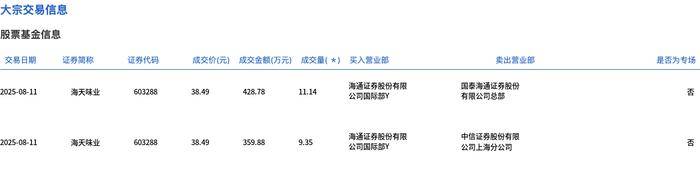
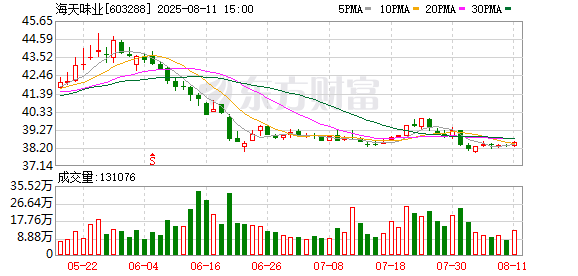
海天味业现2笔大宗交易 总成交金额788.66万元
Zheng Quan Shi Bao Wang· 2025-08-11 13:27
| 成交量 | 成交金额 | 成交价格 | 相对当日收盘折 | 买方营业部 | 卖方营业部 | | --- | --- | --- | --- | --- | --- | | (万股) | (万元) | (元) | 溢价(%) | | | | 11.14 | 428.78 | 38.49 | 0.00 | 海通证券股份有限公 | 国泰海通证券股份有 | | | | | | 司国际部Y | 限公司总部 | | 9.35 | 359.88 | 38.49 | 0.00 | 海通证券股份有限公 | 中信证券股份有限公 | | | | | | 司国际部Y | 司上海分公司 | (文章来源:证券时报网) 海天味业8月11日大宗交易平台共发生2笔成交,合计成交量20.49万股,成交金额788.66万元。成交价格 均为38.49元。 证券时报·数据宝统计显示,海天味业今日收盘价为38.49元,上涨0.60%,日换手率为0.24%,成交额为 5.04亿元,全天主力资金净流入3275.32万元,近5日该股累计上涨0.60%,近5日资金合计净流入174.56 万元。 两融数据显示,该股最新融资余额为12.01亿元,近5日减少13 ...
海天味业今日大宗交易平价成交20.49万股,成交额788.66万元
Xin Lang Cai Jing· 2025-08-11 09:46
| 交易日期 | 任务简称 | 证券代码 | 成交价[元] 成交金额(万元) 成交量(*) 英入营业部 | | | | 美出精变部 | 是否为专场 | | | --- | --- | --- | --- | --- | --- | --- | --- | --- | --- | | 2025-08-11 | 海天味业 | 603288 | 38.49 | 428.78 | 11.14 | 海通证券股份有限 公司固体验人 | 国泰海通证券股份 有限公司总监 | | 192 | | 2025-08-11 | 海天味业 | 603288 | 38.49 | 359.88 | 9.35 | 海通证券股份有限 公司国际部Y | 中信证券股份有限 公司上海分公司 | | 종 | 8月11日,海天味业大宗交易成交20.49万股,成交额788.66万元,占当日总成交额的1.54%,成交价 38.49元,较市场收盘价38.49元持平。 ...