外卖

Search documents
“配送慢”上热搜,外卖补贴战降温,配送压力反变大了?
Di Yi Cai Jing· 2025-08-18 13:22
Core Viewpoint - The competition among food delivery platforms is shifting from price wars to service quality, as consumer sensitivity to delivery performance increases following the reduction of subsidies [1][2]. Group 1: Delivery Issues - Users have expressed dissatisfaction with slow delivery times, with over 90 complaints noted on social media platforms in the past week, highlighting issues such as delivery times exceeding one hour and lack of available riders [1]. - The summer peak period has seen significant delivery chaos, with promotions leading to overwhelming demand that outstrips supply, resulting in order cancellations and delays [1]. Group 2: Rider Statistics - The number of delivery riders has significantly increased, with Ele.me reporting a 181% growth in active riders and a 236% increase in crowd-sourced riders by the end of July [2]. - In August, Ele.me's total number of riders reached 3.5 times that of the previous year, while JD reported 25 million daily orders in Q2, supported by over 150,000 full-time riders [2]. Group 3: Operational Challenges - Despite the increase in rider numbers, the distribution of riders may vary by region and time, complicating the ability to meet delivery demands during peak hours [3]. - Systemic issues, such as discrepancies in estimated delivery times between merchants and riders, as well as inefficient navigation routes, contribute to delays and require optimization [3]. Group 4: Competitive Landscape - Meituan is pushing for a "15-minute delivery" model, which has attracted user interest, although actual delivery times often exceed this promise, leading to consumer complaints [5]. - The competition is now focused on three main areas: user engagement, merchant partnerships, and rider resources, with a shift from acquiring new users to maximizing the value of existing ones [5].



内卷式竞争:怎么看,怎么办?
Jing Ji Guan Cha Wang· 2025-08-18 09:13
Core Viewpoint - Major platforms such as Meituan, Ele.me, and JD.com have jointly committed to resisting vicious competition and regulating promotional behaviors, marking a significant response to regulatory signals and a potential shift towards sustainable development in the industry [1] Group 1: Concept and Classification of "Involutionary Competition" - "Involution" refers to a complex internal development process that leads to increased complexity without qualitative change, often resulting in resource wastage and industry deterioration [2][3] - "Involutionary competition" is defined as excessive competition for limited market share that fails to enhance efficiency or create new value, leading to a waste of resources and a vicious cycle within the industry [2][3] Group 2: Types of "Involutionary Competition" - Horizontal involutionary competition manifests as price wars among peer companies, significantly compressing profit margins and damaging industry health [3][4] - Vertical involutionary competition occurs when dominant firms exert pressure on upstream and downstream partners, transferring costs and risks, which can lead to a low-quality, low-price, and low-efficiency cycle [4][5] Group 3: Causes of "Involutionary Competition" - Shrinking internal and external demand due to factors like trade tensions and demographic changes has led to increased price competition among firms [6][7] - Local government policies that prioritize short-term growth metrics over sustainable practices have exacerbated the issue, encouraging firms to engage in irrational competition [8][9] - The lure of China's vast market encourages aggressive strategies that prioritize market share over profitability, leading to a "winner-takes-all" mentality [10] - Scale economies and network effects drive firms to engage in price wars to achieve cost advantages, often at the expense of long-term stability [11] - Distorted financial valuation logic prioritizes growth over profitability, pushing firms to adopt aggressive pricing strategies to attract investment [12] - Cultural factors, such as the belief in "thin profit and high sales," contribute to a competitive environment that favors price cuts over value enhancement [13][14] Group 4: Strategies to Address "Involutionary Competition" - Expanding internal and external demand through policy reforms and enhancing consumer confidence is crucial to alleviating price competition [16][17] - Restructuring industrial policies and local incentives to focus on high-quality growth rather than short-term metrics can mitigate involutionary pressures [18][19] - Redefining competition boundaries and incentive structures in the unified market to prioritize value over price is essential [20][21] - Regulating platform governance and ensuring fair competition can prevent monopolistic behaviors that lead to systemic inefficiencies [21] - Reforming financial valuation logic to emphasize long-term value creation over short-term growth can help curb involutionary practices [22] - Promoting cultural change within organizations to prioritize sustainable growth and value creation over mere sales volume is necessary [23][24]
智氪|京东外卖的三笔账
3 6 Ke· 2025-08-18 07:55
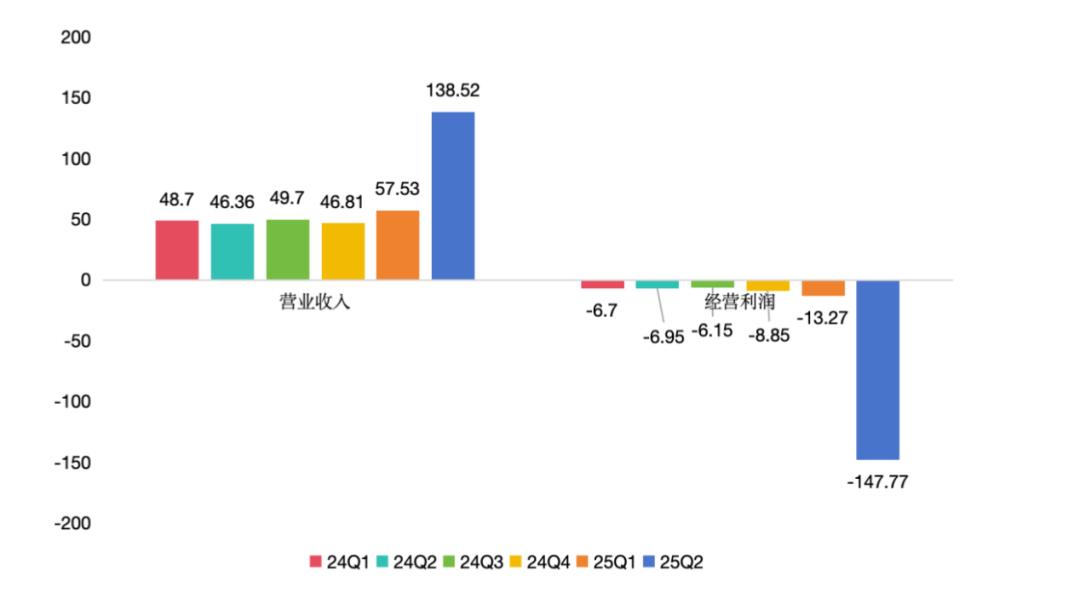
Core Insights - JD Group reported Q2 2025 earnings with revenue of 356.66 billion RMB, a year-on-year increase of 22.4%, while net profit dropped by approximately 51% to 6.178 billion RMB, primarily due to the impact of subsidies in the food delivery business [2][3] Financial Performance - The retail segment achieved revenue of 310.075 billion RMB, a year-on-year growth of 20.6%, and operating profit of 13.939 billion RMB, up 37.9% [15][21] - New business revenue, including food delivery, surged nearly 200% year-on-year to 13.852 billion RMB in Q2 2025, with operating losses expanding to approximately 14.777 billion RMB [5][9] Cost Structure - Operating expenses for new businesses increased significantly, with a year-on-year rise of 127.6 billion RMB being the main factor for losses in the food delivery segment [8][10] - Marketing expenses grew by about 128% to 27.013 billion RMB, largely driven by subsidies for the food delivery service [10][12] User Engagement and Growth - The food delivery business has positively impacted user engagement, with active user growth exceeding 40% and shopping frequency increasing over 40% [13][19] - The integration of food delivery into JD's ecosystem is expected to enhance cross-category purchasing behavior among users [19][24] Future Outlook - To mitigate the impact of food delivery on overall profitability, JD needs to scale the business to cover rider costs and reduce subsidies [24][25] - The company is exploring synergies between food delivery and retail, aiming to optimize operations in response to increased traffic from food delivery users [19][24]
外卖大战,打到了体育圈
3 6 Ke· 2025-08-18 07:49
Core Viewpoint - The article discusses the increasing trend of food delivery platforms, particularly Meituan, leveraging sports stars as brand ambassadors to enhance consumer trust and market penetration, especially in lower-tier cities and among price-sensitive consumers [2][10][13]. Group 1: Marketing Strategies - Meituan has appointed Olympic champion Sun Yingsha as the spokesperson for its "Pin Hao Fan" service, which focuses on affordable group meal deliveries, aiming to attract a broader consumer base [3][5]. - The marketing campaign emphasizes the connection between sportsmanship and everyday needs, positioning affordable meals as a choice endorsed by a champion, thus enhancing the perceived value of the service [7][9]. - The strategy reflects a shift in consumer perception, where low prices are no longer seen as inferior but as a viable option supported by a trusted athlete [9][16]. Group 2: Competitive Landscape - The article highlights a competitive landscape where various platforms, including JD and Taobao, have also begun to utilize sports stars for marketing, indicating a trend in the industry towards this approach [10][11][13]. - The collaboration with sports figures is seen as a way to differentiate brands in a saturated market, leveraging the athletes' credibility and public appeal to drive consumer engagement [14][15]. - The use of sports stars is not just about immediate sales but also about building long-term brand loyalty and consumer habits through emotional connections [15][17]. Group 3: Consumer Insights - Current data shows that the primary users of food delivery services are young consumers in first and new-tier cities, with lower penetration in lower-tier markets and among older demographics [5][6]. - The article suggests that sports stars resonate well with consumers across various age groups, making them effective in promoting services aimed at price-sensitive segments [6][15]. - The narrative around sportsmanship and everyday life creates a relatable image for consumers, encouraging them to try services like "Pin Hao Fan" [16][17].

乘AI东风,抢占中国科技核心资产的全球重估红利
Mei Ri Jing Ji Xin Wen· 2025-08-18 05:33
Group 1 - The Hang Seng Index rose by 0.62% to 25,426.53 points, with the Hang Seng Tech Index increasing by 1.96% and the Hang Seng China Enterprises Index up by 1.01% on August 18 [1] - The market's half-day trading volume reached HKD 171.95 billion, indicating active trading conditions [1] - Notable gainers included NIO-SW, which surged by 8.04%, JD Health rising by 6.94%, and SenseTime-W increasing by 5.20%, while Hua Hong Semiconductor fell by 5.89% and Sunny Optical Technology declined by 2.39% [1] Group 2 - The valuation pressure on the Hong Kong tech sector has been fully released after nearly a quarter of adjustment, with improved risk sentiment and ample liquidity laying a solid foundation for the next phase of growth [1] - The market is awaiting a strong thematic narrative to catalyze a new wave of enthusiasm in the Hong Kong tech sector [1] - The structural changes in the Hong Kong market have led to technology and consumer sectors now accounting for a significant portion of the market, shifting away from the previous dominance of finance and real estate [1] Group 3 - Global capital reallocation is expected to make Chinese assets a safe haven as overseas funds seek alternatives to dollar-denominated assets [2] - The Hong Kong market is experiencing a qualitative change with an influx of high-quality companies, which is fundamental for the sustainable bullish trend in the market [2] - The proportion of overseas funds allocated to Chinese assets remains relatively low, suggesting potential for future inflows if market sentiment stabilizes and international relations improve [2] Group 4 - The valuation system is undergoing a significant upgrade, with the Hang Seng Index's PE ratio rising from approximately 7.5 times to 11.6 times, aligning with the ten-year average and indicating room for further appreciation [2] - The Hong Kong tech sector is entering a golden window for systematic valuation reshaping, driven by multiple favorable factors including AI demand and rational market behavior [2] - The launch of the Hong Kong Stock Connect Tech ETF (159101) provides investors with an excellent opportunity to invest in leading tech companies in Hong Kong [2]
财报“敲响警钟”!摩根大通:京东三季度或退出价格战,阿里或继续,美团挑战严峻
美股IPO· 2025-08-18 03:54
Core Viewpoint - Morgan Stanley indicates that the competition in China's food delivery market is more intense than expected, leading to significant financial losses for major players like JD, Alibaba, and Meituan [8][10]. Group 1: JD's Performance - JD's second-quarter losses in food delivery investments reached 13 billion yuan, exceeding Morgan Stanley's forecast of 10 billion yuan by 30% [2][6]. - The revenue from JD's new business segment surged by 198.8% year-on-year, primarily driven by food delivery, but operational losses expanded dramatically from 700 million yuan to 14.8 billion yuan [4][5]. - JD's second-quarter loss per order is estimated at 10 yuan, which could indicate a challenging outlook for profitability [7][10]. Group 2: Alibaba's Strategy - Based on JD's performance, Morgan Stanley has raised Alibaba's third-quarter food delivery loss forecast to over 30 billion yuan, significantly higher than the previous estimate of 17 billion yuan [2][7]. - Alibaba is expected to continue investing in its food delivery business, preparing for a long-term competitive battle, contrasting with JD's potential withdrawal from aggressive pricing strategies [11][14]. - The increase in Alibaba's daily active users and merchant transactions suggests that its strategy may be yielding positive results despite the losses [14]. Group 3: Meituan's Challenges - Meituan, as the traditional market leader, faces the most severe challenges, with both market share and profitability at risk due to the changing competitive landscape [11][14]. - The shift in market share dynamics could significantly impact Meituan, which has historically captured a large portion of industry profits [14]. - Morgan Stanley warns that a decline in the industry's profit pool and Meituan's market share could lead to sustained pressure on its stock price [14].


快手联手美团上线外卖入口,采用轻资产模式突围
Sou Hu Cai Jing· 2025-08-18 03:01
Core Viewpoint - Kuaishou is entering the food delivery market by launching an independent "takeout" section on its app, aiming to differentiate itself through a "Meituan supply chain + self-owned merchants" light asset model amid intense competition in the food delivery sector [2][3]. Company Strategy - Kuaishou's new takeout service relies on Meituan's merchant vouchers, requiring users to complete orders through Meituan's mini-program, with delivery handled by Meituan or third-party services [5][10]. - The company has previously explored local lifestyle services, partnering with various platforms and establishing a dedicated local lifestyle division in 2022 [6][8]. - Kuaishou's strategy includes a dual approach of leveraging Meituan's supply chain while also incorporating its own local merchants, with approximately 90% of products sourced from Meituan [10]. Market Context - The food delivery market is highly competitive, with major players like Meituan, Alibaba, and JD.com already established [2][9]. - Kuaishou's entry into this market comes as its core business faces growth challenges, particularly in live streaming and e-commerce, where GMV growth has significantly slowed [12][16]. Financial Performance - In 2024, Kuaishou reported revenue of 1268.98 billion yuan, an 11.83% year-on-year increase, with a net profit of 153.35 billion yuan, up 139.76% [13]. - The company's e-commerce GMV reached 1.39 trillion yuan in 2024, with growth rates dropping from 78% in 2021 to 17% in 2024, highlighting a stark contrast with Douyin's performance [16][17]. User Engagement - Kuaishou's daily active users reached 408 million by Q1 2025, with over 62% from new tier cities, providing a potential consumer base for its food delivery services [10]. - The number of users paying for local delivery services increased by over three times in Q2 2024, indicating a shift in user behavior towards food delivery [11]. Competitive Landscape - Kuaishou's cautious approach in the food delivery sector is influenced by the challenges faced by Douyin, which has struggled to establish a successful delivery model despite its initial efforts [9][20]. - The company aims to explore new growth avenues through its food delivery initiative, potentially alleviating pressures from declining growth in its core businesses [18].


快手的“叛逆”期到了
3 6 Ke· 2025-08-18 02:23
Core Viewpoint - Kuaishou has entered the food delivery market amidst a slowdown in competition among major players like Meituan, Taobao, and JD, which have called for a halt to chaotic competition [1][2][5]. Group 1: Market Dynamics - The food delivery war has entered a phase of reduced competition, with major platforms advocating for orderly practices [1][2]. - Kuaishou's entry into the food delivery space comes at a time when other platforms, such as Douyin, have explicitly stated they have no plans to develop their own delivery services [5][10]. - Kuaishou's food delivery feature acts as a link to third-party services rather than establishing its own delivery infrastructure, similar to previous collaborations with Meituan [5][7]. Group 2: User Engagement and Strategy - Kuaishou's decision to launch a food delivery service is driven by a need to retain user engagement as its growth rate slows [7][11]. - The platform aims to keep users within its ecosystem while they order food, contrasting with the strategies of e-commerce platforms that seek to attract users to their apps [15][17]. - Kuaishou's community culture and high user retention rates are seen as critical assets in this strategy [19][21]. Group 3: Financial Performance and Growth - Kuaishou's local life services have shown significant growth, with a reported GMV increase and a revenue growth of 200% year-on-year in Q1 2025 [24][25]. - Despite revenue growth, Kuaishou's core marketing projects have seen a decline in growth rates, indicating a need for diversification in revenue streams [28][29]. - The company is exploring various monetization avenues, including self-operated e-commerce and food delivery, to adapt to competitive pressures [30][32]. Group 4: Competitive Landscape - Other platforms like JD are also exploring new models in the food delivery space, such as opening their own delivery kitchens, which presents a competitive challenge to Kuaishou [33][36]. - Kuaishou's user demographics are more concentrated in specific regions, allowing for targeted strategies in food delivery that leverage local preferences [39][41]. - The integration of food delivery with Kuaishou's existing content and community features could enhance user interaction and retention [43][44].
财报“敲响警钟”!摩根大通:京东三季度或退出价格战,阿里或继续,美团挑战严峻
Hua Er Jie Jian Wen· 2025-08-18 01:08
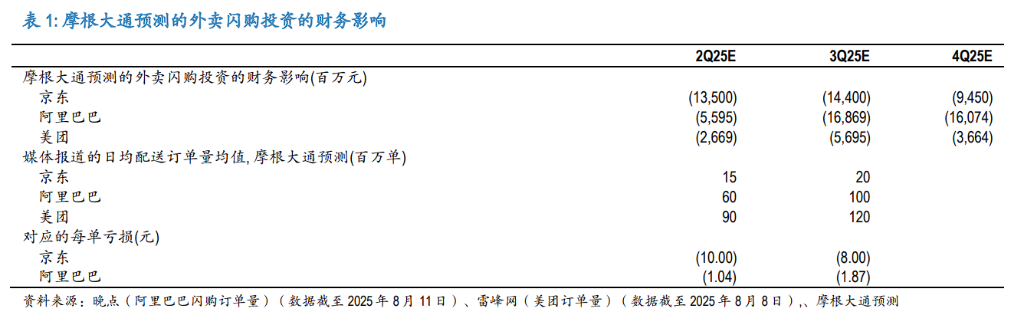
Core Insights - Morgan Stanley warns that the competition in China's food delivery market is more intense than expected, leading to differentiated fates for the three major players: JD.com, Alibaba, and Meituan [1][6] Group 1: Financial Performance - JD.com's second-quarter losses in food delivery investments reached 13 billion yuan, exceeding Morgan Stanley's initial forecast of 10 billion yuan by 30% [3] - Alibaba's projected losses for the third quarter are now expected to exceed 30 billion yuan, significantly higher than the previous estimate of 17 billion yuan [4][5] - The financial impact of food delivery investments for the second to fourth quarters of 2025 is projected as follows: - JD.com: (13.5 billion), (14.4 billion), (9.45 billion) - Alibaba: (5.595 billion), (16.869 billion), (16.074 billion) - Meituan: (2.669 billion), (5.695 billion), (3.664 billion) [5] Group 2: Market Dynamics - JD.com may be the first to withdraw from the price war due to financial pressures, while Alibaba is likely to continue investing in food delivery for strategic reasons [1][6] - Meituan, as the industry leader, faces the most severe long-term challenges due to changing market dynamics [1][8] - The competitive landscape is expected to fundamentally change, with Alibaba potentially continuing to invest in food delivery and exploring flash purchase opportunities [8] Group 3: Consumer Behavior and Market Share - The long-term investments in the industry may alter consumer behavior, potentially lowering the average order value and GMV, which could negatively impact the overall profit pool of the industry [8] - Meituan's market share and profitability are at risk if the industry's profit pool declines, leading to sustained pressure on its stock price [8]
京东这一仗,单季血亏超百亿
雷峰网· 2025-08-18 00:52
Core Viewpoint - JD's entry into the food delivery market has resulted in significant financial losses, impacting its overall profitability and stock performance, despite a record revenue growth in Q2 2025 [2][3][9]. Group 1: Financial Performance - In Q2 2025, JD reported a revenue of 356.66 billion yuan, a year-on-year increase of 22.4%, but net profit dropped by 50.8% to 6.2 billion yuan [2][7]. - The operating loss in the new business segment, which includes food delivery, surged from 700 million yuan to 14.8 billion yuan year-on-year, leading to an overall operating loss of 900 million yuan [8][9]. - Marketing expenses skyrocketed from 11.9 billion yuan to 27 billion yuan, a 127.6% increase, significantly outpacing revenue growth [8]. Group 2: Market Dynamics - JD's stock price fell over 33% from a peak of 179 HKD in March to 120.3 HKD by mid-August, reflecting investor concerns about its profitability [4][10]. - The food delivery business, which generated 13.9 billion yuan in revenue, is seen as a major focus for analysts, despite its substantial losses [5][8]. Group 3: Strategic Outlook - JD's CEO emphasized the long-term vision for food delivery and instant retail, aiming for sustainable business models rather than short-term profits [11]. - Despite the challenges, JD's core retail business remains strong, with a 20.6% revenue growth, contributing significantly to overall profits [7][12]. - Analysts express skepticism about JD's ability to maintain user growth and profitability in the food delivery sector, especially given the competitive landscape [11][14].