
白电

Search documents
深度求索系列 - 牛市思维看白电
2025-08-11 14:06
Summary of Key Points from the Conference Call on the White Goods Industry Industry Overview - The white goods industry is currently experiencing low valuations, with leading companies like Midea, Gree, and Haier trading below the 1/3 percentile of their historical valuation since 2010, contrasting with the rising valuations of the CSI 300 index [1][3] - Future growth in the white goods sector is expected to be driven primarily by overseas markets, particularly in emerging regions such as Asia, Africa, and Latin America, where Chinese appliance companies are likely to expand their market share through channel development and brand optimization [1][5] Valuation and Market Sentiment - Current valuations of leading white goods companies are at historically low levels, with Midea's price-to-earnings (P/E) ratio dropping from 15.3 to around 13, Gree from 8.4 to 7.6, and Haier from 14.2 to approximately 12 [3][4] - Despite concerns about short-term market conditions, historical trends indicate that the white goods sector has potential for price recovery, especially in the context of new public fund regulations and increased institutional investment [1][7] Financial Health and Shareholder Returns - Leading white goods companies have a high proportion of cash assets, approximately 35% of total assets, which provides them with the capacity and motivation to increase cash dividends and dividend yields [6][10] - The decline in government bond yields is expected to support a temporary recovery in the valuations of the white goods sector, making investments in this sector more attractive compared to government bonds [11] Growth Opportunities - The expansion of production capacity in Thailand is seen as beneficial for global stability in the white goods market, with long-term growth trends remaining reliable despite cyclical fluctuations in profitability [9] - The white goods sector is expected to benefit from a gradual recovery in U.S. real estate demand starting in 2026, which could positively impact companies like Haier [18] Regulatory and Market Dynamics - New public fund regulations are likely to enhance the preference for competitive assets in the white goods sector, as they emphasize long-term performance metrics [14] - Insurance capital is expected to increasingly invest in the A-share market, with the white goods sector being attractive due to its high dividend yields [15] Dividend Performance - The dividend yields of leading white goods companies, such as Gree (6.8% to 7%) and Midea (4.8% to 5%), are significantly higher than those of the banking and non-banking sectors, indicating a favorable investment environment [16] Price Competition and Profitability - Concerns regarding price competition in the air conditioning segment have been found to be overstated, as price reductions were limited to specific online SKUs and have since stabilized [17] Conclusion - Despite market concerns about the white goods industry's performance, it remains a relatively stable sector with potential for recovery and growth, particularly in light of favorable valuation conditions and emerging market opportunities [18]



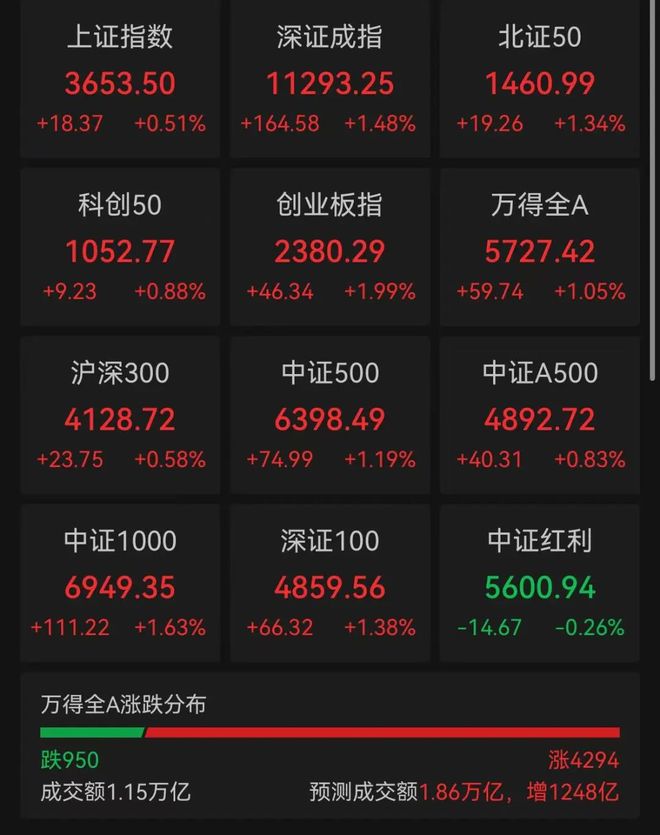
超4200股上涨,沪指再刷年内新高
2 1 Shi Ji Jing Ji Bao Dao· 2025-08-11 03:55
Market Performance - A-shares experienced a collective rise with major indices reaching new highs, with the Shanghai Composite Index up by 0.51%, Shenzhen Component Index up by 1.48%, and ChiNext Index up by 1.99% [1][2] - The trading volume in the Shanghai and Shenzhen markets exceeded 1 trillion yuan for the 53rd consecutive trading day, with an expected total trading amount of over 1.8 trillion yuan [2] Sector Performance - The market showed a healthy rotation of hotspots, with over 4,200 stocks rising, while sectors such as PEEK materials and lithium mining led the gains [3][4] - PEEK materials increased by 6.20%, lithium mining by 5.51%, while sectors like banking, electricity, and gold saw declines [3][4] Investment Insights - Huatai Securities noted a rebound in A-shares driven by trading funds, with a tactical focus on sectors like storage, software, and insurance, while maintaining a strategic outlook on large financials, pharmaceuticals, and military industries [5] - The average price-to-earnings ratios for the Shanghai Composite and ChiNext indices are at 14.93 and 41.75 respectively, indicating a suitable environment for medium to long-term investments [5] - The Chinese economy is showing a moderate recovery, with consumption and investment as core drivers, supported by a favorable liquidity environment [5]

国金证券:短期市场模糊期,亦可适当把握复苏前期行业轮动的路径
Di Yi Cai Jing· 2025-08-11 01:15
Core Viewpoint - The market is experiencing accelerated sector rotation as it approaches a profit bottom, with recent trends reflecting this characteristic [1] Group 1: Investment Strategies - Historical experiences from 2016 and 2020 indicate that a "high cut low" strategy can yield excess returns in the early stages of recovery, but the effectiveness based on stock price levels is weaker than that based on valuations [1] - Investors are currently more focused on demand-side recovery and improvements in operational efficiency/profit quality, as indicated by the performance of ROA and revenue change factors, which outperform ROE and net profit [1] - The current market is unique in that the pricing power of institutional investors focusing on valuation and profit is weaker than in previous recovery periods, while the importance of individual investors has increased [1] Group 2: Sector Focus - Two strategies are recommended for the current short-term rotation: 1. Focus on sectors with expected demand and asset profitability recovery that are undervalued 2. Identify stocks in sectors with relatively low stock prices, particularly those that attract higher attention from individual investors [1] - In the first strategy, sectors such as industrial metals, rail transit equipment, kitchen appliances, and white goods show improving profit margins while maintaining mid-to-low valuation levels [1] - For the second strategy, the consumer sector has a relatively high proportion of stocks at 250-day lows, while growth sectors with high individual investor interest include media, brokerage, and computer industries, which have a high concentration of stocks at 20-day lows [1]

华泰证券:战略配置继续看好大金融、医药、军工
Zheng Quan Shi Bao Wang· 2025-08-11 00:03
Core Viewpoint - Huatai Securities research report indicates that the A-share market experienced a rebound last week, driven by trading funds that activated thematic market activity, with an expectation of increased volatility [1] Tactical Allocation - The report suggests tactical allocation to sectors showing signs of improvement and those with potential for catch-up, including storage, software, general automation, certain chemical products, insurance, coal, and white goods with attractive dividend yields [1] Strategic Allocation - For strategic allocation, the report maintains a positive outlook on large financials, pharmaceuticals, and military industries [1]

十大券商一周策略:A股仍处于牛市中继,避免参与似是而非的资金接力
Zheng Quan Shi Bao· 2025-08-10 23:59
Group 1 - The current market for small and micro-cap stocks needs to slow down, as high valuations and negative TTM profits make it difficult to justify further upward movement [2] - The five strong industry trends (non-ferrous metals, telecommunications, innovative pharmaceuticals, gaming, and military industry) have more reasonable valuations compared to the small and micro-cap stocks [2] - The main drivers of small and micro-cap stocks are liquidity and retail investor contributions, but their overall profit growth is not as strong as in 2015 [2] Group 2 - A rebound in A-shares was observed, driven by trading funds, with a focus on themes like dividends and small micro-cap stocks [3] - The two financing balance reached a nearly 10-year high, indicating that liquidity-driven market conditions may still have incremental support [3] - The PPI has shown signs of bottoming out, and the "anti-involution" policy is beginning to show effects, suggesting a stable economic outlook [3] Group 3 - July exports exceeded expectations, particularly in competitive manufacturing sectors like machinery, automobiles, and integrated circuits [4] - The PPI decline has stabilized, benefiting from price rebounds in sectors like black metals, non-ferrous metals, coal, and photovoltaics [4] - The basic economic fundamentals are showing a trend of steady improvement, with recommendations to focus on sectors with high growth or improvement in earnings [4] Group 4 - The two financing balance has risen above 2 trillion yuan, but remains at historical mid-levels compared to the peak in 2015 [5] - The market is expected to maintain a high volatility range, with a focus on sectors with strong earnings performance during the concentrated reporting period [5] - The "anti-involution" concept is anticipated to be a recurring theme in the market, alongside opportunities in growth sectors driven by AI and emerging industries [5] Group 5 - The current bull market atmosphere is not expected to dissipate easily, with potential mainline directions including domestic technological breakthroughs and competitive manufacturing sectors [6] - The market is likely to maintain its characteristics of sector rotation and high micro-level activity, with small-cap growth stocks continuing to outperform [6] - There are new opportunities for participation, particularly in event-driven individual stocks [6] Group 6 - Short-term upward movement in A-shares may face resistance, but the market remains in a bull market continuation phase [7] - The focus is on new low-level niche products in emerging sectors, with significant potential in areas like brain-computer interfaces and liquid cooling technologies [7] - The military sector is expected to have a short-term rally, with attention on new combat capabilities and military trade-related stocks [7] Group 7 - The current market rally is supported by various sources of incremental capital, with a notable increase in M1-M2 growth rates indicating enhanced liquidity [8] - The two financing balance reaching a 10-year high reflects a rising risk appetite among individual investors [8] - The focus on new technologies and growth directions, such as domestic computing power and robotics, is expected to drive future market trends [8] Group 8 - There is a divergence in judgment regarding the liquidity-driven bull market, with the potential for significant resident capital inflow into the stock market [9] - Historical patterns suggest that the initial phases of a bull market often see improvements in specific channels before broader participation [9] - The current market's rise is still modest compared to previous bull markets, indicating that concerns about a major downturn may be premature [9] Group 9 - The current market adjustment is seen as a structural shift rather than a peak in the broader cycle, with manageable index fluctuations [11] - The market is transitioning from traditional cyclical sectors to technology sectors, driven by policies similar to previous economic stimulus measures [11] - Continued focus on technology sectors, including AI and robotics, is recommended for future investment strategies [11]
华泰证券:战术关注景气改善的低位补涨品种,战略看好大金融、医药、军 工
Sou Hu Cai Jing· 2025-08-10 23:45
Group 1 - The A-share market experienced a rebound driven by trading funds, with a notable increase in volatility expectations and a return to a "dumbbell" style focusing on dividends and small-cap stocks [1][2] - The margin trading balance reached a nearly 10-year high of 2 trillion yuan, indicating significant liquidity support for the market [2][3] - The number of public fund reports has shown signs of recovery, suggesting a potential shift of household savings into equity funds [2][3] Group 2 - The "anti-involution" policy is beginning to show results, with July's PPI year-on-year expected to rebound from its low point, although the extent of recovery will depend on policy effectiveness [3][4] - The macroeconomic indicators, such as improved profit margins for industrial enterprises and reduced accounts receivable turnover days, reflect positive impacts from the "anti-involution" measures [3][4] - Certain sectors, including wind power, automotive, logistics, and aquaculture, are experiencing a recovery in sentiment, indicating a broader improvement in economic conditions [3][4] Group 3 - External risks remain, particularly regarding tariff policies and Federal Reserve monetary policy, which could affect market sentiment and investment strategies [4][5] - The market is approaching a period of concentrated interim report disclosures, which may lead to increased volatility, but the downside risk is considered limited [5][6] - Tactical investment strategies are recommended to focus on sectors with improving sentiment and potential for rebound, such as storage, software, and certain chemical products [5][6]
【十大券商一周策略】A股仍处于牛市中继!避免参与似是而非的资金接力
券商中国· 2025-08-10 16:05
Group 1 - The current market sentiment suggests that small and micro-cap stocks need to slow down, as their valuation and earnings growth do not justify further upward movement [2] - The five strong industries (non-ferrous metals, telecommunications, innovative pharmaceuticals, gaming, and military industry) have more reasonable valuations compared to the small and micro-cap stocks [2] - The driving force behind the small and micro-cap stocks is primarily liquidity, with significant contributions from quantitative products, small active equity products, and retail investors [2] Group 2 - Recent data indicates that A-shares experienced a rebound driven by trading funds, with a notable increase in margin trading balances reaching a near 10-year high [3][6] - The market is expected to maintain a high level of volatility, with sector rotation likely to occur as companies report their semi-annual results [3][6] - The "anti-involution" policy is showing initial effects, and the determination and difficulty of implementing such policies should not be underestimated [3] Group 3 - July exports exceeded expectations, particularly in the machinery, automotive, and integrated circuit sectors, indicating resilience in growth [5] - The Producer Price Index (PPI) has stabilized, benefiting sectors like black metals, non-ferrous metals, coal, and photovoltaic industries, which are experiencing price rebounds [5] - The overall economic fundamentals are showing a trend of stability and improvement, suggesting a focus on sectors with high growth or improvement in earnings for investment [5] Group 4 - The market is expected to remain in a high oscillation range, supported by favorable liquidity conditions, with a focus on sectors with strong earnings momentum [6][10] - The "anti-involution" concept is anticipated to be a recurring theme in market trends, with growth sectors likely to show high levels of activity [6] - The military industry is expected to remain a point of interest, particularly as the "14th Five-Year Plan" concludes and the "15th Five-Year Plan" begins to take shape [6] Group 5 - The current market adjustment is seen as a structural shift rather than a peak in the economic cycle, with limited impact on overall market sentiment [14] - The market is transitioning from traditional cyclical sectors to technology sectors, with a focus on AI and robotics as key investment areas [14] - The "anti-involution" policies are expected to lead to a structural market trend similar to previous government-led initiatives aimed at boosting demand [14]

TCL智家20250807
2025-08-07 15:03
Summary of TCL Smart Home Conference Call Company and Industry Overview - **Company**: TCL Smart Home - **Industry**: Home Appliances, specifically focusing on refrigerators and white goods Key Points and Arguments 1. **Ouma Refrigerator's Dominance**: Ouma Refrigerator holds a leading position within TCL Smart Home due to its high profit margins, benefiting from its upstream position in the supply chain and strong economies of scale, with an average profit of approximately 150 RMB per unit [2][8] 2. **Acquisition Strategy**: TCL's acquisition of Ouma Electric aims to enhance the valuation of white goods assets through a reverse listing and leverage the synergy between black and white goods, particularly in the European market, to expand higher-margin white goods business [2][6] 3. **China's Global Market Position**: Chinese home appliance manufacturers dominate the global market, producing a significant portion of the world's air conditioners, refrigerators, and washing machines, with Ouma accounting for about 30% of the export market share [2][11] 4. **Acquisition Status**: TCL has paused the acquisition of the remaining 49% stake in Ouma Refrigerator but retains the right of first refusal for future strategic needs [2][10] 5. **Impact of European Market**: The European market is crucial for the refrigerator export industry, with fluctuations in inventory, shipping costs, and exchange rates affecting large enterprises like Ouma, which can capitalize on rising shipping costs to gain market share [2][17] 6. **Consolidation in Domestic Market**: The domestic refrigerator industry is experiencing consolidation, with smaller manufacturers losing market share, while larger companies like Ouma benefit from economies of scale and process optimization to achieve higher profit margins [2][18] 7. **Profitability Factors**: TCL Smart Home has benefited from lower domestic PPI and higher European CPI, significantly improving export profit margins despite potential short-term growth slowdowns [3][16] 8. **Core Assets**: The core assets of TCL Smart Home include Ouma Refrigerator and TCL Hefei, with Ouma contributing the majority of profits, while TCL Hefei is currently at a break-even point [4][6] 9. **Historical Context**: Ouma Electric faced liquidity risks in 2019 due to its internet finance business, leading to the sale of a 49% stake in Ouma Refrigerator to address these issues, followed by TCL becoming the largest shareholder in 2021 [5][6] 10. **Black and White Goods Synergy**: The synergy between black and white goods is vital for enhancing brand influence and market share, particularly in Europe, where successful examples exist [7][8] 11. **Cost Advantages**: Chinese home appliance manufacturers, including Ouma, enjoy significant cost advantages, with manufacturing cost indices showing China at 100 compared to 120-130 for Vietnam and 180-200 for the U.S. [8][11] 12. **Bullwhip Effect**: The home appliance export sector experiences a bullwhip effect, where retail fluctuations are less than shipment fluctuations, leading to increased uncertainty in the upstream supply chain [14] 13. **International Market Dynamics**: TCL's exposure to the U.S. market is limited due to tariff policies, while its exports to Europe are increasing, reflecting a shift in production capabilities [15][22] 14. **Future Growth Potential**: TCL Smart Home's current valuation is around ten times earnings, considered relatively cheap, with long-term growth potential expected from the next industrial cycle [22] Additional Important Insights - **Production Cost Management**: Ouma's ability to reuse molds significantly reduces opening mold costs, enhancing its competitive edge in the refrigerator manufacturing sector [12] - **Emerging Market Challenges**: While emerging markets present growth opportunities, challenges such as electricity coverage and potential loss of existing customer orders due to brand competition remain [21][20] - **Strategic Global Capacity Layout**: Ouma Electric is expanding its global capacity in Southeast Asia to meet future business demands, leveraging its strong supply chain capabilities [19]


浙商证券:白电估值处于历史低位 补涨机会显现
智通财经网· 2025-08-07 07:57
Group 1 - The current valuation of leading white goods companies is at a low level not seen since 2010, while the valuation of the CSI 300 index has been rising, indicating a potential "high cut low" rebound opportunity for the white goods sector [1] - Despite a marginal decline in short-term industry prosperity, the long-term growth potential remains intact, supported by expectations of increased dividend rates and declining government bond yields, which may lead to a phase-wise recovery in valuations [1] - Historical performance during the last A-share bull market shows that leading white goods companies underperformed the CSI 300 and Shanghai Composite Index, but they exhibited excess returns during rapid index upswings [2] Group 2 - The new regulations for public funds may enhance their preference for white goods, with over 10% of holdings in leading companies, and a significant portion being passive index funds, indicating room for increased allocation [3] - The current dividend yield of white goods companies is attractive, with Gree at 7% and Midea at 5%, which is significantly higher than that of banks and non-bank financials, suggesting a favorable investment opportunity [4] - The insurance sector is expected to allocate 30% of new premiums to A-shares starting in 2025, which could further boost investment in white goods due to their stable dividend yields and higher return on equity compared to banks [4]

家电2025H2策略:价值稳舵,新消费破浪
2025-08-05 03:20
Summary of Key Points from the Conference Call Industry Overview - The home appliance industry is characterized by an oligopolistic structure, with leading companies benefiting from significant economies of scale and having substantial growth potential in overseas markets, indicating long-term investment value, particularly in cash returns [1][3] Core Insights and Arguments - The white goods sector showed weak performance in the first half of the year due to tariffs and the diminishing effects of the old-for-new policy, while the air conditioning segment performed relatively well [1][4] - The black goods sector benefited from Mini LED technology upgrades and a more favorable competitive landscape, leading to increased profit elasticity [1][4] - Investment strategies for the second half of the year should focus on high dividend yields and high ROE, with leading companies like Midea, Haier, and Gree offering dividend yields of approximately 4%, 7-8%, and 5% respectively, providing valuation support [1][6] - The competitive landscape in the white goods sector is concentrated on models priced below 2,700 yuan, with Midea initiating a price war against Xiaomi, which is adopting a defensive strategy to increase market share in the 4,000-4,500 yuan price range [1][7] - Export chain companies need to be aware of the expected differences in overseas tariffs, with Southeast Asia's production capacity performing better than expected and China's production capacity recovering well [1][10] Additional Important Insights - The competition in the black goods sector has improved, with Chinese panel manufacturers reducing costs through technology upgrades, allowing companies like Hisense and TCL to capture market share overseas [1][14] - The white goods sector's competition is expected to remain intense, particularly in the low-end market, while leading companies are leveraging brand extension and high-end product profits to mitigate impacts from low-end market pressures [1][7] - The national subsidy policy is expected to continue in the second half of 2025, but its marginal effects may weaken, particularly in certain regions where specific products may not qualify for subsidies [1][8] - The Mini LED television market is experiencing increased penetration due to declining electronic module costs and government subsidy policies narrowing the price gap between high-end and low-end products [1][18] - New consumer trends in the home appliance industry are emerging, focusing on low penetration, high explosive growth, and high scarcity, with brands like Beiding showing significant growth in the small appliance segment [1][20] - The robotic vacuum cleaner sector is currently in a phase of improving competitive dynamics, with companies like Ecovacs and Roborock showing promising profit trends [1][21] - Future investment strategies in the home appliance industry should prioritize robust assets, improving competitive landscapes, and new consumer trends, particularly in high-dividend white goods, black goods, and innovative small appliance brands [1][22]
