
银行业

Search documents
金属市场不是牛市结束,而是中场休息
Sou Hu Cai Jing· 2026-02-09 01:09
Core Viewpoint - Morgan Stanley indicates that major metals like gold, silver, and copper will enter a consolidation phase in the coming weeks after significant price increases [2][3]. Group 1: Gold Market Analysis - The recent decline in gold prices is characterized as a technical reversal rather than a long-term bearish trend, suggesting that the bull market is still intact but requires a pause [3][4]. - Gold's previous price surge exhibited a parabolic pattern, which typically faces momentum exhaustion, with $5000 and the $5100–$5150 range acting as significant short-term resistance levels [5]. - The core logic supporting the gold bull market remains intact, primarily driven by the weakness of the US dollar, which is expected to stay below 100, indicating ongoing risks of currency devaluation [6]. Group 2: Copper and Economic Expectations - Copper prices have recently slowed above $14,000, raising questions about whether the price increase is detached from fundamental realities, as current manufacturing PMI is around 50.5, while copper prices imply a PMI of approximately 53 [10]. - The analysis suggests that the optimism surrounding copper is not isolated but reflects a broader bet on economic recovery across cyclical assets, including semiconductor stocks [11]. - In the upcoming consolidation phase, basic metals like copper are expected to receive more support than precious metals due to the dual influence of manufacturing recovery and cyclical rotation, while gold faces profit-taking pressures [12]. Group 3: Market Dynamics and Investment Strategy - The report emphasizes that during the consolidation phase, the focus should be on market rhythm rather than direction, with the metaphor of a paused dance indicating that while the metal frenzy may slow, it is not over [13][14]. - Investors are encouraged to reassess their positions rather than exit the market entirely, as true trends often require consolidation to solidify their foundations [15].


格林大华期货早盘提示-20260209
Ge Lin Qi Huo· 2026-02-08 23:29
Report Industry Investment Rating - The investment rating for the bond futures in the macro and finance sector is "volatile" [1] Core Viewpoints of the Report - On Friday, the main contracts of bond futures opened higher across the board and fluctuated upwards throughout the day, with the 30-year variety showing stronger performance. The 1-year inflation expectation in the US dropped from 4% to a 13-month low of 3.5%. The official manufacturing PMI in January was 49.3%, falling back below the boom-bust line. The bond futures may fluctuate in the short term, and trading investors are advised to conduct band operations [1][2] Summary by Relevant Catalogs Market Review - On Friday, the main contracts of bond futures opened higher across the board and fluctuated upwards throughout the day. The 30-year bond futures main contract TL2603 rose 0.42%, the 10-year T2603 rose 0.08%, the 5-year TF2603 rose 0.03%, and the 2-year TS2603 rose 0.02%. The Wind All A index opened lower, rose in the morning session, and slightly declined in the afternoon, closing down 0.19% from the previous trading day, forming a small Yang line with an upper shadow, with a trading volume of 2.16 trillion yuan, a slight contraction compared to the previous trading day's 2.19 trillion yuan [1][2] Important Information - Open market: On Friday, the central bank conducted 31.5 billion yuan of 7-day reverse repurchase operations and 300 billion yuan of 14-day reverse repurchase operations. With 477.5 billion yuan of reverse repurchases maturing on the same day, the net withdrawal was 146 billion yuan. - Money market: On Friday, the overnight interbank funding market rate remained flat compared to the previous trading day. The weighted average of DR001 throughout the day was 1.32%, and that of DR007 was 1.48%. - Cash bond market: On Friday, the closing yields of interbank government bonds declined compared to the previous trading day. The yield to maturity of the 2-year government bond dropped 0.37 BP to 1.36%, the 5-year dropped 1.34 BP to 1.56%, the 10-year dropped 0.67 BP to 1.81%, and the 30-year dropped 2.00 BP to 2.25%. - US policy: The US President signed an executive order to impose tariffs on countries trading with Iran, but no new tariffs have been added for now. The US and Iran held "very good talks," and the US will negotiate with Iran again next week. - US inflation expectation: The 1-year inflation expectation in the US dropped from 4% to a 13-month low of 3.5% [1] Market Logic - In January, the official manufacturing PMI was 49.3%, falling back below the boom - bust line, with the new order index at 49.2%, indicating a decline in manufacturing market demand. The business activity index of the construction industry in January was 48.8%, and that of the service industry was 49.5%, remaining below the boom - bust line for the third consecutive month. The Ministry of Finance stated that in 2026, the fiscal deficit, total debt, and total expenditure will be maintained at a necessary level. The central bank governor said that there is still room for reserve requirement ratio cuts and interest rate cuts this year [1][2] Trading Strategy - Trading investors are advised to conduct band operations [2]
中国黄金,宣布调整
Sou Hu Cai Jing· 2026-02-08 23:21
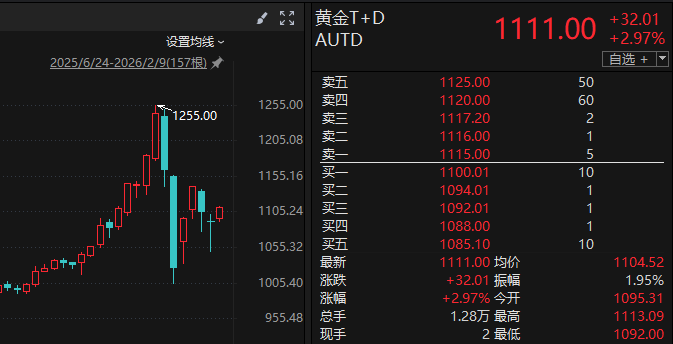
Core Viewpoint - The recent volatility in precious metal prices has prompted China Gold to adjust its gold repurchase business rules to enhance risk management and operational efficiency in response to market uncertainties [1][3]. Group 1: Market Conditions - Precious metal prices have shown significant fluctuations, with gold T+D prices recently at 1111 RMB per gram, up by 32.01 RMB (2.97%) from the previous trading day, but down 11.47% from a recent high of 1255 RMB per gram [2]. - The Shanghai gold futures market also reflects this volatility, with the latest price at 1114.5 RMB per gram, down 11.46% from a recent peak of 1258.72 RMB per gram [2]. Group 2: Business Adjustments - China Gold's adjustment to its repurchase rules includes limiting transactions to trading days to align with market pricing mechanisms, thereby avoiding pricing disputes and operational risks [1][3]. - The company aims to control its risk exposure during periods of price volatility, as acquiring physical gold without market price references could lead to significant losses [1][3]. - The new rules will implement limit management on repurchase transactions starting February 7, 2026, including daily repurchase limits and appointment systems, with adjustments based on market conditions [3]. Group 3: Industry Insights - Experts suggest that the adjustment is a necessary measure to stabilize the market and protect investor interests amid increasing price volatility and a lack of risk awareness among investors [3]. - Other major gold retailers are also adjusting their repurchase policies, indicating a broader industry trend towards enhanced risk management practices [7]. - The current trading sentiment in the precious metals market has shifted from risk aversion to speculation, exacerbating trading risks, particularly as stock market optimism grows [7].

金价真的一夜变天!2月7日最新报价,全国价差最高差430元克?
Sou Hu Cai Jing· 2026-02-08 23:04
Core Viewpoint - The significant price disparity in the gold market, with differences reaching up to 430 yuan per gram, raises questions about the true value of gold purchases and whether they represent an investment or merely an expensive consumer experience [3][4]. Market Dynamics - On February 7, the Shanghai Gold Exchange's gold T+D contract closed at approximately 1111 yuan per gram, reflecting a nearly 3% increase, while international gold prices surged to 4962 USD per ounce, indicating substantial market volatility [6]. - The basic gold price serves as an initial anchor point, but the actual prices consumers encounter in retail settings differ significantly due to various factors [8]. Pricing Structures - Investment gold bars sold by banks, such as those from China Construction Bank and Industrial and Commercial Bank, were priced around 1079.60 yuan and 1106.64 yuan per gram, respectively, showing a price difference of nearly 30 yuan between banks [9]. - Retail prices at high-end jewelry stores like Chow Tai Fook and Lao Feng Xiang reached as high as 1508 yuan per gram, which is over 420 yuan more than the bank prices, primarily reflecting brand premiums and additional costs [11][15]. Brand and Channel Costs - The additional costs in brand jewelry stores include brand premiums, high channel costs, and luxurious shopping experiences, which contribute to the overall price of gold jewelry [13][14]. - The Shenzhen Shui Bei wholesale market offers a more economical alternative, with prices around 1247 yuan per gram plus minimal processing fees, resulting in total costs that remain significantly lower than those at branded stores [14][15]. Recovery and Realization - Regardless of the purchase price, when consumers attempt to sell their gold, it is valued based on the raw gold price, typically around 1070 yuan per gram, negating any brand or craftsmanship premiums [15].

湾财周报|人物 马斯克团队考察光伏产业链;李小军谈再建一个新广药
Sou Hu Cai Jing· 2026-02-08 22:50
Group 1 - The core point of the article discusses the strategic moves by Guangzhou Pharmaceutical Group to reshape its brand and operational strategy, including the establishment of a brand strategy committee and a new management framework [15] - The company plans to close 80% of its existing stores over the next five years and will only open new stores with a minimum area of 400 square meters, focusing on creating "super stores" centered around IP products [16] Group 2 - The article highlights recent personnel changes in the financial sector, including the appointment of Lin Chaohui as the new president of Guangfa Bank, with the bank's personal AUM exceeding 1 trillion yuan last year [18] - It also mentions the appointment of Bai Xiaodong as the chairman of Beijing Rural Commercial Bank and Tian Hui as the new president, pending regulatory approval [19] - Additionally, Xu Mingjie has been confirmed as the Chief Risk Officer of China Merchants Bank, with the bank's non-performing loan ratio decreasing last year [20]

求职背后,隐藏着一张差额体检的“账单”
Xin Lang Cai Jing· 2026-02-08 19:33
Group 1 - The core issue highlighted is the prevalence of "differential medical examinations" in the recruitment process, where the number of candidates required to undergo medical checks exceeds the actual number of positions available, leading to financial burdens on job seekers [1][2][3] - Many job seekers incur significant costs for these differential medical examinations, with expenses ranging from 300 to 600 yuan per examination, and additional travel and accommodation costs averaging around 2000 yuan for out-of-town checks [2][3] - The lack of transparency in the selection process following these examinations raises concerns among candidates, as they are often left unaware of the criteria used for selection and the results of their medical checks [3][4] Group 2 - Employers implement differential medical examinations primarily to mitigate the risk of unfilled positions, allowing them to have a pool of candidates ready to step in if the selected candidate cannot start [4][5] - Despite government policies advocating for the mutual recognition of medical examination results, many employers still prefer differential examinations, indicating a disconnect between policy and practice [4][6] - There is a growing call for standardization and transparency in the differential medical examination process, with suggestions for employers to clarify the selection criteria and ensure that candidates are informed of their medical results [6][7]
南向资金3天扫货超500亿港元 港股“估值底”吸引逆势布局
Shang Hai Zheng Quan Bao· 2026-02-08 17:31
Core Viewpoint - The Hong Kong stock market is experiencing a correction, while southbound funds are actively buying, indicating a potential undervaluation recovery opportunity in the market [1][2]. Group 1: Market Performance - The Hang Seng Index fell by 4.55% and the Hang Seng Tech Index dropped by 9.39% from January 29 to February 6, 2026, while southbound funds saw a net inflow during this period [2]. - From February 4 to February 6, southbound funds net bought 532.09 billion HKD, with daily net purchases exceeding 100 billion HKD for three consecutive days [2]. - Notably, on February 5, the net purchase reached 249.77 billion HKD, marking the first time since August 15, 2025, that a single-day purchase exceeded 200 billion HKD [2]. Group 2: Investment Strategies - Southbound funds are focusing on "technology + dividends" as their bottom-fishing strategy, with significant investments in Tencent Holdings and Xiaomi Group, net buying 128.84 billion HKD and 121.32 billion HKD respectively [2][3]. - Other companies like China Life, China Construction Bank, Pop Mart, and Kuaishou also received net purchases exceeding 50 billion HKD [2]. Group 3: Valuation Insights - As of February 5, the price-to-earnings (PE) ratio of the Hang Seng Index was only 12 times, while the Hang Seng Tech Index was at 25 times, both at historical low percentiles [3]. - Sectors such as consumer goods, healthcare, telecommunications, and utilities have seen valuations drop below their average since 2015, presenting long-term investment appeal [3]. Group 4: Market Outlook - The recent inflow of southbound funds is expected to boost market sentiment and alleviate liquidity pressure in the offshore market, potentially leading to a rebound in undervalued stocks [4]. - Analysts from various institutions maintain a positive outlook for the Hong Kong stock market, attributing recent adjustments to technical and emotional pressures rather than fundamental changes [4]. - The overall market is characterized by a "moderate recovery in fundamentals, synchronized liquidity improvement, and neutral to warm sentiment," suggesting a favorable investment environment [4].


宏观量化经济指数周报20260208:预计2026年1月贷款温和增长、社融小幅同比多增-20260208
Soochow Securities· 2026-02-08 15:26
Economic Indicators - As of February 8, 2026, the ECI supply index is at 50.08%, down 0.01 percentage points from last week, while the demand index is at 49.88%, up 0.02 percentage points[9] - The ECI investment index is at 49.95%, up 0.04 percentage points from last week, and the export index is at 50.26%, up 0.02 percentage points[10] Production and Consumption - Industrial production shows a seasonal decline before the Spring Festival, with the operating rate for automotive tires at 60.70%, down 1.74 percentage points from last week[20] - Passenger car sales averaged 50,171 units per day in mid-January, a decrease of 23,608 units compared to the same period last year[26] Real Estate and Investment - The sales area of new homes in 30 major cities decreased to 139.50 million square meters, down 2.94% from the previous week[34] - The government net financing in January 2026 reached 1.18 trillion yuan, an increase of 250 billion yuan year-on-year[18] Export Performance - The export growth rate for South Korea in January was 33.90%, a significant increase of 20.50 percentage points from December[40] - The monitored port cargo throughput reached 28,159.70 million tons, a 9.27% increase from the previous week[39] Monetary Policy - The expected new RMB loans for January 2026 are between 4.80 to 5.0 trillion yuan, similar to the levels seen in 2024 and 2023[16] - The social financing scale is projected to increase slightly year-on-year, with an expected addition of around 7.10 trillion yuan in January 2026[18]
央行连续第15个月增持黄金;商业航天好消息|周末要闻速递
21世纪经济报道· 2026-02-08 15:09
Key Points - The Chinese government is focusing on high-quality development, emphasizing the need for major initiatives and projects to enhance new productive forces, strengthen domestic circulation, and promote income growth for residents [2] - The People's Bank of China has increased its gold reserves for the 15th consecutive month, with reserves reaching 74.19 million ounces by the end of January 2026, up from 74.15 million ounces at the end of December 2025 [3] - Eight Chinese departments, including the People's Bank of China, have issued a notice to further prevent and address risks related to virtual currencies, clarifying that these currencies do not have the same legal status as fiat currencies [4] - A draft national standard for prepared dishes has been released, prohibiting the use of preservatives and limiting shelf life to no more than one year [5] - Shanghai aims to create a trillion-level industry by focusing on new sectors such as smart terminals, commercial aerospace, and low-altitude economy during the 14th Five-Year Plan [6] - China successfully launched a reusable experimental spacecraft, which is expected to lead to a normalization of high-frequency commercial space launches by 2026 [7] - The semiconductor industry is projected to reach a total sales figure of $791.7 billion in 2025, with a 26% growth expected in 2026, potentially marking the industry's entry into the trillion-dollar era [8] - The Shanghai Gold Exchange has adjusted margin levels and price limits for several contracts, increasing the margin ratio for gold contracts from 17% to 18% and for silver contracts from 23% to 24% [10] - Guotai Junan Fund has established a working group to address investor concerns regarding the valuation adjustments of its silver LOF fund, emphasizing the protection of investor rights [11] - Major financial reports are expected from companies such as SMIC, Coca-Cola, AstraZeneca, and BP in the upcoming week [13][15]

管涛:沃什重返美联储影响几何
Di Yi Cai Jing· 2026-02-08 12:45
Core Viewpoint - The nomination of Kevin Warsh as the next Federal Reserve Chairman by President Trump is a significant personnel decision that has triggered volatility in financial markets, particularly causing a sharp decline in precious metal prices [1][12]. Group 1: Warsh's Monetary Policy Stance - Warsh is known for his hawkish monetary policy stance, having previously opposed quantitative easing and criticized the Fed's reliance on data and its expansion into areas outside its mandate [3][5]. - His policy proposals can be summarized into three main areas: supporting interest rate cuts, reducing the Fed's balance sheet, and narrowing the Fed's functional scope [4][6]. - Warsh has expressed support for interest rate cuts, aligning with Trump's views, and believes that artificial intelligence could help combat inflation and enhance economic competitiveness [4][7]. Group 2: Market Reactions and Implications - The market reacted negatively to Warsh's nomination, with the U.S. dollar index rising by 1.0%, and gold and silver prices experiencing significant declines, with gold dropping by 9.25% and silver by 26.42% [12]. - The decline in precious metal prices is attributed not only to Warsh's nomination but also to existing market overheating, indicating a necessary market correction [12]. - In the medium to long term, precious metal prices are expected to remain strong amid macroeconomic risks and uncertainties, although short-term volatility may increase due to various factors [12][13]. Group 3: Challenges Ahead - Warsh's proposed policies may face challenges, as the Federal Reserve operates on a consensus basis, and he may not be able to implement his agenda unilaterally [8][9]. - The potential for significant interest rate cuts lacks data support, and convincing the committee to adopt a productivity narrative without sufficient evidence could be difficult [8][10]. - The plan to reduce the Fed's balance sheet may encounter resistance from Fed officials and could lead to higher long-term interest rates, conflicting with Trump's goal of lowering borrowing costs [9][10].