券商

Search documents
第23届财经风云榜线上评选启动,五大榜单寻找中国经济突围之路
和讯· 2025-10-26 02:50
Core Viewpoint - The overall economic operation in China is stable and improving in the first half of 2025, but structural contradictions remain prominent, with investment, consumption, and exports not synchronizing. The focus for 2026 will be on deepening reforms to stimulate market vitality and balancing stable growth with structural optimization [1]. Group 1: Economic Context - The economic performance in the first half of 2025 is characterized by "policy efforts" and "export grabbing," leading to a stable and positive overall operation [1]. - There is a need to address new challenges in the second half of the year while consolidating the achievements of the first half [1]. - Key focuses for 2026 include stimulating private sector vitality, reshaping industrial chain advantages, promoting technological innovation, and improving expectations and confidence [1]. Group 2: Event Overview - The 23rd Financial Wind and Cloud Awards, co-hosted by Hexun and the Financial China Association, aims to identify industry leaders contributing significantly to China's economic and industry development [1]. - The awards cover five major categories: listed companies, banks, insurance, finance, and comprehensive fields, utilizing a dual evaluation system of public voting and expert review [1]. Group 3: Participation Guidelines - Eligible companies must operate legally within China, covering all types (state-owned, private), nationalities (domestic, foreign, joint ventures), and scales (listed, non-listed) [3]. - Participating companies must comply with various Chinese laws and regulations and should not have significant violations or investigations in the past year [3]. - Each company can submit a maximum of two cases for evaluation, ensuring that the content aligns with the category requirements [3].


10月25日,寒武纪大涨9%,超越贵州茅台重登A股股王宝座
Sou Hu Cai Jing· 2025-10-25 16:21
Group 1 - Cambrian's stock price surged by 9%, reclaiming the title of "A-share king," reflecting a shift in market sentiment towards technology stocks [1] - The A-share market reached a nearly ten-year high, with the Shanghai Composite Index closing above 3950 points, indicating strong market performance [3] - The central bank emphasized the importance of maintaining stability in the stock market, marking a significant policy shift [3][13] Group 2 - The technology sector, including Cambrian, has shown strong performance, with many tech stocks experiencing positive momentum [8][10] - QFII has increased its holdings in 30 stocks and raised stakes in 21 stocks, signaling a positive influx of capital into the market [8] - The overall market sentiment is influenced by the government's focus on technological self-reliance as outlined in the "14th Five-Year Plan" [8][11] Group 3 - The recent CPI data in the U.S. has led to increased expectations for interest rate cuts by the Federal Reserve, impacting global capital flows [5][6] - The Nasdaq China Golden Dragon Index saw a 2.4% increase, indicating positive performance among Chinese tech stocks [6] - The market is witnessing a notable shift in investor behavior, with a rise in institutional investor participation and a longer holding period for stocks [10][13] Group 4 - There is a clear divergence in stock performance, with about 30% of stocks underperforming the market index, raising questions about overall market health [15] - The valuation levels of the CSI 300 index are at a historically elevated level, with significant disparities between sectors, particularly between technology and traditional industries [15] - Cambrian's stock fluctuations have sparked discussions about the AI industry chain, highlighting both opportunities and challenges in the domestic AI chip sector [11][17]


基金大事件|公募基金,四季度投资策略来了;百亿私募突破100家!
中国基金报· 2025-10-25 13:02
Group 1 - The core viewpoint of the articles highlights the increasing popularity and rapid fundraising of public funds, particularly active equity funds and FOF products, indicating a favorable market environment for these investment vehicles [2][3][10] - The recent fundraising success of the Jiashi Growth Sharing Mixed Fund, which raised approximately 30 billion yuan, marks it as one of the largest active equity funds in recent times [2] - The Hua Tai Bai Rui Ying Tai Stable 3-Month Holding Mixed FOF completed its fundraising in just one day, raising around 55 billion yuan, showcasing the strong demand for FOF products amid a low-interest-rate environment [3] Group 2 - The performance of top-performing public funds, such as Yongying Technology Smart Selection, which achieved a nearly 195% return, has led to significant increases in fund sizes, with Yongying's size growing nearly tenfold in the third quarter [4][16] - The number of private equity funds with over 10 billion yuan in assets has reached 100, indicating a robust growth in the private equity sector [6][7] - The private equity market is seeing a shift towards macro strategies, with an average return of 24.54% in the first three quarters, attracting more institutions to diversify their investment sources [25] Group 3 - The public fund market is experiencing a resurgence in public offerings, with total subscriptions for public placements exceeding 31.5 billion yuan, a 50% increase compared to the same period last year [11][12] - The ETF market is expanding, with significant growth in both the Shanghai and Shenzhen stock exchanges, indicating strong investor interest and participation [18][17] - The recent asset transfer by Hangyin Consumer Finance at a significant discount highlights the ongoing challenges in the consumer finance sector, with a total of 1.974 billion yuan in non-performing loans being offered at a mere 0.35% of their value [8]

重要信号出现!新一轮大行情要开始了?
大胡子说房· 2025-10-25 04:03
Core Viewpoint - The recent important meeting and its outcomes indicate a shift in focus towards technology and consumption, while financial markets were notably absent from discussions, leading to mixed interpretations about the implications for capital markets [3][4][6]. Group 1: Meeting Outcomes - The meeting emphasized industries, technology, and consumption, with no direct mention of finance, which some interpreted as a negative signal for capital markets [3][4]. - The relationship between wealth and capital markets is crucial, as the future positioning of capital markets is expected to be as significant as real estate has been over the past 20 years [7][10]. - The actual implementation of policies post-meeting is more critical than the meeting's general statements, as specific actions will shape market dynamics [11]. Group 2: Market Reactions - Following the meeting, major indices in both A-shares and Hong Kong stocks experienced notable increases, with the Shanghai Composite Index rising by 0.71% to reach 3950 points, indicating market approval of the meeting's signals [12][13]. - The market's enthusiasm has waned in October compared to previous months, as institutional investors awaited the meeting's outcomes before making directional choices [15]. Group 3: Future Market Direction - Uncertainty remains due to ongoing negotiations between the US and China, which may hinder market movements until a resolution is reached [17][31]. - Institutional investors are likely to prioritize profit preservation as the year-end approaches, impacting their risk appetite and overall market direction [20]. - Government interventions in market indices have been observed, with adjustments made to maintain stability during periods of market volatility [21][22]. Group 4: Sector Focus - The technology sector is expected to remain a key focus for future market movements, as the meeting highlighted its importance [34][36]. - Investors are advised to manage their investment strategies by aligning with government priorities and sector rotations, particularly in defensive sectors during market downturns [36][37].

港股上涨 恒指涨0.74% 科指涨1.82%
Xin Hua Cai Jing· 2025-10-24 11:38
Market Overview - The Hang Seng Index rose by 0.74% to close at 26,160.15 points, while the Hang Seng Tech Index increased by 1.82% to 6,059.89 points, and the China Enterprises Index gained 0.68% to 9,363.94 points [1] - The index opened at 26,177.11 points, initially declined, and fluctuated around 26,000 points before closing up by 192.17 points with a total turnover exceeding 226.6 billion HKD [1] - There were 1,262 advancing stocks, 895 declining stocks, and 1,047 stocks remained unchanged [1] Sector Performance - Most sectors experienced gains, particularly in chips, local consumption, retail, lithium batteries, non-ferrous metals, and brokerage stocks [1] - Mixed performance was observed in sectors such as biomedicine, technology, banking, insurance, new energy vehicles, and electricity [1] - Declines were noted in new consumption, transportation (road and rail), and real estate sectors [1] Notable Stocks - Pop Mart fell by 0.86%, while Huahong Semiconductor surged by 13.73%, and Huitian Technology rose by 12.02% [1] - Contemporary Amperex Technology increased by 3.46%, and Weishi Jiajie rose by 6.48% [1] - Notable declines included Shandong Gold down by 1.53%, NIO down by 3.22%, and China Petroleum down by 0.12% [1] - Among the top three stocks by turnover, Alibaba rose by 2.25% with a turnover exceeding 14.1 billion HKD, SMIC increased by 8.04% with over 12 billion HKD in turnover, while Xiaomi fell by 1.75% with a turnover exceeding 7.9 billion HKD [2]
重要会议之后,市场行情会怎么走?
大胡子说房· 2025-10-24 11:25
Core Viewpoint - The article emphasizes that the recent important meeting's outcomes and subsequent actions are more significant than the keywords mentioned in the official communiqué, particularly regarding the capital market's future role and the relationship between wealth and capital markets [1][2]. Market Reaction - Following the meeting, major stock indices in China experienced notable increases, with the Shanghai Composite Index rising by 0.71% to reach 3950 points, marking a new high for the year [2][3]. - The Shenzhen Component Index increased by 2.02%, and the ChiNext Index rose by 3.57%, indicating market approval of the signals released during the meeting [3]. Market Dynamics - Despite the positive market reaction, the article notes that market enthusiasm in October has been lower compared to previous months, as institutional investors awaited the meeting's outcomes before making directional choices [4]. - The uncertainty surrounding ongoing negotiations between China and the U.S. is expected to keep the market cautious, as large funds prefer certainty before making significant moves [4][7]. Institutional Behavior - As the year-end approaches, large institutions are likely to prioritize profit preservation, leading to a conservative risk appetite in the fourth quarter [5]. - The government's management of the market index has been evident, with interventions to stabilize the market during periods of high enthusiasm and to support certain sectors like banking and liquor when necessary [6][7]. Sector Focus - The article suggests that technology remains a key focus for future market movements, as it was frequently mentioned during the meeting [7][8]. - Investors are advised to manage their portfolios by allocating short-term funds to follow government actions and sector rotations while also investing long-term in technology stocks [8][9].

A股五张图:指数就跟那“收费站”似的!
Xuan Gu Bao· 2025-10-24 10:32
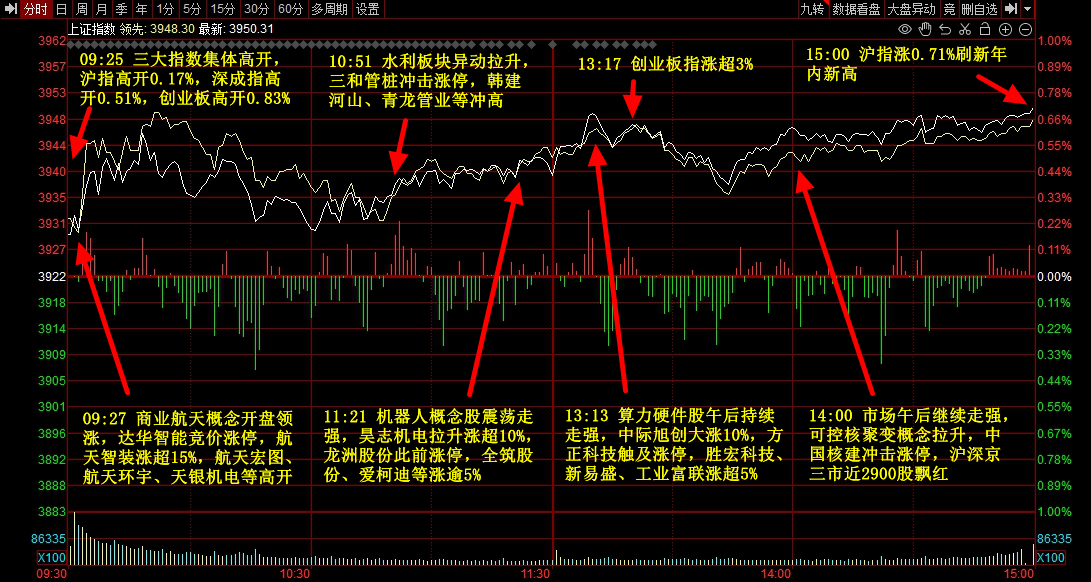
Market Overview - The market indices experienced significant gains, with the Shanghai Composite Index, Shenzhen Component Index, and ChiNext Index rising by 0.71%, 2.02%, and 3.57% respectively, and over 3,000 stocks rising while more than 2,200 stocks fell [4] - The trading volume approached 2 trillion yuan, indicating increased market activity [4] - The Shanghai Composite Index reached a new high for the year, while the ChiNext Index also returned to near its yearly high [5] Storage Sector - The storage sector opened strongly, with several stocks hitting the daily limit, including Xianggang Technology, Dwei Co., and Purun Co., among others [8] - The flash memory and DRAM sectors saw increases of 8.25% and 7.92% respectively, driven by price hikes from major companies like Samsung and SK Hynix, which raised prices by up to 30% [8] - The surge in the storage sector was also influenced by a significant rise in U.S. storage stocks, particularly SanDisk, which increased by over 13.6% [8] Financial Sector - The financial sector initially lagged behind the market, with no mentions in the recent five-year plan, leading to a perception of underperformance [12] - However, after a statement from a senior financial official emphasizing the importance of high-quality financial development, the sector saw a rebound, with brokerage stocks gaining 0.85% by the end of the day [12] Technology and Robotics - Jinfutech experienced a sharp rise after announcing a collaboration with Shanghai Hanzhi Information Technology and receiving a manufacturing order for humanoid robots [16] - This marked a significant advancement in the company's involvement in the robotics sector, moving beyond mere partnerships to actual manufacturing contracts [16]


港股收评:恒指涨0.74%,芯片半导体十分强势,券商股午后拉升明显
Ge Long Hui· 2025-10-24 08:28
Market Performance - The three major indices of the Hong Kong stock market collectively rose, with the Hang Seng Tech Index leading with a gain of 1.82%, while the Hang Seng Index increased by 0.74%, both recovering the 6000 and 26000 points thresholds respectively [1] - The National Enterprises Index rose by 0.68%, indicating a positive trend across the indices for the week [1] Sector Performance - Large technology stocks generally saw an increase, with Alibaba and Kuaishou rising over 2%, and Baidu and NetEase increasing over 1%, while Xiaomi experienced a decline of nearly 2% [1] - Semiconductor stocks performed notably well, with Huahong Semiconductor surging nearly 14%, and leading company SMIC rising by 8% [1] - The military industry stocks became active following the Fourth Plenary Session's emphasis on modernizing national defense, with notable gains in Chinese brokerage stocks such as CICC rising by 4.4% and CITIC Securities by 3.7% [1] - The non-ferrous metals sector, including gold, copper, and aluminum, also saw collective gains [1] Underperforming Sectors - Water utility stocks, nuclear power stocks, new consumption concept stocks, domestic property stocks, gas stocks, and coal stocks mostly performed poorly, with China Water Affairs Group dropping over 11% and Nayuki Tea falling over 3% [1] - Real estate companies such as Longfor Group and Agile Group both declined by over 2% [1]
港股中资券商股震荡走高,中金公司、中国光大控股涨超4%
Xin Lang Cai Jing· 2025-10-24 07:25
Group 1 - The core viewpoint of the article highlights the upward movement of Chinese brokerage stocks in the Hong Kong market, with notable gains from several major firms [1] Group 2 - China International Capital Corporation (CICC) and China Everbright Holdings both saw their stock prices increase by over 4% [1] - Citic Securities, Dongfang Securities, and GF Securities experienced stock price increases of over 3% [1]

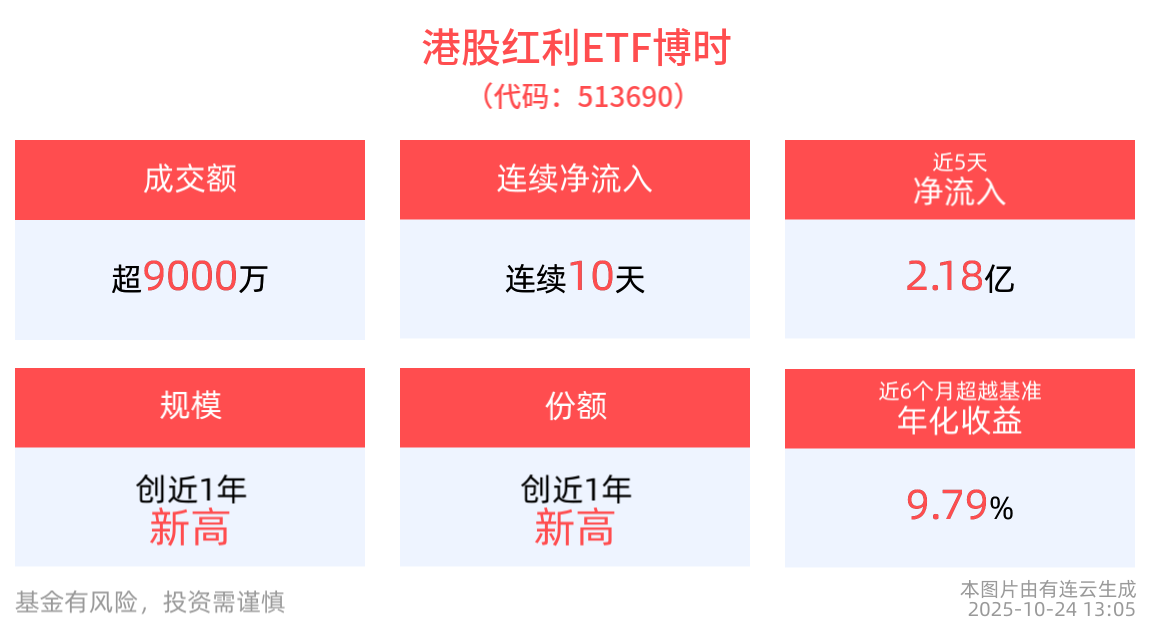
港股红利ETF博时(513690)连续10日“吸金”合计3.32亿元,机构称红利行情或延续至明年
Xin Lang Cai Jing· 2025-10-24 05:24
Core Viewpoint - The recent developments in the Hong Kong stock market, particularly the performance of high dividend yield stocks, indicate a cautious yet optimistic sentiment among investors, driven by ongoing economic discussions between China and the U.S. and a stable outlook for various sectors [3][4]. Market Performance - The Hang Seng High Dividend Yield Index rose by 0.01% as of October 24, 2025, with notable increases in stocks such as China Hongqiao (+3.08%) and Bank of China Hong Kong (+2.27%) [3]. - The BoShi Hong Kong Dividend ETF (513690) has seen a 1.37% increase over the past week, reflecting a mixed market sentiment [3]. Economic Events - A delegation from China will engage in economic discussions with the U.S. from October 24 to 27, focusing on key issues in the China-U.S. economic relationship [3]. - The Fourth Plenary Session of the 20th Central Committee of the Communist Party of China was held on October 23, 2025, signaling ongoing political and economic developments [3]. Investment Strategies - The demand for stable asset allocation remains strong, with strategies focusing on "dividend + micro盘" in bear markets and "dividend + tech growth" in bull markets, highlighting the role of dividend stocks as a stabilizing force [4]. - Low-risk preference funds are increasingly entering the market, as evidenced by a fund raising over 5.5 billion in just one day, indicating a growing demand for diversified asset allocation in a low-interest-rate environment [4]. Sector Analysis - The financial, cyclical, and consumer sectors are showing stable growth, with significant performance expected from brokerage and insurance stocks due to favorable market conditions [4]. - The coal sector has experienced a surge, driven by supply concerns from both domestic and international sources, alongside increasing demand for winter stockpiling [6]. Fund Performance - The BoShi Hong Kong Dividend ETF has reached a new high in scale at 5.806 billion, reflecting strong investor interest [7]. - The ETF has also seen a significant inflow of funds, with a total of 3.32 billion in net inflows over the past ten days, indicating robust demand for high dividend yield investments [8].