茶饮

Search documents
消费动机迭代释放新经济增长潜能 五大新消费赛道活力奔涌
Zhong Guo Chan Ye Jing Ji Xin Xi Wang· 2025-07-11 23:30
Group 1: Consumption Policies and Market Trends - The "Consumption Promotion Special Action Plan" has effectively stimulated consumption as a core driver of economic growth in the first half of 2025 [1] - Emerging economic forms such as the trendy toy economy, tea beverage consumption, pet economy, outdoor economy, and silver-haired economy are rapidly rising, becoming new engines for market vitality and economic growth [1] Group 2: Trendy Toy Economy - The trendy toy economy is reshaping the offline commercial ecosystem, driven by emotional value and the healing economy, with a market value of approximately 600 billion yuan in 2023, expected to reach 1.101 trillion yuan by 2026, with a growth rate of over 20% [2] - Major brands like Pop Mart are achieving significant revenue growth, with Pop Mart's revenue projected to reach 13.04 billion yuan in 2024, a year-on-year increase of 106.9% [2][3] - The number of trendy toy-related enterprises in China has reached 22,300, with a notable increase in registrations since 2021, indicating a growing market [3] Group 3: Tea Beverage Consumption - The tea beverage industry is experiencing a transformation driven by product innovation and globalization, with several major brands successfully listing on stock exchanges in 2025 [4] - The market for tea beverages is increasingly focusing on health, cross-industry collaborations, and cultural connections, enhancing emotional ties with consumers [4][5] - Tea brands are actively expanding into lower-tier cities, with significant proportions of their stores located in third-tier and below cities, indicating a strategic focus on tapping into domestic demand [5][6] Group 4: Pet Economy - The pet economy is rapidly growing, with a market size of 592.8 billion yuan in 2023, expected to reach 1.15 trillion yuan by 2028, driven by individualization and the single economy [7] - The number of pet-related enterprises has surged, with over 4.5775 million existing companies, reflecting a strong entrepreneurial interest in the sector [7] - During the "618" shopping festival, pet-related sales saw significant growth, with many brands achieving record sales figures [8] Group 5: Outdoor Economy - The outdoor economy is emerging as a new consumption trend, with online consumption expected to reach 300 billion yuan in 2024, driven primarily by the 24 to 34 age group [11] - International outdoor brands are increasingly opening their first stores in China, indicating a growing interest in the outdoor market [11] - The integration of outdoor activities into modern lifestyles is reshaping commercial real estate, with a focus on creating immersive consumer experiences [12] Group 6: Silver-Haired Economy - The silver-haired economy is becoming a significant pillar of the consumption market, with projections indicating that the population aged 60 and above will reach 370 million by 2030 [13] - This sector is expanding beyond traditional elderly care services to encompass a full range of consumer needs, reflecting a shift towards a more quality-oriented consumption mindset among older adults [14] - The travel and care industry for the elderly is experiencing robust growth, with participation numbers expected to rise significantly by 2024 [13][14]
新消费时代呼唤金融新工具
Zhong Guo Zheng Quan Bao· 2025-07-11 20:50
Group 1: Market Trends - Lemon prices have surged significantly, with wholesale prices rising from approximately 9 yuan/kg at the beginning of the year to 14 yuan/kg, and reaching as high as 24 yuan/kg in some markets [2][4] - The national average wholesale price for lemons in June was 12.96 yuan/kg, marking a 13.5% increase from May and a 65% increase year-on-year [2] - Coffee bean prices have also seen dramatic fluctuations, with certain blends increasing from about 65 yuan/bag to 90 yuan/bag, reflecting a nearly 40% rise [2][4] Group 2: Supply and Demand Dynamics - The supply of lemons has been adversely affected by extreme weather conditions, leading to a significant drop in production, particularly in major producing areas like Sichuan [4] - Coffee production in key exporting countries such as Brazil and Vietnam has also been impacted by unfavorable weather, contributing to a tightening global supply [4][5] - The demand for both lemons and coffee has been on the rise, with China's coffee market expected to exceed 310 billion yuan by the end of 2024, growing at approximately 18% year-on-year [5][6] Group 3: Financial Tools and Risk Management - The introduction of coffee futures is anticipated to provide a systematic mechanism for price discovery and risk hedging, which is currently lacking in the market [1][7] - Companies are increasingly looking to lock in prices through forward contracts and financial instruments to manage the volatility of raw material costs [6][8] - The use of futures and options is expected to play a crucial role in stabilizing costs and enhancing pricing power for companies in the new consumption landscape [1][7]
易点天下兰向辉:出海企业要抱团,共同寻找、解决本地用户需求
Bei Ke Cai Jing· 2025-07-11 13:26
Core Viewpoint - The fluctuation of US-China tariff policies has minimal impact on service trade companies such as gaming and short dramas, presenting a favorable opportunity for these brands to grow overseas [1] Group 1: Market Expansion - Chinese companies are increasingly looking to expand into emerging markets such as South America and the Middle East [1] - Companies that deeply engage in specific regional markets and address local user needs can achieve sustainable growth, even amidst trade conflicts [1] Group 2: Strategic Adaptation - Companies can adapt to tariff impacts by innovating their product offerings, such as producing AI headphones that provide real-time translation for Spanish-speaking users in the US [1] - The concept of "localization" is emphasized, where companies establish a presence in foreign markets, contributing to local economies and gaining government support [1] Group 3: Globalization Trends - There is a growing trend of Chinese companies listening to local demands and using market data for informed decision-making [1] - A wide range of industries, including e-commerce, gaming, and traditional sectors like tea and dining, are seeking overseas opportunities, indicating a shift towards a more collective approach to international expansion [1] - The experience accumulated by Chinese companies in product development, operations, and capital management provides a competitive edge against foreign counterparts [1]
大河南下沉市场,托起千亿蜜雪丨消费新势力
2 1 Shi Ji Jing Ji Bao Dao· 2025-07-11 12:51
Core Insights - The article highlights the growth and strategic significance of Mixue Ice City, a tea beverage brand originating from Henan, China, emphasizing its successful expansion and market positioning in lower-tier cities [5][23]. Company Background - Mixue Ice City was founded by brothers Zhang Hongchao and Zhang Hongfu, who started with a small shaved ice stall in 1997 before officially launching the brand in 1999 [1][2][3]. - The company gained popularity with its 1 yuan ice cream in 2005, leading to rapid expansion and the establishment of independent stores [3][4]. Strategic Importance of Henan - Henan serves as a crucial hub for Mixue, with its headquarters located in Zhengzhou, which is strategically positioned near major transportation routes [6][13]. - The company has invested significantly in its headquarters and production facilities in Henan, with a production base capable of producing 1.21 million tons of food materials annually [9][10][14]. Market Positioning - Mixue has successfully tapped into the lower-tier market, with over half of its 41,584 stores located in third-tier cities and below, reflecting its strategy of offering affordable products [22][23]. - The brand's growth is supported by a strong local workforce, with many employees returning from larger cities to work at Mixue, indicating its appeal as an employer in the region [21][22]. Financial Performance - In 2024, Mixue reported revenue of 24.829 billion yuan, marking a year-on-year growth of 22.3%, driven largely by its presence in lower-tier markets [22].

茶颜悦色借跨境电商出海北美;海康威视上诉加拿大联邦法院,公司暂已恢复运营;Manus总部迁至新加坡|一周大公司出海动态
Tai Mei Ti A P P· 2025-07-11 12:33
Group 1: AI and Healthcare - Alibaba's Damo Academy has globally promoted its multi-cancer early screening AI, serving 20 million people across 9 countries and regions, positioning AI as a crucial tool in combating cancer [1] Group 2: Corporate Movements - Manus, an AI company, has relocated its headquarters to Singapore and is laying off some domestic staff while focusing on enhancing operational efficiency [2] - Dele Glass has initiated a $50 million production base project in Egypt, with plans to build a high-standard glass furnace [6] - Zhongwei Co. has fully launched its production in Morocco, establishing the first renewable energy materials base in Africa with an annual output of 40,000 tons of nickel-based materials [7] Group 3: Market Expansion - Tea Yan Yue Se has announced its entry into the North American market through e-commerce, launching nearly 40 product types across various platforms [2] - IM5 and IM6 models from Zhiji Auto have been officially launched in the UK, with prices starting at £39,450 (approximately 384,000 RMB) and £47,995 (approximately 467,000 RMB) respectively [3] Group 4: Investment and Acquisitions - Beijing Jiuzhijia Technology Co. has launched an IPO on the Hong Kong Stock Exchange, becoming the first global AMR warehouse robot company, with over 70% of its revenue coming from overseas [8] - ByteDance's Moutong Technology has acquired Hangzhou Xinguangliumei Network Technology Co., aiming to tap into the East Asian market [9] Group 5: Legal and Regulatory Issues - Hikvision has filed for judicial review in Canada after being ordered to cease operations, and the company has resumed normal operations while seeking legal recourse [10]

茶咖日报|特朗普对巴西加征关税反噬自身,美国人喝咖啡或变贵
Guan Cha Zhe Wang· 2025-07-11 11:17
Group 1: Coffee Industry Impact - The Trump administration announced a 50% tariff on Brazilian goods starting August 1, significantly affecting coffee prices in the U.S. [1] - Brazil, the world's largest coffee exporter, may halt coffee supplies to the U.S., potentially driving coffee prices to historical highs [1] - The U.S. imports approximately 8.14 million bags of coffee from Brazil annually, which constitutes one-third of its total coffee consumption [1] Group 2: New Store Openings - Yao Coffee, a brand under Beijing Jinxiang Fosun Pharmaceutical Co., has opened two new stores in Beijing, located at Fuxing Hospital and Guangwai Hospital [3] - The new stores feature a blend of white and wood color schemes, providing a pleasant environment for customers [3] - With the addition of these two stores, Yao Coffee now operates a total of five locations in Beijing [3] Group 3: New Product Launches - Cha Yan Yue Se has launched a new brand "Cha Yan Bing Fang," entering the new Chinese-style baking market with a variety of baked goods [4] - The new product line includes over 20 types of baked items, with member prices ranging from 3.3 to 9.9 yuan each, offering competitive pricing [4] - Currently, the new brand is only available at the Changsha Wanjiali store, indicating a limited initial rollout [4] Group 4: Expansion of Beverage Chains - Mixue Ice City has opened its 8th store in Hong Kong at Blue Bay Plaza, continuing its expansion in the region [5][6] - Since entering the Hong Kong market in late 2023, the brand has rapidly established a presence in key areas, including Mong Kok and Causeway Bay [6] Group 5: Incident Response - A vehicle incident occurred at a Nayuki Tea store in Wuhan, but no injuries were reported, and the store continued operations without dine-in services [7] - The incident took place during non-business hours, and the company is currently assessing damages [7]

半年上新超200款,10大茶饮品牌今年都在推什么?
3 6 Ke· 2025-07-11 11:14
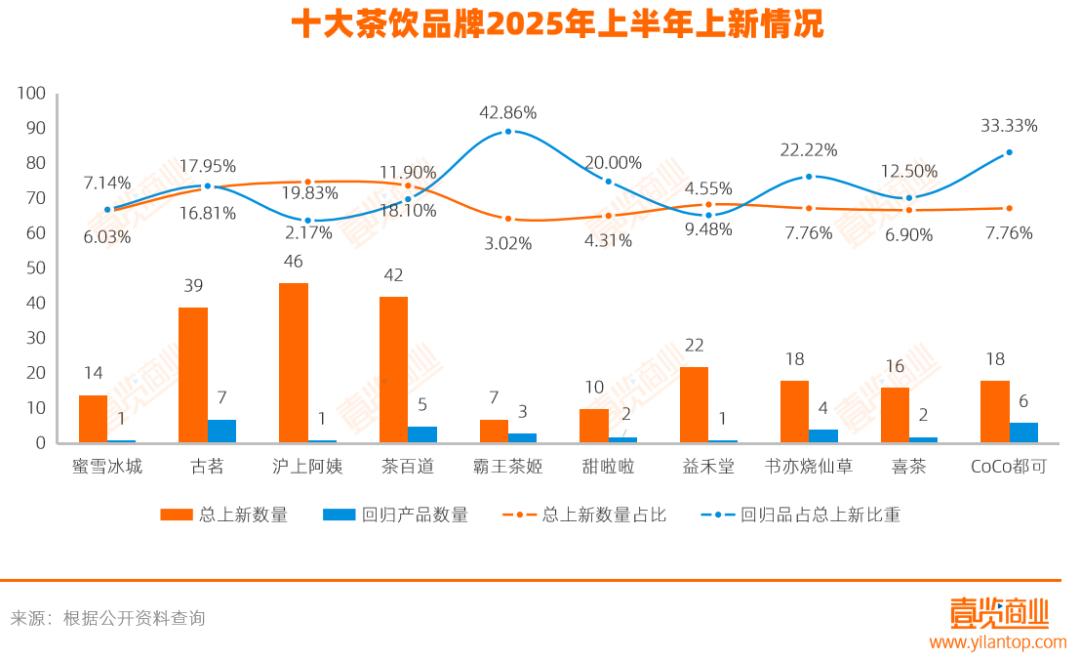
Core Insights - The tea beverage industry is shifting towards value competition in 2025, focusing on product depth, health trends, emotional marketing, and scene segmentation as key strategies for breaking through market challenges [1][20]. Product Launches - In the first half of 2025, the top 10 tea brands launched a total of 232 new products, averaging 1.3 new products per day, including 32 returning products and 200 true new products [1][4]. - The brand "沪上阿姨" led with 45 new products, while "霸王茶姬" had the least with only 4 new products [1][4]. Seasonal Trends and Consumer Preferences - The peak of new product launches occurred in April with 58 new products, followed by May and June with 42 and 46 new products respectively [4]. - Fruit tea, light milk tea, and milk tea dominated the market, accounting for 77% of new product launches, with fruit tea being particularly favored during warmer months [7][10]. Ingredient Innovations - The use of floral elements in new products was prominent, with 67 new products incorporating floral flavors, particularly jasmine [12][14]. - The trend towards health-focused ingredients is evident, with brands moving from "following trends" to "true health" by upgrading raw materials and enhancing health attributes [11][20]. Regional and Flavor Differentiation - Brands are increasingly emphasizing regional tea varieties and unique flavors, with a notable focus on seasonal characteristics in product offerings [19][20]. - The use of fruits in new products showed significant seasonal variation, with lemon being the most commonly used fruit, appearing in 32 new products [20][21]. Conclusion - The tea beverage industry is evolving with a focus on health and differentiation, as leading brands innovate through high-frequency product launches and diverse ingredient strategies to meet consumer demands [20].
泰国三巨头注资1.42亿泰铢,获霸王茶姬子公司51%股权
Nan Fang Nong Cun Bao· 2025-07-11 11:00
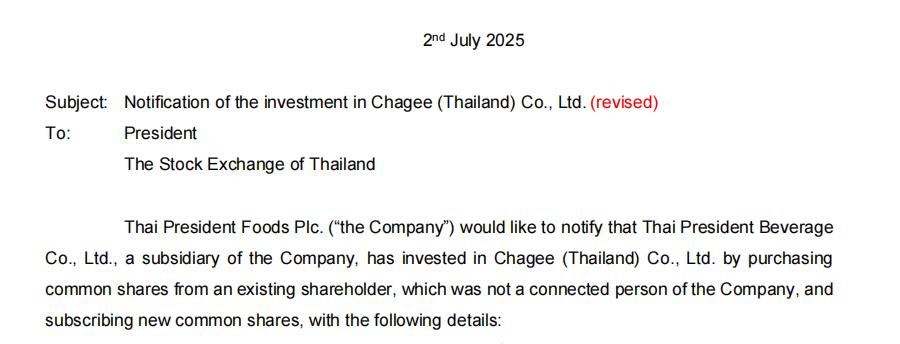
Group 1 - The Thai beverage market is undergoing significant changes with the investment of 142 million THB by Thai President Beverage Co., Ltd. and local logistics and real estate giants, acquiring a 51% stake in Chagee, a subsidiary of Bawang Chaji [2][3][5] - The transaction was completed through a combination of "old share transfer + new share subscription," increasing Bawang Chaji Thailand's registered capital from 5 million THB to 279.25 million THB, and expanding the total number of common shares from 50,000 to 2,792,500 [6][10] - The investment involves three leading Thai companies from food production, logistics, and real estate sectors, providing essential resources for the tea beverage brand's overseas expansion [10][12] Group 2 - Bawang Chaji has established a presence in the Thai market, with its first store opening in December 2023 at Central World Shopping Center, and plans for brand revitalization after temporarily closing all Thai stores in April 2025 [21][22] - The joint venture strategy of Bawang Chaji emphasizes deep integration with local resources, forming a tight-knit community of interests, which helps the brand adapt to local market demands and cultural characteristics [28][30] - With the entry of capital-rich Thai giants into the tea beverage market, Bawang Chaji is expected to receive comprehensive support for faster development in Thailand and further expansion in Southeast Asia [32][33]

中国新消费集团(8275)公告:通过一般授权配售新股募资约1056万港元 拓展茶饮业务及补充营运资金
Xin Lang Cai Jing· 2025-07-11 07:27
Group 1 - The core point of the article is that China New Consumption Group announced a fundraising through the placement of new shares, raising approximately HKD 10.56 million, with net proceeds of about HKD 10.26 million after expenses [1] - The company issued 96,000,689 shares at a price of HKD 0.11 per share, which represents a discount of approximately 14.7% compared to the previous trading day's closing price of HKD 0.129 [1] - The newly issued shares account for about 13.3% of the existing issued share capital and will represent approximately 11.8% of the enlarged share capital upon completion [1] Group 2 - The funds raised will be allocated as follows: approximately HKD 5.26 million for the acquisition and investment in "Tea Da Ye" stores and the operation of the group's tea beverage business, and about HKD 5 million for general working capital [1] - The fundraising is conducted under the general authorization granted by the shareholders' meeting and is expected to be completed at 4 PM on the completion date, subject to the fulfillment of all conditions outlined in the placement agreement [1]
霸王茶姬出售泰国公司51%股权
3 6 Ke· 2025-07-11 05:54
Core Viewpoint - The company Bawang Chaji is accelerating its expansion into Southeast Asia through a joint venture model, specifically in Thailand, where it has secured a 51% stake in its local subsidiary with an investment of over 142 million Thai Baht (approximately 31.19 million RMB) from Thai President Foods and other local partners [1][3]. Group 1: Joint Venture Details - The transaction was completed through a combination of "old share transfer + new share subscription," with a total investment of 142.4 million Thai Baht, resulting in the registered capital of Bawang Chaji Thailand increasing from 5 million Thai Baht to 279.25 million Thai Baht [3][4]. - The new company has three shareholders: Thai President Foods Plc. (55% stake), Komsan Saelee (25% stake), and Chanond Ruangkritya (20% stake) [5][6]. Group 2: Strategic Rationale - Bawang Chaji chose the joint venture model to closely bind with local partners, creating a tight-knit community of interests that encourages full commitment from collaborators [6][8]. - The Southeast Asian market presents challenges due to its diversity in language, culture, and local conditions, making a local agent crucial for accessing key resources and reducing trial-and-error costs [6][10]. Group 3: Partner Contributions - Thai President Foods, the largest instant noodle manufacturer in Thailand, offers extensive supply chain and market operation experience, which will support Bawang Chaji's local production and market entry [8][10]. - Komsan Saelee, founder of Flash Express, brings a robust logistics network, having rapidly expanded the company to become Thailand's leading private courier service [8][10]. - Chanond Ruangkritya, founder of Ananda Development, provides access to prime commercial real estate locations, facilitating the establishment of Bawang Chaji's stores [9][10]. Group 4: Expansion Strategy - Bawang Chaji's joint venture in Thailand follows a similar strategy employed in Malaysia, where it established a partnership to open 300 stores within three years, indicating a replicable model for regional expansion [10][12]. - The company aims to open 1,000 to 1,500 new stores globally, supported by approximately 144.8 million USD raised from its recent U.S. IPO [12][11]. Group 5: Building a Global Engine - Bawang Chaji is constructing a comprehensive "outbound engine" by integrating capital, talent, and local resources to support its global expansion ambitions [11][12]. - The appointment of Eugene Lee, a former McDonald's executive, as Vice President for the Asia-Pacific region highlights the company's focus on balancing global brand consistency with local market strategies [12].