
国防军工

Search documents
信达军工E周刊第199期:行业持续改善,重点关注军贸、机器人
Xinda Securities· 2025-10-19 12:38
Investment Rating - The investment rating for the defense and military industry is "Positive" [2] Core Viewpoints - The industry is experiencing continuous improvement, with a focus on military trade and robotics. The year 2025 is anticipated to be a significant turning point for military investment, driven by a combination of economic recovery, value reassessment, and event catalysts [5][48] - The military trade market is expected to see substantial growth, particularly with Indonesia's potential procurement of Chinese J-10 fighter jets, which could serve as a breakthrough for domestic military trade [5][25] - The robotics sector is rapidly evolving, with significant advancements in both consumer and business applications, including the launch of the ZhiYuan G2 robot and the Figure 03 humanoid robot [4][11][12] Summary by Sections 1. Robotics Industry Tracking - The ZhiYuan G2 robot has received over 100 million yuan in orders and is now in commercial delivery, showcasing its capabilities in various industrial applications [11] - The Figure 03 humanoid robot has made significant advancements, enabling it to perform household tasks and serve in hospitality roles [12][15] - Police robots have been officially deployed in Zhejiang for patrol duties, indicating a new application area for robotic technology [17][20] 2. Military Trade Prospects - Indonesia is expected to procure Chinese J-10 fighter jets, marking a significant milestone in China's military trade exports [5][23] - The domestic military trade market has substantial growth potential, with China ranking sixth globally in military exports, accounting for only 3.9% of the market [25] 3. Market Performance Review - The defense and military index underperformed the broader market, with a decline of 5.12% during the week of October 13-17, 2025 [3][26] - Year-to-date, the defense and military index has increased by 15.0%, slightly outperforming the broader market [29][30] 4. Investment Focus and Beneficiary Stocks - Key investment themes include "new quality combat capabilities" and "value reassessment in a recovering market," with recommended stocks in various segments such as next-generation combat systems, unmanned equipment, and satellite internet [6][48] - Specific beneficiary stocks include AVIC Shenyang Aircraft, Huayin Technology, and various companies involved in unmanned systems and missile production [6][48]
申万宏源策略一周回顾展望(25/10/13-25/10/18):高切低进行时,但攻守有别
Shenwan Hongyuan Securities· 2025-10-18 13:42
Group 1 - The "high-cut low" style switch is currently unfolding, but there are differences in offense and defense. The market has shown that cyclical and value trends cannot lead the overall index higher, and the market continues its adjustment phase since early September. The key catalyst for cyclical trends has not yet arrived, and the trend of technology growth industries remains concentrated. A-shares will ultimately need to wait for technology to lead for effective breakthroughs [1][3][4] - Discussions about style switching in the fourth quarter have increased significantly. The current "high-cut low" market is defensive in nature, with intensified competition among offensive assets (such as non-ferrous metals and chemicals) within cyclical and value sectors, while defensive assets show absolute returns. The overall profit effect is declining, and technology rebounds show better profit effects [4][5][11] Group 2 - The overseas environment has become more stable. Recent credit risks in U.S. regional banks have created short-term disturbances in risk appetite. However, these risks are still considered isolated events, and the VIX index has peaked and started to decline. A potential turning point in overseas pressures may have passed [8] - The mid-term market judgment remains unchanged: before spring 2026, the catalytic effect of technology industries will significantly exceed that of cyclical industries. Although the long-term cost-effectiveness of technology is currently low, short-term cost-effectiveness issues have been sufficiently digested, allowing for the emergence of a new round of technology trends [8][9] Group 3 - Spring 2026 may represent a structural high point for the A-share market, but it is unlikely to be the peak for the entire year or the current bull market. The conditions for a comprehensive bull market will become increasingly sufficient over time [11] - In the short term, cyclical products (such as non-ferrous metals and chemicals) are not performing well, with a preference for defensive and hedging assets (such as banks and food and beverage). The outlook for 2026 is better than for 2025, with opportunities still available in Q4 2025, particularly in areas like overseas computing power, advanced manufacturing represented by new energy, and national defense and military industries [11][12]
避险情绪持续发酵
Tebon Securities· 2025-10-17 12:47
Market Analysis - The A-share market experienced a significant decline, with the Shanghai Composite Index closing at 3839.76 points, down 1.95%, and the Shenzhen Component Index falling 3.04% to 12688.94 points [3] - The overall market saw 4781 stocks decline, marking the highest number of declining stocks in nearly a month, with a total trading volume of 1.95 trillion [3][4] - The current market sentiment is characterized by heightened risk aversion, attributed to escalating uncertainties in US-China trade relations, despite the absence of significant negative news [6] Sector Performance - All major sectors declined, but defensive sectors related to dividends, such as banking and agriculture, experienced smaller declines, with the Agricultural Bank of China rising 1.74% to a record high [6] - High-performing sectors earlier in the year, such as power equipment, electronics, and automotive, saw the largest declines, with drops of 4.99%, 4.10%, and 3.74% respectively [6] Policy and Earnings Outlook - The upcoming fourth quarter is expected to bring a series of policy announcements, including the Fourth Plenary Session and the Central Economic Work Conference, which will clarify policy directions for the following year [6] - Investment opportunities may arise from themes such as "de-involution" in new energy and semiconductors, unified markets in consumption and cycles, and marine economy [6] Bond Market - The bond market showed a continued upward trend, with all government bond futures contracts rising, particularly the 30-year contract which closed at 115.87, up 0.74% [12] - The central bank's operations indicate a relatively ample liquidity environment, with a net withdrawal of 244.2 billion from the market, yet overall funding remains sufficient [12] Commodity Market - Precious metals continued to show strength, with gold prices reaching a new high, peaking at 1001 CNY per gram, driven by risk aversion and policy expectations [12][10] - The energy sector faced downward pressure due to rising oil inventories and production levels, with the US EIA reporting an increase of 3.524 million barrels in crude oil inventories [11] Trading Hotspots - Key investment themes include precious metals driven by central bank purchases and anticipated Fed rate cuts, artificial intelligence due to increased capital expenditures by tech giants, and domestic chip production driven by technological breakthroughs [13] - The consumer sector is expected to benefit from RMB appreciation and market style shifts, while brokerage firms may see increased activity due to active trading and potential changes in trading regulations [13]
“十五五”研究系列(一):“十五五”规划前瞻:从政策方向寻找产业线索
Ping An Securities· 2025-10-17 09:07
Group 1 - The "14th Five-Year Plan" has achieved high-quality completion of most policy goals, including economic growth, labor productivity, and R&D investment, with significant progress in urbanization and life expectancy indicators [9][10][11] - The "15th Five-Year Plan" is positioned as a critical period for achieving Chinese-style modernization, focusing on solidifying the foundation for modernization and comprehensive development [7][8] Group 2 - Four industrial clues are identified for the "15th Five-Year Plan": fostering new productive forces, expanding domestic demand, advancing the construction of a unified national market, and enhancing resource utilization and protection [4][12][16] - The macroeconomic environment shows new momentum in domestic growth, with a need to address insufficient effective demand, emphasizing the importance of technology innovation and expanding domestic consumption [13][14] Group 3 - The focus on new productive forces includes the development of emerging industries, traditional industry upgrades, and the stimulation of digital economy innovation [4][12][18] - Expanding domestic demand involves promoting consumption through initiatives like "old-for-new" exchanges and investing in human capital, alongside infrastructure investment to support urban renewal [4][12][16] Group 4 - The construction of a unified national market aims to reduce internal competition and enhance efficiency in sectors like new energy, traditional cycles, and consumer goods [4][12][16] - Resource utilization and protection strategies emphasize the development of the marine economy and the safeguarding of strategic mineral resources [4][12][16] Group 5 - The market outlook suggests that technology innovation sectors such as TMT, new energy, and biomedicine will continue to be key investment themes, supported by policy and industry growth [4][12][16] - Historical analysis indicates that A-share market trends around the announcements of previous five-year plans show a pattern of initial growth followed by sector rotation and differentiation [4][12][16]
【盘中播报】沪指跌1.39% 电力设备行业跌幅最大
Zheng Quan Shi Bao Wang· 2025-10-17 06:59
Core Viewpoint - The A-share market experienced a decline today, with the Shanghai Composite Index dropping by 1.39% and trading volume decreasing by 4.76% compared to the previous trading day [1] Industry Performance Summary - **Coal**: Slight increase of 0.12% with a transaction amount of 165.48 billion yuan, led by Antai Group which rose by 10.00% [1] - **Banking**: Minor decrease of 0.04% with a transaction amount of 302.99 billion yuan, led by Shanghai Bank which fell by 0.83% [1] - **Steel**: Decrease of 0.09% with a transaction amount of 133.07 billion yuan, led by Wujin Stainless Steel which dropped by 7.73% [1] - **Transportation**: Decrease of 0.11% with a transaction amount of 258.60 billion yuan, led by Pulutong which fell by 3.36% [1] - **Textiles and Apparel**: Decrease of 0.25% with a transaction amount of 119.79 billion yuan, led by Yingfeng Shares which dropped by 9.99% [1] - **Oil and Petrochemicals**: Decrease of 0.29% with a transaction amount of 83.04 billion yuan, led by Compton which fell by 3.19% [1] - **Agriculture, Forestry, Animal Husbandry, and Fishery**: Decrease of 0.45% with a transaction amount of 139.82 billion yuan, led by Aonong Biological which dropped by 4.66% [1] - **Real Estate**: Decrease of 0.52% with a transaction amount of 213.60 billion yuan, led by Wolong New Energy which fell by 7.80% [1] - **Utilities**: Decrease of 0.52% with a transaction amount of 302.04 billion yuan, led by *ST Lingda which dropped by 13.20% [1] - **Construction and Decoration**: Decrease of 0.75% with a transaction amount of 278.81 billion yuan, led by Kexin Development which fell by 8.15% [1] - **Home Appliances**: Decrease of 0.79% with a transaction amount of 217.37 billion yuan, led by Greer which dropped by 6.72% [1] - **Food and Beverage**: Decrease of 0.86% with a transaction amount of 194.67 billion yuan, led by Huaiqi Mountain which fell by 6.44% [1] - **Environmental Protection**: Decrease of 0.92% with a transaction amount of 140.79 billion yuan, led by Science which dropped by 6.68% [1] - **Retail**: Decrease of 0.97% with a transaction amount of 173.43 billion yuan, led by Ruoyu Chen which fell by 9.98% [1] - **Social Services**: Decrease of 1.07% with a transaction amount of 89.87 billion yuan, led by Chuangye Heima which dropped by 5.28% [1] - **Light Industry Manufacturing**: Decrease of 1.12% with a transaction amount of 135.66 billion yuan, led by Songyang Resources which fell by 10.02% [1] - **Pharmaceuticals and Biology**: Decrease of 1.16% with a transaction amount of 845.22 billion yuan, led by Warner Pharmaceuticals which dropped by 7.67% [1] - **Basic Chemicals**: Decrease of 1.21% with a transaction amount of 618.91 billion yuan, led by Xinong Shares which fell by 8.88% [1] - **Non-ferrous Metals**: Decrease of 1.24% with a transaction amount of 1149.11 billion yuan, led by Galaxy Magnetics which dropped by 7.14% [1] - **Telecommunications**: Decrease of 1.28% with a transaction amount of 806.90 billion yuan, led by Shijia Photon which fell by 17.59% [1] - **Non-bank Financials**: Decrease of 1.39% with a transaction amount of 491.74 billion yuan, led by Hainan Huatie which dropped by 6.17% [1] - **Building Materials**: Decrease of 1.66% with a transaction amount of 94.02 billion yuan, led by Yaopi Glass which fell by 7.82% [1] - **Media**: Decrease of 1.68% with a transaction amount of 263.96 billion yuan, led by Vision China which dropped by 9.93% [1] - **Beauty and Personal Care**: Decrease of 1.76% with a transaction amount of 33.94 billion yuan, led by Baiya Shares which fell by 4.98% [1] - **Computers**: Decrease of 2.38% with a transaction amount of 1005.18 billion yuan, led by Kaipu Cloud which dropped by 11.94% [1] - **Comprehensive**: Decrease of 2.42% with a transaction amount of 27.84 billion yuan, led by Dongyangguang which fell by 4.70% [1] - **Defense and Military Industry**: Decrease of 2.55% with a transaction amount of 387.73 billion yuan, led by Hangyu Technology which dropped by 8.38% [1] - **Machinery and Equipment**: Decrease of 2.68% with a transaction amount of 940.87 billion yuan, led by Yingweike which fell by 10.00% [1] - **Automobiles**: Decrease of 2.69% with a transaction amount of 775.95 billion yuan, led by Tianpu Shares which dropped by 10.00% [1] - **Electronics**: Decrease of 3.19% with a transaction amount of 2631.19 billion yuan, led by Nanya New Materials which fell by 16.26% [1] - **Electric Power Equipment**: Decrease of 3.79% with a transaction amount of 1881.52 billion yuan, led by Shenghong Shares which dropped by 11.80% [1]
特朗普宣布建造凯旋门计划,为纪念明年美国建国250周年
Di Yi Cai Jing· 2025-10-17 04:49
Group 1 - The announcement of a proposed "Trump Arc" in Washington D.C. is part of the celebration for the 250th anniversary of American independence in July next year [1][4] - The design of the arch is inspired by the Arc de Triomphe in Paris and aims to welcome visitors from Arlington, Virginia to the capital [4] - The arch is planned to be located near the Arlington National Cemetery and Lincoln Memorial, with completion expected before the anniversary celebration [4] Group 2 - The fundraising dinner attended over 130 executives from various tech and defense companies, including representatives from Google, Meta, Amazon, and Lockheed Martin [3] - The proposal for the arch is still in development and requires congressional approval due to the complexities of building monuments in the capital [4][5] - Federal law prohibits new construction on the National Mall, making the proposed site a designated area for new memorials, provided they hold significant historical importance [5] Group 3 - Trump expressed his passion for real estate development and has been personally overseeing various renovation projects at the White House since returning in January [6] - Recent renovations include the unveiling of a "Presidential Walk of Fame" featuring gold-plated portraits of himself and other presidents, excluding President Biden [6]

Deutsche Bank's Maximilian Uleer: Here's why the bull thesis for Europe holds
Youtube· 2025-10-16 16:53
Core Viewpoint - European indices are forecasted to see a 12 to 16% gain by 2026, driven by positive underlying data and increased government spending, particularly in Germany [1][2]. Economic Outlook - Earnings season is expected to outperform expectations in both the US and Europe, with Europe showing particularly strong underlying data despite perceptions of economic disaster [2]. - Germany's government has recently passed a budget allowing for increased spending, which is anticipated to positively impact the economy [3][4]. Government Spending - Germany plans to spend an additional €800 billion over the next four years, with €500 billion allocated for infrastructure and €300 billion for defense, which is expected to be GDP accretive [5][6]. - Recent announcements of defense spending, including €3 billion and €9 billion in the past weeks, indicate a significant shift in fiscal policy [4][5]. Employment and Efficiency - Despite layoffs at companies like Nestle, overall unemployment rates in Europe remain very low, suggesting that these layoffs are not indicative of a structural problem in the labor market [7][8]. - European companies are expected to benefit from advancements in AI, enhancing efficiency without the need for massive capital expenditures [9]. Monetary Policy - The European Central Bank (ECB) has successfully managed inflation, currently at around 2%, providing a stable environment for economic growth [10][12]. - There is uncertainty regarding future rate cuts, but the current economic conditions suggest stability rather than drastic changes [11][12]. Comparative Analysis - When comparing fiscal situations, the US is projected to have a deficit above 7%, while France is expected to have a 5% deficit, indicating a more favorable fiscal outlook for Europe [13][14]. - France's defense industry is positioned to benefit from increased German spending, although the French index has underperformed compared to the rest of Europe [15].


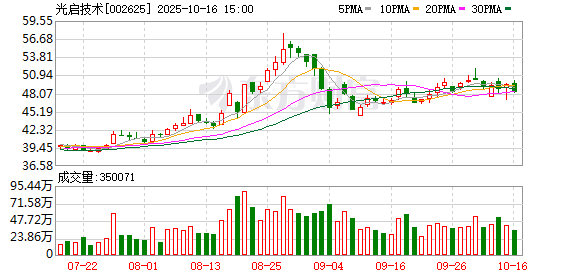
光启技术发生4笔大宗交易 合计成交2.92亿元
Zheng Quan Shi Bao Wang· 2025-10-16 09:50
Summary of Key Points Core Viewpoint - On October 16, 2023, Guangqi Technology experienced significant trading activity with a total of 6.2 million shares traded through block transactions, amounting to 292 million yuan, at a price of 47.09 yuan per share, reflecting a discount of 2.51% compared to the closing price of the day [2]. Trading Activity - A total of 4 block trades were recorded on October 16, with a cumulative trading volume of 6.2 million shares and a total transaction value of 292 million yuan [2]. - Over the past three months, Guangqi Technology has seen 80 block trades, with a total transaction value of 6.148 billion yuan [2]. Stock Performance - The closing price of Guangqi Technology on October 16 was 48.30 yuan, marking a decline of 2.40% for the day, with a turnover rate of 1.62% and a total trading volume of 1.719 billion yuan [2]. - The stock has experienced a cumulative decline of 3.78% over the past five days, with a net outflow of funds totaling 994 million yuan during the same period [2]. Margin Financing - The latest margin financing balance for Guangqi Technology stands at 8.104 billion yuan, having increased by 392 million yuan over the past five days, representing a growth rate of 5.09% [2]. Company Background - Guangqi Technology Co., Ltd. was established on July 18, 2001, with a registered capital of 2.154588762 billion yuan [2].

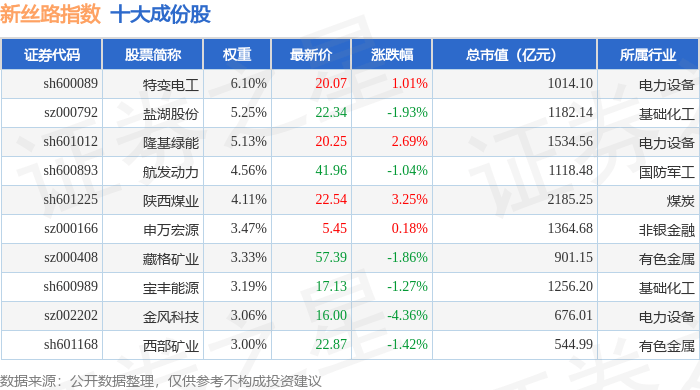
10月16日新丝路(399429)指数跌0.69%,成份股西部黄金(601069)领跌
Sou Hu Cai Jing· 2025-10-16 09:29
Core Points - The New Silk Road Index (399429) closed at 1575.16 points, down 0.69%, with a trading volume of 58.815 billion yuan and a turnover rate of 2.12% [1] - Among the index constituents, 23 stocks rose, with Baiyin Nonferrous leading with a 10.0% increase, while 75 stocks fell, with Western Gold leading the decline at 6.2% [1] Index Constituents Summary - The top ten constituents of the New Silk Road Index include: - TBEA Co., Ltd. (6.10% weight, latest price 20.07, 1.01% increase, market cap 101.41 billion yuan) in the Power Equipment sector - Salt Lake Industry (5.25% weight, latest price 22.34, 1.93% decrease, market cap 118.21 billion yuan) in the Basic Chemicals sector - LONGi Green Energy (5.13% weight, latest price 20.25, 2.69% increase, market cap 153.46 billion yuan) in the Power Equipment sector - AVIC Aviation Power (4.56% weight, latest price 41.96, 1.04% decrease, market cap 111.85 billion yuan) in the Defense and Military sector - Shaanxi Coal and Chemical Industry (4.11% weight, latest price 22.54, 3.25% increase, market cap 218.53 billion yuan) in the Coal sector - Shenwan Hongyuan (3.47% weight, latest price 5.45, 0.18% increase, market cap 136.47 billion yuan) in the Non-Bank Financial sector - Zangge Mining (3.33% weight, latest price 57.39, 1.86% decrease, market cap 90.12 billion yuan) in the Nonferrous Metals sector - Yuxing Energy (3.19% weight, latest price 17.13, 1.27% decrease, market cap 125.62 billion yuan) in the Basic Chemicals sector - Goldwind Technology (3.06% weight, latest price 16.00, 4.36% decrease, market cap 67.60 billion yuan) in the Power Equipment sector - Western Mining (3.00% weight, latest price 22.87, 1.42% decrease, market cap 54.50 billion yuan) in the Nonferrous Metals sector [1] Capital Flow Summary - The New Silk Road Index constituents experienced a total net outflow of 1.81 billion yuan from main funds, while retail investors saw a net inflow of 1.744 billion yuan [3] - Notable capital flows include: - Baiyin Nonferrous: 5.16 million yuan net inflow from main funds, 2.30 million yuan net outflow from retail investors - LONGi Green Energy: 172 million yuan net inflow from main funds, 15.1 million yuan net outflow from retail investors - New Mileage: 1.59 million yuan net inflow from main funds, 93.05 million yuan net outflow from retail investors - Other companies like China Western Electric and Zhongcai Zihuan also showed varying degrees of net inflows and outflows [3]





美国防部证实!用80亿美元研发经费给军人发工资
Zheng Quan Shi Bao· 2025-10-16 07:00
Core Points - The U.S. Department of Defense has confirmed that approximately $8 billion from research and development funds has been used to pay military personnel to avoid salary disruptions due to the government shutdown [1] - The Senate is set to vote on a "clean" temporary funding bill for the tenth time, which requires 60 votes to advance, but is expected to be blocked again [1] - A procedural vote on the defense appropriations bill is also scheduled, which, if passed, could lead to the full defense funding bill being approved in a few weeks, ensuring military salaries are addressed even if the government remains shut down [1] Group 1 - The Department of Defense repurposed $8 billion from its previous fiscal year's remaining funds for military salaries [1] - The Senate's upcoming vote on the temporary funding bill is critical, as failure to pass it could prolong the government shutdown until October 20 [1] Group 2 - The Senate's procedural motion for the defense appropriations bill requires 60 votes, and if successful, it could expedite the funding process for military salaries [1]