计算机

Search documents
新贵扩军!A股百元股突破200只 呈现明显“科技味” 电子行业上榜量第一
Shen Zhen Shang Bao· 2026-01-08 18:08
1月8日A股收盘,寒武纪收报1444.00元/股,排名第一;贵州茅台、源杰科技位居二、三名,收盘价分 别为1412.30元/股、715.00元/股。 从市场表现来看,去年1月8日至今年1月8日,A股207只百元股中,仅11只个股逆市下跌;百元股平均 涨幅达182%,远高于全部A股平均涨幅56%。 新年伊始,沪指重回4000点创10年来新高,A股百元股数量大幅扩容。据记者统计,截至1月8日收盘, A股百元股数量达207只,较去年同期增加137只,同比增长196%。 从行业分布来看,A股207只百元股中,以申万一级行业分类,较为集中的行业有电子、计算机、机械 设备、电力设备、汽车、医药生物、食品饮料等,其中,电子行业有76只股票上榜,位居第一名,占比 36.72%;计算机、机械设备行业均有22只股票上榜,并列第二名;电力设备行业有17只股票上榜,位 居第三名。 百元股呈现明显"科技味" 记者统计发现,百元股的分布呈现出明显的"科技味"。科创板、创业板、北交所的百元股数量达165 只,占比近八成,达79.71%。沪市主板、深市主板分别有27只、14只。以科创板为例,在90只科创板 百元股中,寒武纪以1444.00元 ...
国泰海通|计算机:八部门印发人工智能赋能制造专项行动实施意见,制造业AI大有可为
国泰海通证券研究· 2026-01-08 14:11
Core Viewpoint - The article emphasizes the importance of the "Artificial Intelligence + Manufacturing" initiative, which aims to enhance technological supply and industrial application, while accelerating the "intelligent industrialization" and "industrial intelligence" processes to support the development of a strong manufacturing nation and digital China [1][3]. Group 1: Policy Implementation - On January 7, eight government departments jointly issued the "Implementation Opinions on the 'Artificial Intelligence + Manufacturing' Special Action," focusing on both technological supply and application empowerment [1]. - The initiative aims to promote the deep integration of AI technology and manufacturing applications, enhancing the innovation capabilities of both sectors [1]. Group 2: Goals and Targets - By 2027, the initiative targets achieving a secure and reliable supply of key AI technologies, maintaining a leading position in industrial scale and empowerment levels globally [2]. - The plan includes the deep application of 3-5 general large models in manufacturing, the creation of 100 high-quality industrial data sets, and the promotion of 500 typical application scenarios [2]. Group 3: Industry Support and Development - The document encourages local governments to provide support such as "computing power vouchers" and "model vouchers" to reduce application development costs for enterprises [3]. - It emphasizes the establishment of a collaborative mechanism among departments and industries to guide enterprises in differentiated development and prevent excessive competition [3].


一座城市的长期主义:用产业生态撑起下一个技术支点
远川研究所· 2026-01-08 13:37
Core Insights - The article discusses the evolution of Silicon Valley from an agricultural region to a global technology hub, driven by successive waves of technological innovation and the emergence of key companies in the semiconductor, computing, internet, and AI sectors [2][4]. Group 1: Historical Development of Silicon Valley - Before the 1950s, Santa Clara Valley was known as the "World's Fruit Basket" and not the tech hub it is today [2]. - The IPOs of Intel and AMD in 1971 and 1972 marked the beginning of a significant investment wave in the semiconductor industry, providing crucial funding for expansion and R&D [2]. - Apple's IPO in 1980 raised over $100 million, the largest since Ford's in 1956, signaling the start of the personal computing and enterprise IT era [2]. Group 2: Emergence of Key Tech Companies - Adobe, founded in 1982, represented a novel business model in software licensing [3]. - Cisco, Nvidia, Yahoo, and Google were established in the 1980s and 1990s, contributing to the diversification of Silicon Valley's tech landscape [3]. Group 3: Transition to AI Era - Nvidia has become a core player in AI computing, with its market value rising from $100 billion three years ago to over $4 trillion today [4]. - Google has diversified into cloud computing, AI applications, and AI chips, solidifying its position as a leading internet company [4]. - OpenAI, founded in 2015, has emerged as a top-tier company in the AI era [4]. Group 4: Shanghai's AI Industry Development - Shanghai has seen a surge in AI companies, with five firms going public within a month, including MuXi and BiRan Technology [6]. - The city is fostering a comprehensive AI ecosystem, from semiconductor design to application deployment, creating a positive feedback loop in the industry [9][10]. Group 5: Infrastructure and Support for AI Startups - Shanghai's AI startups benefit from a complete supply chain within a 10-kilometer radius, facilitating rapid innovation and production [10]. - The city has established a robust semiconductor industry cluster, providing essential support for AI development [10]. Group 6: Policy and Resource Allocation - Shanghai's policy shift aims to provide entrepreneurs with clearer pathways and more security, enhancing resource responsiveness [14][16]. - Initiatives like the "1 yuan office space" and "targeted apartments" are designed to extend the cash flow lifespan of startups [14]. Group 7: Talent and Ecosystem - Shanghai's talent pool, supported by local universities and international recruitment, is a significant advantage for AI startups [17]. - The city's industrial ecosystem combines manufacturing and services, allowing for unique flexibility in AI application development [20]. Group 8: Long-term Vision - The article emphasizes that the competition among cities in technology is a long-term endeavor, requiring a resilient infrastructure to support ongoing innovation [19][21]. - Shanghai is focused on aligning research, funding, regulations, and market needs to build a strong foundation for future technological waves [21].



超聚变要上市 走势之外的关键在这里
Sou Hu Cai Jing· 2026-01-08 13:10
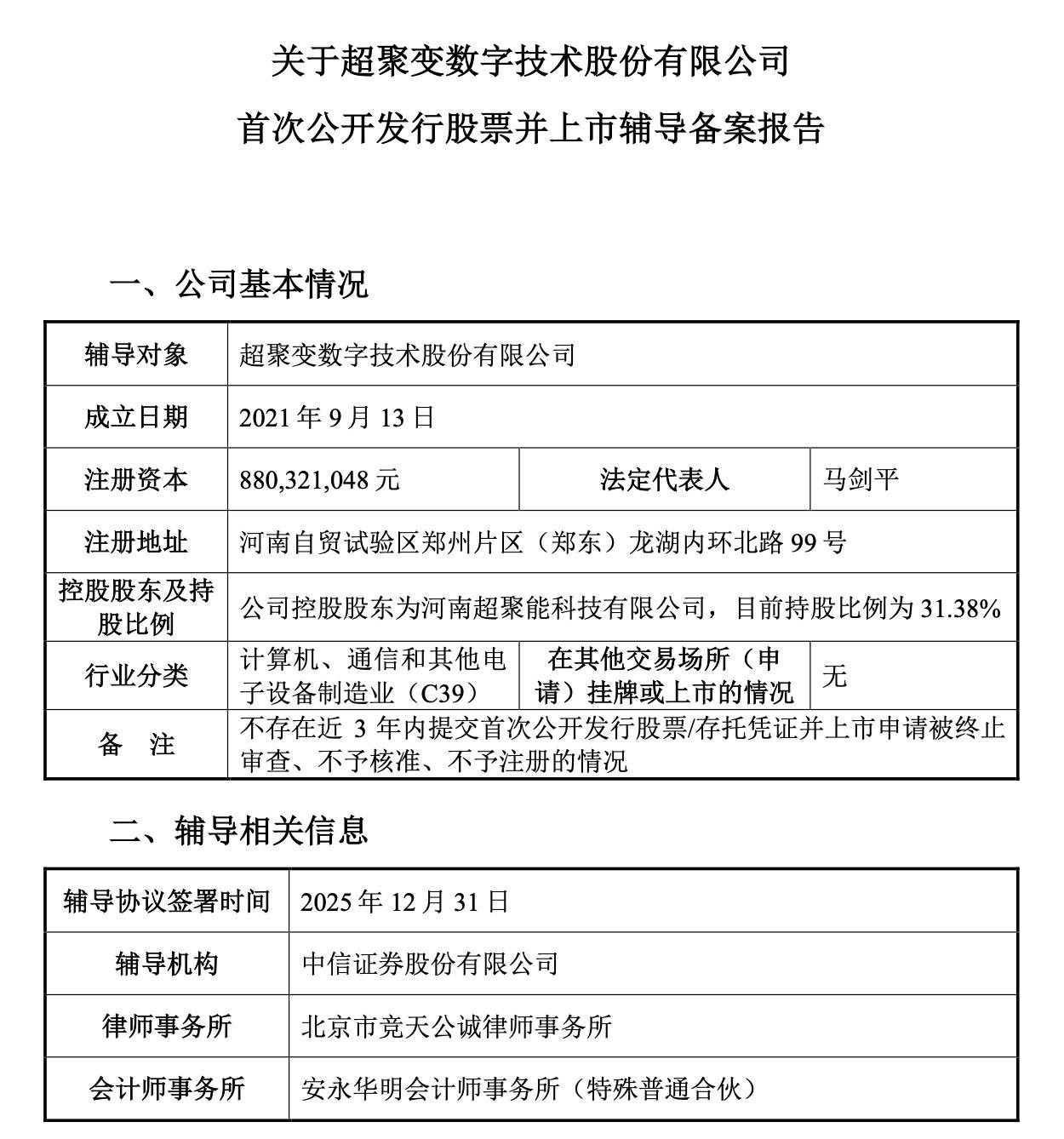
Group 1 - The core point of the article highlights the rapid growth of Chaojuyuan Digital Technology Co., Ltd., which has seen its revenue increase from 10 billion in 2022 to 40 billion in 2024, and is preparing for an IPO with support from major state-owned investors [1][2] - Chaojuyuan was established in September 2021 and is based in Zhengzhou, Henan, with a registered capital of approximately 880 million yuan [2] - The company is backed by significant state-owned entities, including China Mobile's investment arm and China Telecom, indicating strong institutional support [1][2] Group 2 - The article emphasizes that stock price movements are primarily influenced by institutional trading behaviors rather than company fundamentals or shareholder backgrounds [1][6] - It discusses the importance of monitoring institutional inventory data to understand market trends, as institutional funds have a more substantial impact on stock prices than retail investors [6][9] - The author shares experiences illustrating how misleading stock price movements can be, stressing that true market dynamics are driven by institutional actions rather than superficial trends [4][11] Group 3 - The article concludes that for investors, especially retail ones, it is crucial to focus on institutional trading behaviors rather than just stock price movements or news [13][14] - It suggests that even if a company has strong fundamentals, the stock price will ultimately depend on the interest and activity of institutional investors [13][14] - The use of quantitative data to assess institutional activity is recommended as a more reliable method for making investment decisions [14]
董责险走热:1700多家上市公司投保,理赔有多少?
经济观察报· 2026-01-08 12:16
Core Viewpoint - The implementation of the new Securities Law and the increase in civil liability cases have heightened the awareness and necessity of Directors and Officers Liability Insurance (D&O Insurance) among A-share listed companies, with the insurance coverage rate expected to rise from 12% in 2020 to 32% by 2025 [1][2]. Group 1: D&O Insurance Market Trends - By the end of 2025, the number of listed companies that purchased D&O Insurance reached 1,753, with a market penetration rate increasing from 28% in 2024 to 32% [2]. - In 2025, 643 A-share listed companies announced plans to purchase D&O Insurance, a year-on-year increase of 19% [5]. - The average D&O Insurance premium rate has decreased to below 0.05% by the end of 2025, indicating a "rate trough" in the market [15][16]. Group 2: Industry and Company Insights - The highest D&O Insurance penetration rates are found in the real estate and electricity sectors, exceeding 60%, reflecting a correlation between industry risk and insurance demand [6]. - Companies with assets over 50 billion yuan have a D&O Insurance purchase rate of 68%, significantly higher than the 20% rate for companies with assets below 2 billion yuan [6]. - Private enterprises account for nearly 60% of new D&O Insurance purchases in 2025, but state-owned enterprises have the highest penetration rates [7]. Group 3: Legal and Regulatory Impact - The new Securities Law and Company Law have established a legal foundation for the proliferation of D&O Insurance, with high-profile cases like the Kangmei Pharmaceutical scandal driving increased awareness and adoption [11]. - The number of companies facing administrative investigations has risen significantly since 2020, with 366 companies having received warning letters after previously purchasing D&O Insurance [11][12]. - The long-tail effect of D&O Insurance claims means that while regulatory scrutiny and potential lawsuits are increasing, large-scale payouts have not yet fully materialized [16].


淡水泉、高毅等百亿私募最新动向曝光
Cai Jing Wang· 2026-01-08 12:06
Core Insights - In December 2025, a total of 713 private equity firms participated in A-share research activities, covering 392 stocks across 28 primary industries, with a total of 1,765 research instances recorded [1] - Notably, 43 large private equity firms conducted research on 151 A-shares, accounting for 16.49% of the total research instances [1] - The most researched stocks included Haiguang Information and Zhongke Shuguang, each receiving 117 research instances, significantly outpacing other A-shares [1][2] Industry Focus - The top ten stocks receiving the most attention from private equity firms were primarily in the machinery, electronics, and pharmaceutical industries, with three stocks from the machinery sector making the list [2][4] - The electronics industry had 60 stocks researched, totaling 384 instances, while the machinery sector had 64 stocks with 286 instances, making them the focal points of private equity research [4][5] - Other industries that garnered significant attention included computer, pharmaceutical, automotive, and power equipment, each surpassing 100 research instances [4][5] Stock Research Rankings - The top ten A-shares by research instances in December included: - Haiguang Information (117 instances) - Zhongke Shuguang (117 instances) - Changan Automobile (42 instances) - Jerry Holdings (34 instances) - Boying Welding (31 instances) - Weichuang Electric (30 instances) - Yipin Hong (30 instances) - Huqin Technology (27 instances) - Huatong Cable (25 instances) - Zoli Pharmaceutical (24 instances) [3] Active Private Equity Firms - In December, 24 private equity firms conducted at least 10 research instances, with 12 of them being large firms [5][6] - Zhengyuan Investment led with 28 research instances covering 27 stocks, primarily in the machinery sector [6][7] - Other notable firms included Dui Shui Quan with 25 instances, Gao Yi Asset and He Xie Hui Yi Asset with 21 instances each, and Panjing Investment with 19 instances [6][7][8]




AI时代,如何挑战行业巨头?
Xin Lang Cai Jing· 2026-01-08 11:44
Core Insights - The article discusses the rapid disruption of Meituan's monopoly in China's food delivery market, initiated by JD.com and Ele.me, with significant financial backing and strategic investments [3][28] - A four-dimensional resource capability framework is proposed to analyze the competitive dynamics among major internet platforms in the food delivery sector [3][28] Market Dynamics - Starting in February 2025, a competitive battle emerged in the food delivery market, leading to a significant decline in Meituan's market share from 85% to 65% by August 2025, while Ele.me's share increased from 15% to 28%, and JD.com captured 7% [3][28] - By November 2025, Meituan's market share further dropped to 50%, with the Alibaba ecosystem (Ele.me + Taobao Flash Purchase) rising to 42%, indicating a narrowing gap [3][28] Resource Capability Framework - The article constructs a framework based on "capital + technology + operations + ecosystem" to explain how challengers can disrupt established market leaders [3][28] - The framework emphasizes the need for a multi-dimensional and high-matching resource capability system to effectively compete against dominant players like Meituan [38] Competitive Strategies - JD.com and Ele.me launched substantial subsidy programs, with JD.com initiating a "100 billion subsidy" plan to attract riders and merchants, while Ele.me also announced significant financial support [40][41] - Both challengers leveraged their existing user bases and data assets to enhance their marketing and operational efficiencies, with JD.com focusing on high-value consumer segments and Ele.me utilizing Alibaba's extensive data resources [41] Operational Efficiency - Meituan's operational efficiency, with an average delivery time of 34 minutes and a cost of 7 yuan per delivery, posed a significant challenge to the operational capabilities of JD.com and Ele.me [42] - JD.com managed to reduce delivery times to under 30 minutes in key cities, while Ele.me maintained similar efficiency levels, highlighting the importance of logistics and rider management in competitive positioning [42] Ecosystem Synergy - The integration of Ele.me with Taobao creates a synergistic flow of users, enhancing Ele.me's potential as a traffic entry point for Alibaba's instant retail business [44] - The competition in the food delivery market has led to improved conditions for merchants, riders, and consumers, fostering a more balanced ecosystem [45][46] Conclusion - The competitive landscape in the food delivery market is evolving, with significant implications for operational strategies, market share dynamics, and the overall ecosystem, suggesting a shift towards healthier competition and innovation [45][46]



“市场绝对第一”,阿里巴巴最新宣布!盈利+流动性双驱动,港股互联网ETF(513770)连续吸金超5亿元
Xin Lang Cai Jing· 2026-01-08 11:31
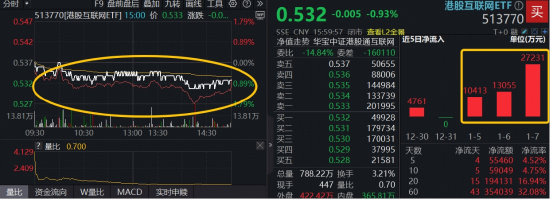
Market Overview - The Hong Kong stock market continued its downward trend on January 8, with the Hang Seng Index and Hang Seng Tech Index both falling over 1% [1][9] - Major tech stocks such as Meituan, Alibaba, and Tencent experienced declines, while Bilibili saw a rise of over 2% [1][9] - The Hong Kong Internet ETF (513770) closed down 0.93%, indicating a persistent premium and a positive attitude from buyers, with over 500 million yuan net inflow in the last three days [1][9] Alibaba Developments - Alibaba announced significant progress in its Taobao Flash Sales in the latest quarter and plans to increase investments to achieve market leadership [3][11] - Forecasts suggest that the market share of Taobao Flash Sales will continue to grow strongly by Q4 2025, with a faster reduction in losses compared to competitors [3][11] - The Ministry of Commerce predicts that China's instant retail market will exceed 1 trillion yuan by 2026 and reach 2 trillion yuan by 2030 [3][11] AI Advancements - Alibaba's Amap has upgraded its "Street Scanning List" with new features, leveraging self-developed world model technology to introduce a "Flying Street View" function [3][11] - Industry experts believe Amap is building a continuously evolving "true" digital asset pool, positioning itself as a super hub in the AI era [3][11] - The profitability cycle of the AI industry is expected to drive growth for major internet companies like Alibaba and Tencent, with a projected 34% EPS growth for the Hang Seng Tech Index by 2026 [3][11] Capital Inflows - Since the beginning of the year, southbound funds have significantly purchased Hong Kong stocks, with a net inflow of 30.78 billion HKD in the first three trading days of 2026 [4][12] - Major beneficiaries include Xiaomi, which received a net inflow of 3.148 billion HKD, and Alibaba, which saw over 2 billion HKD in net purchases [4][12] - Goldman Sachs forecasts that southbound fund inflows will reach a new high of 200 billion USD in 2026, driven by the current 37% premium of AH shares, highlighting the valuation advantages of Hong Kong stocks [4][12] Market Outlook - According to Guangfa Securities, the rise in Hong Kong assets is supported by fundamentals, with signs of structural recovery in profitability starting from the second half of 2024 [4][12] - The shift from liquidity-driven growth to a combination of profitability and liquidity is anticipated, especially with the decline of food delivery subsidies and the emergence of AI-driven advertising and cloud services as new growth points [4][12] - The Hong Kong Internet ETF and its linked funds track the CSI Hong Kong Internet Index, with major holdings in Alibaba, Tencent, and Xiaomi, accounting for over 78% of the top ten weighted stocks [4][12] Top Holdings in Hong Kong Internet ETF - Tencent Holdings (0700.HK) - 15.42% [5][13] - Alibaba (0988.HK) - 14.50% [5][13] - Xiaomi Group (1810.HK) - 13.11% [5][13] - Meituan (3690.HK) - 12.03% [5][13] - Kuaishou (1024.HK) - 4.24% [5][13]
沪指强势15连阳,光大证券:接下来需注意市场波动的风险 | 华宝3A日报(2026.1.8)
Xin Lang Cai Jing· 2026-01-08 11:19
Group 1 - The A50 ETF by Huabao, the CSI A100 ETF, and the A500 ETF are part of the "A series" of broad-based ETFs launched to provide investors with diverse options for investing in China [2][6] - The A50 ETF tracks the CSI A50 Index, focusing on 50 leading companies, while the CSI A100 ETF encompasses the top 100 industry leaders, and the A500 ETF covers a broader range of 500 companies [2][6] - The market experienced a decline with the Shanghai Composite Index down by 0.07% and the ChiNext Index down by 0.51%, with a total market turnover of 2.8 trillion yuan [1][6] Group 2 - Institutional viewpoint from Everbright Securities indicates that the market has seen a strong performance with the Shanghai Composite Index achieving a 14-day winning streak, but warns of potential profit-taking pressure and increased market volatility [2][6] - The upcoming Alibaba Cloud Tongyi Intelligent Hardware Exhibition from January 8-11 in Shenzhen is expected to showcase over 1,000 AI hardware products, which may stimulate interest in AI-related concepts [2][6]


【8日资金路线图】国防军工行业净流入逾119亿元居首 龙虎榜机构抢筹多股
Zheng Quan Shi Bao· 2026-01-08 10:35
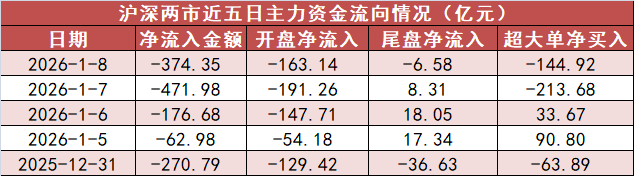
1月8日,A股市场整体涨跌互现。 截至收盘,上证指数收报4082.98点,下跌0.07%,深证成指收报13959.48点,下跌0.51%,创业板指收报3302.31点,下跌0.82%,北证50指数上涨0.81%。 1.A股市场全天主力资金净流出374.35亿元 今日A股市场主力资金开盘净流出163.14亿元,尾盘净流出6.58亿元,A股市场全天主力资金净流出374.35亿元。 | | | 沪深两市近五日主力资金流向情况(亿元) | | | | --- | --- | --- | --- | --- | | 日期 | | 分流入金额 开盘净流入 | | 尾盘净流入 超大单净买入 | | 2026-1-8 | -374. 35 | -163.14 | -6. 58 | -144.92 | | 2026-1-7 | -471.98 | -191. 26 | 8. 31 | -213.68 | | 2026-1-6 | -176. 68 | -147.71 | 18. 05 | 33. 67 | | 2026-1-5 | -62.98 | -54. 18 | 17. 34 | 90. 80 | | 2025-12-3 ...