
基础化工

Search documents
国内PC市场打破4年震荡探底格局,石化ETF(159731)份额规模创新高
Mei Ri Jing Ji Xin Wen· 2026-02-10 06:45
石化ETF(159731)及其联接基金(017855/017856)紧密跟踪中证石化产业指数,从申万一级行业分 布来看,基础化工行业占比为60.02%,石油石化行业占比为32.43%,能够分享下游化工品的利润修 复。伴随行业格局优化和供需结构调整,行业中长期叙事改善。 截至2月10日14:24,石化ETF(159731)跌0.29%,持仓股圣泉集团、广东宏大、扬农化工涨幅居前。 从资金净流入方面来看,石化ETF(159731)近20个交易日资金净流入总计14.63亿元。石化ETF最新份 额达17.63亿份,最新规模18亿元,均创成立以来新高。 (文章来源:每日经济新闻) 2026年开年以来,国内PC市场呈现显著的价格上行态势,打破了此前长达近4年的震荡探底格局。据隆 众资讯,截至1月底,华东地区PC国产料注塑级主流商谈价格区间11400元/吨~12850元/吨,较12月底 上涨500元/吨~1000元/吨不等,涨价幅度超出市场预期,而当月行业生产毛利同步推升至1095元/吨, 环比涨幅48.58%。其中,国产PC正牌料整体涨幅更大,且基本回升至2025年以来最高水平。中邮证券 认为,这场涨价行情的核心驱动力, ...
大宗商品持续涨价,行业景气度较高,石化ETF(159731)近20日合计“吸金”14.63亿元
Sou Hu Cai Jing· 2026-02-10 02:46
Core Viewpoint - The petrochemical industry index is experiencing fluctuations, with a slight decline of approximately 0.4%, while certain stocks are performing well, indicating mixed performance in the sector [1] Group 1: Market Performance - The largest petrochemical ETF (159731) has seen a net inflow of 1.463 billion yuan over the past 20 trading days, reaching a new high of 1.8 billion yuan in total scale [1] - Major industry indices such as Shenwan Media, Shenwan Nonferrous Metals, Shenwan Petroleum and Petrochemicals, and Shenwan Basic Chemicals have all increased by over 10% this year, leading among 31 Shenwan industry indices [1] Group 2: Investment Drivers - Analysts from Dongwu Securities suggest that the resource sector is entering a major cycle, driven by new demand from AI and high-end manufacturing, while supply is constrained by geopolitical factors [1] - The ongoing narrative of de-dollarization and macroeconomic factors is contributing to the sustained price increase of bulk commodities, resulting in high industry prosperity [1] Group 3: ETF Composition - The petrochemical ETF (159731) and its linked funds (017855/017856) closely track the petrochemical industry index, benefiting from both basic chemicals and petroleum and petrochemical sectors [1] - Key weighted stocks in the ETF include Wanhua Chemical (global MDI leader), China Petroleum (domestic oil and gas leader), Sinopec (domestic refining leader), and Salt Lake Potash (domestic potash fertilizer leader) [1]
朝闻国盛:周期板块景气预期开启扩张
GOLDEN SUN SECURITIES· 2026-02-10 01:15
Group 1: Macro Overview - The report indicates that the cyclical sector is expected to enter an expansion phase, with both cyclical and growth sectors currently in the analysts' expansion zone, resonating with the industry mainline model [3] - The report highlights that the cumulative amount of pending foreign exchange settlement funds since 2022 is approximately 1.13 trillion USD, with a weighted average exchange rate of 7.1 [2] - It is projected that the USD to RMB exchange rate will likely stabilize between 6.8 and 7.1 in 2026, with an overall upward trend but limited potential for sustained unilateral appreciation [2] Group 2: Industry Performance - The report lists the top-performing industries for January, March, and the past year, with notable performances in the oil and petrochemical sector (32.0% increase over the past year) and construction materials (42.7% increase) [1] - Conversely, the report identifies the worst-performing industries, including defense and military (-6.7% in January) and pharmaceuticals (-3.6% in January) [1] Group 3: Company Analysis - Huijia Times - Huijia Times is recognized for its competitive advantages, including a dense store network and deep local market insights, which contribute to significant scale effects and brand barriers in the Xinjiang region [6] - The company is actively upgrading its supermarket and shopping center formats and exploring innovative "low-altitude economy + consumption" scenarios, which are expected to open a second growth curve [6] - Revenue projections for Huijia Times from 2025 to 2027 are estimated at 2.422 billion, 2.557 billion, and 2.782 billion RMB, with year-on-year growth rates of 0.5%, 5.6%, and 8.8% respectively [6]

2/9财经夜宵:得知基金净值排名及选基策略,赶紧告知大家
Sou Hu Cai Jing· 2026-02-09 16:42
写在文章前的声明:在本文之前的说明:本文中所列的投资信息,只是一个对基金资产净值进行排行的客观描述,并无主观倾向性,也不是投资建议,纯属 娱乐性质。 一顿操作猛如虎,基金净值已更新,谁是基金中的王者,谁又垫底,请看数据: | 基金简称 PK | | | 最新净体制号学风雨圆人 | | | --- | --- | --- | --- | --- | | 1 | 华富成长趋 ... C | 1.9890 | 9.15% | | | | 020383 | 2026-2-9 | | | | 2 | 华富成长趋 ... A | 2.0245 | 9.15% | 8 | | | 410003 | 2026-2-9 | | | | 3 | 浦银安盛数 ... A | 1.5042 | 8.73% | | | | 025421 | 2026-2-9 | | | | 4 | 浦银安盛数 ... C | 1.5024 | 8.73% | 8 | | | 025422 | 2026-2-9 | | | | 5 | 长城久祥混合A | 1.8651 | 8.58% | 8 | | | 001613 | 2026-2-9 | | | ...

北交所市场周报:市场震荡调整,投资者规模突破千万户新里程碑-20260209
Western Securities· 2026-02-09 14:41
Investment Rating - The industry is rated as "Overweight," indicating an expected increase in performance exceeding the market benchmark index by more than 10% over the next 6-12 months [40]. Core Insights - The North Exchange market has reached a significant milestone with the number of qualified investors surpassing 10 million, marking a net increase of nearly 2 million compared to the same period last year, which lays a solid foundation for long-term healthy market development [3][34]. - Despite recent market adjustments, the long-term allocation value of the North Exchange remains recognized by institutions, with a slight decrease in margin financing indicating a reduction in market risk appetite [3][36]. - The acceleration of new stock issuances is expected to provide new supply to the market, with five new stocks issued in January and more expected in the coming weeks [3][36]. Summary by Sections Market Overview - The average daily trading volume of all A-shares on the North Exchange reached 20.48 billion yuan, a decrease of 28.7% week-on-week [8]. - The North Exchange 50 index fell by 0.70% during the week, with an average turnover rate of 2.13% [8]. Key News and Policies - A joint release by ten departments introduced the "Low Altitude Economy Standard System Construction Guide (2025 Edition)," focusing on five core areas including low-altitude aircraft and safety regulation [20]. - The Shanghai Gold Exchange adjusted the trading margin levels and price fluctuation limits for certain gold and silver contracts [24]. Core Driving Factors - The North Exchange's market construction has reached a new stage, with a significant increase in qualified investors, indicating enhanced market attractiveness and investor ecosystem development [34]. - Structural differentiation is evident in the industry, with active performance in energy and technology sectors, while the overall valuation shows signs of convergence [35]. - Market sentiment is cautious, with a slight retreat in margin financing indicating reduced risk appetite among investors [36]. Investment Recommendations and Strategies - Attention is recommended on the upcoming adjustments to the North Exchange 50 constituent stocks, which may create passive allocation demand for index funds [37]. - Focus on sectors with clear industrial trends such as AI, commercial aerospace, and semiconductors, as well as leading companies in the new energy sector that align with new productivity directions [38]. - A bottom-up approach is suggested to identify stocks with matching performance and valuation, especially those with potential for exceeding earnings expectations [38].
以旧换新引爆新车销量!化工板块全天强势,化工ETF(516020)上探1.79%!机构看好这些细分方向
Xin Lang Cai Jing· 2026-02-09 11:39
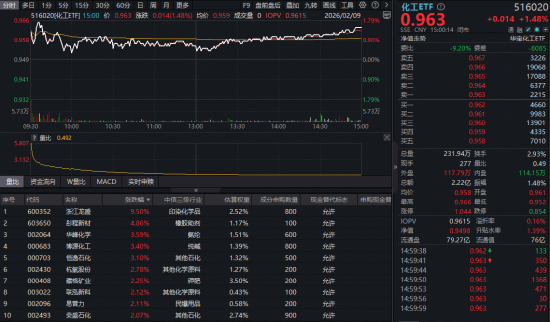
Group 1 - The chemical sector continues to rebound, with the Chemical ETF (516020) opening high and experiencing a maximum intraday increase of 1.79%, closing with a gain of 1.48% [1][7] - Key stocks in the sector include Zhejiang Longsheng, which surged by 9.5%, and Tongcheng New Materials, which rose by 4.86%, along with several others exceeding 3% gains [1][7] - The Chemical ETF tracks a specialized index that includes popular stocks in sectors like new energy, which are expected to benefit significantly from the ongoing growth in electric vehicle sales [9][10] Group 2 - According to Zhongyuan Securities, the ongoing anti-involution policies are expected to strengthen supply-side constraints in the industry, benefiting certain sub-sectors such as chlor-alkali, pesticides, and polyester filament [10] - Guohai Securities notes that the anti-involution measures may lead to a revaluation of the Chinese chemical industry, with potential for increased cash flow and dividend yields as capacity expansion slows [10] - The Chemical ETF (516020) is suggested as an efficient way to capitalize on the rebound in the chemical sector, covering themes like AI computing power and new energy [10][11] Group 3 - Recent data from the Ministry of Commerce indicates that as of February 5, 2026, there were 335,000 applications for the vehicle trade-in subsidy, driving new car sales to 53.77 billion yuan, which supports market development and resource recycling [8][9] - The average price of new cars participating in the trade-in program exceeded 160,000 yuan, showing a significant increase compared to the previous year, while the number of scrapped vehicles reached 659,000, a year-on-year increase of 50.2% [8][9]


【9日资金路线图】两市主力资金净流入超110亿元,电子等行业实现净流入
证券时报· 2026-02-09 09:57
盘后数据出炉。 沪深300今日主力资金净流入66.71亿元,创业板净流入125.74亿元。 | | | 各板块最近五个交易日主力资金净流入数据(亿元) | | | --- | --- | --- | --- | | 日期 | 沪深300 | 创业板 | 科创板 | | 2026-2-9 | 66.71 | 125.74 | -21.49 | | 2026-2-6 | -72.87 | -141.98 | -10.61 | | 2026-2-5 | -141.86 | -198.14 | -0.62 | | 2026-2-4 | -144.23 | -257.76 | -12.22 | | 2026-2-3 | -18.21 | -3.48 | -44.87 | | | | 尾盘资金净流入数据(亿元) | | | 2026-2-9 | 4.77 | 5.70 | -4.57 | | 2026-2-6 | -20.66 | -44.54 | 1.21 | | 2026-2-5 | -12.92 | -17.42 | -2.00 | | 2026-2-4 | 9.36 | 14.02 | -4.14 | | 202 ...

中东持续拉响警报!石化市场,被大幅加仓
证券时报· 2026-02-09 09:19
Group 1 - The article highlights the rising tensions in the Middle East, particularly between the US and Iran, which could lead to significant impacts on global energy and chemical markets [2][4] - Iran's role as a major supplier of energy and chemical products is emphasized, with potential disruptions in supply and transportation through the Strait of Hormuz if conflicts escalate [2][4] - Recent market movements show a cautious sentiment, with significant inflows into oil and chemical futures, indicating investor interest despite geopolitical risks [2][4][6] Group 2 - The article notes that the "Middle East factor" has become a key driver of market capital flows, with oil prices showing a notable increase of approximately 10.89% since January due to geopolitical tensions [4] - Analysts predict that energy and chemical sectors will experience short-term volatility, particularly in response to developments in the US-Iran situation [4][5] - The chemical sector is expected to see a recovery in 2026, with supply pressures easing and valuations at historical lows, making it an attractive investment opportunity [5][8] Group 3 - Institutional investors are increasingly bullish on the domestic chemical sector, driven by expectations of improved supply conditions and the potential for short-term price surges due to geopolitical events [7][8] - Data indicates a significant number of chemical products have seen price increases, with notable gains in liquid chlorine, lithium hydroxide, and other chemicals, reflecting a recovery trend in the basic chemical market [7] - The A-share market has shown resilience in the chemical sector, with substantial inflows into related stocks and indices, indicating strong investor confidence [6][8]

短期避险情绪升温
Qi Huo Ri Bao· 2026-02-09 07:11
Market Overview - The A-share and stock index futures market are exhibiting distinct "pre-holiday characteristics" as the Spring Festival approaches, aligning with historical patterns of risk aversion and market sentiment contraction [1] - Trading volume has significantly shrunk, with the average daily trading volume in the Shanghai and Shenzhen markets dropping to around 2.5 trillion yuan in February, down from 3 trillion yuan in January [1] - The market is experiencing a cautious sentiment, with traders preferring short-term speculative trades rather than long-term holdings, reflecting increased uncertainty [1] Trading Behavior - The last week before the holiday is expected to see a continued decline in average daily trading volume due to traders' inclination to secure profits and a lack of willingness for new capital to enter the market [2] - The margin financing scale has also decreased, indicating a decline in risk appetite and cautious trading sentiment ahead of the holiday [2] - The current margin financing balance accounts for only 2.62% of the A-share market's circulating market value, suggesting a healthy market structure [2] Industry Performance - In the first week of February, there was a notable divergence in industry performance, with food and beverage, beauty care, transportation, and banking sectors showing gains, while sectors like non-ferrous metals, telecommunications, electronics, and petrochemicals faced declines [3] - Defensive sectors such as food and beverage and banking are performing better, aligning with the trend of risk-averse capital seeking stable returns [3] - The market sentiment has shifted from previous exuberance to a more rational phase, with long-term investors focusing on valuation and earnings certainty [3] Futures Market Dynamics - The significant divergence in performance among stock index futures is attributed to the varying styles in the spot market, with the price spread between IC and IH narrowing after reaching a historical high [4] - The price spread is expected to continue contracting in February, aligning with the mean reversion logic of stock index futures [4] - Post-holiday, there is a strong likelihood of a "New Year rally," driven by the return of previously withdrawn funds and positive market sentiment [4]
中东持续拉响警报 机构资金大举加仓能源化工板块
Xin Lang Cai Jing· 2026-02-09 06:55
Group 1 - The core viewpoint of the articles highlights the rising tensions in the Middle East, particularly between the US and Iran, which could lead to significant impacts on global energy and chemical markets, especially in oil and methanol prices [1][2] - As of February 6, 2023, the oil futures market attracted nearly 3.4 billion yuan in investments, while the chemical futures sector saw over 1.4 billion yuan inflow, indicating a strong interest despite overall cautious market sentiment [1] - The geopolitical risks have led to a noticeable increase in international oil prices by approximately 10.89% and methanol prices by about 1.26% since January 2023, reflecting the market's sensitivity to Middle Eastern developments [2] Group 2 - In the context of the chemical sector, 207 out of 319 tracked products experienced price increases, with significant gains in liquid chlorine (71.43%), lithium hydroxide (44.10%), and acetonitrile (32.86%), indicating a recovery in basic chemical prices [3] - The A-share basic chemical sector showed resilience, with notable gains in fluorine chemicals and chemical fibers, as the China Petroleum and Chemical Industry Index rose by 2% on February 6, 2023 [3] - Fund managers have shown increased interest in the chemical sector, with a reported active allocation increase of 1.13% in the basic chemical industry, reflecting a growing confidence in the sector's long-term prospects [4]