新能源汽车制造

Search documents
造车新势力格局生变:零跑持续领跑,第二梯队加速突围
2 1 Shi Ji Jing Ji Bao Dao· 2025-11-03 12:45
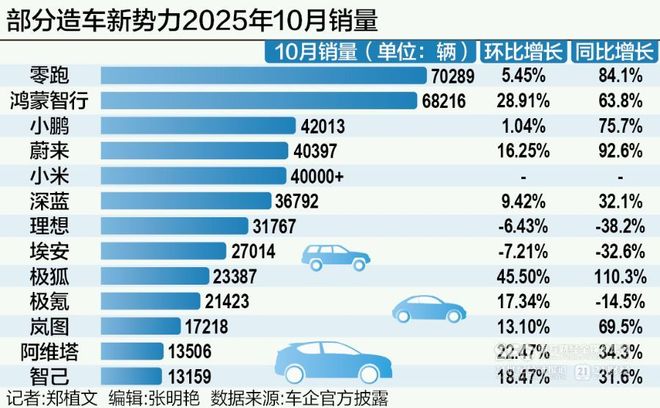
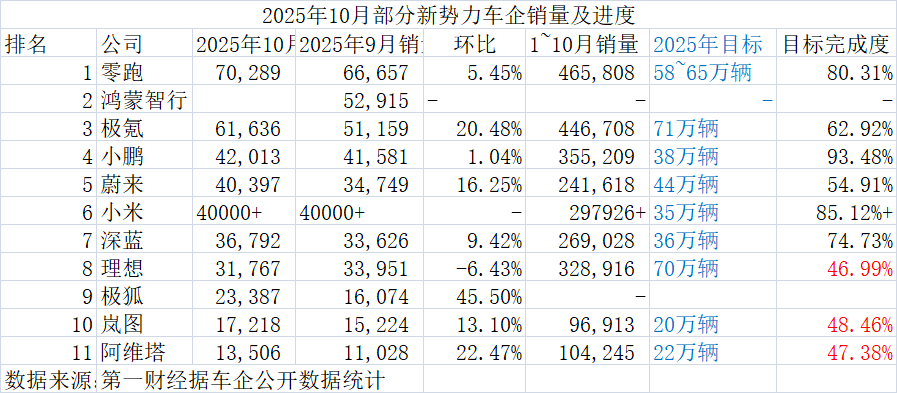
Core Viewpoint - The new energy vehicle market is experiencing significant growth, with most brands reporting both year-on-year and month-on-month sales increases, indicating a recovery in market demand [2] Group 1: Sales Performance - Leap Motor leads the market with a record monthly delivery of 70,289 units, achieving a year-on-year growth of 84.1% [2][4] - Hongmeng Zhixing follows closely with 68,216 units delivered, marking a month-on-month increase of 28.91% and a year-on-year increase of 63.8% [2] - Xiaopeng and Xiaomi both maintain over 40,000 units in monthly deliveries, while NIO joins the "40,000 club" for the first time with 40,397 units, reflecting a year-on-year growth of 92.6% [2][6] - Second-tier brands like Jihu and Lantu show significant growth, with year-on-year increases of 110.3% and 69.5%, respectively [2][8] Group 2: Market Dynamics - The traditional market structure represented by "Wei Xiaoli" is being disrupted, with Leap Motor's "technology for all" strategy gaining momentum [2][9] - Li Auto faces challenges with a month-on-month decline of 6.4% and a year-on-year drop of 38.2%, adjusting its annual sales target down from 700,000 to 640,000 units [3][4] - The competitive landscape is shifting, with brands needing to focus on technology development, supply chain management, and cost optimization to maintain their positions [9] Group 3: Strategic Insights - Leap Motor's strategy includes a price reduction for its B10 model to around 120,000 yuan, targeting mainstream consumers effectively [3] - Xiaopeng's growth is attributed to its precise product iteration strategy, with new models like MONA M03 and P7+ successfully penetrating the market [5] - NIO's multi-brand strategy is beginning to show results, with its sub-brand contributing significantly to overall sales [6] Group 4: Second-Tier Brands - Jihu's explosive growth in October, with 23,387 units delivered, is driven by the launch of its A0-class model, which offers competitive pricing and features [7] - Other second-tier brands like Zeekr, Avita, and Zhiji also report steady month-on-month growth, indicating a robust competitive response [7][8]


短剧概念火了!黄金股,重挫!
Zheng Quan Shi Bao Wang· 2025-11-03 02:45
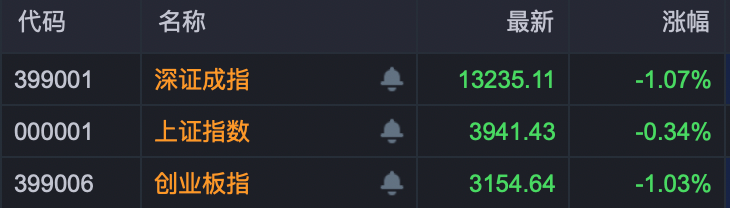
Market Overview - The Shenzhen Component Index decreased by 1.07% to 13,235.11, while the Shanghai Composite Index fell by 0.34% to 3,941.43. The ChiNext Index also dropped by 1.03% to 3,154.64 [1]. Short Drama Concept Stocks - Short drama concept stocks surged at the market open, with several stocks hitting the daily limit, including Yingxin Development (+10.08%), Jishi Media (+10.00%), and Dongfang Mingzhu (+10.00%) [2][3]. - The short drama game sector consists of 62 stocks, with significant net inflows into leading stocks such as Yingxin Development (¥200 million) and Jishi Media (¥435 million) [3]. Coal Sector Activity - The coal sector remained active, with Antai Group hitting the daily limit (+9.97%), and other companies like Jinkong Coal Industry (+6.25%) and Lu'an Environmental Energy (+5.68%) also seeing gains [4]. - The demand for coal is expected to rise as the peak season approaches, driven by high demand from steel mills and thermal power companies. The long-term trend indicates a fundamental shift in the coal supply-demand balance since May, suggesting a sustained upward trend in coal prices [4]. AI Application Sector - The AI application sector continued its strong performance, with stocks like Fushi Holdings achieving a "20cm" limit-up. Other notable gainers included Jishi Media and Sanqi Interactive Entertainment [5]. Gold Stocks in Hong Kong - Gold stocks in Hong Kong experienced a downturn, with companies like Laopuyin and Chow Tai Fook dropping over 7%. The market is closely watching new tax policies on gold set to take effect in November 2025 [6][8]. New Energy Vehicle Market - New energy vehicle stocks generally rose, with NIO and Xpeng both increasing by nearly 3%. October saw record-high delivery numbers for several companies, with Leap Motor delivering 70,289 vehicles (up 84% year-on-year) and NIO achieving 40,397 vehicles (up 92.6%) [9]. AI Application User Growth - According to a report by QuestMobile, the number of active mobile users in China's AI application sector has surpassed 700 million, reaching 729 million as of September 2025 [10].




港股高开 10月交付出炉新能源汽车集体上涨 黄金股走低
Ge Long Hui· 2025-11-03 01:29
Group 1 - The Hong Kong stock market opened higher on the first day of November, with the Hang Seng Index rising by 0.36%, the Hang Seng China Enterprises Index increasing by 0.33%, and the Hang Seng Tech Index up by 0.48% [1] - Major technology stocks mostly saw gains, with Xiaomi up by 1.39%, and Meituan, JD.com, and Tencent also experiencing increases [1] - The film and entertainment sector rose, highlighted by a collaboration with South Korea's Galaxy, leading to a significant opening increase of 8% for Superstar Legend [1] Group 2 - New energy vehicle stocks opened higher following the release of October delivery figures, with NIO rising by 3.48% [1] - In the early Asian market, spot gold fell below $3970 per ounce, leading to declines in gold stocks and non-ferrous metal stocks [1]
A股盘前播报 | 商务部回应安世半导体相关问题 公募业绩比较基准指引出炉
智通财经网· 2025-11-03 00:43
Group 1 - The Ministry of Commerce responds to ASML-related issues, indicating that China will consider exemptions for eligible exports due to disruptions in the global supply chain caused by inappropriate government interventions [1] - The China Securities Regulatory Commission has released guidelines for public fund performance benchmarks, aiming to prevent style drift and enhance investment behavior stability [2] - The Ministry of Finance and the State Taxation Administration clarified that taxpayers selling standard gold outside exchanges must pay value-added tax according to existing regulations [3] Group 2 - In October, new energy vehicle companies reported strong delivery numbers, with Leap Motor exceeding 70,000 units, Xiaopeng and NIO setting monthly delivery records, and Xiaomi maintaining over 40,000 units [4] - The solid-state battery technology industry conference was held, emphasizing the importance of demand and corporate profitability for market sustainability [5] - Citic Securities identified structural opportunities in the market, focusing on manufacturing upgrades, Chinese enterprises going abroad, and edge AI [7] - Everbright Securities suggested that the market may continue to experience range-bound fluctuations, with a focus on opportunities in media and computer sectors related to AI applications [9] Group 3 - China has achieved its first thorium-uranium nuclear fuel conversion based on molten salt reactors, which could enhance energy independence and has broad market prospects [10] - The introduction of a new payment channel for high-value innovative drugs in 2025 is expected to create significant investment opportunities in the pharmaceutical sector [11] - The president of the China Animal Husbandry Association emphasized the need to control pig production capacity, predicting a year-on-year decline in pig prices by 2025 [12]
竞争大叠加高研发 比亚迪步入业绩阵痛期
Bei Jing Shang Bao· 2025-11-02 16:01
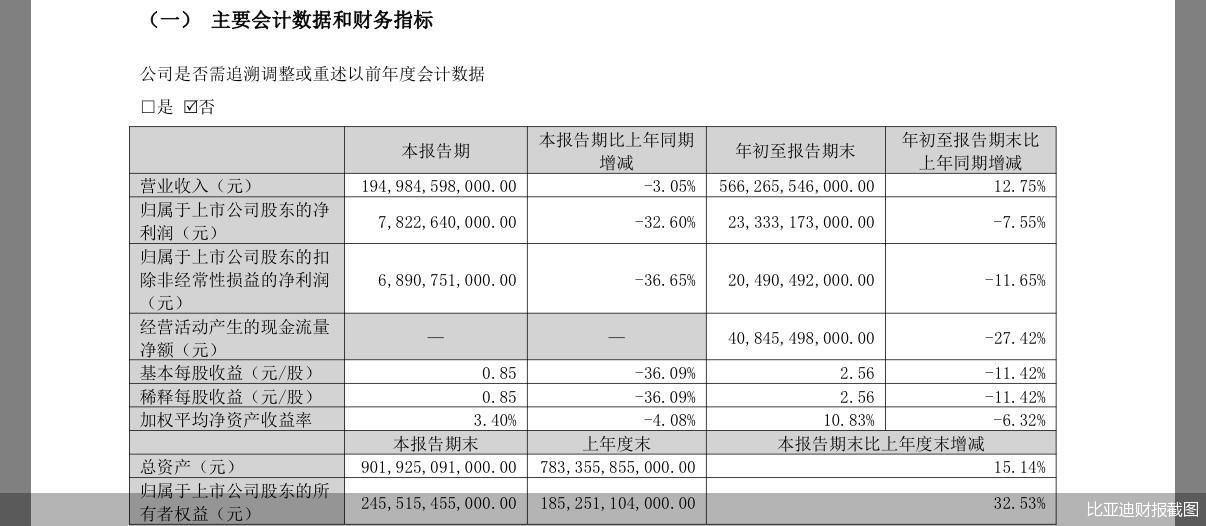
Core Insights - BYD's Q3 2025 financial report shows a significant divergence in core data, with revenue declining by 3.05% year-on-year to 194.985 billion yuan, marking the first quarterly revenue drop since 2022, while net profit fell sharply by 32.6% to 7.823 billion yuan, indicating ongoing performance pressure [1][3] - Despite a 12.75% year-on-year increase in revenue for the first three quarters to 566.266 billion yuan, net profit decreased by 7.55% to 23.333 billion yuan, highlighting challenges in short-term profitability [3][4] - The company has adjusted its annual sales target from 5.5 million to 4.6 million units, with Q3 sales showing a 1.8% year-on-year decline, primarily due to a 5.52% drop in September sales, marking the first monthly sales decline this year [3][4] Revenue and Profit Trends - Q3 revenue of 194.985 billion yuan represents a 3.05% decline year-on-year, while net profit of 7.823 billion yuan reflects a 32.6% drop [3][4] - For the first three quarters, total revenue reached 566.266 billion yuan, up 12.75% year-on-year, but net profit decreased by 7.55% to 23.333 billion yuan [3][4] - The company's gross margin improved slightly from 16.3% in Q2 to 17.9% in Q3, yet remains at a near low for recent years [4] Sales Performance - BYD's global sales for the first three quarters reached 3.26 million units, a year-on-year increase of 18.64%, but Q3 sales saw a decline of approximately 1.8% [3] - The company completed 70.87% of its revised annual sales target by the end of Q3, necessitating nearly 450,000 units per month in the remaining two months to meet the target [3] R&D Investment - R&D expenses for the first three quarters totaled 43.75 billion yuan, a 31.3% increase year-on-year, significantly exceeding net profit [6] - The company has invested 10.9 billion yuan more in R&D than Tesla this year, launching several advanced technologies [6][7] - The rising R&D expense ratio has negatively impacted profits, with the cost per vehicle reaching 112,000 yuan in Q2, up approximately 10,000 yuan from the previous quarter [6] Competitive Landscape - The intensifying competition in the smart vehicle sector poses a challenge for BYD, with competitors like Tesla and Huawei gaining market share [8][9] - To differentiate itself, BYD needs to enhance its smart driving technology and accelerate the iteration of its "Tian Shen Zhi Yan" system [8] - The company is advised to build an integrated smart ecosystem and localize R&D efforts to adapt to different market regulations and consumer habits [8][9]


突发!750亿房企获第一大股东不超过220亿元借款额度
Xin Lang Cai Jing· 2025-11-02 11:07
Company Announcements - Vanke A signed a framework agreement with Shenzhen Metro Group for a loan limit of up to 22 billion yuan, with a total expected loan principal and interest not exceeding 23.691 billion yuan [1] - Seres reported a 42.89% year-on-year increase in October new energy vehicle sales, totaling 51,456 units [2] - BYD's new energy vehicle sales for the first ten months increased by 13.88% year-on-year, with October sales reaching 441,706 units [2] - SAIC Group's new energy vehicle sales in October grew by 31.58%, totaling 206,700 units [2] - Beida Pharmaceutical entered a strategic cooperation with Shengsi Bio, obtaining exclusive distribution rights for a recombinant coagulation factor product [3] Shareholding Changes - Tianmo Technology's shareholder plans to reduce holdings by up to 3% of the company's shares [4] - Jinyi Permanent Magnet's directors and executives plan to collectively reduce their holdings by up to 0.15% of the company's shares [5] - Yongzhen Co., Ltd. shareholders plan to reduce holdings by up to 3% of the company's shares due to personal funding needs [6] Performance & Sales - BAIC Blue Valley's subsidiary reported a 112.02% year-on-year increase in October sales [9] - Changan Automobile's new energy vehicle sales in October increased by 36.14% year-on-year [7] - Great Wall Motors reported a 22.5% year-on-year increase in October vehicle sales [8] Contracts & Projects - Daye Intelligent plans to sign a charter contract with OOS for two vessels, with total rental income estimated at approximately 48.73 million USD [10] - Lanjian Intelligent signed a significant operating contract worth 138 million yuan, expected to positively impact the company's 2026 performance [11] - ST Yifei signed an overseas procurement order worth approximately 190 million yuan, which is expected to positively influence future performance [13] - Jingye Intelligent received a bid notification for a project worth 134.4 million yuan, which could positively impact performance if the contract is signed [14] Other Developments - Weiming Environmental was selected as a supplier for an energy-from-waste project in Indonesia, indicating recognition of its financial and technical capabilities [15] - Nenghui Technology established a joint venture with Zhejiang Lisan Technology, with a registered capital of 10 million yuan [16]





三个央企新能源品牌,销量加起来不如一个新势力
Di Yi Cai Jing· 2025-11-01 11:25
Core Insights - The sales gap among new energy vehicle companies is widening, with significant disparities in delivery numbers for October [1][2] Group 1: Sales Performance - Leap Motor delivered over 70,000 vehicles in October, achieving a record high of 70,289 units, representing a year-on-year increase of over 84% [2] - Xiaopeng and NIO both surpassed 40,000 deliveries, with 42,013 and 40,397 units respectively, marking their historical highs [3] - Li Auto's deliveries fell to 31,767 units in October, down 6.43% month-on-month and 38.25% year-on-year, making it the only new force car company with less than 50% of its delivery target achieved [4] Group 2: Competitive Landscape - The new energy vehicle first-tier group now has a monthly sales threshold of 40,000 units, including Leap Motor, Hongmeng Zhixing, Xiaopeng, NIO, and Xiaomi, while Li Auto has been excluded from this group [4] - Zeekr achieved a monthly sales record of over 60,000 units, with Zeekr brand sales at 21,423 units and Lynk brand sales at 40,213 units [7] - The combined sales of Deep Blue, Lantu, and Avita in October totaled 67,516 units, which is still lower than Leap Motor's single-month sales [9] Group 3: Market Trends - The market is witnessing a significant differentiation among new energy vehicle companies, with those lacking competitive advantages facing a harsher elimination process in the coming year [9] - The CEO of Leap Motor emphasized the importance of continuous improvement and leveraging strengths to succeed in the long-term automotive industry [9]
竞品挤压叠加高研发,比亚迪步入盈利阵痛期
Bei Jing Shang Bao· 2025-10-31 07:21
Core Viewpoint - BYD's Q3 2025 financial results show a significant divergence with a decline in revenue and a sharp drop in net profit, indicating pressure on performance amid increased competition and high R&D costs [1][3]. Financial Performance - Q3 revenue reached 194.99 billion yuan, a year-on-year decrease of 3.05%, marking the first quarterly revenue decline since 2022 [3]. - Net profit for Q3 was 7.82 billion yuan, down 32.6% year-on-year, continuing a trend of profit decline over two consecutive quarters [1][3]. - For the first three quarters, total revenue was 566.27 billion yuan, reflecting a 12.75% year-on-year growth, while net profit decreased by 7.55% to 23.33 billion yuan [2][3]. Sales and Market Dynamics - BYD's global sales for the first three quarters reached 3.26 million units, a year-on-year increase of 18.64%, but Q3 sales saw a decline of approximately 1.8% [3]. - The company adjusted its annual sales target from 5.5 million to 4.6 million units, with Q3 sales of 396,300 units falling short of the target [3]. R&D Investment - R&D expenses for the first three quarters amounted to 43.75 billion yuan, a 31.3% increase year-on-year, significantly exceeding net profit [5]. - The high R&D costs are impacting short-term profitability, with the average vehicle cost rising to 112,000 yuan in Q2 [5][6]. Competitive Landscape - The intensifying competition in the smart driving sector is a critical factor affecting BYD's performance, with competitors like Tesla and Huawei gaining market share [7][8]. - BYD's "Tiangshen Eye" smart driving system has been installed in 1.7 million vehicles, but the company faces challenges in expanding its urban navigation capabilities [7]. Strategic Recommendations - Industry experts suggest that BYD should enhance the differentiation of its smart driving technology and improve R&D efficiency to avoid resource wastage [6][8]. - Building an integrated smart ecosystem and accelerating localized R&D for different markets are also recommended to enhance user engagement and adapt to local regulations [8].
威马又一工厂迎复活曙光,破产产能能成“香饽饽”么?
Zhong Guo Qi Che Bao Wang· 2025-10-31 01:45
Core Viewpoint - Chuangneng New Energy is reportedly interested in acquiring the Weima Xinghui factory for vehicle manufacturing, indicating a trend of revitalizing underutilized manufacturing facilities in the new energy vehicle sector [1][5]. Company Overview - Chuangneng New Energy, based in Xiaogan, Hubei, is backed by the fourth-largest dealership group in China, Hengxin Automotive Group, and has a strong competitive edge in the battery sector, focusing on energy storage and power batteries [3]. - The company has established production bases with a total capacity exceeding 110 GWh and plans to expand to over 350 GWh by 2025, positioning itself among the top five globally in energy storage battery shipments [3]. - Hengxin Automotive Group, which owns Chuangneng, has a significant presence with over 310 dealerships across more than 60 cities, achieving a total revenue of 78.51 billion yuan and sales exceeding 410,000 vehicles in 2024 [3]. Acquisition Details - The potential acquisition of the Weima Xinghui factory, which has a total investment of 20.2 billion yuan and a planned capacity of 150,000 vehicles, is seen as a strategic move for Chuangneng to accelerate its entry into vehicle manufacturing [8]. - The factory is recognized for its advanced intelligent manufacturing capabilities and has been awarded as a champion enterprise in Hubei province, indicating its competitive position in the new energy vehicle manufacturing sector [8][10]. Market Context - The trend of acquiring existing manufacturing facilities is gaining traction as companies seek to leverage established production capabilities rather than building new plants from scratch, which can be resource-intensive [10][11]. - The new energy vehicle market is experiencing rapid growth, with a significant shift from traditional fuel vehicles, making the revitalization of existing production capacities a strategic necessity for companies entering this space [10][11].

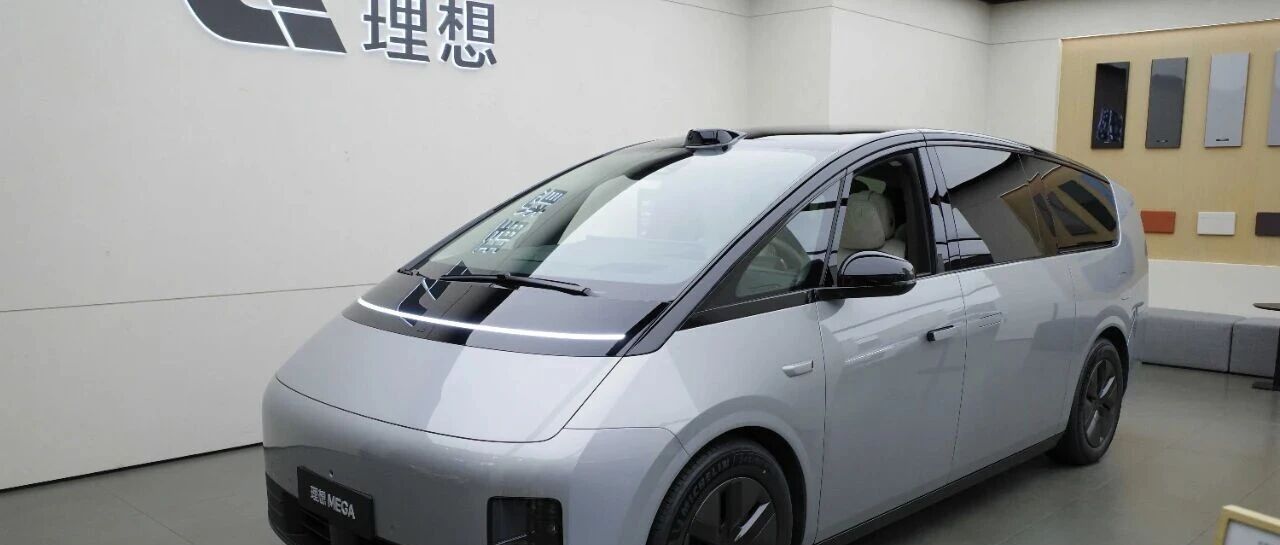
谁该为理想MEGA起火事故负责?律师详解→
第一财经· 2025-10-30 10:13
Core Viewpoint - The recent fire incident involving the Li Auto MEGA has reignited public concerns regarding battery safety, particularly focusing on the role of battery suppliers like CATL in such events [3][4]. Group 1: Incident Overview - The Li Auto MEGA utilizes a ternary lithium-ion power battery supplied by CATL, which is a major player in the battery industry [3]. - The incident has raised questions about the responsibility for electric vehicle fires, which is not straightforward and involves multiple factors [4]. Group 2: Responsibility and Legal Implications - Determining responsibility for battery-related fires is complex, involving various disciplines such as electrochemistry and materials science [4]. - Factors contributing to battery thermal runaway may include internal defects, battery management system failures, external impacts, or charging management issues [4]. - Even if a battery defect is identified, the responsibility may still be ambiguous, involving potential design flaws from the battery manufacturer or integration issues from the vehicle manufacturer [5]. Group 3: Consumer Rights and Evidence Collection - Consumers facing vehicle fires should focus on building a robust evidence chain, including official documents like fire incident reports and traffic accident responsibility determinations [6]. - Key evidence includes video footage of the incident and documentation of damages or injuries, which are crucial for legal claims [6]. - Consumers can pursue multiple avenues for redress, including legal action against manufacturers, insurance claims, and complaints to regulatory bodies [6].