
汽车等

Search documents
释放积极信号,国资央企增持回购持续加速,国企共赢ETF(159719)盘中交投高度活跃,备受资金关注
Xin Lang Cai Jing· 2025-06-10 05:55
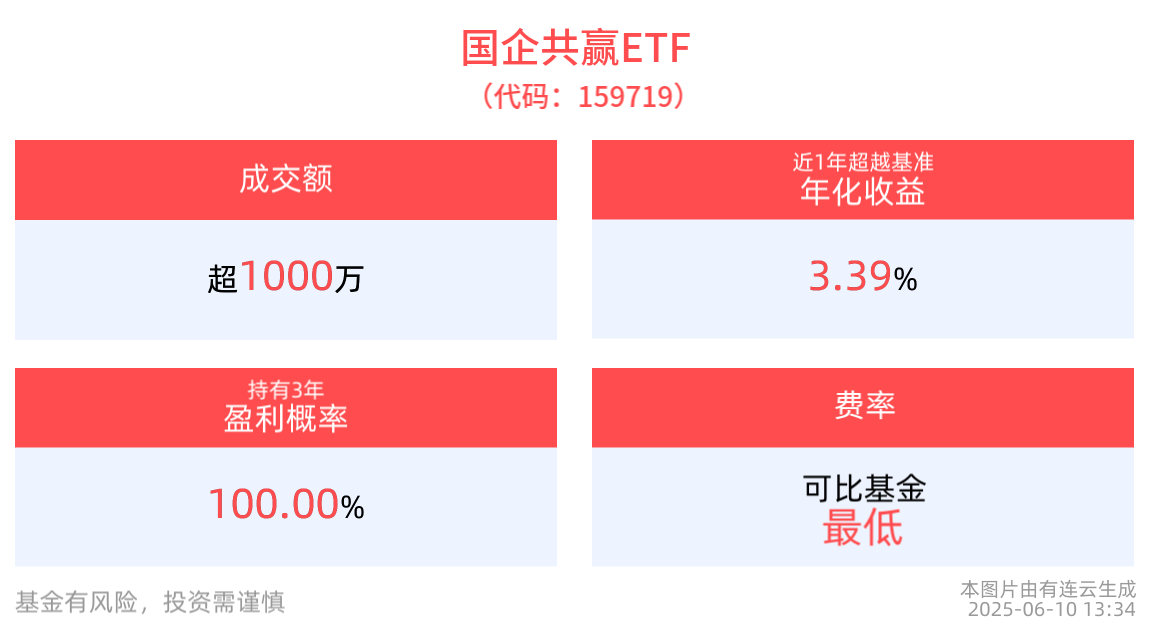
Group 1 - The National Enterprise Win ETF (159719) has seen a slight decline of 0.33% as of June 10, 2025, with a latest price of 1.52 yuan, while it has accumulated a rise of 0.92% over the past week as of June 9, 2025 [1] - The liquidity of the National Enterprise Win ETF is active, with a turnover rate of 11.05% and a transaction volume of 12.35 million yuan, while the average daily transaction volume over the past year is 17.53 million yuan [1] - The China Securities Guangdong-Hong Kong-Macao Greater Bay Area Development Theme Index (931000) has decreased by 1.12% as of June 10, 2025, with mixed performance among constituent stocks [1] Group 2 - There is a notable trend of central enterprises accelerating share buybacks and increases, with 35 central enterprise-controlled listed companies disclosing shareholding increase plans and 27 companies announcing buyback plans this year [2] - Since April 2025, 29 companies have disclosed the latest progress on shareholding increases and 18 on buybacks, indicating a rapid implementation of these plans [2] - The market is expected to see a systematic deepening of central enterprise value management, with opportunities for value re-evaluation in the capital market anticipated in the second half of the year [2] Group 3 - The Greater Bay Area ETF closely tracks the China Securities Guangdong-Hong Kong-Macao Greater Bay Area Development Theme Index, with the top ten weighted stocks accounting for 53.21% of the index as of May 30, 2025 [5] - The National Enterprise Win ETF tracks the FTSE China National Enterprise Open Win Index, which consists of 100 constituent stocks, including 80 A-share companies and 20 Chinese companies listed in Hong Kong [5] - The top ten constituent stocks of the National Enterprise Win ETF are predominantly "China National" stocks, including major companies like China Petroleum and China Mobile [5]

第二批长三角创新联合体名单发布,三家安徽企业牵头!
Xin Lang Cai Jing· 2025-06-09 04:37
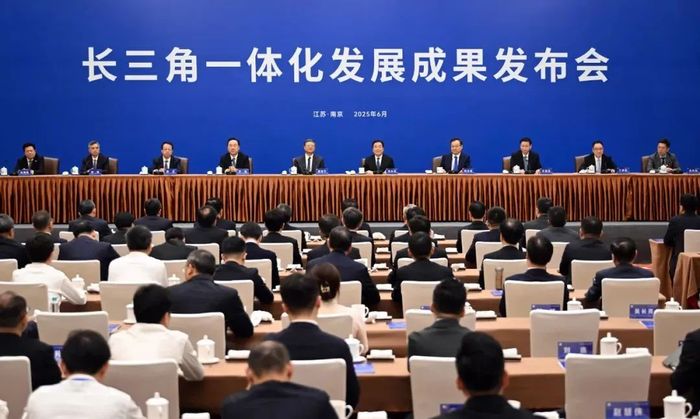
Core Viewpoint - The second batch of Yangtze River Delta Innovation Alliances has been officially announced, with three enterprises from Anhui leading the initiatives [1][4]. Group 1: Innovation Alliances - A total of 12 innovation alliances have been established, each led by a different company, focusing on various technological advancements [3]. - The leading companies and their respective innovation alliance names include: - Jiangsu Hengtong Optic-Electric Co., Ltd. leading the "Yangtze River Delta Marine Information Transmission Technology Innovation Alliance" - Jiangsu Aosaikang Pharmaceutical Co., Ltd. leading the "Yangtze River Delta Antimicrobial Infection Drug Research Innovation Alliance" - Nanjing Meichen Microelectronics Co., Ltd. leading the "Yangtze River Delta Low Earth Orbit Satellite Communication Integration Technology Innovation Alliance" - China Electronics Jinxin Digital Technology Group Co., Ltd. leading the "Yangtze River Delta Artificial Intelligence Source Network Collaborative Energy Management Innovation Alliance" - Shanghai Chemical Industry Research Institute Co., Ltd. leading the "Yangtze River Delta Isotope Technology Innovation Alliance" - Shanghai Yudu Semiconductor Technology Co., Ltd. leading the "Yangtze River Delta Electrical Measurement Equipment Innovation Alliance" - Zhejiang Jingsheng Mechanical and Electrical Co., Ltd. leading the "Yangtze River Delta Integrated Circuit Large Silicon Wafer Polishing Technology Innovation Alliance" - Hangzhou Shenhao Technology Co., Ltd. leading the "Yangtze River Delta Intelligent Robot Innovation Alliance" - Ningbo Geely Luoyou Engine Parts Co., Ltd. leading the "Yangtze River Delta Green Intelligent Powertrain Innovation Alliance" - Efort Intelligent Robot Co., Ltd. leading the "Yangtze River Delta Robot High-Speed High-Precision Technology Innovation Alliance" - Anhui Wanyi Technology Co., Ltd. leading the "Yangtze River Delta Wireless Minimally Invasive Surgery System Innovation Alliance" - Anhui Jianghuai Automobile Group Co., Ltd. leading the "Yangtze River Delta Automotive Low Carbon and Intelligent Technology Innovation Alliance" [3]. Group 2: Strategic Focus - The 12 innovation alliances are designed to address national strategic needs and align with local dominant industry directions, aiming to build an industrial chain around innovation [4]. - The goal is to promote the aggregation of various innovative elements towards the innovation alliances [4].






第二批长三角创新联合体名单发布
Zhong Guo Xin Wen Wang· 2025-06-07 08:30
Core Viewpoint - The second batch of Yangtze River Delta Innovation Alliances has been announced, aiming to enhance technological innovation and industrial integration in the region [1][3]. Group 1: Innovation Alliances - A total of 12 new innovation alliances have been established, each led by a prominent company in the region [2]. - The leading companies and their respective innovation alliance names include: - Jiangsu Hengtong Optic-Electric Co., Ltd. leading the "Yangtze River Delta Marine Information Transmission Technology Innovation Alliance" - Jiangsu Aosai Kang Pharmaceutical Co., Ltd. leading the "Yangtze River Delta Antimicrobial Infection Drug Research Innovation Alliance" - Nanjing Meichen Microelectronics Co., Ltd. leading the "Yangtze River Delta Low Earth Orbit Satellite Communication Integration Technology Innovation Alliance" - And others across various sectors such as AI, semiconductor technology, and automotive [2]. Group 2: Objectives and Future Plans - The goal of these alliances is to create a collaborative framework involving leading technology enterprises, academic institutions, and various innovation entities to tackle major technological challenges [3]. - Future plans include improving organizational structures and operational mechanisms, leveraging the influence of leading units, and fostering innovation across the entire industrial chain [3]. - The alliances will focus on forward-looking collaborative research, joint tackling of key technologies, and the transformation and industrialization of scientific achievements to enhance the autonomous innovation capabilities and core competitiveness of key industries in the Yangtze River Delta [3].
基金研究周报:权益结构性走强,大宗与黄金承压(5.26-5.30)
Wind万得· 2025-06-01 22:38
市场概况: 上周(5月26日至5月30日)A 股市场呈现结构性分化格局,低估值蓝筹与中小盘股表现迥 异。上证指数、深证及创业板指均有不同程度下跌,而万得微盘指数逆势上涨 2.65%,反映出权重股在 流动性边际收紧预期下的承压状态;与之形成鲜明对比的是,中证 500、中证 1000 等中小盘指数分别 上涨 0.32% 和 0.62%,市场结构性机会明显。 权益方面,美股三大指数集体上涨,科技巨头业绩超预期支撑风险偏好。欧洲市场德国DAX、法国 CAC表现较好。亚洲市场分化相对显著,新兴市场中越南、印度、巴西等涨跌互现。CBOE波动率指数 (VIX)下跌超10%,市场恐慌情绪降温。 商品方面,各品种承压明显。能源与工业金属领跌,贵金属随美元走强而回调,COMEX黄金仍收报于 3300美元/盎司上方。农产品方面,仅生猪期货上涨,BDI 干散货因中国进口需求而有所波动。 图 一周摘要 图 行业板块: 上周Wind一级平均涨幅0.17%,Wind百大概念指数上涨比例67%。板块方面,环保、医药 生物、国防军工相对表现良好,分别上涨3.42%、2.21%、2.13%,计算机、传媒、交通运输、通信等小 幅上行,而有色金属、 ...

现金流ETF800(516460)盘中上涨,机构:中国权益资产正迎来年度级别牛市
Xin Lang Cai Jing· 2025-05-28 03:09
Group 1 - The core viewpoint is that the Chinese equity market is expected to enter a bull market starting from Q4 2025, driven by synchronized economic and policy cycles among major global economies, with a shift in market style towards core assets after four years of small-cap rotations [1][2] - The China Securities Index 800 Free Cash Flow Index has shown a positive performance, with a 0.90% increase, and notable gains in constituent stocks such as Debon Logistics (up 9.98%) and Lao Feng Xiang (up 7.35%) [1] - The introduction of policies to support listed companies in attracting institutional investors with over 5% holdings and establishing long-term cash dividend policies is expected to enhance corporate governance and attract long-term capital [1] Group 2 - Analysts believe that the decline in risk-free interest rates will be a key driver for the rise of the Chinese stock market in 2025, leading to a broad-based increase in valuations for both A and H shares, particularly benefiting blue-chip stocks [2] - The Cash Flow 800 ETF primarily consists of large-cap blue-chip stocks, focusing on high dividend yields, stable cash flows, and profitability [3] - As of April 30, 2025, the top ten weighted stocks in the China Securities Index 800 Free Cash Flow Index accounted for 69.54% of the index, highlighting the concentration of cash flow-generating companies [3]
ETF复盘0527|两市成交额跌破万亿大关,创新药再度爆发
Sou Hu Cai Jing· 2025-05-27 10:46
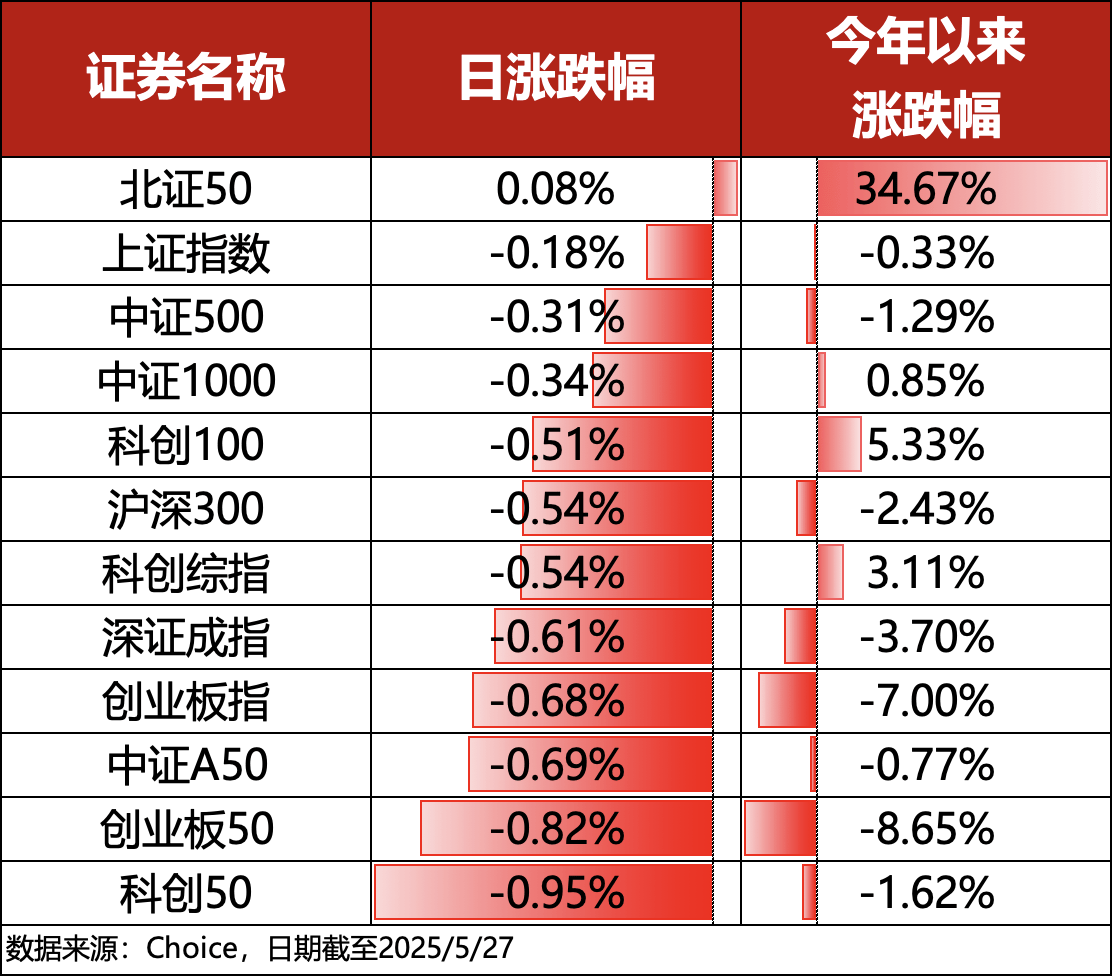
Market Overview - On May 27, A-shares experienced a collective pullback, with the Shanghai Composite Index down by 0.18%, Shenzhen Component Index down by 0.61%, and ChiNext Index down by 0.68%. Only the North Securities 50 Index saw a slight increase of 0.08% [1] - The total trading volume in the Shanghai and Shenzhen markets fell below 1 trillion RMB, amounting to 998.93 billion RMB [2] Index Performance - The North Securities 50 Index has increased by 34.67% year-to-date, while the Shanghai Composite Index has decreased by 0.33% [2] - Other indices such as the Shenzhen Component Index and ChiNext Index have seen declines of 3.70% and 7.00% respectively this year [2] Sector Performance - In sector performance, textiles and apparel (1.30%), pharmaceuticals (0.97%), and beauty care (0.88%) showed the highest gains, while sectors like non-ferrous metals (-2.06%), electronics (-1.28%), and automotive (-1.05%) faced the largest declines [7] Hong Kong Market - The main indices in the Hong Kong market experienced varying degrees of increase, with the Hang Seng Technology Index leading with a rise of 0.48%. Southbound funds recorded a net inflow of 11.975 billion HKD [5][6] Industry Highlights - The 2025 American Society of Clinical Oncology (ASCO) annual meeting will take place from May 30 to June 3, showcasing over 70 research results from Chinese pharmaceutical companies, highlighting the growth and competitiveness of domestic innovative drugs in the global market [8] - The Beijing Stock Exchange has revised its major asset restructuring review rules, introducing a "small and fast" review mechanism and simplified restructuring procedures, which are expected to enhance the efficiency of mergers and acquisitions for listed companies [9]
【盘中播报】沪指跌0.24% 有色金属行业跌幅最大
Zheng Quan Shi Bao Wang· 2025-05-27 06:32
证券时报·数据宝统计,截至下午13:58,今日沪指跌0.24%,A股成交量671.87亿股,成交金额8033.50亿 元,比上一个交易日减少1.61%。个股方面,2153只个股上涨,其中涨停81只,3026只个股下跌,其中 跌停3只。从申万行业来看,纺织服饰、环保、医药生物等涨幅最大,涨幅分别为0.96%、0.59%、 0.59%;有色金属、电子、汽车等跌幅最大,跌幅分别为2.15%、1.34%、1.20%。 今日各行业表现(截至下午13:58) | 申万行业 | 行业涨跌(%) | 成交额(亿元) | 比上日(%) | 领涨(跌)股 | 涨跌幅(%) | | --- | --- | --- | --- | --- | --- | | 纺织服饰 | 0.96 | 120.05 | 13.35 | 明牌珠宝 | 10.08 | | 环保 | 0.59 | 111.24 | 24.11 | 万德斯 | 11.30 | | 医药生物 | 0.59 | 646.97 | -7.98 | 新天地 | 17.87 | | 银行 | 0.54 | 179.24 | 3.25 | 杭州银行 | 2.25 | | 房地产 | ...
2024年主动基金产品全部持股的行业偏离度分析:显著低配金融和红利资产
Shenwan Hongyuan Securities· 2025-05-21 13:14
Group 1: Report Core Information - The report analyzes the industry deviation of the full holdings of active public - offering fund products in 2024, with a total of 4403 funds and a net asset value of about 2.88 trillion yuan [3][8] - On May 7, 2025, the CSRC issued the "Action Plan for Promoting the High - quality Development of Public - offering Funds", with two key points related to performance benchmarks [3][8] Group 2: Product Performance Benchmark - Nearly 70% of active equity products use the three major broad - based indexes (CSI 300, CSI 800, and CSI 500) as performance benchmarks, and the proportion is similar in terms of product scale [3][10] - About 18% of products use industry indexes as benchmarks, with products using medicine, consumption, emerging, and energy as benchmarks accounting for about 3% each [3][10] - In 2024, 14.0% of active products in terms of quantity and 16.3% in terms of scale used Hang Seng Index, Hong Kong Composite Index, and Hang Seng Composite Index as performance benchmarks [3][14] Group 3: Industry Allocation Deviation - Banks, non - bank finance, public utilities, food and beverages, computers, etc. are relatively under - allocated industries, with financial and dividend assets having a high degree of under - allocation [3][17] - Industries with an over - allocation margin close to or exceeding 1 percentage point include basic chemicals, social services, light manufacturing, etc., with electronics having an over - allocation of 4.9 percentage points [3][17] - In terms of absolute amount, banks and non - bank finance are under - allocated by about 190 billion yuan each compared to the performance benchmark, while electronics is over - allocated by nearly 140 billion yuan [3][18] - After excluding products with industry indexes as benchmarks, banks and non - bank finance are under - allocated by over 8 percentage points, and electronics is over - allocated by 5.8 percentage points. Banks and non - bank finance are under - allocated by about 180 - 200 billion yuan, and electronics is over - allocated by about 130 billion yuan [3][24]
策略周专题(2025年5月第2期):大小盘风格分化或将收敛
EBSCN· 2025-05-18 13:14
Group 1 - The report indicates that the A-share market has shown an upward trend, with major indices such as the ChiNext Index, SSE 50, and CSI 300 leading in gains, while the STAR 50 and CSI 500 experienced slight declines [1][15][17] - Since early April, there has been a significant outperformance of small-cap indices compared to large and mid-cap indices, with the CSI 2000 and Wind Micro-cap Index rising by 16.4% and 22.1% respectively from April 8 to May 16 [2][20][26] - The report highlights that the small-cap indices have benefited from a rebound after a prior decline, as well as from improved market sentiment following substantial progress in US-China trade talks [2][26][27] Group 2 - Historical patterns suggest that the divergence between small and large-cap stocks may converge in the future, as market sentiment shifts from riskier small-cap stocks to more stable large-cap stocks during prolonged market rallies [3][34][36] - The report emphasizes that mid to long-term capital inflows into the A-share market are likely to favor large-cap stocks, as these are typically preferred by institutional investors seeking stability and predictable performance [3][35] - The report also notes that the profitability of large-cap stocks is currently stronger, with the ROE (TTM) for the CSI 300 and CSI 500 at 9.8% and 6.0% respectively, compared to lower figures for small-cap indices [3][37] Group 3 - The report suggests a potential rotation between defensive and growth styles in the market, with defensive sectors focusing on stable or high-dividend industries, while growth sectors emphasize thematic growth and independent cyclical industries [4][58][59] - It identifies specific industries to watch under different market sentiment scenarios, with utilities, banks, and construction being favored in a declining sentiment environment, while media, defense, and technology sectors may perform better if sentiment improves [4][59][60] - The report provides a scoring framework for industry allocation, indicating that public utilities and banks score highly under current conditions, suggesting a preference for these sectors in the near term [4][65]
权益ETF系列:震荡调整,关注医药及红利板块的相对机会
Soochow Securities· 2025-05-18 08:35
Investment Rating - The report maintains an "Overweight" rating for the sector [1] Core Viewpoints - The market is expected to experience a period of volatility, with a focus on relative opportunities in the pharmaceutical and dividend sectors [19][21] - The model predicts a potential shift to a downward trend for the Wande All A Index, indicating a possible adjustment phase in May [19][26] - The pharmaceutical sector is highlighted for its relative stability and potential for returns, while the dividend sector is also expected to perform well after a short-term adjustment [19][21] Summary by Sections A-share Market Overview (May 12-16, 2025) - The top three broad indices were: North Certificate 50 (3.13%), Wande Micro-Pan Daily Equal Weight Index (1.58%), and ChiNext Index (1.38%) [10] - The bottom three indices were: Sci-Tech Innovation 100 (-1.29%), Sci-Tech Innovation 50 (-1.10%), and Sci-Tech Comprehensive Index (-1.00%) [10] A-share Market Outlook (May 19-23, 2025) - The Wande All A Index's daily model shifted from a positive to a negative signal on May 15, suggesting a potential adjustment phase [19][26] - The monthly model for May scored -2.5, indicating a slight adjustment in the A-share market [19][26] - The report anticipates a "V-shaped" market movement, with ongoing pressure on trading volumes [19] Fund Allocation Recommendations - The report suggests a defensive ETF allocation strategy, focusing on the pharmaceutical and dividend sectors for relative returns [19][21]