
信息技术

Search documents
全球股市立体投资策略周报8月第1期:关税影响渐退,降息博弈升温-20250804
GUOTAI HAITONG SECURITIES· 2025-08-04 15:07
Market Performance - Global markets experienced a general decline, with MSCI Global down by 2.2%, MSCI Developed down by 2.3%, and MSCI Emerging down by 1.6% [8][15][17] - Among developed markets, the Australian S&P 200 showed the best performance with a decline of only 0.1%, while the French CAC40 was the weakest, down by 3.7% [8][15] - In the emerging markets, the Taiwan Weighted Index was the best performer, up by 0.3%, while the Hang Seng Index was the worst, down by 3.5% [8][15] Trading Sentiment - Trading volume increased across major indices, with the Hang Seng Index reaching 198 billion shares and a turnover of 736.1 billion USD, while the S&P 500 had a turnover of 58.6 billion USD [24] - Investor sentiment in the Hong Kong market improved, with short-selling accounting for 13.5% of total turnover, while North American sentiment showed a decline [24][29] - Volatility increased in the US markets, while it decreased in the Hong Kong market [24][30] Fund Flows - Global macro liquidity expectations turned more accommodative, with the market anticipating 2.4 rate cuts by the Federal Reserve within the year [53][56] - Significant capital inflows were observed in the Hong Kong market, with a total of 18.3 billion HKD flowing in during the last week [61][65] - The net inflow of funds into the Hong Kong market was primarily driven by stable foreign capital, amounting to 13.8 billion HKD [61] Earnings Expectations - The earnings expectations for the Hang Seng Index were revised down from 2195 to 2191 for 2025, with the financial sector seeing the largest upward revision [66][68] - The S&P 500's earnings expectations were adjusted upward from 265 to 267, with the technology sector experiencing the most significant increase [66][68] - The Eurozone STOXX50 index saw a slight downward revision in earnings expectations from 336 to 335 for 2025 [66][68]
打造人才生态“磁场” 激活创新发展“动能”
Qi Lu Wan Bao Wang· 2025-08-04 12:43
Group 1 - The third Youth Scientist Innovation Development Conference was held in Jinan, Shandong, focusing on supporting young scientific talents and fostering their growth through various activities and platforms [1][2][3] - The conference emphasized the importance of mentorship from experienced scientists to guide and inspire young talents, creating a collaborative environment for knowledge transfer [4][5] - A significant feature of the conference was the industry demand matching event, which facilitated direct interactions between young scientists and business leaders, leading to potential collaborations [7][8] Group 2 - The Shandong Provincial Youth Talent Support Project has been instrumental in providing resources and opportunities for young scientists, with 342 talents selected since its inception in 2018 [10][11] - The establishment of a new online service platform aims to enhance the connection between young scientific talents and industry needs, promoting efficient technology transfer and collaboration [11] - The conference showcased various activities designed to support young scientists, including forums, dialogues, and workshops, all aimed at enhancing their innovation capabilities and career development [2][3][10]
中证下游消费与服务产业指数报5772.50点,前十大权重包含五粮液等
Jin Rong Jie· 2025-08-04 11:05
Core Viewpoint - The China Securities Index for downstream consumption and service industries has shown positive performance, with a 2.65% increase over the past month and a 1.18% increase year-to-date, indicating a stable growth trend in the sector [1][2] Group 1: Index Performance - The China Securities Index for downstream consumption and service industries reported a value of 5772.50 points [1] - The index has increased by 2.65% in the last month, 1.93% in the last three months, and 1.18% year-to-date [1] Group 2: Index Composition - The index is composed of three sub-indices: upstream resource industry, midstream manufacturing industry, and downstream consumption and service industry [1] - The index is based on the China Securities 800 index sample, selecting large-scale companies with relevant industry chain characteristics [1] Group 3: Top Holdings - The top ten holdings in the index include: Kweichow Moutai (10.75%), Midea Group (4.21%), BYD (3.44%), Heng Rui Medicine (3.34%), Wuliangye (2.83%), WuXi AppTec (2.77%), Gree Electric (2.49%), Yili Group (2.1%), Beijing-Shanghai High-Speed Railway (1.92%), and Mindray Medical (1.66%) [1] Group 4: Market Distribution - The index holdings are distributed with 54.73% from the Shanghai Stock Exchange and 45.27% from the Shenzhen Stock Exchange [1] Group 5: Industry Breakdown - The industry composition of the index includes: major consumption (27.56%), healthcare (23.18%), discretionary consumption (21.03%), industrial (10.08%), communication services (9.53%), and information technology (8.62%) [2] Group 6: Sample Adjustment Rules - The index samples are adjusted biannually, with adjustments occurring on the next trading day after the second Friday of June and December [2] - New securities that meet selection criteria and rank in the top 10 by total market capitalization will be quickly included in the index after their tenth trading day [2]





上半年江苏A股上市公司增量位居全国第一
Zheng Quan Shi Bao Wang· 2025-08-04 07:05
数据显示,今年上半年,江苏在A股新增上市公司12家,位列全国第一;此外,在港股新增上市公司6 家,在美国纳斯达克新增上市公司2家。 数据还显示,截至目前,江苏还有接近60家企业在沪深京三地交易所排队上市,超20家企业在港交所排 队上市,"后备军"数量充足、覆盖行业丰富。 (文章来源:证券时报网) 从总量上看,苏州也处于江苏省内第一、全国前五的位置。截至6月末,苏州全市共有上市企业273家, 其中,境内A股上市企业222家,位居全省第一、全国第五。上市公司中,有57家登陆科创板,数量仅 次于上海、北京,位列全国第三;有12家登陆北交所,数量仅次于北京,位列全国第二。 从行业看,江苏新增上市公司主要集中在半导体、生物医药、新材料、信息技术等战略性新兴产业,这 也展现了近年来江苏省产业结构优化和转型升级的成果。 除了A股外,上半年还有6家江苏企业在港股上市,分别是曹操出行、药捷安康、恒瑞医药、正力新 能、江苏宏信、维昇药业。6月30日,总部位于南京雨花台区的零排放技术提供商南京司凯奇汽车科技 有限公司,通过与境外特殊目的并购公司Finnovate Acquisition Corp.合并,实现在美国纳斯达克证券 交易 ...
这些基金反亏超15%!7月A股“小阳春”狂欢,调仓越勤亏越惨
Hua Xia Shi Bao· 2025-08-04 01:08
Group 1 - The A-share market continued its "small spring" trend in July, with the Shanghai Composite Index surpassing 3600 points and a year-to-date increase of over 6.6%, led by sectors such as building materials, rare earths, and innovative pharmaceuticals [1] - Despite the overall market performance, some funds experienced significant losses, with certain products down nearly 20% year-to-date, highlighting a stark contrast to the market's gains [1] - The performance of actively managed funds has been disappointing, with fund managers failing to demonstrate effective operational capabilities in the face of market fluctuations [1] Group 2 - The Qianhai Kaiyuan AI-themed mixed fund reported a year-to-date loss of 19.15% as of the end of July, ranking low among its peers [2] - This fund underwent a significant portfolio adjustment at the beginning of the year, shifting from established AI leaders to smaller chip companies, which has been viewed as a "dark horse gamble" [2] - The fund's strategy has been criticized for not including leading AI companies, and its performance continued to decline despite further changes in the second quarter [2] Group 3 - Star fund manager Qu Yang stepped down in June after managing the fund for nine years, with the fund's assets shrinking from 600 billion yuan at its peak in 2021 to 144 billion yuan [3] - The fund's return during the dual management period with Wei Chun was -41.32%, contrasting sharply with the 93.3% return during Qu Yang's sole management [3] Group 4 - The Jianxin China Manufacturing 2025 fund, managed by Sun Sheng, also faced a loss of over 15% year-to-date, attributed to poor timing in its investment strategy [4] - The fund made significant changes to its top holdings, reflecting a shift towards computing infrastructure, but suffered from a market pullback in the first quarter [4] - The fund's performance continued to lag in the second quarter, with a net asset value decline of 6.43% due to weaker-than-expected domestic AI development [4] Group 5 - The Vanguard funds managed by Liu Zhiqiang also revealed inconsistencies between strategy and performance, with both funds experiencing net value declines exceeding 14% in the first quarter [5] - The funds claimed to maintain a flexible strategy for stable returns, yet their actual performance significantly lagged behind the benchmark [5] - Many of these funds are labeled as "thematic funds," but their performance benchmarks are tied to broad market indices, raising questions about their investment focus [5] Group 6 - Industry experts noted that aggressive portfolio adjustments can lead to repeated mistakes, particularly for funds that have not aligned their strategies with market trends [6] - Many underperforming funds made extensive adjustments in the first quarter, attempting to follow market shifts, but ended up underperforming their benchmarks [6] - The trend of frequent and aggressive adjustments has resulted in further declines in net asset values, illustrating the risks of misjudging market directions [6] Group 7 - Despite the challenges faced by some active funds, there are still a number of successful actively managed funds that have generated significant excess returns through deep industry insights and precise stock selection [7] - Investors are advised to adopt a more rational "core-satellite" strategy, combining broad market index ETFs for stability with selectively chosen active funds for potential alpha returns [7] - This structured approach can help mitigate risks while allowing for a more measured response to market fluctuations and the short-term volatility of certain active funds [7]
中金:美股风险溢价为何能如此低?
智通财经网· 2025-08-04 00:20
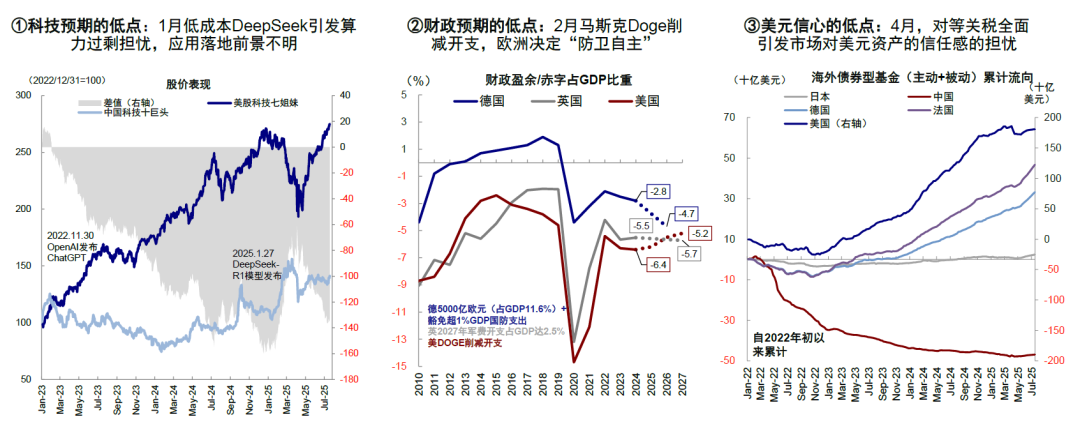
Group 1 - The core argument of the article is that despite challenges faced by the U.S. stock market in early 2023, it has managed to recover and reach new highs, supported by three macro pillars: AI technology, fiscal expansion, and global capital rebalancing [1][4][39] - The U.S. stock market's risk premium has reached historically low levels, with the Nasdaq's risk premium remaining negative since May 2023, indicating a strong investor demand for equities despite rising interest rates [4][6][7] - The decline in risk premium is primarily attributed to the rapid increase in interest rates initiated by the Federal Reserve in March 2022, which has led to a significant drop in the equity risk premium [9][11][21] Group 2 - The article discusses the structural differentiation within the U.S. stock market, highlighting that the performance of the "Magnificent Seven" tech stocks has significantly outpaced the broader market, contributing to the overall low risk premium [39][41] - The risk premium for the top 20 performing stocks is notably lower than that of the remaining 480 stocks, indicating a concentration of risk and performance within a small number of high-growth companies [41][46] - The article suggests that as long as the advantages of leading tech stocks, particularly in the AI sector, continue, the low risk premium in the U.S. stock market can be sustained [38][46] Group 3 - The article proposes that the reasonable level of risk premium for the S&P 500 could still have slight room for decline, with potential index levels projected between 6200 and 6400 based on current economic conditions and interest rate expectations [52][58] - It emphasizes that adjustments in the calculation of risk premium, considering relative interest rates and the contribution of overseas investors, indicate that the perceived low risk premium may not be as low as it appears [30][36][38] - The analysis concludes that the ongoing "asset scarcity" globally and the relative attractiveness of U.S. equities will likely support the current market dynamics, despite potential short-term volatility [38][58]

中金:美股风险溢价为何能如此低?
中金点睛· 2025-08-03 23:37
Core Viewpoint - The article discusses the low equity risk premium in the US stock market, exploring the underlying factors that contribute to this phenomenon and its implications for future market performance [6][34]. Group 1: Macro Factors Influencing US Stock Market - The US stock market has been buoyed by three macro pillars: AI technology, fiscal expansion, and global capital rebalancing, which have created a positive feedback loop [2]. - Despite challenges in early 2023, including tech layoffs and fiscal tightening, the US stock market has quickly recovered and reached new highs [2][4]. - The performance of the US stock market and the dollar suggests a potential slight strengthening of the dollar, contrary to the prevailing narrative of "de-dollarization" [4]. Group 2: Understanding Equity Risk Premium - The equity risk premium (ERP) measures the additional return investors require for taking on the risk of investing in stocks compared to risk-free assets [7][8]. - Currently, the ERP for the S&P 500 and Nasdaq is significantly lower than that of other major global markets, with the S&P at 0.36% and Nasdaq at -0.6%, while European and Japanese markets show premiums of 4.0% and 3.6% respectively [8][10]. - The decline in the ERP began after the Federal Reserve's interest rate hikes in 2022, which raised the 10-year Treasury yield from 2.1% to nearly 5.0% [10]. Group 3: Reevaluating Risk Premium Calculations - The article questions whether the traditional method of calculating ERP using nominal interest rates is appropriate, given the recent economic changes [12][13]. - It highlights that the divergence between nominal and real interest rates, particularly post-pandemic, may distort the perceived risk premium [15]. - The relative interest rate, which considers the difference between actual and natural rates, may provide a more accurate reflection of opportunity costs and valuation [17][21]. Group 4: Structural Differentiation in the US Stock Market - The low ERP is also attributed to significant structural differences within the market, driven primarily by AI trends and leading tech stocks [34]. - The "Magnificent Seven" stocks have surged 174% since late 2022, significantly outperforming the broader S&P 500, which rose 62% [34][36]. - The top 20 performing stocks have a current ERP of -0.8%, while the remaining 480 stocks have an ERP of 1.2%, indicating a stark contrast in risk premiums [36][41]. Group 5: Future Outlook for Risk Premium - The article suggests that the ERP may have room for slight decline, with potential S&P 500 levels projected between 6200 and 6400 based on current economic conditions [43][50]. - It also discusses the possibility of a market correction due to external factors, which could provide better buying opportunities [50].

北交所策略专题报告:开源证券WAIC展出具身智能等多项前沿展品,关注北证AI、机器人产业链
KAIYUAN SECURITIES· 2025-08-03 11:42
Group 1: AI and Robotics Industry - The 2025 World Artificial Intelligence Conference (WAIC) showcased over 3,000 cutting-edge exhibits, including more than 40 large models, 50 AI terminal products, and 60 intelligent robots, with a total exhibition area exceeding 70,000 square meters [2][12][13] - As of August 1, 2025, there are 20 AI-related companies listed on the Beijing Stock Exchange (BSE) with a total market capitalization of 75.903 billion yuan [2][21] - The robotics sector on the BSE includes 11 companies with a total market capitalization of 42.815 billion yuan, featuring products such as hollow cup motors and polymer lithium batteries [2][25] Group 2: Pharmaceutical and Biotech Industry - The pharmaceutical and biotech sector experienced an average increase of 4.04% in stock prices during the week of July 28 to August 1, 2025, while other sectors like high-end equipment and information technology saw declines [3][26] - The average price-to-earnings (P/E) ratio for the pharmaceutical and biotech industry decreased to 46.0X during the same period [39] Group 3: Technology New Industries - Among 150 companies in the technology new industries, the median price-to-earnings (P/E) ratio fell from 60.5X to 58.6X, with an overall market capitalization decline from 485.859 billion yuan to 471.580 billion yuan [4][45][46] - The median price change for these companies was -3.26%, with 19 companies experiencing stock price increases [42][44] Group 4: Company Announcements - Jianbang Technology's subsidiary in Thailand has transitioned to the production phase after receiving the business license, focusing on the manufacturing of cast automotive parts [66]
南向资金持续加仓港股,关注恒生ETF易方达(513210)、H股ETF(510900)等产品投资机会
Mei Ri Jing Ji Xin Wen· 2025-08-03 03:22
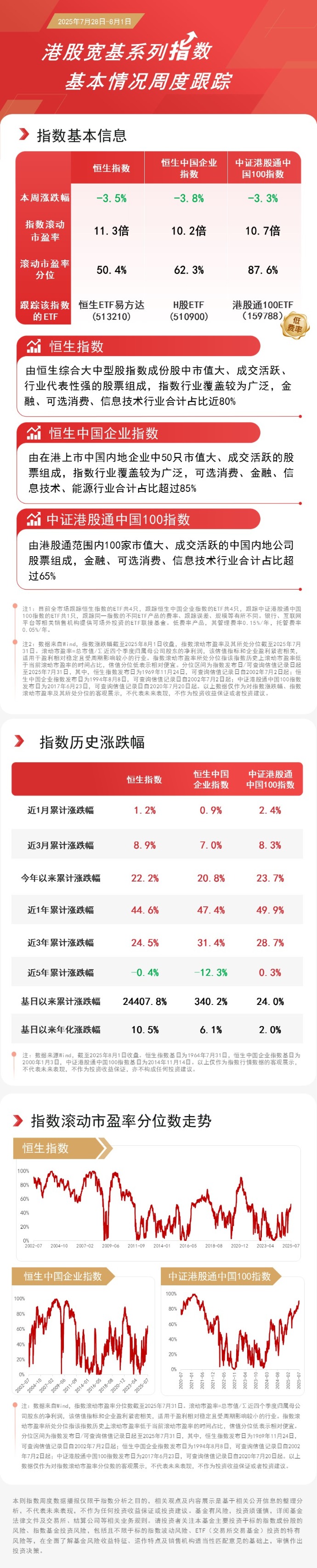
Market Overview - The Hong Kong stock market experienced a correction this week, with the Hang Seng Index declining by 3.5%, the Hang Seng China Enterprises Index down by 3.8%, and the CSI Hong Kong Stock Connect China 100 Index falling by 3.3% [1][3]. Fund Flows - Southbound funds were actively increasing their positions, with a total net purchase of nearly 60 billion yuan [1]. Index Performance - The rolling price-to-earnings (P/E) ratios for the indices are as follows: Hang Seng Index at 11.3 times, Hang Seng China Enterprises Index at 10.2 times, and CSI Hong Kong Stock Connect China 100 Index at 10.7 times [3]. - The rolling P/E ratio percentiles indicate that the Hang Seng Index is at 50.4%, the Hang Seng China Enterprises Index at 62.3%, and the CSI Hong Kong Stock Connect China 100 Index at 87.6% [3]. Sector Composition - The CSI Hong Kong Stock Connect China 100 Index comprises 100 large-cap and actively traded companies from mainland China, with financials, consumer discretionary, and information technology sectors accounting for over 65% of the index [6]. - The broader index sectors, including consumer discretionary, financials, information technology, and energy, collectively represent over 85% of the index [6]. Historical Performance - Year-to-date performance shows the Hang Seng Index up by 22.2%, the Hang Seng China Enterprises Index up by 20.8%, and the CSI Hong Kong Stock Connect China 100 Index up by 23.7% [7]. - Over the past year, the Hang Seng Index has increased by 44.6%, the Hang Seng China Enterprises Index by 47.4%, and the CSI Hong Kong Stock Connect China 100 Index by 49.9% [7].
为国家重大战略和关键领域输送人才
Jing Ji Ri Bao· 2025-08-02 21:48
Group 1 - The core viewpoint highlights the commitment of Beijing University graduates to contribute to national development and regional innovation, particularly in the western regions of China [1][2] - The employment data indicates that 20.3% of Beijing University graduates chose to work in the Yangtze River Delta, while 16.5% opted for the Pearl River Delta [1] - The university has organized various recruitment events to enhance employment resources in key sectors and regions, aligning with national strategies for western development and revitalization of the northeast [2] Group 2 - A notable trend is the increasing number of graduates from Beijing University entering state-owned enterprises and sectors related to national security and economic lifelines [2] - Statistics show that 72.7% of master's and doctoral graduates from the information engineering department have entered various enterprises, with 57.7% working in new generation information technology, advanced manufacturing, and energy sectors [2]