半导体

Search documents
NAND,大涨90%
半导体芯闻· 2026-03-04 10:23
Core Viewpoint - The global NAND Flash industry is expected to see significant revenue growth driven by AI infrastructure demand, with the top five brands projected to achieve a combined revenue of $21.17 billion in Q4 2025, reflecting a quarter-over-quarter increase of 23.8% [2]. Group 1: Revenue Performance of Major NAND Flash Suppliers - Samsung leads the NAND Flash market with a revenue of $6.6 billion in Q4 2025, showing a quarter-over-quarter increase of 10%, although its market share has decreased to 28% [3]. - SK Group (including SK Hynix and Solidigm) reported a revenue increase of 47.8% to $5.21 billion, maintaining its second position with a market share of 22.1, driven by growth in Mobile NAND Flash and enterprise SSDs [3]. - Kioxia achieved a revenue of $3.31 billion, marking a quarter-over-quarter increase of 16.5%, with both revenue and bit shipments reaching record highs for the quarter [3]. - Micron's revenue increased by 24.8% to nearly $3.03 billion, ranking fourth, as the company continues to enhance QLC production and expand its offerings using the ninth-generation NAND Flash technology [3]. - SanDisk reported a revenue of nearly $3.03 billion, with a quarter-over-quarter increase of 31.1%, benefiting from the overall NAND supply shortage and making significant progress in the server sector [4]. Group 2: Market Outlook and Trends - TrendForce anticipates that NAND Flash prices will remain high in 2026 due to limited foreseeable capacity expansion and surging AI demand [4]. - Major manufacturers are accelerating technology upgrades and shifting their product focus towards high-capacity QLC enterprise SSDs (122TB/245TB) to meet the requirements of generative AI for large capacity and high-speed transmission [4]. - Capacity resources are expected to continue to tilt towards the server segment, leading to a squeeze in supply for consumer products [4].

半导体行业2月份月报:半导体行业涨价蔓延未止,关注AI驱动下细分赛道结构性机会-20260304
Donghai Securities· 2026-03-04 09:54
Investment Rating - The semiconductor industry is experiencing a recovery with a positive outlook for March 2026, driven by AI computing power and structural opportunities in semiconductor equipment and key components [6][7]. Core Insights - The semiconductor industry showed continued price increases in February 2026, with demand improving globally, particularly in TWS headphones, wearable devices, smart home products, AI servers, and new energy vehicles [6][7]. - Despite high inventory levels, certain segments driven by AI demand are leading to price increases from upstream wafer foundries, while memory price hikes may impact consumer electronics costs [6][7]. - The overall semiconductor supply-demand balance is expected to remain favorable in March 2026, with storage prices continuing to rise and demand for AI-related products driving growth [6][7]. - The report highlights the importance of geopolitical factors affecting technology sectors, with a focus on domestic semiconductor production acceleration due to external pressures [6][7]. Monthly Market Review - In February 2026, the semiconductor sector experienced a decline of 4.25%, while the overall electronic sector fell by 0.87% [13][15]. - The semiconductor valuation metrics indicate a PE of 97.85% and a PB of 81.49%, reflecting high historical levels [20][22]. - Public fund holdings in the semiconductor sector account for 65.23% of the electronic industry, with a total market value of 671.64 billion [25][28]. Semiconductor Supply and Demand Tracking - Semiconductor prices continued to rise in February, with certain segments experiencing supply shortages [6][7]. - Global semiconductor sales in December 2025 showed a year-on-year increase of 37.13%, indicating a recovery in demand [6][7]. - The report provides detailed tracking of semiconductor inventory and supply chain dynamics, highlighting the ongoing adjustments in production capacity [6][7]. Downstream Demand Data - The report forecasts a gradual improvement in overall semiconductor demand in 2025, with specific growth in AI servers, new energy vehicles, and wearable devices [6][7]. - Global smartphone shipments showed a slight increase of 2.28% year-on-year in Q4 2025, while PC shipments rose by 9.61% [6][7]. - The demand for consumer electronics is projected to decline in 2026 due to rising storage prices impacting shipment volumes [6][7]. Investment Recommendations - The report suggests focusing on leading companies in AIOT, AI-driven sectors, and semiconductor equipment, highlighting specific companies such as 乐鑫科技, 恒玄科技, and 瑞芯微 [6][7]. - It emphasizes the importance of monitoring developments in AI and semiconductor pricing trends, recommending strategic investments in undervalued segments [6][7].
有研硅(688432):跨境并购落地,国资保障利基硅片与刻蚀硅供应
NORTHEAST SECURITIES· 2026-03-04 09:48
Investment Rating - The report initiates coverage with a "Buy" rating for the company [3]. Core Insights - The successful completion of a cross-border acquisition allows the company to extend its market position from silicon materials to equipment components, enhancing its competitiveness in the semiconductor core consumables sector [1]. - The company is increasing its investment in 12-inch silicon wafer production capacity, aiming to ramp up output from 150,000 wafers per month to 300,000 wafers per month by early 2025 [2]. - The expansion of domestic wafer fabrication plants is expected to significantly increase the demand for local silicon and etching silicon, providing a stable demand foundation for upstream consumables [2]. Financial Projections - The company is projected to achieve revenues of CNY 1.005 billion, CNY 1.262 billion, and CNY 1.424 billion for the years 2025, 2026, and 2027 respectively, with net profits of CNY 209 million, CNY 260 million, and CNY 299 million for the same years [3][4]. - The revenue growth rates are expected to be 0.93% in 2025, 25.58% in 2026, and 12.78% in 2027, while net profit growth rates are projected at -10.14% in 2025, 24.22% in 2026, and 15.09% in 2027 [9]. Market Data - As of March 3, 2026, the company's closing stock price was CNY 15.27, with a market capitalization of CNY 19,092.11 million [4]. - The stock has shown an absolute return of 35% over the past 12 months, outperforming the market benchmark [7]. Analyst Team - The report is prepared by a team of analysts with extensive backgrounds in the semiconductor and financial sectors, ensuring a comprehensive analysis of the company's market position and financial outlook [10].

阿里Qwen负责人离职;高盛CEO表示市场对伊朗战争反应“温和”令人意外;两天熔断!韩国股市暴跌12%,100万亿韩元救市基金待命
新财富· 2026-03-04 09:42
Group 1 - Goldman Sachs CEO David Solomon expressed surprise at the "mild" market reaction to the Middle East conflict, indicating that it may take weeks to fully understand the situation and its impacts [2][4] - The conflict has led to a surge in oil prices, with Brent crude surpassing $82 per barrel, marking the largest two-day increase since 2020, prompting traders to significantly lower expectations for Federal Reserve rate cuts [3] - The market sentiment is partly supported by the U.S. commitment to ensure the safety of shipping in the Strait of Hormuz, despite the high shipping risks due to Iranian naval control and attacks on oil tankers [4][5] Group 2 - The ongoing conflict in the Middle East is causing significant panic in Japan and South Korea, with the KOSPI index in South Korea plummeting by 12%, raising concerns over energy supply and regional security [5][11][31] - The South Korean government is prepared to activate a market stabilization plan worth approximately 100 trillion won (about $68 billion) in response to the stock market turmoil, which has been exacerbated by rising oil prices and inflation expectations [32][31] Group 3 - The Chinese smart glasses market saw a dramatic increase in sales, reaching 1.454 million units, a 211% rise, indicating strong demand and growth potential in the emerging consumer electronics sector [6] - The Ministry of Science and Technology and other departments have issued opinions to promote high-quality development of technology insurance, focusing on the risk protection needs of technology enterprises throughout their lifecycle [15]

“特斯拉铁粉”股东大举购入100万股英伟达(NVDA.US),力挺AI非泡沫!
智通财经网· 2026-03-04 09:19
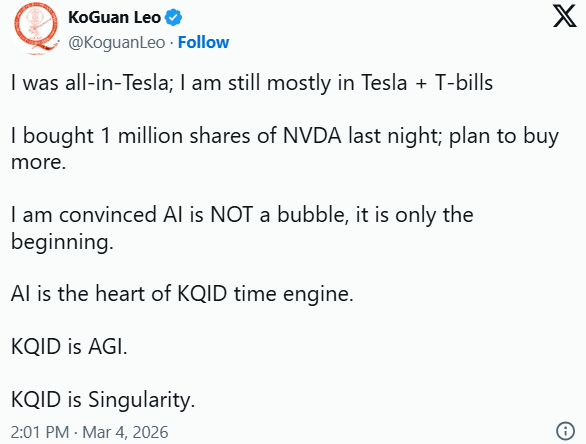
智通财经APP获悉,几年前成为特斯拉(TSLA.US)最大个人股东之一的亿万富翁廖凯原(Leo KoGuan)表 示,他周二购买了英伟达(NVDA.US)100万股股票。英伟达股票周二收于180.05美元,这意味着这位71 岁的亿万富翁大约支付了1.8亿美元。根据数据,他的财富为128亿美元。 廖凯原周三在X上发帖说:"我确信人工智能不是泡沫,它仅仅是个开始。计划很快再买入更多英伟达 股票,以安抚紧张的市场。" 尽管廖凯原对埃隆·马斯克和特斯拉越来越持怀疑态度,包括特斯拉决定向其首席执行官提供价值可能 高达1万亿美元的薪酬方案,但他表示自己"仍然主要持有特斯拉股票"和美国国债。他拒绝透露这些年 来他减持了多少特斯拉股份。 他在社交媒体平台上写道:"我认为特斯拉的能源、网络安全和Teslabot的价值还没有完全反映在股价 中。所以,有胆识的投资者现在仍然可以买入特斯拉股票,以期未来获得巨额财富。特斯拉是全球领先 的智能人机交互公司。" 廖凯原出生于印度尼西亚,在纽约接受教育,现居新加坡。他最初通过与前妻共同经营的位于新泽西州 萨默塞特的SHI国际公司积累了财富。这家企业软件公司由他本人创立。他曾表示,自己从20 ...


特斯拉“铁粉”斥资上亿美金加仓英伟达 称AI浪潮非泡沫
Xin Lang Cai Jing· 2026-03-04 08:57
格隆汇3月4日丨亿万富翁Leo KoGuan曾在几年前以特斯拉(TSLA.US)最大个人股东之一的身份崭露头 角,他表示周二买入了100万股英伟达(NVDA.O)股票。Leo 周三在X平台上发布贴文称:"我坚信AI不 是泡沫,这仅仅是开始。"随后他补充道:"计划很快再买入100万股英伟达。以此向紧张的市场表示支 持。"英伟达周二在纽约收盘报180.05美元,这意味着这位71岁的亿万富翁大约支付了1.8亿美元。根据 亿万富翁指数,他的身家达128亿美元。 来源:格隆汇APP ...
【宏观月报】:2月全球投资十大主线-20260304
Huachuang Securities· 2026-03-04 08:47
Market Trends - Global asset performance in February 2026 ranked commodities (2.13%) highest, followed by global stocks (1.59%), and the Chinese yuan (1.38%) [2] - The S&P 500 index faces significant resistance at the 7000-point level, with heightened defensive behavior in the market due to geopolitical risks [3] - The relative valuation of U.S. stocks has dropped to a ten-year low, with the S&P 500 equal-weighted index's P/E ratio at 1.11 compared to global markets excluding the U.S. [3] Investment Strategies - Fund managers are shifting towards emerging markets, with a net overweight ratio rising to 49%, the highest since February 2021 [4] - Defensive sectors like consumer staples have outperformed cyclical sectors since January 2026, indicating a cautious market sentiment [3] Currency and Bond Market - The U.S. dollar weakened following the Supreme Court's ruling against Trump's tariffs, with the dollar index dropping by 0.10% and the VIX index by 5.64% on February 20 [5] - Japanese long-term bonds are being purchased by overseas investors, leading to a flattening of the yield curve, with expected total returns around 6% for dollar investors [6] Global Economic Indicators - The yen's status as a global safe-haven asset is linked to changes in Japan's international balance of payments, with a significant shift occurring since 2005 [7] - The Hang Seng Tech Index fell by 10.15% in February, while the KOSPI index surged by 46% year-to-date, indicating a divergence in market sentiment between the two regions [8] Risk Factors - The AI technology bubble is identified as a major tail risk, with 25% of fund managers citing it as a concern in February 2026 [9] - The People's Bank of China has reduced the foreign exchange risk reserve requirement to zero, aiming to stabilize the yuan's appreciation against the dollar [10]
特朗普“护航”失效,亚洲市场崩了
华尔街见闻· 2026-03-04 08:39
Core Viewpoint - The geopolitical tensions in the Middle East, exacerbated by Trump's statements, have led to a significant decline in the Asia-Pacific markets, particularly impacting technology and semiconductor stocks, as rising energy prices raise inflation concerns and delay potential interest rate cuts by the Federal Reserve [2][4][15]. Market Performance - The Asia-Pacific stock markets have experienced a substantial downturn for three consecutive trading days, with the South Korean index falling over 12%, marking its largest single-day drop in history [2][3]. - The Kospi index has seen a cumulative decline of 20% over two days, erasing all gains made in February and recording the worst two-day performance since 2008 [3][4]. - Major stocks such as Samsung Electronics and SK Hynix have dropped over 11% and 9%, respectively, following a period where the Kospi was one of the best-performing indices globally [4][6]. Energy Prices and Inflation Concerns - Brent crude oil prices have surged approximately 12% over two days, reaching above $82 per barrel, the largest two-day increase since 2020 [8]. - The rise in oil prices and the strengthening dollar have compounded the challenges faced by Asian markets, with the dollar index experiencing its largest two-day increase in nearly a year [9]. Investor Sentiment and Market Dynamics - The current market sell-off is characterized by a rapid withdrawal of foreign capital, particularly from South Korea, with over $7 billion exiting in just two trading days [10]. - Analysts suggest that the sell-off is driven more by profit-taking and risk reduction rather than a fundamental deterioration in earnings [11][12]. - The high concentration of investments in major tech stocks has made the South Korean market particularly vulnerable to these geopolitical tensions [10]. Future Outlook - Despite the current downturn, some analysts are beginning to identify potential rebound opportunities, noting that a rapid de-escalation of tensions could trigger significant short-covering rallies [13]. - However, a stable market recovery is contingent upon clear signals of de-escalation in the Middle East, as the geopolitical landscape remains unpredictable [14][15].

崩了!韩国大跌12%再度熔断!黄金白银同步大跌,资金疯狂涌入美元!抛售潮谁能幸免?
雪球· 2026-03-04 08:29
Market Overview - The A-share market experienced a collective pullback, with the Shanghai Composite Index down 0.98% to 4082.47 points, the Shenzhen Component down 0.75% to 13917.75 points, and the ChiNext Index down 1.41% to 3164.37 points [2] - The trading volume in the Shanghai and Shenzhen markets was 238.82 billion, a decrease of 76.98 billion from the previous day [2] Sector Performance - Most industry sectors declined, with electric grid equipment, national defense, electric power equipment, and small metals showing gains, while shipping ports, precious metals, insurance, oil and petrochemicals, liquor, and logistics sectors faced significant losses [3] - The shipping sector saw a notable decline, with stocks like Lianyungang and Nanjing Port hitting the daily limit down [3][5] Shipping Sector - Shipping stocks generally fell over 9%, with specific stocks like Lianyungang down 10.06% and Nanjing Port down 10.02% [6][7] - The shipping sector's decline was influenced by geopolitical tensions, particularly in the Gulf region, affecting oil prices and trade [8][9] Storage Sector - The storage chip sector experienced a strong rebound, with stocks like Baiwei Storage hitting the daily limit up by 20% and Jiangbolong rising over 14% [11] - Baiwei Storage projected revenues of 4 to 4.5 billion for January-February 2026, a year-on-year increase of 340% to 395%, driven by AI computing demand and domestic substitution [14] Global Market Impact - The Japanese and South Korean stock markets faced significant declines, with the Nikkei 225 down 3.61% and KOSPI down 12.2%, triggering circuit breakers due to excessive losses [17] - Concerns over inflation and monetary policy normalization in Japan were exacerbated by rising oil prices and a strong dollar, impacting financial stocks [19] Precious Metals - Gold and silver futures saw substantial declines, with gold dropping 4.4% and silver over 8%, as investors liquidated positions for liquidity amid global market sell-offs [20]

中国银河策略:A股市场波动的“正负手”及投资展望
Xin Lang Cai Jing· 2026-03-04 08:10
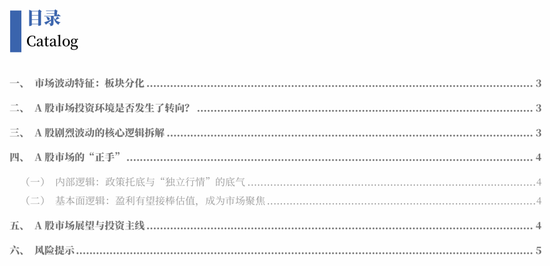
炒股就看金麒麟分析师研报,权威,专业,及时,全面,助您挖掘潜力主题机会! 来源:中国银河策略 A股市场投资机会展望:A股剧烈波动并非趋势性转向,而是外围压力叠加下的短期情绪集中释放,中 长期市场向好趋势未变,后续将逐步从"情绪驱动"回归"基本面驱动",呈现"震荡消化、动能提升、结 构聚焦"的运行格局。一是政策面持续发力,两会期间政策红利将集中释放,为市场提供明确的主线方 向;二是国内经济复苏基础逐步夯实,企业盈利有望持续改善,为市场提供基本面支撑;三是当前A股 估值仍处于合理水平,长线资金逐步入场,市场中长期向好趋势明确。配置机会上,建议重点关注:主 线一,短期确定性,涨价与避险。若地缘冲突短期内难以平息,全球实物资产正经历价值重估过程。霍 尔木兹海峡的紧张局势直接驱动能源及替代性需求走强。油气、石油化工(直接受益于油价上涨)、煤 炭(替代逻辑);有色金属(铜、铝、黄金,受益于通胀预期和避险需求);航运港口(运价飙升及航 线重构)。主线二,供需格局改善与行业盈利修复逻辑,以及估值具备安全边际的红利资产,建议关注 基础化工(业绩边际改善预期加强,如化学制品、化学原料、农化制品等)、钢铁、建筑材料、金融 (尤其是 ...