农产品加工

Search documents
奋进的河南——决胜“十四五”·“农”墨重彩卷丨豫字号农产品何以打响
He Nan Ri Bao· 2025-10-10 23:24
Core Insights - The article highlights the transformation of Henan's agricultural products into recognized overseas brands, driven by a combination of industry strength, branding efforts, regulatory support, and logistics improvements [1][2][3][4][5][6][7] Group 1: Industry Foundation - Henan is a crucial grain production area, utilizing 6% of China's arable land to produce 10% of the nation's grain and 25% of its wheat, maintaining a stable grain output of over 1.3 trillion jin for eight consecutive years [2] - The province focuses on deep processing, establishing six major industrial clusters and 18 rural prosperity industry chains, with 6,103 regulated agricultural processing enterprises and 119 national-level agricultural industrialization leading enterprises [2] - The food industry in Luohe has surpassed 250 billion yuan, accounting for a quarter of the province's total, while Zhengzhou has become the largest frozen food R&D and production base in the country [2] Group 2: Branding Strategy - Historically, high-quality agricultural products from Henan faced challenges due to a lack of unified branding, leading to low-price sales [3] - The introduction of public brands like "Yunong Youpin" and "Meiyu Grain and Oil" has significantly changed the landscape, integrating 377 enterprises and 717 products under a cohesive branding strategy [3] - By 2024, exports of agricultural products to ASEAN are expected to account for 30% of Henan's total agricultural exports, establishing "Yuzhao" as a prominent brand in international markets [3] Group 3: Regulatory Support - The provincial government has issued guidelines to enhance the quality of the grain industry, focusing on the coordination of the industrial, value, and supply chains [4] - Luohe has made significant strides in standardization, establishing 20 provincial standards and 309 local standards in the agricultural sector, ensuring a high quality of products [4] - The quality inspection pass rate for agricultural products and food in the province is expected to remain above 98% in 2024, reinforcing the credibility of "Yuzhao" products [4] Group 4: Logistics and Distribution - Cold chain logistics are vital for the freshness of agricultural exports, with the cold chain logistics scale in Henan projected to exceed 120 billion yuan in 2024 [5] - The establishment of cross-border logistics channels, including regular cold chain trains and efficient air routes, has facilitated smoother trade with ASEAN countries [5][6] - The successful export of products like grapes and durians demonstrates the effectiveness of these logistics improvements, creating a beneficial cycle of trade between Henan and ASEAN [6] Group 5: Market Expansion through Exhibitions - Exhibitions serve as a critical platform for showcasing Henan's agricultural products, with significant agreements made during events like the "Belt and Road" International Agricultural Cooperation Expo [7] - The third expo saw 33 enterprises sign contracts worth over 10 billion yuan, indicating a robust market presence in ASEAN [7] - The upcoming 2025 China-ASEAN Grain and Agricultural Cooperation Development Conference is expected to further enhance collaboration and increase exports, with projections suggesting a potential export value exceeding 700 million USD for 2025 [7]

潍坊农产品远销148个国家和地区
Qi Lu Wan Bao Wang· 2025-10-10 14:16
Core Viewpoint - The Weifang National Agricultural Open Development Comprehensive Experimental Zone is the first national comprehensive experimental zone focused on agriculture, achieving significant reforms and innovations since the "14th Five-Year Plan" period [1][2]. Group 1: Policy and Reform Initiatives - The zone has implemented 45 customs supervision policies, reducing business processing time by over 90% and lowering enterprise costs by 30% compared to the end of the "13th Five-Year Plan" [2]. - A total of 1.3 million transactions have been completed since the "14th Five-Year Plan," revitalizing assets worth 252 billion yuan [2]. Group 2: International Cooperation and Trade - Agricultural products are exported to 148 countries and regions, with an annual export growth rate of 10% [2]. - The establishment of international agricultural cooperation parks with countries like Thailand and Japan has been a key focus [2]. Group 3: Technological Advancements - The zone has achieved 399 new crop variety rights and developed significant genomic maps for crops, reducing reliance on imported vegetable seeds from 70% to 70% self-researched [3]. - The introduction of advanced smart agricultural machinery has filled domestic gaps, with 340-horsepower smart tractors being a notable example [3]. Group 4: Economic Growth and Industry Development - The total output value of agriculture, forestry, animal husbandry, and fishery has increased by 30.9%, reaching 135.87 billion yuan, ranking first in the province [3]. - The revenue of 1,350 large-scale agricultural processing enterprises has reached 293 billion yuan, with an annual growth rate of 11.1% [3]. Group 5: Future Goals - The zone aims to become an international agricultural cooperation center, focusing on agricultural openness, technological innovation, and the integration of primary, secondary, and tertiary industries during the "15th Five-Year Plan" [4].
广东创新古树保护利用 激活绿美经济新引擎
Nan Fang Nong Cun Bao· 2025-10-10 12:33
Core Viewpoint - Guangdong is innovatively integrating the protection and utilization of ancient trees to activate a new engine for the green economy, promoting ecological, cultural, and industrial development [3][4][30]. Group 1: Ancient Tree Protection and Economic Development - Guangdong has over 85,000 ancient trees, and the province is exploring a model of "ecology + industry + culture" for their protection and economic development [3][4]. - The province has built 210 ancient tree parks, enhancing facilities to convert ecological resources into assets that benefit local communities [16][18]. - Ancient tree parks are becoming hotspots for eco-tourism, contributing to local economies and creating a positive cycle of "protecting trees and increasing income" [11][19]. Group 2: Economic Impact and Community Benefits - In Renhua County, the establishment of 13 green ancient tree parks has generated over 200,000 yuan annually for local communities [10][11]. - In Guangzhou's Dengshan Village, the ancient olive trees have led to the formation of a cooperative, generating over 5 million yuan annually through a full chain of "planting-processing-tourism" [24][30]. - The ancient tree economy is evolving from a single-resource reliance to a full-chain development, enhancing both ecological and economic value [30]. Group 3: Cultural Significance and Tourism - Ancient trees serve as cultural symbols, with initiatives like "one tree, one story" enhancing cultural tourism and attracting visitors [34][36]. - The ancient tree IP is being leveraged to create immersive cultural experiences, drawing tourists and fostering a sense of nostalgia [34][39]. - Guangdong aims to harmonize ancient tree protection with urban and rural development, enhancing the quality of life and ecological environment for residents [42][49].


非瘟再现+政策强力去产能,猪周期拐点将至?农牧渔ETF(159275)逆市上探1.5%,四大细分领域获机构看好!
Xin Lang Ji Jin· 2025-10-10 11:54
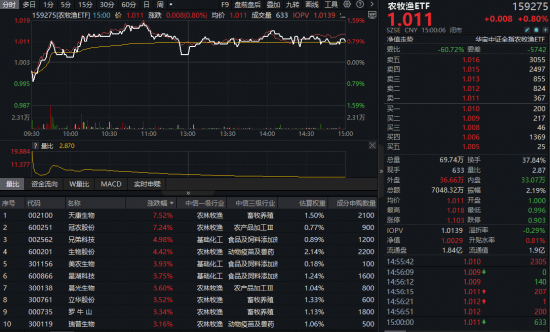
Core Viewpoint - The agricultural, animal husbandry, and fishery sector showed strong performance on October 10, with the first agricultural ETF (159275) experiencing a significant increase in net subscriptions and notable gains in constituent stocks [1][3]. Market Performance - The agricultural ETF (159275) opened lower but quickly rebounded, closing up 0.8% after reaching a maximum intraday gain of 1.5%. It recorded a net subscription of 52 million units by the end of the day [1]. - Key stocks in the sector, such as TianKang Biological and GuanNong Co., saw increases exceeding 7%, while several others, including XiongDi Technology and ShengWu Shares, rose over 4% [1]. Industry Dynamics - The pig farming industry is undergoing capacity reduction, with a reported decrease of 400,000 breeding sows compared to the previous month and a total reduction of 3.4 million from the peak last year [2]. - Recent outbreaks of African swine fever in Vietnam and Guangxi, China, have heightened risks for the farming sector. A meeting on September 16 emphasized policies aimed at reducing production capacity [2][3]. Investment Outlook - Analysts from Pacific Securities and Dongfang Securities suggest that the current fundamentals and policy changes favor capacity reduction in the pig farming industry, indicating potential long-term investment value as most listed companies are at historical low valuations [3][4]. - The agricultural sector's valuation remains low, with the agricultural ETF's underlying index trading at a price-to-book ratio of 2.61, which is in the lower 34.9% of the past decade, suggesting a favorable entry point for investors [3]. Future Trends - The trend towards improving quality and efficiency in the pig farming industry is expected to continue, with outdated capacities being phased out and market dynamics shifting towards higher prices in the long term [4][5]. - Investment opportunities are identified in various segments, including pig farming, feed, animal health, and crop planting, as the demand for these sectors is anticipated to rise with the recovery of pig stocks [5][6].





菜籽类市场周报:温度下降刚需下滑,菜粕继续走低-20251010
Rui Da Qi Huo· 2025-10-10 09:11
Report Industry Investment Rating - Not provided in the content Core Views Rapeseed Oil - This week, rapeseed oil futures rose first and then fell. The closing price of the 01 contract was 10,061 yuan/ton, up 17 yuan/ton from the previous week. The Canadian rapeseed harvest is approaching, and the high yield will put pressure on its price. The new progress of Indonesia's B50 biodiesel policy is beneficial to the palm oil market, but the palm oil inventory in Malaysia has increased for seven consecutive months. The initial ruling on the anti - dumping policy of Canadian rapeseed in China has been announced, and the supply of imported rapeseed is expected to tighten in the fourth quarter. Rapeseed oil will continue to reduce inventory, which will support its price. It is recommended to participate in a bullish way and pay attention to the China - Canada trade situation [8]. Rapeseed Meal - This week, rapeseed meal futures fluctuated and declined. The closing price of the 01 contract was 2,391 yuan/ton, down 30 yuan/ton from the previous week. The harvest of U.S. soybeans is progressing actively, and the expected high yield restricts the price. China has not ordered U.S. soybeans for the current year, and the export pressure remains. The soybean issue will be discussed at the APEC summit. The U.S. old - crop soybean inventory is lower than expected. In China, the import of Canadian rapeseed and U.S. soybeans will still be restricted in the fourth quarter, but the demand for rapeseed meal will decline due to the weakening of aquaculture demand and the substitution of soybean meal. It is recommended to participate in the short - term and pay attention to China - Canada and China - U.S. trade policies [12]. Summary by Directory 1. Weekly Key Points Summary Rapeseed Oil - Strategy: Participate in a bullish way and pay attention to China - Canada trade [7]. - Market review: The 01 contract closed at 10,061 yuan/ton, up 17 yuan/ton from the previous week [8]. - Outlook: Canadian high - yield pressure, Indonesia's policy impact, palm oil inventory increase in Malaysia, and China's anti - dumping policy support rapeseed oil price [8]. Rapeseed Meal - Strategy: Participate in the short - term [11]. - Market review: The 01 contract closed at 2,391 yuan/ton, down 30 yuan/ton from the previous week [12]. - Outlook: U.S. soybean harvest, export pressure, inventory situation, and China's import restrictions, along with weakening demand, affect rapeseed meal price [12]. 2. Futures and Spot Market Futures Price and Position - Rapeseed oil futures rose first and then fell, with a total position of 313,988 lots, up 10,548 lots from before the holiday. Rapeseed meal futures fluctuated and declined, with a total position of 371,708 lots, up 18,844 lots from before the holiday [18]. - The top 20 net long position of rapeseed oil futures decreased, and the top 20 net short position of rapeseed meal futures increased [24]. Futures Warehouse Receipts - Rapeseed oil registered warehouse receipts were 8,057 lots, and rapeseed meal registered warehouse receipts were 9,199 lots [30][31]. Spot Price and Basis - The spot price of rapeseed oil in Jiangsu was 10,370 yuan/ton, slightly rising from last week, and the basis was +309 yuan/ton. The spot price of rapeseed meal in Nantong, Jiangsu was 2,440 yuan/ton, falling from last week, and the basis was +49 yuan/ton [37][43]. Futures Monthly Spread - The 1 - 5 spread of rapeseed oil was +459 yuan/ton, and that of rapeseed meal was +65 yuan/ton, both at medium levels in the same period in recent years [50]. Futures - Spot Ratio - The ratio of rapeseed oil and rapeseed meal 01 contracts was 4.21, and the average spot price ratio was 4.07 [53]. Price Spread between Oils and Meals - The 01 contract spread of rapeseed oil and soybean oil was 1,759 yuan/ton, and that of rapeseed oil and palm oil was 623 yuan/ton, both narrowing this week. The 01 contract spread of soybean meal and rapeseed meal was 531 yuan/ton, and the spot spread was 430 yuan/ton [63][69]. 3. Industry Situation Rapeseed - Supply: As of September 26, 2025, the total inventory of rapeseed in oil mills was 50,000 tons. The estimated arrivals in October, November, and December were 150,000, 450,000, and 505,000 tons respectively. The spot crushing profit was +1,457 yuan/ton. In the 40th week of 2025, the crushing volume of coastal oil mills was 10,000 tons, down 33,000 tons from last week, and the operating rate was 2.45%. In August 2025, the import volume was 246,600 tons, a year - on - year decrease of 58.52% [74][78][82][86]. Rapeseed Oil - Supply: As of the 39th week of 2025, the inventory of imported and crushed rapeseed oil was 650,000 tons, a week - on - week decrease of 2.15%. In August 2025, the import volume was 140,000 tons, a year - on - year increase of 16.67% [91]. - Demand: As of August 31, 2025, the monthly output of edible vegetable oil was 4,506,000 tons, and the monthly catering revenue was 449.57 billion yuan. As of the 39th week of 2025, the contract volume of imported and crushed rapeseed oil was 61,000 tons, a week - on - week decrease of 19.54% [95][99]. Rapeseed Meal - Supply: As of the 39th week of 2025, the inventory of imported and crushed rapeseed meal was 17,000 tons, unchanged from last week. In August 2025, the import volume was 213,400 tons, a year - on - year increase of 4.72% [103][107]. - Demand: As of August 31, 2025, the monthly output of feed was 2,927,200 tons [111]. 4. Option Market Analysis - As of October 10, the implied volatility of rapeseed meal options was 20%, down 8.91% from last week, slightly lower than the 20 - day, 40 - day, and 60 - day historical volatility of the underlying [114].

专访蓝顿旭美郝昳雯:以全链ESG变废为宝,探食品加工绿色路径
2 1 Shi Ji Jing Ji Bao Dao· 2025-10-10 08:41
Core Insights - The article discusses how food companies, particularly Landun Xumei Food Co., are integrating sustainable development into their operations, focusing on the entire potato supply chain from breeding to processing [1][2]. Group 1: Sustainable Development Strategy - The company has been committed to sustainable development for eight years, integrating this philosophy into all business operations, including breeding, planting, and processing [2]. - The company aims to achieve a "zero waste" model by fully utilizing potato by-products, such as producing plastic bags and paper from potato peels [2][5]. Group 2: Logistics and Carbon Emission Reduction - The company optimizes logistics by strategically locating potato planting bases closer to processing facilities, significantly reducing transportation distances and associated carbon emissions [3]. - Collaborations with fleets using new energy vehicles and smart systems for route planning have further enhanced logistics efficiency and reduced fuel consumption [3]. Group 3: ESG Integration and Performance - ESG indicators are incorporated into employee performance evaluations, linking energy efficiency, pesticide reduction, and waste recycling rates to individual and team performance [4]. - This approach fosters a proactive culture among employees, transforming the mindset from "I have to" to "I want to" regarding sustainability efforts [4]. Group 4: Waste Resource Utilization - The company processes approximately 25,000 tons of waste from potato production, collaborating with institutions like MIT and Shanghai University to develop new products from waste materials [5][6]. - A comprehensive ESG management system tracks the lifecycle of waste materials, allowing for precise measurement of carbon reduction achieved through resource utilization [7]. Group 5: Community Engagement and Economic Development - The company has established a "Rural Revitalization CEO" position to connect farmers with the business, enhancing local agricultural practices and increasing farmer incomes by over three times [8]. - The model of "leading enterprises + cooperatives + bases + farmers" ensures sustainable agricultural practices and provides skill training to local farmers [8]. Group 6: Future Goals and Challenges - The primary challenge faced by the company is cost control, particularly in the early stages of sustainable development, which requires significant investment and time [9]. - Future goals include achieving carbon balance and developing a zero-carbon park, with a focus on detailed research and implementation of related initiatives [9].
农产品加工板块10月10日涨1.23%,冠农股份领涨,主力资金净流出6489.08万元
Zheng Xing Xing Ye Ri Bao· 2025-10-10 08:39
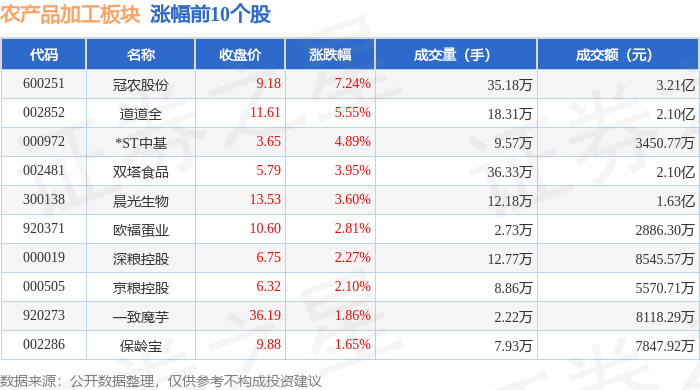
Core Insights - The agricultural processing sector saw a rise of 1.23% on October 10, with Guan Nong Co., Ltd. leading the gains [1] - The Shanghai Composite Index closed at 3897.03, down 0.94%, while the Shenzhen Component Index closed at 13355.42, down 2.7% [1] Agricultural Processing Sector Performance - Guan Nong Co., Ltd. (600251) closed at 9.18, up 7.24% with a trading volume of 351,800 shares and a turnover of 321 million yuan [1] - Dao Dao Quan (002852) closed at 11.61, up 5.55% with a trading volume of 183,100 shares and a turnover of 210 million yuan [1] - ST Zhongji (000972) closed at 3.65, up 4.89% with a trading volume of 95,700 shares and a turnover of 34.51 million yuan [1] - Other notable performers include Shuangta Food (002481) up 3.95%, Chenguang Biological (300138) up 3.60%, and Oufu Egg Industry (920371) up 2.81% [1] Capital Flow Analysis - The agricultural processing sector experienced a net outflow of 64.89 million yuan from institutional investors, while retail investors saw a net inflow of 40.97 million yuan [2] - The overall capital flow indicates a mixed sentiment, with institutional investors withdrawing funds while retail investors are actively buying [2] Individual Stock Capital Flow - Jinlongyu (300999) had a net outflow of 18.95 million yuan from institutional investors, while retail investors contributed a net inflow of 26.36 million yuan [3] - Jin Jian Rice Industry (600127) saw a net inflow of 4.54 million yuan from institutional investors, but a net outflow from retail investors [3] - ST Zhongji (000972) had a net inflow of 4.21 million yuan from institutional investors, indicating some positive sentiment despite overall sector outflows [3]




铜冠金源期货商品日报-20251010
Tong Guan Jin Yuan Qi Huo· 2025-10-10 07:37
Report Industry Investment Rating No relevant content provided. Core Views - Overseas, the US government shutdown persists, the Senate has rejected the appropriation bill for the seventh time, and there are differences among Fed officials on interest rate cuts. The dollar index has risen, and the prices of gold, oil, and stocks have fluctuated. Domestically, the stock and bond markets both rose on the first trading day after the holiday. The stock market is expected to rise structurally in the short term, and the bond market is expected to fluctuate in October [2][3]. - For precious metals, the easing of the Middle - East situation has weakened the safe - haven demand, and investors are taking profits. Gold and silver prices may face short - term adjustment risks [4]. - For copper, Teck Resources has lowered its production forecast, and the copper price is expected to continue to rise in the short term under the strong support of fundamentals [5][6]. - For aluminum, news has driven the price to continue to be strong, and the short - term price is expected to remain strong [7][8]. - For alumina, the supply pressure is still high in the short term, but the bottom support may gradually strengthen [9]. - For zinc, the short - term market sentiment is positive, and the zinc price is expected to continue to be strong in a volatile manner [10]. - For lead, the decrease in inventory during the holiday is beneficial to the price, but the increase in supply and weak consumption will limit the upward space [11]. - For tin, supply - side disturbances support the price, and the short - term price is expected to be strong, but the upward trend may slow down [12]. - For industrial silicon, the supply is slightly loose, the demand is weak, and the price is expected to continue to fluctuate in the short term [13][14]. - For steel products, the demand has recovered after the holiday, and the price is expected to fluctuate [15][16]. - For iron ore, the demand is stable, the supply is flat, and the price is expected to fluctuate [17]. - For soybean and rapeseed meal, the domestic supply is sufficient, and the price is expected to be under pressure and fluctuate in the short term [18][19]. - For palm oil, the expectation of the Indonesian B50 policy provides support, and the price is expected to fluctuate widely in the short term [20][21]. Summary by Related Catalogs 1. Metal Main Varieties Yesterday's Trading Data - SHFE copper closed at 86,750 yuan/ton, up 4.38%; LME copper closed at 10,777 dollars/ton, up 0.74% [22]. - SHFE aluminum closed at 21,090 yuan/ton, up 1.98%; LME aluminum closed at 2,783 dollars/ton, up 1.13% [22]. - SHFE alumina closed at 2,875 yuan/ton, up 0.24% [22]. - SHFE zinc closed at 22,315 yuan/ton, up 2.25%; LME zinc closed at 3,014 dollars/ton, up 0.65% [22]. - SHFE lead closed at 17,115 yuan/ton, up 1.03%; LME lead closed at 2,021 dollars/ton, up 0.80% [22]. - SHFE nickel closed at 124,480 yuan/ton, up 2.96%; LME nickel closed at 15,485 dollars/ton, up 0.67% [22]. - SHFE tin closed at 287,090 yuan/ton; LME tin closed at 36,820 dollars/ton, up 1.57% [22]. - COMEX gold closed at 3,991.10 dollars/ounce, down 1.71%; SHFE silver closed at 11,169.00 yuan/kilogram, up 2.30%; COMEX silver closed at 47.66 dollars/ounce, down 1.62% [22]. - SHFE rebar closed at 3,096 yuan/ton, up 0.78%; SHFE hot - rolled coil closed at 3,286 yuan/ton, up 1.01% [22]. - DCE iron ore closed at 790.5 yuan/ton, up 1.28% [22]. - DCE coking coal closed at 1,164.0 yuan/ton, up 3.37%; DCE coke closed at 1,654.0 yuan/ton, up 1.91% [22]. - GFEX industrial silicon closed at 8,640.0 yuan/ton, unchanged [22]. - CBOT soybeans closed at 1,021.8 yuan/ton, down 0.78%; DCE soybean meal closed at 2,939.0 yuan/ton; CZCE rapeseed meal closed at 2,435.0 yuan/ton [22]. 2. Industrial Data Perspective - For copper, SHFE copper's main contract price rose from 83,110 yuan/ton on September 30th to 86,750 yuan/ton on October 9th. LME copper's March contract price rose from 10,697 dollars/ton to 10,776.5 dollars/ton. LME inventory increased by 275 tons to 139,475 tons [23]. - For nickel, SHFE nickel's main contract price was 124,480 yuan/ton on October 9th. LME nickel's March contract price rose from 15,382 dollars/ton to 15,485 dollars/ton. LME inventory increased by 4,260 tons to 236,892 tons [23][26]. - For zinc, SHFE zinc's main contract price rose from 21,825 yuan/ton to 22,315 yuan/ton. LME zinc price rose from 2,994.5 dollars/ton to 3,014 dollars/ton. SHFE warehouse receipts increased by 1,646 tons to 58,867 tons [26]. - For lead, SHFE lead's main contract price rose from 16,940 yuan/ton to 17,115 yuan/ton. LME lead price slightly decreased from 2,005 dollars/ton to 2,004.5 dollars/ton. LME inventory decreased by 625 tons to 236,075 tons [26]. - For aluminum, SHFE aluminum's continuous third - month contract price was 21,085 yuan/ton. LME aluminum's March contract price rose from 2,751.5 dollars/ton to 2,782.5 dollars/ton. LME inventory increased by 2,200 tons to 508,600 tons [26]. - For alumina, SHFE alumina's main contract price rose from 2,868 yuan/ton to 2,875 yuan/ton. The national average spot price of alumina decreased from 3,008 yuan/ton to 2,998 yuan/ton [26]. - For tin, SHFE tin's main contract price was 287,090 yuan/ton. LME tin price rose from 36,250 dollars/ton to 36,820 dollars/ton. LME inventory decreased by 115 tons to 2,390 tons [26]. - For precious metals, there were no significant price changes in SHFE gold, COMEX gold, and related gold products. SHFE silver and COMEX silver also had relatively stable prices. The SHFE gold - silver ratio rose from 80.09 to 81.86, and the COMEX gold - silver ratio decreased slightly from 83.83 to 83.75 [26]. - For steel products, SHFE rebar's main contract price rose from 3,072 yuan/ton to 3,096 yuan/ton. SHFE hot - rolled coil's main contract price rose from 3,253 yuan/ton to 3,286 yuan/ton. The north - south price difference of rebar decreased slightly [28]. - For iron ore, DCE iron ore's main contract price rose from 780.5 yuan/ton to 790.5 yuan/ton. The price of PB fines at Rizhao Port rose from 778 yuan/ton to 784 yuan/ton [28]. - For coking coal and coke, DCE coking coal's main contract price rose from 1,126.0 yuan/ton to 1,164.0 yuan/ton. DCE coke's main contract price rose from 1,623.0 yuan/ton to 1,654.0 yuan/ton [28]. - For lithium carbonate, the main contract price of lithium carbonate rose from 7.274 to 7.36. The spot prices of electric - grade and industrial - grade lithium carbonate decreased slightly [28]. - For industrial silicon, the main contract price of industrial silicon was 8,640 yuan/ton. The average price of East China's 3303 industrial silicon was 10,550 yuan/ton [28]. - For soybean and rapeseed meal, CBOT soybean's main contract price rose from 1,000.75 to 1,021.75. DCE soybean meal's main contract price rose from 2,928 yuan/ton to 2,939 yuan/ton. CZCE rapeseed meal's main contract price rose from 2,421 yuan/ton to 2,435 yuan/ton [28].
光大期货农产品日报-20251010
Guang Da Qi Huo· 2025-10-10 05:23
1. Report Industry Investment Rating There is no information about the report industry investment rating in the provided content. 2. Core Views of the Report - Corn: Corn prices are oscillating weakly. During the National Day holiday, the prices in the Northeast decreased, those in North China fluctuated, and those in the sales areas were generally weak. Technically, the November contract of corn hit a new low, and the harvest pressure continues to affect the market, with the arbitrage spread of selling near and buying far narrowing [1]. - Soybean and Two - meal: CBOT soybeans closed down on Thursday. Domestic two - meal prices oscillated higher. The increase in soybean import costs during the holiday provided cost support, but the market is highly watchful due to the loose domestic soybean meal spot and the decline in pig and egg prices [1]. - Oil: BMD palm oil reached a seven - month high. Domestic oils opened higher and oscillated. It is advisable to buy oils on dips and pay attention to the MPOB report on Friday [1]. - Egg: Egg futures and spot prices are oscillating weakly. The increase in egg - laying hen inventory and the seasonal decline in post - holiday demand put pressure on prices [1]. - Pig: Pig prices are oscillating weakly. During the National Day, the prices showed a "not - prosperous in peak season" downward trend. The supply is high, and the demand is weak, and the weak situation is expected to continue [2]. 3. Summary According to Relevant Catalogs 3.1 Research Views - **Corn**: During the National Day, the new corn listing in the Northeast increased, and the price decreased. In North China, the price fluctuated due to weather. The supply of deep - processing enterprises was high, and the price decreased. In the sales areas, the price was weak. Technically, the November contract hit a new low, and the arbitrage spread was narrowing [1]. - **Soybean and Two - meal**: CBOT soybeans closed down. Domestic two - meal prices oscillated higher. The increase in import costs provided support, but the market was watchful due to spot supply and demand [1]. - **Oil**: BMD palm oil rose. Domestic oils opened higher and oscillated. It is recommended to buy on dips and focus on the MPOB report [1]. - **Egg**: Egg futures and spot prices declined. The increase in inventory and post - holiday demand decline led to weak prices [1]. - **Pig**: Pig futures prices continued to decline. During the National Day, the prices were "not - prosperous in peak season". The supply was high, and the demand was weak, and the weak situation is expected to continue [2]. 3.2 Market Information - Brazil's soybean, bean - meal, and corn exports and planned exports from September 28 to October 11 are provided [3]. - New Hope's pig sales volume in September 2025 increased both month - on - month and year - on - year, but the sales revenue decreased year - on - year [3]. - Russia will set a slightly higher grain export quota from February to June 2026 compared to the same period this year [4]. - Indonesia will implement the mandatory B50 biodiesel plan in the second half of 2026, which will eliminate the need for diesel imports [4]. 3.3 Variety Spreads - **Contract Spreads**: Diagrams of contract spreads such as corn 1 - 5, corn starch 1 - 5, and others are presented [5][6][7]. - **Contract Basis**: Diagrams of contract basis such as corn, corn starch, and others are presented [13][14][17].
生猪亏损加剧催化行业巨变!农牧渔板块大涨,农牧渔ETF(159275)上探1.59%!布局时机到了?
Xin Lang Ji Jin· 2025-10-10 04:44
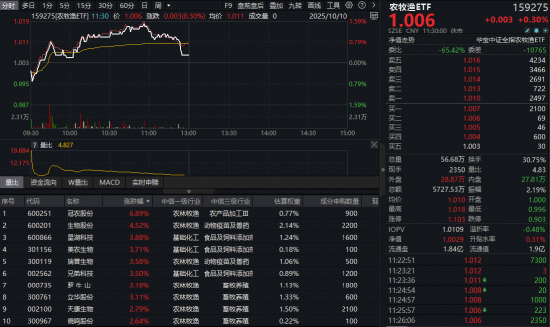
Core Viewpoint - The agricultural, animal husbandry, and fishery sector showed strong performance on October 10, with the first agricultural ETF (159275) experiencing a price increase after a low opening, indicating positive market sentiment in this sector [1][5]. Market Performance - The agricultural ETF (159275) opened lower but quickly rebounded, achieving a maximum intraday increase of 1.5% and closing up 0.3% [1]. - Key stocks in the sector, such as Guannong Co. (up 6.89%) and Shengwu Co. (up 4.52%), led the gains, with several others also showing increases of over 3% [1][5]. Price Trends - National average pig prices fell to 12.55 CNY/kg as of October 7, a decrease of 1.6% compared to the pre-holiday period, following a 10% drop in September [2][3]. - The decline in pig prices has resulted in significant losses for farmers, with losses of 54 CNY per pig for self-bred pigs and 128 CNY for purchased piglets [2][3]. Policy and Industry Outlook - The National Development and Reform Commission, along with the Ministry of Agriculture, has signaled a clear policy direction towards reducing production capacity in the pig industry, which is expected to enhance market dynamics [3][4]. - The current low valuation of the agricultural sector, with the agricultural ETF's price-to-book ratio at 2.61, suggests a favorable time for investment [3][4]. Future Expectations - Analysts predict that the ongoing measures to counteract overproduction in the pig industry will lead to a gradual increase in pig prices in the medium to long term [4][5]. - The focus on improving quality and efficiency in the pig industry, along with the elimination of outdated production capacity, is expected to benefit financially stable producers [4][5].