
家电

Search documents
海尔智家20260108
2026-01-08 16:02
Summary of Haier Smart Home Conference Call Company Overview - **Company**: Haier Smart Home - **Industry**: Home Appliances Key Points Business Growth and Strategy - Haier Smart Home is laying the foundation for business growth by implementing digital reforms and adjusting overseas strategies for 2026 [2] - The air conditioning industry has seen effective changes in products, channels, and cost management, while the HVAC sector is accelerating its integration [2][3] - Despite uncertainties in demand and costs, the company remains confident about future performance [2] Competitive Positioning - To enhance efficiency and user experience amidst fierce market competition, Haier is adopting measures such as digital inventory transformation and order forecasting systems [2][3] - The Leader brand air conditioners and refrigerators have shown significant growth, indicating the company's proactive stance in competition [2][6] Product and Supply Chain Management - The company aims to increase the self-manufacturing ratio of air conditioners, with compressor production capacity reaching 6 million units, to mitigate raw material cost fluctuations [2][7] - The internal target for air conditioning business is to maintain double-digit growth by 2027 through disruptive products and direct-to-consumer models [2][10] Profitability and Financial Goals - Domestic household air conditioning profit margins are approximately 3-4%, while overall air conditioning business margins are around 5.2%, with a future target of over 7% [2][11] - The net profit growth target for 2026 is expected to outpace revenue growth, with emerging market profit margins not lower than those in Europe and the U.S. [22] Market Dynamics and Forecasts - The home appliance market remains highly competitive, with brands like Xiaomi showing growth, while Haier's Leader brand air conditioners grew over 50% and refrigerators over 90% in Q3 [6] - The company anticipates a stable demand outlook for the U.S. home appliance market in 2026, with a trend of low initial demand followed by recovery [24] Emerging Markets Performance - Haier's products, including refrigerators, washing machines, and air conditioners, are performing strongly in emerging markets, particularly in Southeast Asia, South Asia, and the Middle East [20][21] - The company is focusing on enhancing its business scale in the Middle East and Africa, where it currently has a weaker presence [20] Capital Expenditure and Future Plans - The capital expenditure plan for 2027 includes an increase of 1 billion RMB to enhance supply chain resilience and diversification, focusing on overseas factory construction and potential acquisitions [27] - The company plans to increase its dividend payout ratio to at least 50% in 2026 [26] Conclusion - Haier Smart Home is optimistic about future growth, driven by internal reforms and strategic adjustments in response to market challenges faced from 2022 to 2024 [28] - The company is committed to improving operational efficiency and maintaining a competitive edge in the home appliance industry [28]

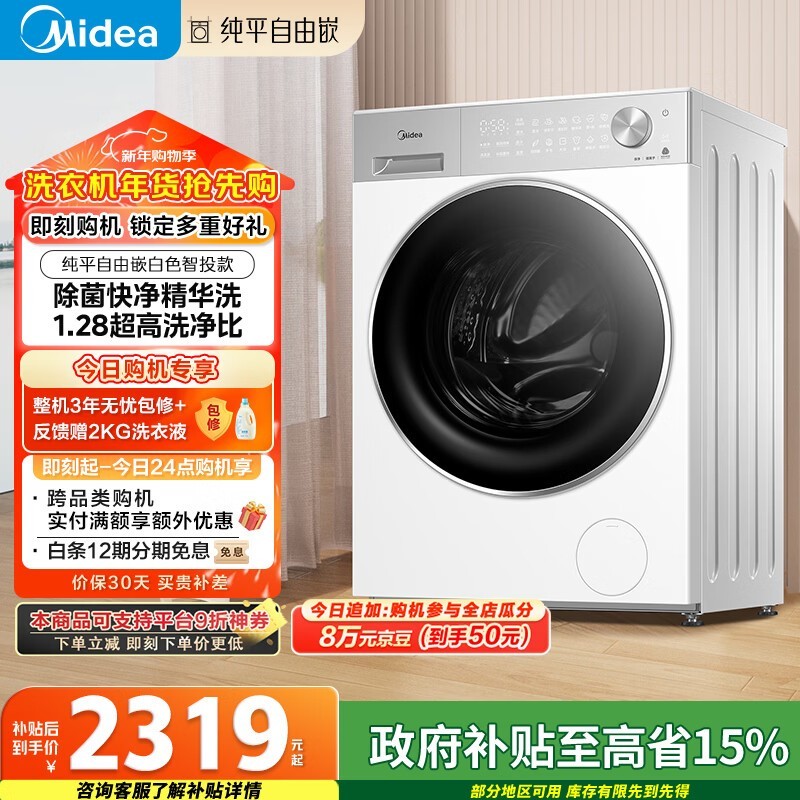
美的10kg滚筒洗衣机京东特惠低至2027.65
Xin Lang Cai Jing· 2026-01-08 14:51
具备资讯 下载APP > (Midea | 阿里中带自由嵌 Quide T NE N 70 G 新年购物季 液衣机套毛绿色完成 即刻购机 锁定多重好礼 纯平自由嵌白色智投款 除菌快净精华洗 1.28超高洗净比 今日两和气事 整机3年无忧包修+ 日 即刻起-今日24点购机享 · 跨品类购机 实付满额享额外优惠 · 白条12期分期免息 28 价保30天 买贵补差 今日追加:购机参与全店瓜分 本商品可支持平台9标 8万元京豆 (到手50元) 下单立减 即刻下单价更低 神贴后 政府补贴至高省15% 元起 到主机 咨询客服了解补贴详情 部分地区可用 库存有限先到先得 ( Midea Quide 新年购物季 波农机年佳综合完换 即刻购机 锁定多重好礼 纯平自由嵌白色智投款 除菌快净精华洗 1.28超高洗净比 合目两加拿事 整机3年无忧包修+ 20 即刻起-今日24点购机享 · 跨品类购机 实付满额享额外优惠 · 白条12期分期免息 绘图 价保30天 买贵补差 今日追加:购机参与全店瓜分 本商品可支持平台9旅 8万元京豆 (到月50元) 下单立减 即刻下单价更低 神贴后 政府补贴窒高省15% 元起 到主机 咨询客服了解补贴 ...


格力电器:公司稳步推进多元化战略
Zheng Quan Ri Bao Wang· 2026-01-08 14:13
Group 1 - The company owns three major consumer brands: Gree, TOSOT, and Jinghong, along with industrial brands such as Lingda, Kaibang, and Xinyuan, covering both consumer goods and industrial equipment sectors [1] - The consumer appliance segment is primarily supported by the air conditioning business, which includes a range of products such as refrigeration, washing machines, kitchen appliances, and environmental appliances [1] - The industrial products and equipment segment focuses on smart equipment, industrial robots, compressors, motors, and molds, indicating a diverse industrial strategy [1] Group 2 - The company is committed to a diversified strategy based on core technology and market demand, continuously optimizing its industrial layout [1]

海尔智家(06690)1月8日斥资247.57万元回购9.5万股A股
智通财经网· 2026-01-08 12:56
智通财经APP讯,海尔智家(06690)发布公告,于2026年1月8日斥资247.57万元回购9.5万股A股。 ...
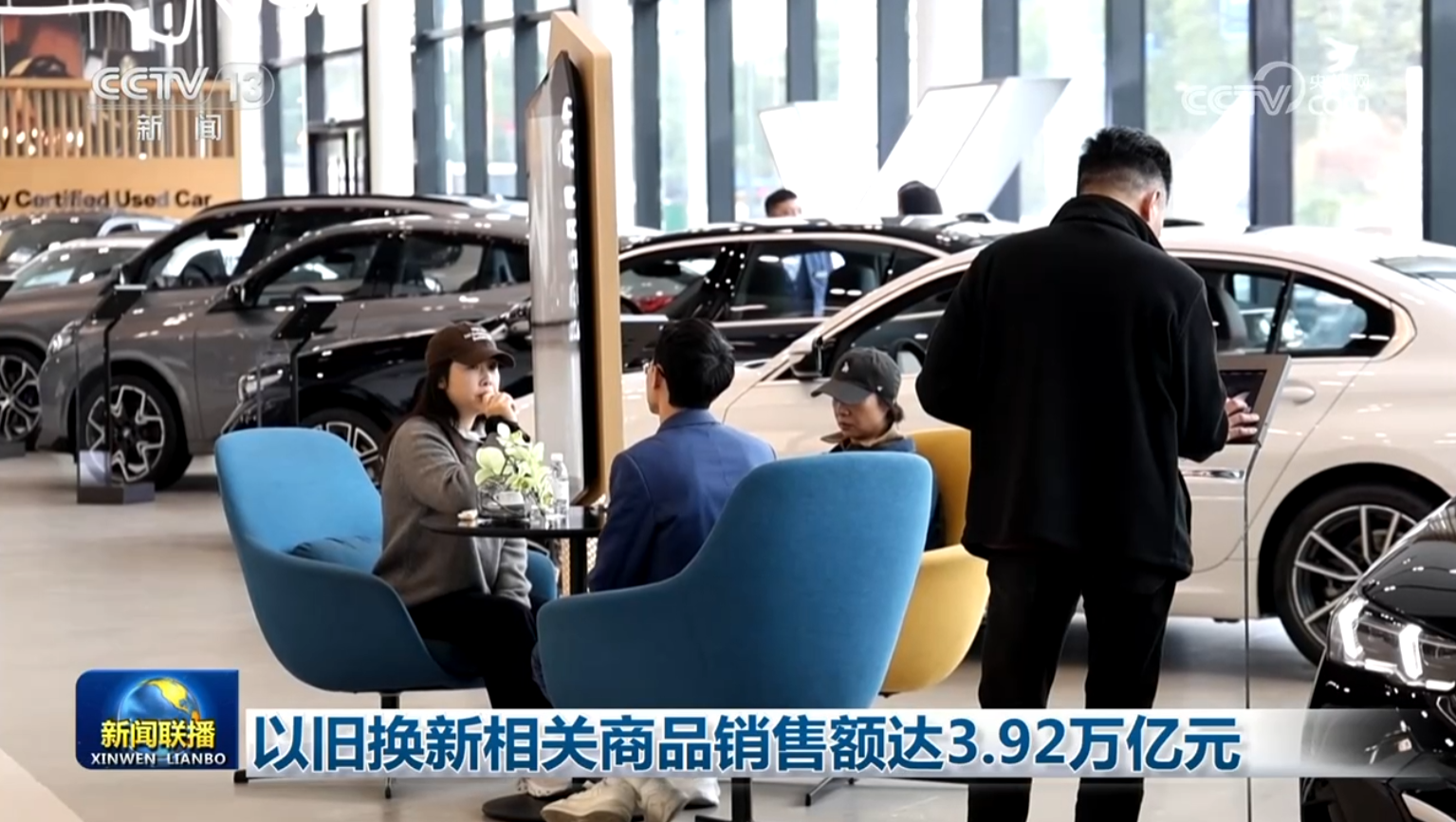
以旧换新相关商品销售额达3.92万亿元
Yang Shi Wang· 2026-01-08 12:38
Core Insights - The implementation of the old-for-new consumption policy in 2024 has resulted in a total sales volume of 3.92 trillion yuan, benefiting 494 million people [1] - The policy has significantly boosted the sales of various products, including over 18.3 million vehicles, more than 192 million home appliances, and approximately 91 million mobile and digital products [1] Group 1: Automotive Industry - In the old-for-new vehicle exchange, nearly 60% of the exchanged vehicles are new energy vehicles, leading to a doubling of sales in the domestic new energy passenger car market [2] - The average growth rate of scrapped vehicle recovery over the past two years has exceeded 45%, resulting in a reduction of carbon emissions by approximately 44 million tons [5] Group 2: Home Appliances - In the home appliance sector, over 90% of exchanged products are of first-level energy efficiency, indicating a strong shift towards energy-efficient products [3] - The presence of old-for-new home appliance stores in densely populated commercial areas has led to a more than 30% increase in consumer spending within a 1-kilometer radius [7] Group 3: Digital Products - Among mobile and digital products, mid-to-high-end models account for 72.5% of new purchases, reflecting a consumer preference for higher quality and advanced technology [3] Group 4: Economic Impact - The introduction of green, low-carbon, and smart new products is enhancing the quality of life for consumers while promoting a green economic transition [5] - Increased consumer engagement in physical stores for product experiences and subsidies is driving cross-scenario consumption in leisure, entertainment, and dining sectors [7]
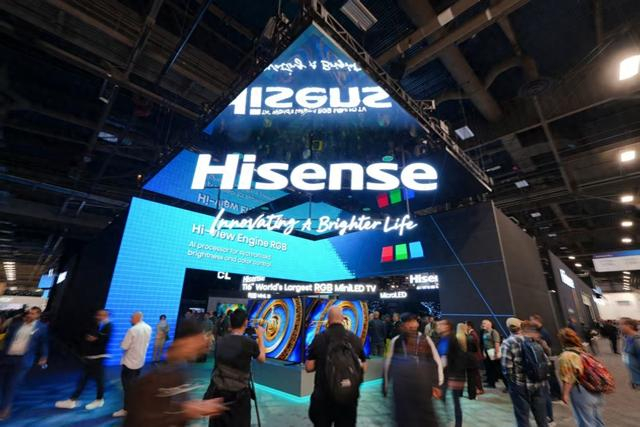
RGB成全球高端显示首选,海信以AI世界杯预热引爆CES 2026
Xin Lang Cai Jing· 2026-01-08 11:44
Core Viewpoint - CES 2026 marks a pivotal moment in the integration of AI technology into consumer electronics, transitioning from concept to practical applications in daily life, with the year being dubbed the "Year of AI Technology Integration and Industrialization" [1]. Group 1: AI Technology and Product Development - Hisense showcased its commitment to AI technology with three main themes: "AI YOUR VISION," "AI YOUR PASSION," and "AI YOUR HOME," highlighting advancements across various product categories [1]. - The RGB-Mini LED technology was introduced as a new high-end display standard, emphasizing Hisense's leadership in display technology and its global market presence [2][4]. - Hisense's RGB-Mini LED technology features significant advancements, including a custom "Linglong True Color Backlight" system and an upgraded AI picture quality chip, enhancing color purity and brightness control [4][5]. Group 2: Market Position and Sales Performance - Hisense dominates the global RGB-Mini LED television market, accounting for nearly 90% of sales and revenue, indicating strong consumer preference for its products [11]. - The RGB-Mini LED technology has become the preferred choice in the high-end television market, with Hisense achieving over 90% market share in the segment of 85-inch TVs priced above 20,000 yuan during the 2025 Double 11 shopping festival [11]. - Predictions indicate that global RGB-Mini LED television shipments could surge to 500,000 units in 2026, representing a 25-fold year-on-year increase, as major brands like Samsung and Sony enter the market [11]. Group 3: AI Integration in Daily Life - Hisense is integrating AI technology into various aspects of home life, including AI washing machines that create customized washing plans based on user input and smart energy management systems that optimize energy use [10]. - The company is also launching AI-powered products for the 2026 FIFA World Cup, enhancing the viewing experience with features like AI sports mode and smart food management in refrigerators [9][10]. - Hisense's second-generation humanoid robot, Harley, and the family companion robot, Beta, showcase the company's commitment to AI in enhancing user interaction and home safety [10]. Group 4: Long-term Strategy and Innovation - Hisense's strong performance at CES 2026 reflects its long-term focus on technological innovation, high-end product development, and global market expansion [11][12]. - The company has filed 179 patents related to RGB-Mini LED technology, demonstrating its commitment to advancing the display industry and contributing to a global display revolution [11]. - Hisense's achievements in display technology, including winning the CES 2026 Best Innovation Award for its 163-inch four-color Micro LED television, highlight its innovative capabilities and market leadership [11].

美的集团今日大宗交易成交7.04万股,成交额511.69万元
Xin Lang Cai Jing· 2026-01-08 08:55
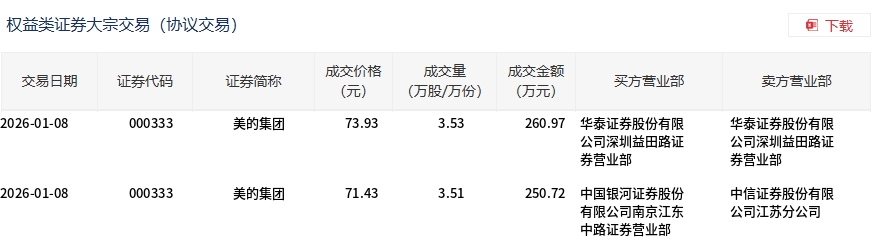
Core Viewpoint - On January 8, Midea Group executed a block trade of 70,400 shares, with a transaction value of 5.1169 million yuan, representing 0.21% of the total transaction volume for the day, at an average price of 72.68 yuan, which is an 8.03% discount compared to the market closing price of 79.03 yuan [1] Group 1 - The highest transaction price for Midea Group on January 8 was 73.93 yuan, while the lowest was 71.43 yuan [1] - The total transaction volume for the day was 70,400 shares, with a total transaction value of 5.1169 million yuan [1] - The block trade accounted for a small percentage (0.21%) of the total trading volume on that day [1] Group 2 - The transaction details include a price of 73.93 yuan for 3.53 million shares, totaling 260.97 million yuan, executed by Huatai Securities [2] - Another transaction occurred at a price of 71.43 yuan for 3.51 million shares, with the buyer being China Galaxy Securities [2]
资本为翼 赋能新质生产力 东元创投深耕宁波硬科技赛道
Zhong Zheng Wang· 2026-01-08 08:35
Core Viewpoint - Venture capital institutions are playing an irreplaceable role in empowering capital for technological innovation and industrial development, with Ningbo Dongyuan Venture Capital Co., Ltd. being a key player in this space since its establishment in 2005 [1][2]. Group 1: Company Overview - Ningbo Dongyuan Venture Capital Co., Ltd. is the first venture capital institution in Ningbo, having supported over 30 local enterprises and nurtured 8 companies to go public [1]. - The company has strategically invested in emerging industries such as advanced manufacturing, new energy, new materials, and semiconductors, becoming a hidden driver of Ningbo's new productivity [1][2]. Group 2: Investment Philosophy - The company emphasizes the concept of "patient capital," which includes not only financial investment but also value-added services such as supply chain integration and governance optimization [2]. - Dongyuan Venture Capital's investment strategy focuses on early-stage, small-scale, and technology-driven investments to provide comprehensive support during critical growth phases [2]. Group 3: Sector-Specific Investments - In the new energy sector, Dongyuan Venture Capital has successfully supported Jinlang Technology, which has become a global leader in photovoltaic string inverters, through multiple rounds of investment from 2007 to 2023 [1]. - The company has also enabled traditional home appliance firms like Deye and Biyi to pivot into new energy and smart manufacturing sectors, showcasing the advantages of Ningbo's manufacturing base [2]. Group 4: Future Outlook - Dongyuan Venture Capital plans to continue expanding its long-term capital supply and deepen its ties with Ningbo's industries, focusing on key segments of strategic emerging industries [3]. - The company aims to facilitate the transition from "manufacturing" to "intelligent manufacturing" by leveraging capital to integrate resources and support technological upgrades [2][3].


推行绿色消费正当其时
Di Yi Cai Jing· 2026-01-08 08:26
Core Viewpoint - The article discusses the implementation of green consumption in China as a crucial strategy for achieving high-quality economic development and addressing environmental challenges, as outlined in the recent notification by the Ministry of Commerce and nine other departments [3][21]. Group 1: Definition and Importance of Green Consumption - Green consumption is defined as a sustainable consumption system that encompasses the entire production, circulation, consumption, and recycling chain, rather than merely focusing on environmentally friendly products [4]. - The concept of green consumption emphasizes intergenerational equity and resource constraints, aiming to meet basic human needs while minimizing waste and pollution [4]. - The promotion of green consumption is essential for addressing tightening resource and environmental constraints, upgrading consumption structures, and competing in the global green transition [5][6][8]. Group 2: Challenges and Trends - China faces multiple challenges, including resource constraints, rapid consumption structure upgrades, and intensified global competition in green transformation [5]. - The shift in consumer preferences towards green, healthy, and low-carbon products is evident, with 73.8% of consumers prioritizing green products in their daily lives [7]. - The market for green consumption is projected to reach 5 trillion yuan in 2024, reflecting a 10% increase from the previous year, with significant growth in sectors like new energy vehicles and green appliances [11]. Group 3: Economic and Environmental Benefits - Green consumption can drive industrial upgrades and enhance economic quality by guiding enterprises towards low-carbon and high-end transformations [10]. - It can expand high-quality domestic demand, injecting lasting momentum into economic growth by creating new consumption patterns and opportunities [11]. - The ecological and economic benefits of green consumption include improved resource efficiency and reduced pollution, contributing to sustainable development [12]. Group 4: Policy Recommendations and Implementation Strategies - Strengthening the supply of green products and services is crucial to address mismatches in supply and demand, focusing on areas like green agriculture, appliances, and automotive sectors [14][15]. - Innovative consumption models, such as green supply chains and green consumption points systems, are necessary to enhance consumer engagement and convenience [16][17]. - A robust policy framework that combines incentives and regulatory measures is essential for fostering a conducive environment for green consumption [18][19]. Group 5: Public Awareness and Participation - Raising public awareness and promoting green consumption behaviors are fundamental to driving widespread participation in green initiatives [20]. - Initiatives should include educational campaigns, community activities, and the promotion of sustainable lifestyles to embed green consumption into societal norms [20]. - The establishment of exemplary green enterprises and communities can serve as models to inspire broader adoption of green consumption practices [20].

港股收评:恒指跌1.17%连跌2日,科技、金融齐挫,“中国版OpenAI”智谱首日上市涨13.17%
Ge Long Hui· 2026-01-08 08:21
Market Performance - The Hong Kong stock market indices continued to decline for the second consecutive day, with significant volatility observed in just five trading days since the beginning of the year [1] - The Hang Seng Tech Index dropped by 1.05%, while the Hang Seng Index and the China Enterprises Index fell by 1.17% and 1.09% respectively [1] Sector Performance - Major sectors such as large technology stocks, financials (including banks, insurance, and brokerage firms), and state-owned enterprises showed weak performance, contributing to market pressure [1] - Notable declines were seen in individual stocks, with Meituan and Baidu both falling over 3%, and other financial stocks like China Silver Group, China Merchants Securities, China Taiping, and Xinhua Insurance also declining [1] Commodity and Other Stocks - The performance of non-ferrous metal stocks, including copper and aluminum, was generally weak, while gaming stocks continued to decline, with Sands China, Wynn Macau, and others hitting new lows [1] - Consumer stocks, including dairy, beer, and dining sectors, also experienced collective declines, alongside drops in solar, home appliance, automotive, and oil stocks [1] Contrasting Trends - In contrast, military stocks surged due to a significant increase in the U.S. military budget, while semiconductor stocks rose as China reportedly requested tech companies to pause orders for H200 chips [1] - Active trading was noted in coal and paper stocks, indicating some sector resilience [1] New Listings - Three new stocks were listed today, with Tian Shuo Zhi Xin rising by 8.44%, Jingfeng Medical-B increasing by 30.9%, and "China's version of OpenAI" Zhipu gaining 13.17% [1]