
新能源车

Search documents
西部证券港股“三重门”
Western Securities· 2026-01-12 02:05
Group 1: Market Overview - In 2025, Hong Kong stocks outperformed A-shares overall, but weakened in the second half due to a stronger USD, slowing southbound capital inflow, and deteriorating fundamentals[6] - In 2026, three factors are expected to drive a rebound in Hong Kong stocks: a weaker USD, appreciation of the RMB attracting overseas Chinese capital, and a recovery in inflation and potential debt reduction policies[6][8] Group 2: Capital Flows - The first gate: A weaker USD in 2026 is likely to drive international capital to allocate more to Hong Kong stocks[8] - The second gate: RMB appreciation in 2026 is expected to attract a significant amount of overseas Chinese capital into Hong Kong stocks, which will be smoother than southbound capital that faces opportunity costs and exchange rate risks[11][60] - The third gate: Recovery in cash flow statements and balance sheets of the real economy in 2026 will mark the beginning of economic prosperity in China[12] Group 3: Investment Opportunities - The "Davis Triple Play" is anticipated for the Hang Seng Technology Index in 2026, with structural opportunities in innovative drugs and new consumption continuing[14][95] - Hong Kong stocks' dividend yield is expected to continue outperforming A-shares, with a long-term higher dividend rate attracting absolute return funds[120] - The innovative drug sector in Hong Kong is expected to see significant growth as Chinese companies improve their R&D capabilities and close the valuation gap with U.S. counterparts[126] Group 4: Risks - Risks include changes in international situations, unexpected increases in U.S. Treasury yields, and shifts in industrial policies[13][141]
机构:把握新能源车结构行情 同时保持审慎
Zheng Quan Shi Bao Wang· 2026-01-12 01:20
Core Viewpoint - The new energy passenger vehicle market is expected to see a retail increase in 2025, with a total of 1.337 million units sold in December, reflecting a year-on-year growth of 2.6% and a month-on-month growth of 1.2% [1] - Cumulative retail sales for the entire year of 2025 are projected to reach 12.809 million units, marking a growth of 17.6% [1] Group 1: Market Dynamics - The adjustment of the new energy vehicle purchase tax exemption policy in 2026 is anticipated to stimulate consumer purchases before the end of 2025, alongside year-end sales pushes from automakers and pre-holiday inventory demands [1] - There is a potential risk of a return to seasonal downturns in the first quarter of 2026 following concentrated sales in the fourth quarter of 2025, suggesting a need for cautious investment strategies [1] Group 2: Supply and Demand - On the supply side, continuous introduction of new products by battery and main engine manufacturers is positively impacting demand, supported by ongoing policy initiatives [1] - The industry has experienced significant price declines, leading to reduced capital expenditures and an improving supply-demand balance, with industry associations and companies actively optimizing capacity and supply to ensure price stability for profitability [1] Group 3: Investment Opportunities - Overall, the new energy vehicle industry chain is currently at a price bottom, with prices likely to rise but difficult to fall, indicating strong demand resilience [1] - The recent adjustments present good opportunities for investment, as core companies within the industry chain are valued at historically low levels, making them attractive for investors [1]
广州加速布局商业航天,1-11月全球动力电池同比增长33%【电新周报260111】
Xin Lang Cai Jing· 2026-01-12 01:19
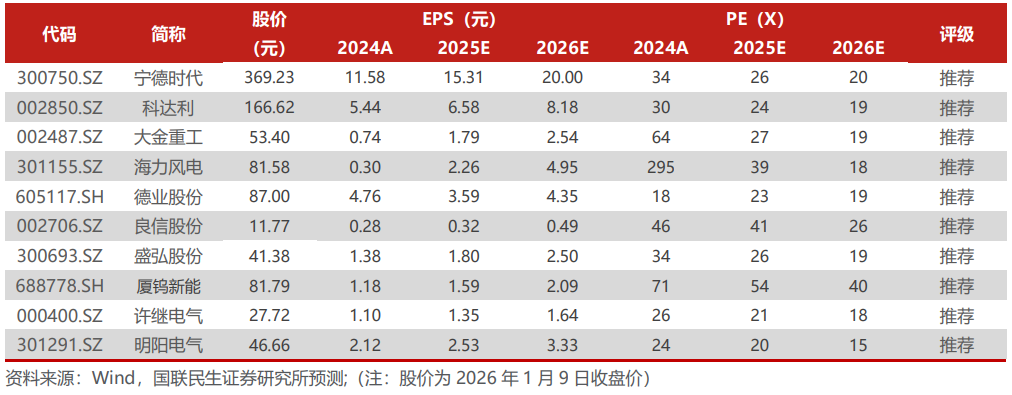
Industry Overview - The electric power equipment and new energy sector rose by 5.02% this week, ranking 13th in terms of performance, outperforming the Shanghai Composite Index [48][59] - The nuclear power index saw the highest increase at 7.47%, while the lithium battery index had the smallest rise at 1.14% [50][59] New Energy Vehicles - In the period from January to November 2025, global power battery installation reached 1046 GWh, marking a year-on-year growth of 32.60% [2][8] - CATL led the market with 400 GWh, followed by BYD with 175.2 GWh and LG Energy with 96.9 GWh [2][9] - Hive Energy showed significant growth with an installation volume of 27.5 GWh, up 85.60% year-on-year [2][9] New Energy Generation - The Ministry of Finance announced the cancellation of the VAT export rebate for photovoltaic products starting April 1, 2026, with a reduction in the rebate rate for battery products from 9% to 6% until the end of 2026 [3][15] - The cancellation of export rebates is expected to increase direct costs for companies and reduce price competitiveness [3][15] Electric Power Equipment and Automation - The National Development and Reform Commission and the National Energy Administration plan to enhance grid construction, aiming to establish a new type of grid platform by 2030 [4][61] - The new grid platform will significantly improve resource allocation capabilities, with a target of over 420 million kW for the "West-to-East Power Transmission" project [4][61] Commercial Aerospace - China submitted an application for an additional 203,000 satellites to the International Telecommunication Union, which includes 14 satellite constellations [4][32] - This increase in satellite applications is expected to stimulate demand for rockets and satellites, positively impacting the industry chain [4][32] Key Companies to Watch - Companies of interest this week include CATL, Keda, Dajin Heavy Industry, Haili Wind Power, Deye Shares, Liangxin Shares, Shenghong Shares, Xiamen Tungsten New Energy, XJ Electric, and Mingyang Electric [5][62]



“国补”落地 买新能源车省多少钱
Xin Lang Cai Jing· 2026-01-11 22:25
Group 1 - The new round of automobile consumption subsidy policy will be implemented in 2026, allowing consumers to save up to 35,000 yuan when purchasing new energy vehicles through various subsidies and tax reductions [1][2] - Consumers can receive a subsidy of 12% of the new car sales price (up to 20,000 yuan) for scrapping old cars and purchasing eligible new energy passenger vehicles, or 8% (up to 15,000 yuan) for replacing old cars [1] - The full vehicle purchase tax is calculated as the car price divided by 1.13 multiplied by 10%, with a maximum reduction of 15,000 yuan due to a half tax collection policy this year [1] Group 2 - Not all new energy vehicles are eligible for subsidies; only those listed in the Ministry of Industry and Information Technology's directory can enjoy both national subsidies and vehicle purchase tax reductions [2] - Starting in 2026, the technical standards for eligible models will change, with the pure electric range requirement for plug-in hybrid vehicles increasing from 43 kilometers to 100 kilometers, potentially disqualifying some entry-level models [2] Group 3 - The application processes for national subsidies and vehicle purchase tax reductions differ, but consumers can apply for both simultaneously [3] - To apply for the national subsidy, consumers must submit materials through the "National Automobile Circulation Information Management System" or the "Car Trade-in" WeChat mini-program, while the vehicle purchase tax reduction is automatically processed through local tax systems without a separate application [3]
行业比较周跟踪:A股估值及行业中观景气跟踪周报-20260111
Shenwan Hongyuan Securities· 2026-01-11 15:24
Investment Rating - The report does not explicitly provide an investment rating for the industry as a whole, but it highlights various sectors with their respective valuation metrics, indicating potential investment opportunities based on historical percentiles [1][2]. Core Insights - The report tracks the valuation of A-shares as of January 9, 2026, with the overall market PE at 22.4 times and PB at 1.9 times, indicating a historical percentile of 83% and 49% respectively [1][2]. - Key sectors with PE valuations above the historical 85th percentile include Real Estate, Automation Equipment, Retail, Chemical Pharmaceuticals, Electronics, and IT Services [1][2]. - The semiconductor market is projected to reach nearly $1 trillion in sales by 2026, with a year-on-year growth of 22.5% [3]. Valuation Summary A-Share Valuation - The overall market PE is 22.4x, with a historical percentile of 83% [1][2]. - The Shanghai Composite Index PE is 12x, with a historical percentile of 65% [1][2]. - The ChiNext Index PE is 42.6x, with a historical percentile of 41% [1][2]. Industry Valuation Comparison - Industries with PE valuations above the 85th percentile include: - Real Estate - Automation Equipment - Retail - Chemical Pharmaceuticals - Electronics - IT Services [1][2]. - Industries with PB valuations above the 85th percentile include: - Defense and Military - Electronics (Semiconductors) - Telecommunications [1][2]. Sector-Specific Insights New Energy - The photovoltaic industry sees a mixed trend with upstream silicon prices down by 9.4% while downstream battery prices increased by 1.3% [1][2]. - Lithium carbonate prices increased by 17.9% due to supply disruptions [1][2]. Technology (TMT) - The semiconductor index rose by 3.7%, with global sales increasing by 29.8% year-on-year [3]. - DRAM prices increased by 10.9%, indicating strong demand in the cloud services sector [3]. Real Estate Chain - Steel prices increased slightly, while cement prices remained stable [3]. - The glass market is expected to reach a weak balance due to production adjustments [3]. Consumer Goods - Pork prices decreased by 1.0%, while wholesale prices for liquor increased by 2.2% [3]. - Agricultural products showed mixed price movements, with corn prices stable and soybean prices up by 0.8% [3]. Midstream Manufacturing - Excavator sales increased by 19.2% year-on-year, driven by equipment upgrades and demand from mining sectors [3]. Cyclical Industries - Industrial metals saw price increases, with copper up by 4.1% [3]. - Brent crude oil prices rose by 3.7% due to geopolitical tensions [3].
2026年新能源车年度策略:产业盈利复苏,技术持续升级
GOLDEN SUN SECURITIES· 2026-01-11 05:44
Group 1: Domestic and Global New Energy Vehicle Market - The domestic new energy vehicle market in China continues to thrive, with a 31% year-on-year increase in sales from January to November 2025, and a penetration rate of 47.5% [11][12] - In Europe, new energy vehicle sales increased by 30% year-on-year from January to October 2025, with a penetration rate of 28.1% [20][23] - In the United States, new energy vehicle sales decreased by 2% year-on-year from January to November 2025, with a penetration rate of 9.4% [24][29] - The report forecasts that global new energy vehicle sales will reach 2.475 million units in 2026, with China accounting for 1.515 million units [30][26] Group 2: Battery and Materials Supply-Demand Dynamics - The supply-demand dynamics in the battery materials sector are improving, with a 35% year-on-year increase in global power battery installations from January to October 2025 [32] - The market share of CATL in the battery segment slightly increased, with a total installation of 355.2 GWh, representing a 36.6% year-on-year growth [32] - The price of battery-grade lithium carbonate has risen by 62% in 2025 due to supply constraints and increasing downstream demand [37][46] Group 3: New Technologies in Battery Development - Solid-state batteries are gaining traction due to their safety and range advantages, with increased interest from automakers for validation and mass production in 2026 [3] - The sodium-ion battery market is expanding, with a market size of approximately 6 GWh in the first nine months of 2025, reflecting a 202% year-on-year growth [3] Group 4: Investment Recommendations - Recommended companies in the battery sector include CATL, Penghui Energy, and Yiwei Lithium Energy [4] - In the midstream materials sector, companies such as Keda Li, Hunan Youneng, and Longpan Technology are highlighted [4] - For solid-state battery technology, companies like Xingyun Co., and Xiamen Tungsten are suggested for investment [4]
白银迎史诗逼空,中国严控出口,全球供需被已经打败
Sou Hu Cai Jing· 2026-01-10 04:46
Core Viewpoint - Silver has been designated as a strategic material by the Chinese government, leading to tighter export controls that favor large producers over small traders and individuals [1]. Group 1: Market Dynamics - The demand for silver is driven by its essential roles in various industries, including photovoltaic applications, AI connections, and electric vehicle batteries [3]. - By 2025, a global supply deficit of 3,660 tons is anticipated, which could double by 2026, indicating a critical need for silver in the market [3]. - The price of silver has already surged by 170% in 2025 due to supply constraints, reflecting market reactions to the tightening of export policies [7]. Group 2: Strategic Implications - The policy reflects a blend of trade strategy and resource nationalism, aiming to reclaim control over industrial materials and pricing power from foreign entities [5]. - The U.S. has recognized silver as a critical mineral, but lacks sufficient refining capacity, with China controlling approximately 65% of the global refining market [5]. - The shift in silver export policy is part of a broader trend of resource nationalism, aligning with global movements towards securing national resources [11]. Group 3: Domestic and International Impact - Domestically, the policy is expected to benefit high-end manufacturing by ensuring access to quality silver, thus supporting industrial upgrades [9]. - Internationally, the pricing dynamics traditionally set by London and New York may be challenged as China gains more control over physical silver supply [9]. - The policy aims to stabilize domestic supply and pricing while promoting the development of refining and alternative technologies to reduce dependency on single materials [13]. Group 4: Investment Perspective - Investors are advised to reconsider silver's role, recognizing it as a critical industrial material rather than merely a companion to gold, necessitating a shift from speculative to strategic investment approaches [14]. - The elevation of silver to a strategic material signifies a declaration of industrial sovereignty and foreshadows a reconfiguration of global supply chains [15].

扩内需促消费政策显效 2025年物价呈温和回升态势
Shang Hai Zheng Quan Bao· 2026-01-09 18:39
Group 1 - The core viewpoint of the articles indicates that the Consumer Price Index (CPI) has shown a moderate recovery, with a year-on-year increase of 0.8% in December 2025, marking the highest level since March 2023 [2][6][7] - The increase in CPI is significantly driven by food prices, particularly fresh vegetables and fruits, which saw year-on-year price increases of 18.2% and 4.4%, respectively [2][3] - The Producer Price Index (PPI) has shown a narrowing year-on-year decline of 1.9% in December, indicating positive changes in certain industries due to improved market competition [4][5] Group 2 - The core CPI, excluding food and energy, rose by 1.2%, maintaining a growth rate above 1% for four consecutive months, reflecting a stable recovery in demand [3][6] - The overall price stability in 2025, with CPI remaining flat year-on-year and PPI declining by 2.6%, suggests that market supply and demand relationships are improving [6][7] - Experts predict that in 2026, with more proactive macroeconomic policies, CPI is expected to rise steadily, supported by recovering consumer demand and structural adjustments in the economy [7][8]
2025年新能源车零售份额过半,机构预计今年增长10%
Di Yi Cai Jing Zi Xun· 2026-01-09 12:41
Core Insights - The automotive market in 2025 experienced positive growth, with total retail sales of passenger vehicles reaching 23.744 million units, a year-on-year increase of 3.8% [1] - Retail sales of new energy vehicles (NEVs) reached 12.809 million units, marking a significant year-on-year growth of 17.6%, with a penetration rate of 53.9% [1] - The market trend for 2025 is characterized by a "U-shaped" pattern, with an initial low, a mid-high, and a subsequent low, leading to a revised growth forecast for 2026 [1][3] Group 1: Market Performance - In December 2025, automotive retail sales were 2.261 million units, reflecting a year-on-year decline of 14% [2] - The decline in December sales was attributed to the expiration of the NEV purchase tax exemption and budget constraints on vehicle trade-in policies, which dampened consumer purchasing activity [2] - Despite the overall decline, NEV sales in December reached a record high of 1.337 million units, showing a year-on-year increase of 2.6% [2] Group 2: Future Projections - The outlook for NEV retail growth in 2026 is optimistic, with an expected growth rate of around 10% [3] - The growth of A00-class electric vehicles has shown signs of slowing down, which may impact overall retail growth in the domestic market [3] - The 2026 market is projected to follow a "U-shaped" trajectory, with commercial vehicle growth expected to outperform passenger vehicles due to unchanged subsidy policies for commercial vehicle updates [3]
乘联分会:2025年12月新能源车在国内总体乘用车的零售渗透率59.1%
Zheng Quan Shi Bao Wang· 2026-01-09 08:25
Core Insights - The penetration rate of new energy vehicles (NEVs) in China's overall passenger car retail market is projected to reach 59.1% by December 2025, an increase of 9.6 percentage points year-on-year [1] Group 1: Market Performance - In December, the penetration rate of NEVs among domestic self-owned brands reached 80.9% [1] - The penetration rate of NEVs in the luxury car segment was 39.1% [1] - The penetration rate of NEVs among mainstream joint venture brands was only 8.2% [1] Group 2: Retail Market Share - In December, the retail market share of self-owned brand NEVs was 64.4%, a year-on-year decrease of 6.7 percentage points [1] - The retail market share of NEVs among mainstream joint venture brands was 3.7%, showing a year-on-year increase of 0.9 percentage points [1] - The new force brands, including XPeng Motors, Leap Motor, and Xiaomi Auto, contributed to a year-on-year growth of 4.9 percentage points in their market share, reaching 23.5% [1] - Tesla's market share was 7.0%, with a year-on-year increase of 0.6 percentage points [1]